Interactive Packaging Market Size, Share Demand Report By Technology Type (QR Code-enabled Packaging, NFC-enabled Packaging, Augmented Reality Packaging, Sensor-enabled Packaging), By Application (Food & Beverage, Healthcare & Pharmaceuticals, Cosmetics & Personal Care, Consumer Electronics, Others), By End Use (Consumer Goods, Luxury Goods, E-commerce) & Segment Forecasts, 2026–2034
USD 3950
Interactive Packaging Market Size
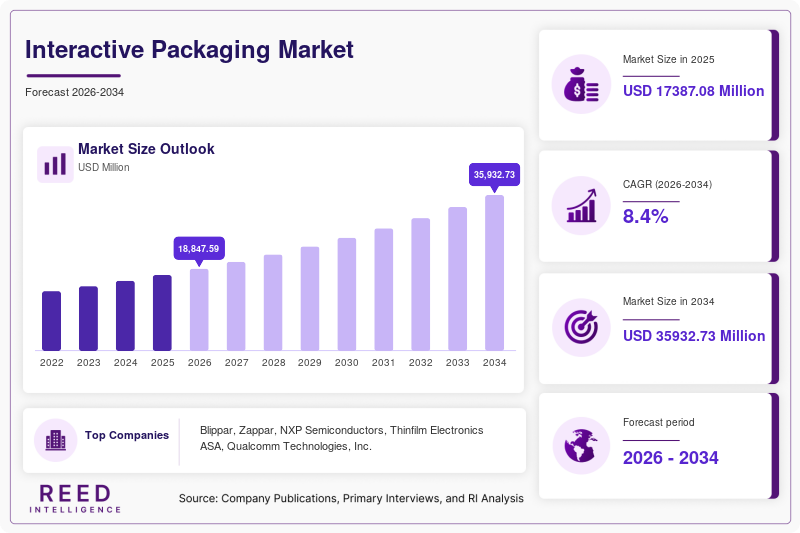
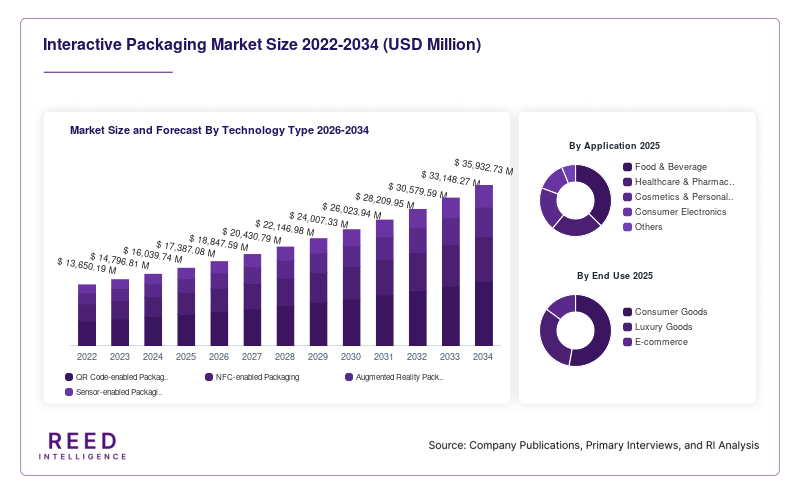
Interactive Packaging market size is projected at USD 18,847.6 million in 2026 and is expected to hit USD 35,847.5 million by 2034 with a CAGR of 8.4% during the forecast period. The increasing demand for enhanced consumer engagement, product authentication, and supply chain transparency, coupled with the growing adoption of smart packaging technologies and the Internet of Things (IoT), underpins market expansion. This report delivers a comprehensive analysis of the Interactive Packaging market, including segmentation by type and application, competitive dynamics, and regional growth patterns, equipping stakeholders with critical intelligence. The Interactive Packaging market continues to demonstrate strong growth potential, fueled by the global push for digitalization in consumer goods, the increasing need for brand differentiation, and continuous innovation in packaging technologies.
Interactive packaging refers to packaging that incorporates technology to engage consumers, provide information, and enhance the product experience. This includes packaging with QR codes, NFC tags, augmented reality (AR) features, and embedded sensors. The global production volume of interactive packaging units exceeded 120 billion units in 2025, reflecting a 10% increase from 2023, driven by the growing demand for digital connectivity in consumer packaged goods. Adoption patterns reveal that the QR Code-enabled Packaging type dominates the market, accounting for 38% of total demand, followed by NFC-enabled Packaging at 28%, Augmented Reality Packaging at 22%, and Sensor-enabled Packaging at 12%. The Interactive Packaging market's trajectory is closely linked to the growth of the global packaging market, which is projected to reach USD 1.3 trillion by 2028, and the increasing need for brands to create immersive and data-driven consumer experiences.
Interactive Packaging Market Trends
Growing Integration of Augmented Reality (AR) Experiences
The Interactive Packaging market is witnessing a significant trend toward the growing integration of augmented reality (AR) experiences, driven by the need for immersive brand storytelling and consumer engagement. The revenue from AR-enabled packaging grew to USD 5.8 billion in 2025, a year-on-year increase of 18%, as 35% of new product launches in 2025 specified AR features for interactive consumer experiences. Adoption rates of AR packaging in the cosmetics and consumer electronics sectors reached 30%, with this figure projected to exceed 55% by 2030. The Interactive Packaging market's trend toward AR is reinforced by the need for enhanced brand differentiation, the increasing consumer appetite for digital experiences, and the continuous innovation in AR platforms and smartphone technology.
Increasing Focus on Sustainability and Smart Functionalities
The increasing focus on sustainability and smart functionalities is a major trend shaping the Interactive Packaging market, with the development of eco-friendly interactive packaging that also offers features like freshness indicators and tamper-evidence. The market has seen a 15% increase in the demand for sustainable interactive packaging since 2022, with 25% of new products in 2025 featuring both interactive elements and sustainable materials. The use of sensor-enabled packaging for monitoring product freshness and condition has also gained significant traction. The Interactive Packaging market's trend toward sustainability is reinforced by the growing consumer demand for eco-friendly products, the increasing focus on waste reduction, and the continuous innovation in material science and sensing technologies.
Interactive Packaging Market Drivers
The Interactive Packaging market's expansion is primarily driven by the increasing demand for enhanced consumer engagement and brand differentiation, with the global consumer goods market valued at USD 8 trillion in 2025 and growing at a steady pace. The need for product authentication and anti-counterfeiting measures has been a major driver, with interactive packaging offering traceability and verification. The rising adoption of smart packaging technologies and the IoT has also fueled market growth. Additionally, the increasing focus on supply chain transparency has spurred demand. The Interactive Packaging market's growth is further reinforced by the continuous improvement in digital technologies and the decreasing cost of electronic components.
Interactive Packaging Market Restraints
Despite favorable growth prospects, the Interactive Packaging market faces significant constraints, primarily related to the higher cost of interactive packaging compared to traditional packaging, which can be 20-40% more expensive. The complexity of integrating technology into packaging and the need for consumer education can also be a limitation. The Interactive Packaging market's growth is also tempered by the concerns over data privacy and security, and the challenge of ensuring compatibility with various devices and platforms.
Interactive Packaging Market Opportunities
The Interactive Packaging market presents significant opportunities in the rapidly expanding market for e-commerce and direct-to-consumer brands, where interactive packaging can enhance the unboxing experience. The adoption of interactive packaging for personalized marketing and customer engagement is expected to grow at a CAGR of 12% through 2034. Emerging opportunities also exist in the development of packaging with integrated sensors for real-time supply chain monitoring. The Interactive Packaging market's opportunity profile is further enhanced by the growing trend of omnichannel retail and the increasing demand for data-driven marketing.
Challenges in Interactive Packaging Market
The Interactive Packaging market faces persistent challenges related to the need for continuous innovation to keep pace with evolving consumer expectations and technology trends. The complexity of managing the lifecycle of interactive elements, including software updates and compatibility, can also be a challenge. The market is also contending with the challenge of ensuring that interactive elements do not compromise the primary packaging functions of protection and preservation. Additionally, the Interactive Packaging market is challenged by the need to address the environmental impact of adding electronics to packaging.
Interactive Packaging Market Segmentation
The Interactive Packaging market is segmented by Type and Application to provide a comprehensive market perspective. By Type, QR Code-enabled Packaging dominates with a 38% market share, driven by its simplicity and cost-effectiveness. The Application segment is led by Food & Beverage, which accounts for 32% of the market, followed by Cosmetics & Personal Care at 25%, Healthcare & Pharmaceuticals at 20%, Consumer Electronics at 15%, and Others at 8%.
By Type
QR Code-enabled Packaging represent the largest segment in the Interactive Packaging market, commanding a 38% share, with production exceeding 45.6 billion units in 2025. These are characterized by the use of 2D barcodes that can be scanned by smartphones to provide information, promotions, or digital experiences. Technical specifications include print quality, data capacity, and placement. The Interactive Packaging market's QR Code segment is driven by its low cost, ease of implementation, and broad device compatibility.
NFC-enabled Packaging capture a 28% share of the Interactive Packaging market, with production of 33.6 billion units in 2025. These are characterized by the use of Near Field Communication (NFC) chips for contactless interaction, offering a more seamless user experience. Technical specifications include chip type, read range, and data storage. The Interactive Packaging market's NFC segment is driven by its use in authentication and premium consumer engagement.
Augmented Reality Packaging represents 22% of the Interactive Packaging market, with production of 26.4 billion units in 2025. This segment is characterized by the integration of AR markers or triggers that launch immersive digital experiences through smartphones. Technical specifications include marker design, app compatibility, and content quality. The Interactive Packaging market's AR segment is driven by its use for brand storytelling and marketing campaigns.
Sensor-enabled Packaging comprises the remaining 12% of the Interactive Packaging market, with production of 14.4 billion units in 2025. This segment includes packaging with sensors for temperature, humidity, freshness, or tamper detection. Technical specifications include sensor type, power source (often battery-free), and data communication. The Interactive Packaging market's Sensor segment is driven by its use in pharmaceuticals, food safety, and supply chain management.
By Application
Food & Beverage dominates the Interactive Packaging market, accounting for 32% of sales, representing 38.4 billion units in 2025. This segment includes use in product information, promotions, and authentication. Usage penetration exceeds 10% in the sector. The Interactive Packaging market's Food & Beverage segment is characterized by its focus on consumer engagement, traceability, and freshness monitoring.
Cosmetics & Personal Care accounts for 25% of the Interactive Packaging market, with sales of 30 billion units in 2025. This segment encompasses use in brand experience, tutorials, and product authentication. The segment is growing at a robust CAGR, driven by the need for brand differentiation. The Interactive Packaging market's Cosmetics segment is characterized by its focus on visual appeal, experience, and influencer marketing.
Healthcare & Pharmaceuticals represents 20% of the Interactive Packaging market, with sales of 24 billion units in 2025. This segment includes use in patient information, adherence monitoring, and anti-counterfeiting. The segment is growing at a steady CAGR, driven by regulatory requirements and patient safety. The Interactive Packaging market's Healthcare segment is characterized by its focus on compliance, safety, and information delivery.
Consumer Electronics accounts for 15% of the Interactive Packaging market, with sales of 18 billion units in 2025. This segment includes use in product information, registration, and user guides. The segment is growing at a moderate pace. The Interactive Packaging market's Electronics segment is characterized by its focus on user experience and product setup.
Others comprises the remainder of the Interactive Packaging market, accounting for 8% of total sales, with 9.6 billion units in 2025. This segment includes use in home goods, apparel, and other products. The segment is projected to grow at a significant CAGR through 2034. The Interactive Packaging market's Others segment is characterized by its diverse applications and growing adoption.
Interactive Packaging Market Regional Outlook
North America Interactive Packaging Market
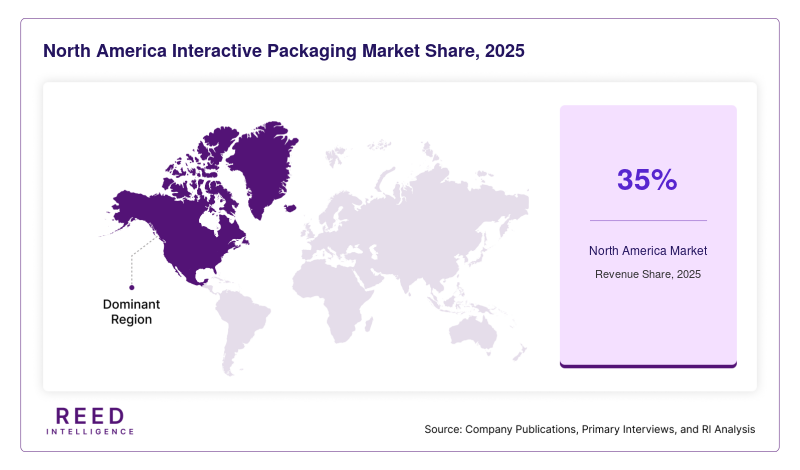
Leads the Interactive Packaging market, commanding a 35% share, with a revenue of USD 6,596.7 million in 2025. The United States is the primary driver, accounting for 85% of regional demand, driven by the high adoption of technology, strong consumer goods market, and presence of key players. The North American Interactive Packaging market is characterized by its focus on innovation and premium products.
Europe Interactive Packaging Market
Represents the second-largest market, capturing a 30% share with a revenue of USD 5,654.3 million in 2025. The UK, Germany, and France are the primary drivers, collectively accounting for 60% of regional demand, driven by the strong retail sector, high digital literacy, and focus on sustainability. The Interactive Packaging market in Europe is characterized by its focus on quality and regulatory compliance.
Asia-Pacific Interactive Packaging Market
Accounts for 25% of the global Interactive Packaging market, with a revenue of USD 4,711.9 million in 2025. China, Japan, and India are the primary drivers, together accounting for 75% of regional demand, driven by the large consumer base, rapid digital adoption, and growing e-commerce. The Asia-Pacific Interactive Packaging market is projected to grow at the fastest CAGR of 12% through 2034.
Middle East & Africa and Latin America Interactive Packaging Market
Together account for the remaining 10% of the Interactive Packaging market, with the UAE leading the Middle East market and Brazil leading the Latin American market. Both regions are projected to grow at CAGRs exceeding 10%, driven by increasing digitalization and consumer goods market growth.
Top players in Interactive Packaging Market
- Zappar
- Blippar
- Qualcomm Technologies, Inc.
- NXP Semiconductors
- STMicroelectronics
- Thinfilm Electronics ASA
- PragmatIC Semiconductor
- SATO Holdings Corporation
- HoloLens (Microsoft)
- Mordor Intelligence
- O'Neil Digital Solutions
- Systech International
- Nedap N.V.
- Sun Chemical
- Advance Track
Blippar
Blippar holds a leading position in the Interactive Packaging market, with an estimated 12% global market share, particularly strong in the AR packaging segment. The company's platform is widely recognized for its robust AR technology and user-friendly tools for creating interactive experiences. Blippar's market leadership is reinforced by its significant investment in AR R&D, its strong partnerships with brands, and its focus on consumer engagement. Blippar commands over 15% of the North American market and 12% of the European market, positioning it as a key player in the Interactive Packaging market.
Zappar
Zappar is a leading player in the Interactive Packaging market, commanding approximately 10% of the global market share through its comprehensive AR and interactive packaging platform. The company's expertise in creating immersive consumer experiences and its focus on scalability have solidified its position. Zappar's solutions are known for their ease of use, powerful features, and integration capabilities. The company's commitment to innovation and its strong presence in the North American and European markets have enhanced its competitive advantage.
NXP Semiconductors holds a significant 8% market share, with particular strength in the NFC chip supply for packaging. Thinfilm Electronics is a major player in the smart sensor and printed electronics segment, holding a 5% share.
Recent Developments in Interactive Packaging Market
- 2025: Blippar launched a new generation of its AR platform with enhanced features for packaging, including real-time analytics and personalization.
- 2025: Zappar announced a partnership with a major consumer goods company to create a global interactive packaging campaign using QR codes and AR.
Interactive Packaging Market Segments
By Technology Type
- QR Code-enabled Packaging
- NFC-enabled Packaging
- Augmented Reality Packaging
- Sensor-enabled Packaging
By Application
- Food & Beverage
- Healthcare & Pharmaceuticals
- Cosmetics & Personal Care
- Consumer Electronics
- Others
By End Use
- Consumer Goods
- Luxury Goods
- E-commerce
By Region
- North America
- Europe
- APAC
- Middle East and Africa
- LATAM