Interactive Patient Care System Market Size, Share & Demand Report By Component (Hardware, Software, Services), By Deployment Mode (On-Premise, Cloud-Based), By Application (Patient Engagement, Clinical Workflow Management, Patient Education, Entertainment), By End-Use (Hospitals, Ambulatory Surgical Centers, Specialty Clinics) & Segment Forecasts, 2025–2034
USD 3950
Market Overview
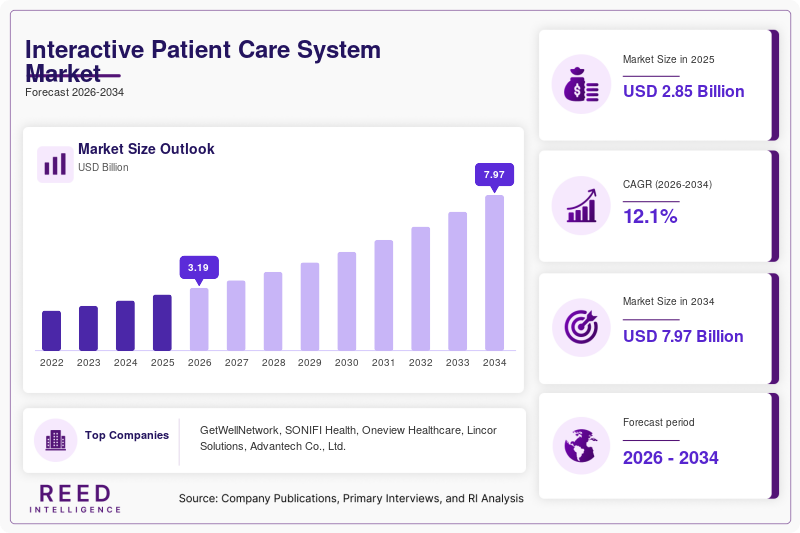
TheInteractive Patient Care System Market size was estimated at USD 2.85 billion in 2025 and is projected to reach approximately USD 7.95 billion by 2034, expanding at a compound annual growth rate (CAGR) of 12.1% from 2025 to 2034. The market growth reflects the increasing integration of digital healthcare infrastructure across hospitals and ambulatory care settings. Healthcare providers are actively adopting interactive systems to improve patient engagement, streamline communication, and enhance clinical workflows.
A key global factor supporting market expansion is the rapid digital transformation in healthcare systems, driven by increased demand for patient-centered care models. Governments and private healthcare organizations are investing in smart hospital technologies that enable real-time communication, entertainment, education, and clinical integration within patient rooms. These systems contribute to improved patient satisfaction scores, reduced hospital stays, and better care coordination, which are critical metrics in modern healthcare delivery.
Key Highlights:
- North America dominated the market with 38.6% share in 2025, while Asia Pacific is expected to grow at the fastest CAGR of 14.3%.
- By component, hardware systems led with 44.2% share, while software solutions are projected to grow fastest at a CAGR of 13.8%.
- By end-use, hospitals accounted for 61.5% share, while ambulatory surgical centers are expected to grow at 13.5% CAGR.
- The U.S. remained the dominant country, with market values of USD 1.05 billion in 2024 and USD 1.16 billion in 2025.
Market Trends
Integration of AI and Predictive Analytics
The integration of artificial intelligence and predictive analytics into interactive patient care systems is emerging as a significant trend. Healthcare providers are increasingly leveraging AI-driven platforms to personalize patient experiences, predict clinical outcomes, and optimize care delivery. These systems analyze patient data to offer tailored educational content, medication reminders, and recovery plans. The incorporation of machine learning algorithms enhances decision-making processes and supports healthcare professionals in delivering efficient and proactive care.
Expansion of Cloud-Based Patient Engagement Platforms
Cloud-based deployment models are gaining traction in the Interactive Patient Care System Market due to their scalability, flexibility, and cost-effectiveness. Healthcare institutions are shifting from traditional on-premise infrastructure to cloud solutions that allow seamless integration with existing hospital systems such as EHRs and telemedicine platforms. Cloud technology enables remote access, real-time updates, and improved data security, making it an attractive option for healthcare providers aiming to modernize their IT ecosystems. This trend is particularly prominent in emerging economies where infrastructure constraints favor cloud adoption.
Market Drivers
Rising Demand for Patient-Centered Care
The increasing emphasis on patient-centered care is a major driver of the Interactive Patient Care System Market. Healthcare providers are focusing on improving patient experience and satisfaction by offering personalized communication and engagement tools. Interactive systems enable patients to access educational content, entertainment, and medical information, fostering active participation in their care journey. This shift toward value-based care models is encouraging hospitals to invest in technologies that enhance patient outcomes and operational efficiency.
Growing Adoption of Smart Hospital Infrastructure
The proliferation of smart hospital initiatives worldwide is significantly boosting market growth. Healthcare facilities are incorporating advanced technologies such as IoT, digital signage, and integrated communication systems to create connected environments. Interactive patient care systems serve as a core component of these smart infrastructures, facilitating seamless communication between patients and caregivers. The increasing investments in healthcare IT modernization and the need for efficient resource management are further driving the adoption of these systems.
Market Restraint
High Implementation and Maintenance Costs
One of the primary restraints affecting the Interactive Patient Care System Market is the high cost associated with implementation and maintenance. Deploying interactive systems requires significant investment in hardware, software, and IT infrastructure. Additionally, healthcare providers must allocate resources for staff training, system integration, and ongoing technical support.
Smaller healthcare facilities and those in developing regions often face budget constraints, limiting their ability to adopt advanced patient care technologies. The complexity of integrating these systems with existing hospital infrastructure further adds to the cost burden. Moreover, concerns related to data security and compliance with healthcare regulations increase operational expenses.
Market Opportunities
Expansion in Emerging Healthcare Markets
Emerging economies present significant growth opportunities for the Interactive Patient Care System Market. Rapid urbanization, increasing healthcare investments, and rising patient awareness are driving the demand for advanced healthcare solutions in these regions. Governments are focusing on improving healthcare infrastructure, creating favorable conditions for the adoption of interactive patient care systems. The growing middle-class population and increasing healthcare expenditure further support market expansion in these regions.
Integration with Telehealth and Remote Monitoring
The integration of interactive patient care systems with telehealth and remote monitoring technologies is creating new growth avenues. These systems can serve as centralized platforms for virtual consultations, remote diagnostics, and patient monitoring. As telehealth adoption continues to rise, healthcare providers are seeking integrated solutions that enhance patient engagement and streamline care delivery. This convergence of technologies is expected to drive innovation and open new revenue streams for market players.
Segmental Analysis
By Component
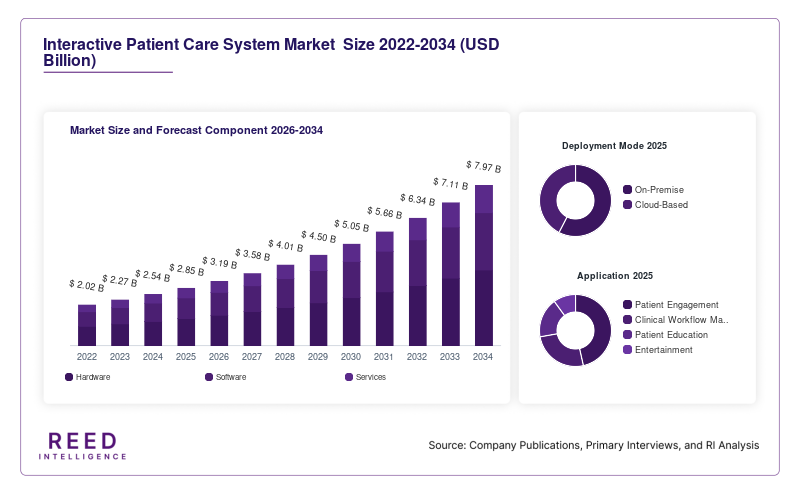
Hardware systems dominated the Interactive Patient Care System Market with a 44.2% share in 2024, driven by the widespread deployment of bedside terminals, televisions, and communication devices in hospitals. These components form the backbone of interactive systems, enabling patient interaction and communication.
Software solutions are expected to grow at the fastest CAGR of 13.8%, driven by the increasing demand for advanced analytics, content management, and integration capabilities. The flexibility and scalability of software platforms will support their rapid adoption.
By Deployment Mode
On-premise deployment accounted for the largest share of 58.3% in 2024, as healthcare providers preferred direct control over their systems and data security. This model was widely used in large hospitals with established IT infrastructure.
Cloud-based deployment is projected to grow at a CAGR of 14.6%, driven by its cost-effectiveness and scalability. Healthcare providers will increasingly adopt cloud solutions to enhance operational efficiency and reduce infrastructure costs.
By End-Use
Hospitals dominated the market with a 61.5% share in 2024, owing to the high volume of patient interactions and the need for comprehensive care solutions. These systems are widely used to improve patient satisfaction and streamline workflows.
Ambulatory surgical centers are expected to grow at a CAGR of 13.5%, driven by the increasing demand for outpatient services and efficient patient management systems.
By Application
Patient engagement applications held the largest share of 36.8% in 2024, as healthcare providers focused on improving patient experience and communication. These applications provide educational content, entertainment, and real-time updates.
Clinical workflow management applications are projected to grow at a CAGR of 13.2%, driven by the need to optimize hospital operations and reduce administrative burden.
Regional Analysis
North America
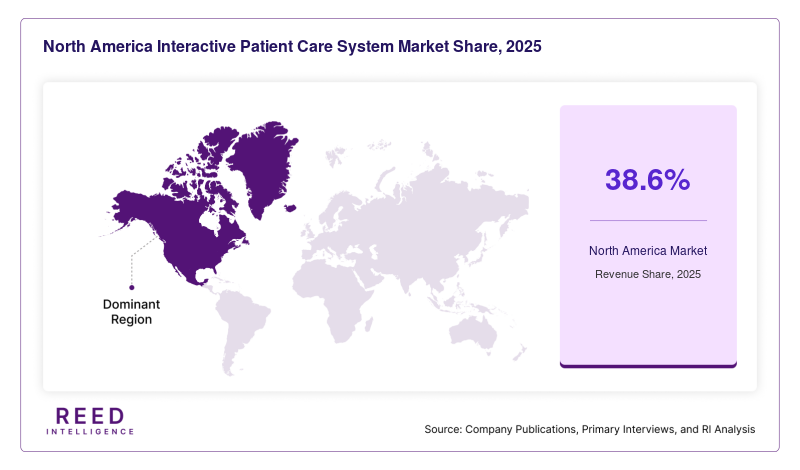
North America accounted for 38.6% of the Interactive Patient Care System Market share in 2025 and is expected to grow at a CAGR of 11.4% during the forecast period. The region’s growth was supported by advanced healthcare infrastructure and high adoption of digital health technologies.
The United States dominated the regional market due to strong investments in healthcare IT and widespread adoption of smart hospital solutions. The presence of leading technology providers and favorable reimbursement policies further contributed to market growth.
Europe
Europe held approximately 27.2% market share in 2025 and is projected to grow at a CAGR of 10.8% through 2034. The region benefited from increasing government initiatives to modernize healthcare systems and improve patient care quality.
Germany emerged as the leading country, driven by its robust healthcare system and focus on digital transformation. The adoption of interactive systems in hospitals and long-term care facilities supported market expansion.
Asia Pacific
Asia Pacific captured around 19.5% of the market share in 2025 and is anticipated to grow at the fastest CAGR of 14.3%. Rapid economic development and increasing healthcare investments fueled regional growth.
China dominated the region due to large-scale healthcare infrastructure development and rising demand for advanced patient care solutions. Government initiatives promoting digital healthcare further accelerated adoption.
Middle East & Africa
The Middle East & Africa region held 8.1% market share in 2025 and is expected to grow at a CAGR of 12.6%. Growth was driven by increasing investments in healthcare infrastructure and smart hospital projects.
The United Arab Emirates led the region, supported by its focus on healthcare innovation and adoption of advanced technologies in hospitals.
Latin America
Latin America accounted for 6.6% of the market share in 2025 and is projected to grow at a CAGR of 11.9%. The region experienced steady growth due to improving healthcare infrastructure and rising awareness of patient engagement solutions.
Brazil dominated the regional market, driven by increasing healthcare expenditure and adoption of digital healthcare technologies.
Competitive Landscape
The Interactive Patient Care System Market is moderately competitive, with several global and regional players focusing on innovation and strategic partnerships. Leading companies are investing in advanced technologies such as AI, cloud computing, and IoT to enhance their product offerings.
One prominent market leader is GetWellNetwork, which has consistently expanded its product portfolio and strengthened its market presence. The company recently introduced an AI-enabled patient engagement platform designed to improve care outcomes and patient satisfaction.
Other key players are focusing on mergers, acquisitions, and collaborations to expand their geographic reach and technological capabilities. Continuous product development and customization remain critical strategies for maintaining competitive advantage in this evolving market.
Key Players
- GetWellNetwork
- SONIFI Health
- Oneview Healthcare
- Lincor Solutions
- Advantech Co., Ltd.
- Cisco Systems, Inc.
- BEWATEC Kommunikationstechnik GmbH
- ITI Technology
- pCare
- TeleHealth Services
Recent Developments
- 2024: A leading player launched a cloud-based interactive patient engagement platform with AI capabilities.
- 2024: Strategic collaboration between healthcare IT firms to integrate telehealth features into patient care systems.
- 2025: Expansion of interactive patient care solutions into emerging markets with localized offerings.
- 2025: Development of advanced bedside terminals with enhanced connectivity and user interfaces.
Interactive Patient Care System Market Segments
Component
- Hardware
- Software
- Services
Deployment Mode
- On-Premise
- Cloud-Based
Application
- Patient Engagement
- Clinical Workflow Management
- Patient Education
- Entertainment
End-Use
- Hospitals
- Ambulatory Surgical Centers
- Specialty Clinics
By Region
- North America
- Europe
- APAC
- Middle East and Africa
- LATAM