Interactive Voice Response (IVR) System Market Size, Share & Demand Report By Deployment Mode (Cloud-Based IVR Systems, On-Premise IVR Systems, Hybrid IVR Systems), By Organization Size (Large Enterprises, Small and Medium Enterprises), By End-Use Industry (BFSI, Healthcare, Retail and E-commerce, Telecommunications, Government, Travel and Hospitality, Others), By Region & Segment Forecasts, 2026–2034
USD 3950
Market Overview
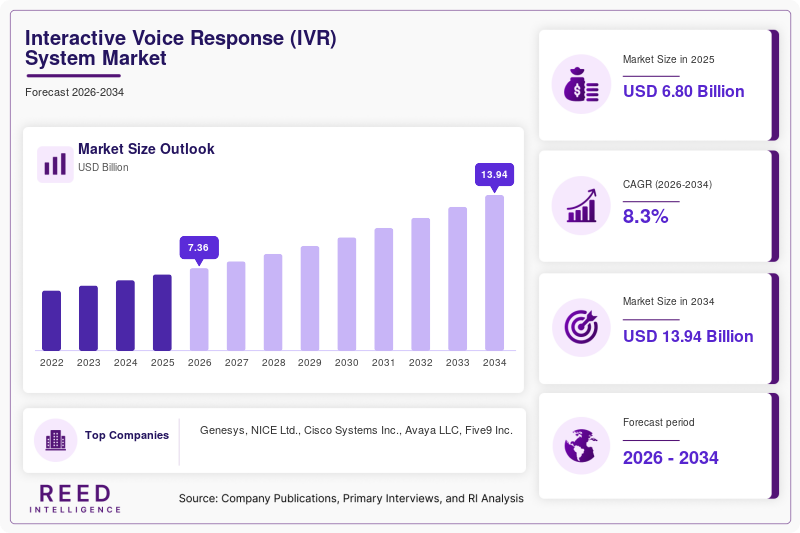
The global Interactive Voice Response (IVR) System Market size was valued at USD 6.8 billion in 2026 and is projected to reach USD 12.9 billion by 2034, expanding at a CAGR of 8.3% during the forecast period from 2026 to 2034. The market continues to gain momentum as enterprises across banking, healthcare, retail, telecommunications, and public services increase investments in automated customer engagement technologies. IVR systems have evolved from basic keypad-driven solutions into intelligent communication platforms integrated with speech recognition, cloud computing, analytics, and artificial intelligence. Businesses are adopting these solutions to improve customer response times, reduce operational expenses, and manage rising call volumes across multiple service channels.
One of the primary global factors supporting market growth is the rapid digital transformation of customer support operations. Organizations are shifting from traditional call center infrastructure toward cloud-enabled communication environments that offer scalability, remote accessibility, and enhanced workflow integration. The growing adoption of self-service technologies among consumers has also accelerated demand for advanced IVR systems capable of resolving routine queries without agent intervention. In addition, the rise in multilingual customer support requirements and increasing demand for 24/7 service availability continue to strengthen market expansion across developed and emerging economies.
Key Highlights
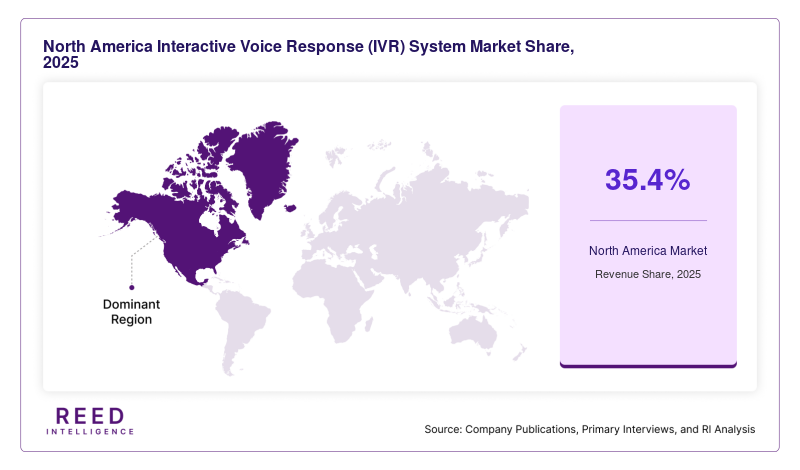
- North America dominated the market with a 35.4% share in 2025, while Asia Pacific is expected to grow at the fastest CAGR of 10.8% during 2026–2034.
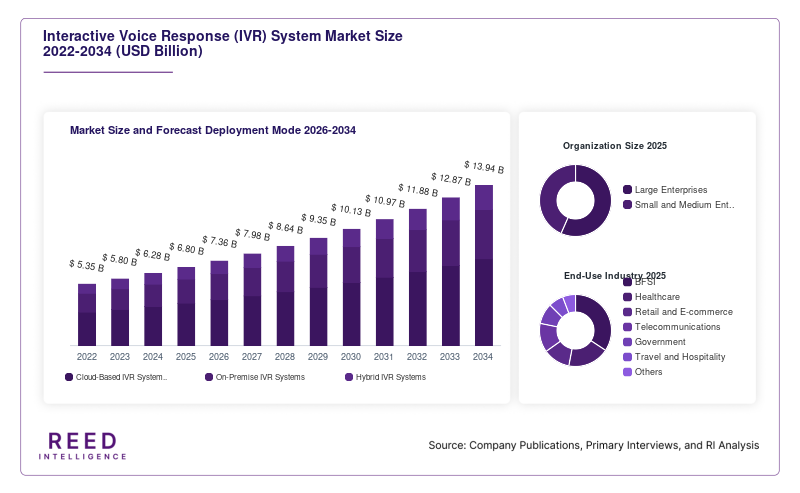
- By deployment mode, cloud-based IVR systems accounted for the largest share of 57.2%, while AI-enabled conversational IVR platforms are projected to grow at a CAGR of 12.6%.
- By organization size, large enterprises led with a 61.8% share, whereas small and medium enterprises are expected to expand at a CAGR of 11.4%.
- By end-use industry, BFSI accounted for the largest share of 28.7%, while healthcare is projected to grow at a CAGR of 11.1% during the forecast period.
- The United States remained the dominant country, with market values of USD 1.72 billion in 2024 and USD 1.89 billion in 2025.
Market Trends
Integration of Artificial Intelligence and Natural Language Processing
The integration of artificial intelligence and natural language processing into IVR platforms is becoming a major trend influencing market development. Businesses are increasingly deploying conversational IVR systems that can understand context, intent, and regional accents more accurately than traditional menu-driven systems. These advanced systems improve customer interactions by reducing call transfer rates and enabling faster issue resolution. AI-powered IVR platforms also support predictive routing and personalized communication based on customer history and behavioral data. Financial institutions, telecom operators, and healthcare providers are among the leading adopters of intelligent IVR solutions as they seek to improve customer satisfaction and optimize contact center efficiency.
The growing use of voice biometrics and sentiment analysis within IVR platforms is further strengthening this trend. Organizations are leveraging analytics tools to monitor customer interactions and identify areas requiring service improvement. AI integration also enables businesses to automate complex workflows such as appointment scheduling, payment processing, and order tracking. As enterprises continue to prioritize digital customer engagement strategies, demand for intelligent IVR systems with multilingual capabilities and cloud-based architecture is expected to increase steadily throughout the forecast period.
Rising Adoption of Cloud-Based Customer Engagement Platforms
Cloud deployment has emerged as a significant trend in the Interactive Voice Response (IVR) System Market due to its operational flexibility and cost advantages. Organizations are moving away from legacy on-premise communication systems and adopting cloud-based IVR platforms that can scale according to business requirements. Cloud solutions provide centralized management, faster deployment, lower maintenance costs, and seamless integration with customer relationship management software. This transition is particularly strong among small and medium enterprises that require cost-effective customer service infrastructure without major upfront investments.
Remote and hybrid work models have also accelerated demand for cloud-enabled IVR systems capable of supporting distributed customer service teams. Companies are using cloud platforms to maintain uninterrupted customer support operations while improving workforce collaboration and performance monitoring. Service providers are expanding subscription-based pricing models and industry-specific cloud solutions to attract new clients. In addition, the availability of real-time analytics, automated updates, and improved cybersecurity features within cloud infrastructure continues to support long-term adoption across sectors such as retail, travel, insurance, and public administration.
Market Drivers
Growing Demand for Automated Customer Service Operations
The increasing need for automated customer service operations is a key driver supporting growth in the Interactive Voice Response (IVR) System Market. Organizations across multiple industries are experiencing higher customer interaction volumes through phone-based support channels. IVR systems help enterprises manage these interactions efficiently by automating routine inquiries such as account balances, appointment confirmations, payment processing, and service requests. This automation reduces dependency on live agents and improves operational productivity. Businesses are also using IVR platforms to provide round-the-clock customer assistance, which has become essential in competitive service industries.
Rising labor costs and the need to improve customer response times are encouraging enterprises to invest in scalable IVR infrastructure. Advanced speech-enabled systems reduce average handling times and increase first-call resolution rates. Enterprises in the BFSI and telecommunications sectors are particularly focused on reducing customer wait times while maintaining service consistency. The adoption of intelligent routing and multilingual support features further enhances service accessibility across diverse consumer groups. As companies continue to modernize contact center operations, automated IVR technology is expected to remain a critical component of customer engagement strategies.
Expansion of Digital Banking and Telehealth Services
The rapid expansion of digital banking and telehealth services is contributing significantly to market growth. Financial institutions are increasingly implementing IVR systems to support secure account management, fraud alerts, payment reminders, and loan-related inquiries. Consumers are using automated voice systems for quick access to financial information without visiting physical branches. Similarly, healthcare providers are deploying IVR platforms for patient scheduling, prescription refill requests, medical reminders, and insurance verification. These applications help institutions improve service accessibility while reducing administrative burdens.
The rising focus on customer convenience and operational efficiency has accelerated IVR adoption in regulated industries that require reliable communication systems. Healthcare organizations benefit from automated patient engagement processes that reduce missed appointments and improve care coordination. Banks and insurance companies use IVR platforms to handle high volumes of customer inquiries during peak periods. In addition, government initiatives promoting digital healthcare infrastructure and financial inclusion in emerging economies are expected to create sustained demand for advanced IVR systems during the forecast period.
Market Restraint
Concerns Related to Complex Customer Interactions and Data Security
Despite the positive growth outlook, the Interactive Voice Response (IVR) System Market faces challenges associated with complex customer interactions and data security concerns. Traditional IVR systems often struggle to address complicated inquiries that require human judgment or emotional understanding. Customers may become frustrated when navigating lengthy menu structures or repeating information multiple times before reaching a live representative. Poorly designed IVR workflows can negatively affect customer satisfaction and brand perception, especially in industries where personalized support is essential.
Data privacy and cybersecurity concerns also present a major restraint for market growth. IVR platforms frequently process sensitive customer information, including banking credentials, healthcare records, and payment details. Organizations operating in regulated sectors must comply with strict data protection standards, which increases implementation complexity and operational costs. Security breaches or unauthorized access to customer data can lead to reputational damage and financial penalties. For example, financial service providers handling voice authentication and account verification processes must continuously upgrade encryption protocols and monitoring systems to minimize fraud risks. These challenges may slow adoption among organizations with limited technical resources or concerns regarding regulatory compliance.
Market Opportunities
Increasing Adoption of Omnichannel Customer Communication Strategies
The growing adoption of omnichannel customer communication strategies is creating strong opportunities for IVR system providers. Enterprises are increasingly integrating voice support with digital channels such as chatbots, mobile applications, email, and social media platforms to deliver consistent customer experiences. Modern IVR systems are being designed to connect seamlessly with customer relationship management software and analytics platforms, enabling businesses to track customer interactions across multiple touchpoints. This integration improves service personalization and allows organizations to manage customer journeys more efficiently.
Retailers, airlines, and utility providers are among the sectors actively investing in omnichannel communication infrastructure. Customers now expect smooth transitions between self-service tools and live support channels without repeating previous interactions. Advanced IVR platforms support this requirement by storing customer history and enabling intelligent routing based on prior engagement patterns. As enterprises continue to prioritize customer retention and digital engagement, demand for integrated IVR solutions capable of supporting omnichannel strategies is expected to expand significantly over the forecast period.
Growth Potential in Emerging Economies and Multilingual Services
Emerging economies present substantial growth opportunities for companies operating in the Interactive Voice Response (IVR) System Market. Rapid urbanization, rising smartphone penetration, and increasing digital service adoption in countries across Asia Pacific, Latin America, and the Middle East are encouraging businesses to modernize customer communication infrastructure. Telecommunications operators, government agencies, and financial institutions in these regions are investing in IVR platforms to improve customer outreach and automate high-volume inquiries.
The growing need for multilingual customer support is another factor supporting opportunity expansion. Businesses operating in diverse linguistic markets require IVR systems capable of handling multiple regional languages and dialects. Cloud-based IVR solutions equipped with AI-driven speech recognition are helping organizations deliver localized customer experiences more effectively. Small and medium enterprises are also gaining access to affordable subscription-based IVR services, enabling broader adoption across developing economies. As digital transformation initiatives continue to expand in emerging regions, vendors offering scalable and language-flexible IVR solutions are likely to experience strong growth prospects.
Segmental Analysis
By Deployment Mode
Cloud-based IVR systems accounted for the largest share of the Interactive Voice Response (IVR) System Market in 2024, representing 57.2% of total revenue. Organizations across industries are increasingly migrating toward cloud infrastructure due to its flexibility, lower maintenance requirements, and ability to support remote operations. Cloud deployment enables businesses to scale customer support services according to changing demand without major investments in hardware infrastructure. Enterprises also benefit from simplified software updates, centralized management, and seamless integration with customer relationship management and analytics platforms. Large enterprises and contact centers handling high call volumes are among the primary adopters of cloud-based IVR systems because they require reliable and scalable communication environments.
AI-enabled conversational IVR platforms are expected to witness the fastest growth during the forecast period, registering a CAGR of 12.6%. These systems leverage artificial intelligence, natural language processing, and machine learning to provide more human-like customer interactions and improved issue resolution accuracy. Businesses are increasingly adopting conversational IVR technologies to reduce call transfer rates and improve customer satisfaction. The growth of voice assistants, multilingual support capabilities, and predictive routing functions is accelerating demand across healthcare, banking, and telecommunications sectors. Vendors are also introducing advanced analytics tools that allow organizations to monitor customer sentiment and optimize service workflows in real time.
By Organization Size
Large enterprises dominated the Interactive Voice Response (IVR) System Market in 2024, accounting for 61.8% of overall market share. These organizations operate extensive customer support networks that require automated systems capable of managing high interaction volumes efficiently. Large enterprises in sectors such as banking, telecommunications, insurance, and retail use IVR platforms to streamline customer engagement processes, reduce operational costs, and improve service consistency. The availability of significant technology budgets and established digital infrastructure enables these organizations to implement advanced IVR solutions integrated with analytics, customer relationship management software, and AI-driven automation tools.
Small and medium enterprises are anticipated to register the fastest growth rate, expanding at a CAGR of 11.4% during the forecast period. Increasing availability of subscription-based cloud IVR services is making advanced communication technologies more accessible to smaller businesses. SMEs are using IVR platforms to enhance customer responsiveness, automate routine inquiries, and improve operational productivity without substantial upfront investments. The rising importance of customer experience management in competitive markets is also encouraging adoption among emerging businesses. In addition, the growing popularity of remote business operations and digital commerce platforms is supporting demand for flexible and cost-effective IVR systems within the SME segment.
By End-Use Industry
The BFSI segment held the largest share of the Interactive Voice Response (IVR) System Market in 2024, contributing 28.7% of global revenue. Banks, insurance providers, and financial institutions rely heavily on IVR systems to manage customer inquiries related to account information, transactions, loan services, and fraud alerts. Automated communication platforms help financial organizations improve service availability while reducing pressure on customer support agents. IVR systems also support secure authentication and payment processing functions, which are increasingly important in digital banking environments. The rising adoption of mobile banking and online financial services continues to strengthen demand for advanced IVR technologies within the BFSI industry.
Healthcare is projected to emerge as the fastest-growing end-use segment, with a CAGR of 11.1% during the forecast period. Hospitals, clinics, and healthcare providers are implementing IVR systems to automate appointment scheduling, prescription refill requests, patient reminders, and insurance verification processes. The increasing focus on patient engagement and operational efficiency is encouraging healthcare institutions to modernize communication infrastructure. AI-powered IVR platforms equipped with multilingual support and voice recognition capabilities are helping providers improve accessibility and reduce administrative workloads. Growing telehealth adoption and digital healthcare initiatives in emerging economies are also expected to support long-term segment expansion.
Regional Analysis
North America
North America accounted for the largest share of the Interactive Voice Response (IVR) System Market in 2025, representing 35.4% of global revenue. The region is projected to expand at a CAGR of 7.6% during the forecast period due to the strong presence of established technology providers and advanced contact center infrastructure. Enterprises across banking, healthcare, retail, and telecommunications continue to invest heavily in customer engagement technologies that improve operational efficiency and reduce service costs. The increasing use of AI-powered voice automation and cloud communication systems is also supporting sustained market expansion.
The United States remains the dominant country in the regional market owing to its extensive adoption of cloud-based contact center solutions and high digital service penetration. Organizations in the country are increasingly implementing speech analytics, predictive call routing, and voice biometrics to improve customer experiences. Another important growth factor is the rapid adoption of remote customer support operations, which has encouraged enterprises to modernize legacy communication infrastructure with scalable IVR platforms capable of supporting distributed workforces and high-volume service demands.
Europe
Europe represented a significant share of the global IVR system market in 2025 and is expected to witness stable growth at a CAGR of 7.4% through 2034. The region benefits from strong digital infrastructure and increasing demand for automated customer service technologies across financial services, transportation, and healthcare sectors. Organizations are focusing on improving customer retention through intelligent communication systems capable of delivering multilingual support and real-time assistance. Cloud adoption among enterprises and increasing investments in digital transformation projects are also contributing to market expansion.
Germany emerged as the leading country within the European market due to its strong industrial base and rapid adoption of enterprise communication technologies. Businesses in Germany are increasingly integrating IVR systems with customer relationship management platforms to improve workflow efficiency and customer engagement. A unique growth factor in the country is the increasing focus on regulatory compliance and secure communication systems, which is encouraging organizations to invest in advanced IVR solutions equipped with data protection and authentication capabilities.
Asia Pacific
Asia Pacific is projected to register the fastest growth rate in the Interactive Voice Response (IVR) System Market, with an estimated CAGR of 10.8% during the forecast period. The region accounted for 24.8% of global market revenue in 2025 and continues to benefit from rapid digitalization across developing economies. Rising smartphone penetration, expanding e-commerce activities, and increasing demand for customer support automation are driving market adoption. Businesses are increasingly deploying cloud-based IVR platforms to handle rising customer interaction volumes efficiently while reducing operational costs.
China remains the dominant country in the Asia Pacific region due to its large telecommunications sector and strong investments in artificial intelligence technologies. Enterprises in China are rapidly implementing AI-enabled voice assistants and speech recognition systems to enhance customer service operations. One unique growth factor supporting the market is the rapid expansion of digital payment ecosystems and online consumer services, which has created high demand for automated communication solutions capable of managing customer inquiries at scale.
Middle East & Africa
The Middle East & Africa region is expected to witness moderate growth in the IVR system market, supported by increasing investments in telecommunications infrastructure and digital government initiatives. The region accounted for 8.6% of global revenue in 2025 and is projected to expand at a CAGR of 8.1% through 2034. Businesses across banking, aviation, and public administration sectors are increasingly adopting automated customer support systems to improve service accessibility and reduce operational workloads. The growing use of cloud communication services is further strengthening regional demand.
The United Arab Emirates continues to dominate the regional market due to its advanced digital economy and high adoption of smart technologies across public and private sectors. Organizations in the country are implementing AI-driven IVR systems to support multilingual customer interactions and improve service responsiveness. A major growth factor in the UAE is the ongoing development of smart city projects and digital public service platforms, which require scalable communication infrastructure capable of handling large customer engagement volumes efficiently.
Latin America
Latin America accounted for a smaller yet steadily expanding share of the Interactive Voice Response (IVR) System Market in 2025 and is expected to grow at a CAGR of 8.5% during the forecast period. The region is experiencing increased adoption of automated communication systems among telecommunications providers, financial institutions, and retail businesses. Enterprises are investing in IVR technologies to improve customer service quality and manage rising demand for digital support channels. Cloud-based solutions are gaining popularity because they reduce upfront infrastructure costs and simplify deployment processes.
Brazil emerged as the dominant country in the Latin American market owing to its large consumer base and expanding financial technology ecosystem. Businesses in Brazil are increasingly deploying multilingual IVR platforms to support diverse customer demographics and improve service accessibility. One unique growth factor driving the market is the rapid expansion of mobile banking and digital commerce services, which has increased the need for secure and efficient automated customer interaction systems across urban and semi-urban regions.
Competitive Landscape
The Interactive Voice Response (IVR) System Market is characterized by strong competition among global communication technology providers, cloud service companies, and specialized customer engagement solution vendors. Market participants are focusing on artificial intelligence integration, cloud deployment capabilities, and strategic partnerships to strengthen their market presence. Companies are also investing in speech analytics, multilingual voice recognition, and omnichannel communication tools to improve customer interaction quality and differentiate their product offerings.
Genesys remains one of the leading companies in the market due to its broad portfolio of cloud-based customer experience solutions and strong enterprise customer base. The company recently expanded its AI-powered conversational automation capabilities to improve predictive customer engagement and workflow optimization. NICE Ltd., Cisco Systems, Avaya, and Five9 are also among the major participants actively developing scalable IVR platforms integrated with analytics and cloud contact center technologies. Strategic acquisitions and collaborations with AI software providers continue to shape competitive dynamics as vendors seek to expand service capabilities and strengthen global distribution networks.
Key Players
- Genesys
- NICE Ltd.
- Cisco Systems Inc.
- Avaya LLC
- Five9 Inc.
- 8x8 Inc.
- RingCentral Inc.
- Nuance Communications
- Verizon Communications Inc.
- AT&T Inc.
- Twilio Inc.
- Talkdesk Inc.
- Mitel Networks Corporation
- Aspect Software
- Enghouse Interactive
Recent Developments
- In February 2026, Genesys introduced an enhanced AI-driven conversational IVR platform designed to improve multilingual customer engagement and predictive call routing capabilities.
- In July 2025, NICE Ltd. expanded its cloud contact center portfolio through the integration of advanced speech analytics and sentiment analysis features for enterprise customers.
- In November 2025, Five9 Inc. partnered with a leading healthcare technology provider to deploy automated patient communication solutions powered by cloud-based IVR infrastructure.
- In March 2026, Cisco Systems launched upgraded IVR integration tools that support omnichannel customer engagement and real-time analytics for hybrid work environments.
- In September 2025, Avaya announced the expansion of its subscription-based IVR services targeted at small and medium enterprises across emerging markets.
Interactive Voice Response (IVR) System Market Segments
Deployment Mode
- Cloud-Based IVR Systems
- On-Premise IVR Systems
- Hybrid IVR Systems
Organization Size
- Large Enterprises
- Small and Medium Enterprises
End-Use Industry
- BFSI
- Healthcare
- Retail and E-commerce
- Telecommunications
- Government
- Travel and Hospitality
- Others
By Region
- North America
- Europe
- APAC
- Middle East and Africa
- LATAM