International Expansion Services Market Size, Share & Trends Analysis Report By Type (Subsidiary Established, M&A, Licensing Arrangements, Others), By Application (SMEs, Large Enterprise) and By Region (North America, Europe, Asia Pacific, Latin America, Middle East & Africa) Forecasts, 2026–2034
USD 3950
International Expansion Services Market Size
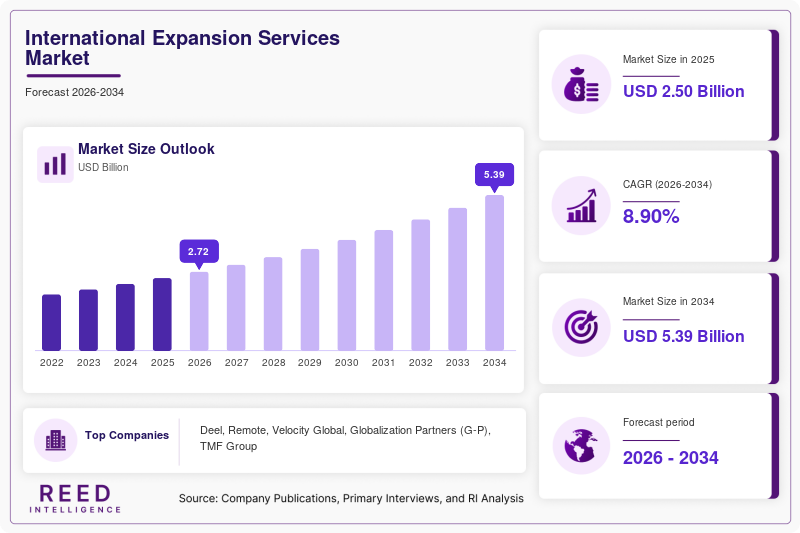
The global international expansion services market size was valued at USD 2.50 billion in 2025 and is projected to grow from USD 2.72 billion in 2026 to USD 5.39 billion by 2034, registering a CAGR of 8.90% during the forecast period from 2026 to 2034.
The international expansion services market is being reshaped by the increasing complexity of operating across multiple jurisdictions. Companies entering a new country must coordinate employment rules, payroll, tax administration, entity governance, local hiring, licensing, reporting, and operational compliance. Managing these activities independently can create duplicated processes and increase the time required to establish a functioning overseas operation.
The service model is therefore shifting toward integrated platforms that combine several stages of internationalization. Deel's June 2026 launch of an Entity Management System connected entity records with HR, payroll, and compliance workflows, reflecting the move toward centralized international operating infrastructure.
International Expansion Services Market Drivers
Increasing Cross-Border Workforce Deployment
International workforce expansion is increasing the need for services that combine hiring, employment compliance, payroll, benefits, and workforce administration. Companies entering new countries frequently need local infrastructure before establishing fully staffed legal and administrative functions.
The mechanism is particularly important for organizations testing a market or expanding quickly. Employer-of-record and outsourced payroll models can provide access to local employment infrastructure without requiring immediate subsidiary establishment. Deel's June 2026 acquisition of PaySpace expanded its payroll infrastructure across Africa and the Middle East, illustrating how geographic payroll capabilities are becoming part of broader international expansion platforms.
The commercial effect is a broader service requirement: customers increasingly expect international providers to handle employment, payroll, compliance, and workforce administration through interconnected systems rather than separate local vendors.
Growing Need for Integrated Entity Management
Establishing an overseas subsidiary creates recurring requirements extending beyond incorporation. Companies must maintain corporate records, manage compliance obligations, coordinate employees and payroll, and keep entity information synchronized with internal finance and HR systems.
This is creating demand for entity-management platforms that connect corporate information with operational workflows. Deel introduced its Entity Management System in June 2026 as a centralized system for entity records, connecting them with people, payroll, and compliance processes.
The mechanism reduces administrative fragmentation. Instead of maintaining separate spreadsheets, local advisers, HR databases, and payroll systems, businesses can increasingly consolidate international entity information into connected platforms. This particularly affects large enterprises managing multiple subsidiaries and jurisdictions.
Enterprise Software Integration Is Reducing Expansion Friction
Companies expanding internationally increasingly want new workforce and compliance services to connect with their existing enterprise systems. Data duplication between HR platforms and international employment providers can create manual work, inconsistent employee records, and additional compliance controls.
Remote's August 2026 Workday Certified Integration allows joint customers to initiate EOR onboarding and synchronize employee-profile and time-off information between Workday and Remote.
The commercial mechanism is therefore shifting from standalone service delivery toward integrated workflows. Providers that connect with established HR and finance systems can reduce implementation friction for enterprise customers and become more deeply embedded in international operating processes.
International Expansion Services Restraints
Regulatory Fragmentation Across Jurisdictions
International expansion services remain constrained by differences in employment, tax, corporate, licensing, reporting, and ownership regulations. A standardized global platform can automate administrative workflows, but country-specific rules still require localized compliance expertise.
The effect is higher operating complexity for service providers. Each additional jurisdiction can require local legal knowledge, payroll configuration, tax expertise, data-management controls, and regulatory monitoring. This limits the extent to which international expansion can be delivered through a completely standardized technology model.
The challenge is particularly relevant to subsidiary establishment and M&A because corporate structures and ownership requirements can differ substantially between countries and industries. Providers therefore need a balance between centralized technology and country-specific operational capabilities.
High Cost and Commitment of Permanent Market Entry
Creating a subsidiary or acquiring a local business generally requires a greater financial and organizational commitment than using licensing arrangements or outsourced workforce infrastructure. Companies with uncertain market demand may therefore delay permanent establishment until commercial traction is demonstrated.
This creates a staged expansion model in which businesses can initially use flexible arrangements before moving toward permanent local infrastructure. The transition can reduce the immediate addressable value of subsidiary-establishment services while increasing demand for EOR, payroll, licensing, and other lower-commitment structures.
Economic uncertainty, regulatory risk, expected customer demand, and the availability of local talent can further influence whether a company chooses direct establishment, acquisition, licensing, or outsourced expansion infrastructure.
International Expansion Services Opportunities
Integrated Global Entity and Workforce Platforms
The convergence of entity management, HR, payroll, compliance, and workforce administration creates an opportunity for providers to capture a larger share of the international expansion workflow.
Deel's June 2026 Entity Management System connects entity data with people, payroll, and compliance workflows, demonstrating how providers are moving beyond individual services toward integrated international operating infrastructure.
The opportunity is commercially significant because companies managing several countries can replace fragmented administrative processes with centralized systems. Providers can also increase recurring revenue by supporting customers after the initial market-entry phase through ongoing entity governance, payroll, workforce management, and compliance.
Adoption will depend on data accuracy, country coverage, security, local regulatory expertise, integration capabilities, and the ability to maintain current jurisdiction-specific requirements.
SME-Oriented Market Entry Services
SMEs represent an important expansion opportunity because smaller companies often lack dedicated international legal, HR, payroll, and tax teams. Flexible services can allow these businesses to test overseas demand without immediately establishing extensive local infrastructure.
EOR, licensing arrangements, outsourced payroll, compliance support, and subsidiary establishment can be combined according to the maturity of an SME's international strategy.
The commercial mechanism is based on lowering the administrative threshold for entering a foreign market. Instead of building an entire local operating structure at the beginning, an SME can purchase selected infrastructure and increase its level of commitment as demand becomes more predictable.
Segmental Analysis
By Type
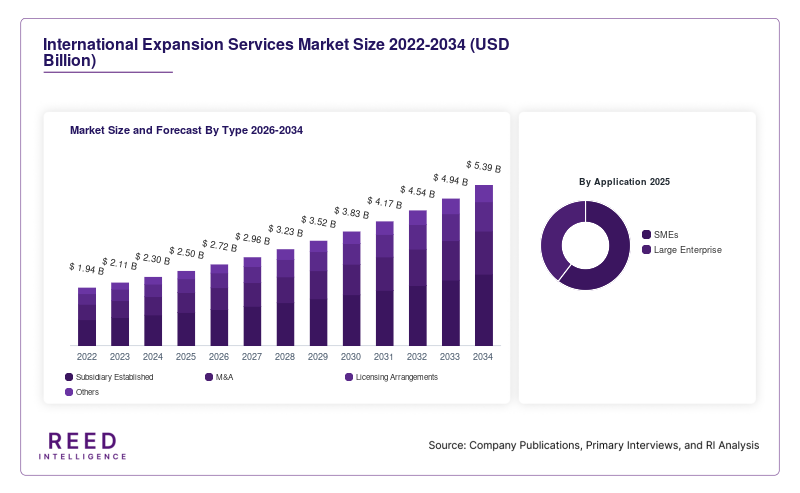
Subsidiary Established represents approximately 37% of the global international expansion services market in 2025, making it the largest type segment. Subsidiary establishment provides companies with direct control over employees, contracts, assets, operations, and local corporate governance. It is particularly relevant for organizations pursuing long-term market presence rather than short-term market testing.
M&A accounts for approximately 22%, while Licensing Arrangements represent approximately 24% and Others account for approximately 17%.
M&A is the fastest-growing type, with an estimated CAGR of 10.1%. Acquiring an existing business can provide immediate access to customers, employees, infrastructure, licenses, suppliers, and local market knowledge. This can shorten the time required to establish a functioning operation compared with building an organization organically. However, transaction costs, regulatory approvals, integration complexity, valuation risk, and organizational restructuring can limit adoption.
By Application
Large Enterprises represent approximately 61% of the market in 2025, making them the largest application segment. Large companies generally manage more jurisdictions, employees, legal entities, currencies, regulatory requirements, and reporting structures, creating recurring demand for international expansion infrastructure.
Their purchasing priorities increasingly include centralized compliance, entity governance, payroll, HR integration, data security, local expertise, and standardized reporting across countries.
SMEs account for approximately 39% of the market but are the fastest-growing application segment, with an estimated CAGR of 10.2%. Flexible international expansion structures allow smaller companies to enter foreign markets without immediately creating permanent administrative infrastructure. EOR, licensing, outsourced payroll, and market-entry support can therefore reduce the initial organizational commitment required for internationalization.
International Expansion Services Market Regional Analysis
North America International Expansion Services Market
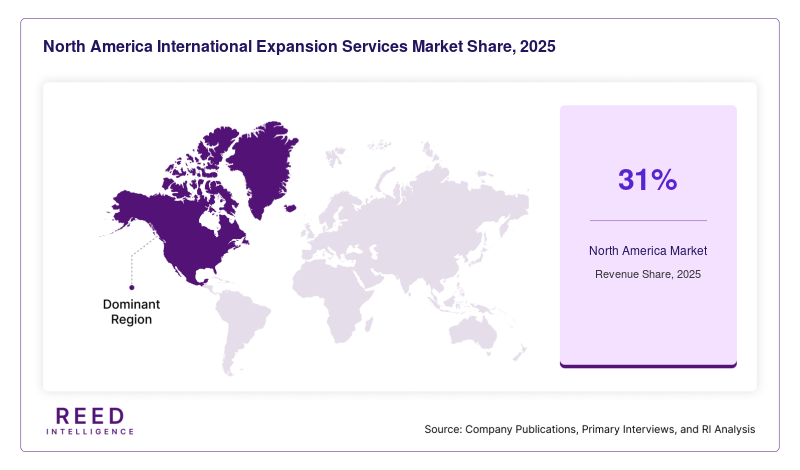
North America represents approximately 31% of the global international expansion services market in 2025, making it the largest regional market. The region benefits from a large base of internationally active companies, technology businesses, professional-services firms, and enterprises with distributed workforces.
The United States is particularly important because companies headquartered in the country frequently hire international employees, establish overseas entities, pursue acquisitions, and expand into new geographic markets. This creates recurring requirements for employment infrastructure, payroll, compliance, entity management, and M&A support.
Technology integration is becoming increasingly important for North American enterprises. Remote's August 2026 Workday Certified Integration provides a validated connection between Workday HCM and its EOR infrastructure, demonstrating the growing requirement for international expansion services to fit into existing enterprise technology environments.
North America is projected to grow at approximately 8.0% CAGR. The market's maturity limits the pace of basic adoption, but enterprise integration, workforce infrastructure, entity management, and cross-border M&A continue to create recurring demand.
Europe International Expansion Services Market
Europe represents approximately 28% of the global market in 2025 and is projected to grow at approximately 8.1% CAGR. Cross-border business activity across European economies creates recurring requirements for local employment, payroll, taxation, entity administration, and regulatory compliance.
Although regional economic integration simplifies some aspects of cross-border commerce, companies still encounter significant differences in employment legislation, taxation, corporate reporting, and local operating requirements.
International expansion providers therefore compete on their ability to combine centralized processes with country-specific compliance. Large enterprises with operations in multiple European countries benefit from standardized workflows that maintain local regulatory controls.
M&A also remains relevant because acquiring an established local company can provide immediate access to customers, employees, distribution networks, and operating infrastructure. However, integration and regulatory requirements can extend transaction timelines.
Asia Pacific International Expansion Services Market
Asia Pacific represents approximately 24% of the global international expansion services market in 2025 and is the fastest-growing region, with an estimated CAGR of 10.7%.
The region combines large and mature economies such as Japan, Australia, South Korea, and China with rapidly expanding Southeast Asian markets. Businesses entering these markets encounter significant differences in employment law, tax, licensing, corporate structures, language, and workforce practices.
The diversity of the region creates a strong requirement for localized international expansion expertise. Companies may initially use EOR, licensing, or outsourced payroll arrangements before committing to subsidiaries or acquisitions.
Technology-enabled international workforce administration is also becoming more important. Deel's 2026 expansion of real-time payroll processing included markets such as Australia, India, Singapore, and Malaysia, demonstrating the increasing integration of country-specific payroll infrastructure into global platforms.
Asia Pacific's principal constraint is regulatory fragmentation, but the combination of multinational investment, digital businesses, workforce mobility, and expanding cross-border operations supports its fastest regional growth.
Latin America International Expansion Services Market
Latin America represents approximately 9% of the global international expansion services market in 2025 and is projected to grow at approximately 9.3% CAGR.
Businesses entering Latin American countries frequently require support with local employment administration, payroll, tax compliance, corporate establishment, licensing, and workforce management. Differences between national regulations make country-level expertise important even where companies pursue a regional expansion strategy.
Brazil and Mexico represent particularly relevant markets for businesses seeking access to large consumer populations and regional operating capabilities. International workforce platforms can reduce the administrative burden associated with entering these countries before a company establishes a fully independent local structure.
The region's opportunity is supported by flexible market-entry models, while currency conditions, regulatory differences, economic volatility, and local administrative requirements can influence investment timing and service selection.
Middle East & Africa International Expansion Services Market
Middle East & Africa represents approximately 8% of the global market in 2025 and is projected to grow at approximately 9.9% CAGR.
The region has diverse employment, corporate, payroll, and licensing frameworks, increasing the need for country-specific expansion infrastructure. Companies entering the region may require local payroll, employment compliance, entity administration, and workforce support before establishing permanent operations.
The acquisition of PaySpace by Deel in June 2026 is particularly relevant to this regional structure. Deel stated that PaySpace had payroll engines across 44 countries in Africa and the Middle East and more than 14,000 customers, giving the combined platform greater local payroll infrastructure across the region.
The development illustrates how regional payroll infrastructure can become an important component of broader international expansion services. Continued demand will depend on foreign investment, regional business formation, workforce mobility, regulatory complexity, and the ability of service providers to maintain reliable local infrastructure.
International Expansion Services Market Competitive Landscape
The International Expansion Services Market is increasingly competitive because providers are expanding from individual international employment or incorporation services into broader operating platforms. The competitive basis now includes geographic coverage, local compliance, payroll infrastructure, entity management, enterprise integration, M&A capabilities, workforce technology, and post-entry operational support.
Deel has expanded its international infrastructure through payroll, entity management, HR, and workforce services. Its June 2026 PaySpace acquisition added native payroll engines across 44 countries in Africa and the Middle East, while the company stated that its broader infrastructure covered entities in more than 150 countries and local payroll engines in more than 50 countries.
Key Market Players
Recent Market Developments
June 2026 – Deel Acquired PaySpace
In June 2026, Deel announced its acquisition of PaySpace, a payroll and HR technology company with more than 20 years of experience and native payroll engines across 44 countries in Africa and the Middle East. Deel stated that PaySpace had more than 14,000 customers and that the acquisition expanded Deel's local payroll infrastructure to more than 50 countries. The development strengthens payroll infrastructure as a core component of international expansion services and expands geographic coverage in markets requiring localized payroll capabilities.
April 2026 – Remote Acquired Bravas
In April 2026, Remote announced the acquisition of Bravas, a French software company specializing in identity and device management. The acquisition added identity and device capabilities to Remote's international employment infrastructure and expanded its platform toward management of the broader employee lifecycle. The development is relevant to international expansion because businesses establishing distributed international teams increasingly require employment, access, device, security, and compliance capabilities to operate together.
International Expansion Services Market Segments
By Type
- Subsidiary Established
- M&A
- Licensing Arrangements
- Others
By Application
- SMEs
- Large Enterprise
By Region
- North America
- Europe
- APAC
- Middle East and Africa
- LATAM