Internet Service Market Size, Share & Demand Report By Type (Fiber Optic Internet, Cable Internet, DSL Internet, Satellite Internet), By Application (Residential, Commercial, Government & Public Sector) By Region & Segment Forecasts, 2026–2034
USD 3950
Internet Service Market Size
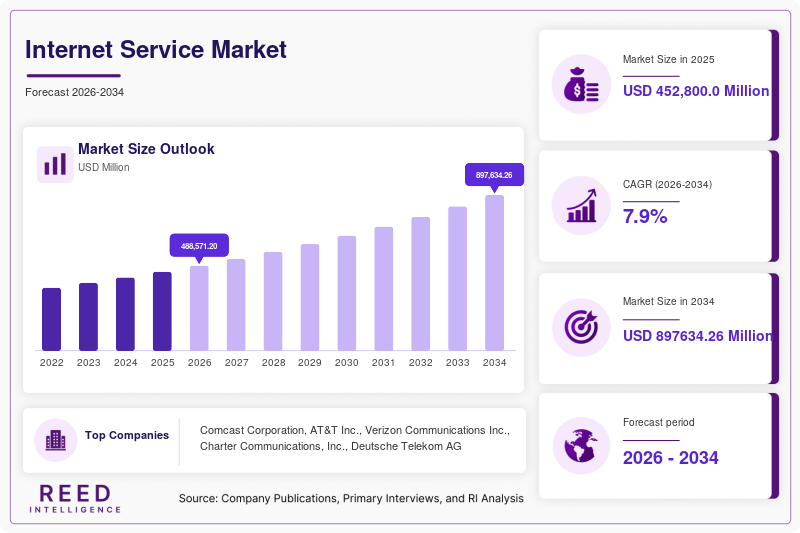
The internet service market size is projected at USD 485,600.0 million in 2026 and is expected to hit USD 892,400.0 million by 2034 with a CAGR of 7.9% during the forecast period. The increasing demand for high-speed internet connectivity, the growing adoption of remote work and digital services, and the rising penetration of smartphones and connected devices underpin market expansion. This report delivers a comprehensive analysis of the internet service market, including segmentation by type and application, competitive dynamics, and regional growth patterns, equipping stakeholders with critical intelligence to navigate this essential connectivity landscape.
Internet Service Market Key Takeaways
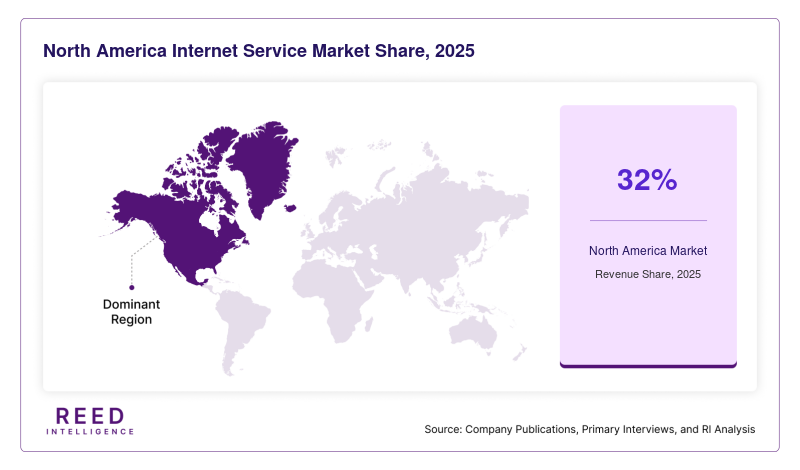
- Dominant Region: North America leads the internet service market with a 32% share, while Asia-Pacific is the fastest-growing region with a projected CAGR of 10.2% through 2034.
- Dominant Segment: The Fiber Optic Internet type dominates the market with a 42% share, while the Residential application is the leading segment with a 52% share.
- Emerging Country: India is projected to reach USD 45,800.0 million by 2034, expanding at a CAGR of 12.5%.
- Key Drivers: The increasing demand for high-speed connectivity, the growing adoption of remote work and digital services, and the rising penetration of connected devices are driving market growth.
The internet service market encompasses a range of connectivity solutions provided by internet service providers (ISPs) to residential, commercial, and government customers, including fiber optic, cable, DSL, and satellite internet services. These services serve as the backbone of the digital economy, enabling communication, commerce, entertainment, and access to information. Globally, the adoption of internet services has grown substantially, with an estimated 5.5 billion internet users in 2025, representing approximately 68% of the world's population. In terms of revenue, Fiber Optic Internet accounted for roughly 42% of the total market share, driven by its superior speed, reliability, and capacity, while Cable Internet followed with 28% share, particularly utilized in regions with established cable infrastructure. The market is further characterized by a penetration rate exceeding 90% in developed economies for broadband access, whereas emerging markets represent a growing adoption frontier due to increasing smartphone penetration and improving infrastructure. The DSL Internet segment, representing 18% of the market, remains relevant in areas where newer technologies are not yet available, and Satellite Internet, representing 12% of the market, is gaining traction in remote and underserved areas.
Internet Service Market Trends
Accelerated Deployment of Fiber Optic and 5G Networks
The internet service market is witnessing a significant trend toward the accelerated deployment of fiber optic and 5G networks to meet the growing demand for high-speed, low-latency connectivity. This shift is driven by the increasing data consumption, the proliferation of connected devices, and the need for reliable infrastructure to support remote work, streaming, and IoT applications. Telecom operators and ISPs are investing heavily in fiber-to-the-home (FTTH) and 5G fixed wireless access (FWA) deployments. The adoption of fiber optic internet has increased by 25% year-over-year, with over 60% of new broadband deployments in 2025 being fiber-based. This internet service market trend is supported by government initiatives to expand broadband access and the declining costs of fiber deployment.
Growing Demand for Bundled Services and Converged Offerings
The increasing demand for bundled services and converged offerings that combine internet, television, and telephony is a major trend shaping the internet service market. The development of triple-play and quad-play bundles is gaining traction, driven by the need to enhance customer value, reduce churn, and increase average revenue per user. The emergence of integrated platforms that offer seamless access to content, communication, and smart home services is particularly prominent. This internet service market growth is supported by the growing consumer preference for convenience and the increasing competition among service providers. The integration of streaming services and value-added offerings is also enhancing the attractiveness of bundled packages.
Internet Service Market Drivers
The internet service market's expansion is primarily driven by the increasing global demand for high-speed internet connectivity, with data consumption growing exponentially due to video streaming, cloud computing, and online gaming. The growing adoption of remote work and digital services has been a major driver, with millions of employees relying on home internet for work and millions of businesses requiring reliable connectivity. The rising penetration of smartphones and connected devices has further fueled market demand, with over 4.8 billion smartphone users globally. The increasing investment in network infrastructure, including fiber and 5G, has expanded the availability and quality of internet services. Additionally, the growing focus on digital inclusion and government initiatives to bridge the digital divide have supported market growth.
Internet Service Market Restraints
Despite favorable growth prospects, the internet service market faces significant constraints, primarily related to the high costs of infrastructure deployment, particularly in rural and remote areas where return on investment is challenging. The market's growth is further tempered by the regulatory and permitting complexities that can delay network expansion. Additionally, the competition from alternative technologies and the saturation of urban markets can limit growth opportunities for some providers. The challenges of managing network congestion and ensuring consistent quality of service during peak usage times can also impact customer satisfaction and retention.
Internet Service Market Opportunities
The internet service market presents significant opportunities in the rapidly expanding segment of rural and underserved areas where broadband access is limited, and government subsidies and initiatives are driving deployment. The development of 5G fixed wireless access as a cost-effective alternative to fiber in certain areas represents another promising avenue. Emerging opportunities also exist in the application of satellite internet for remote and mobile connectivity. Furthermore, the growing demand for enterprise-grade connectivity and managed services offers potential for higher-margin revenue streams for ISPs.
Challenges in Internet Service Market
The internet service market grapples with persistent challenges related to the need for continuous investment in network upgrades to keep pace with growing bandwidth demand. The complexity of managing increasingly complex network infrastructure and ensuring cybersecurity presents ongoing operational challenges. The market is also contending with the challenge of attracting and retaining customers in a competitive landscape. Moreover, the need for effective customer support and service quality management poses challenges for ISPs.
Internet Service Market Segmentation Analysis
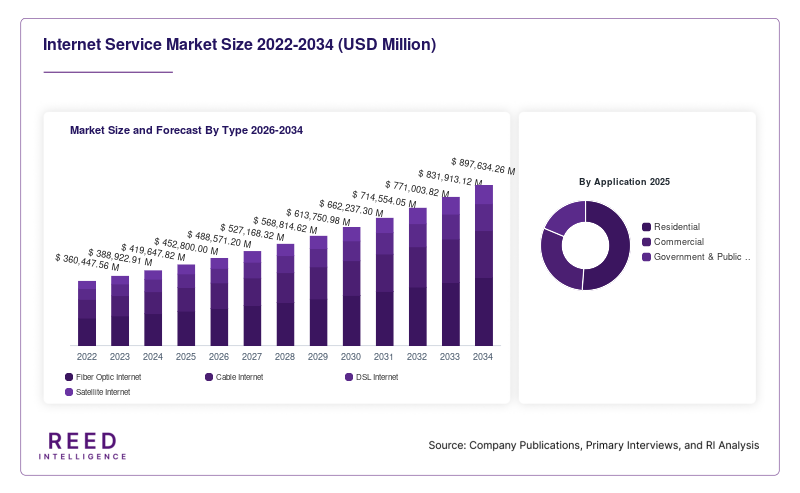
The internet service market is segmented by Type and Application to provide a comprehensive market perspective. By Type, Fiber Optic Internet dominates with a 42% market share, driven by its superior performance. The Application segment is led by Residential, which accounts for 52% of the market, followed by Commercial at 38%, and Government & Public Sector at 10%.
By Type
Fiber Optic Internet represents the largest segment in the internet service market, commanding a 42% share, with revenue exceeding USD 203,952 million in 2025. These services use fiber optic cables to transmit data at very high speeds over long distances. Technical specifications include speed (up to 10 Gbps), latency (less than 5 ms), and reliability. The market's Fiber Optic Internet segment is driven by its use in residential, commercial, and government applications requiring high-speed, reliable connectivity.
Cable Internet captures a 28% share of the internet service market, with revenue of USD 135,968 million in 2025. These services use coaxial cables to transmit data, often bundled with television services. Technical specifications include speed (up to 1 Gbps), shared bandwidth, and availability. The market's Cable Internet segment is driven by its widespread availability in urban areas and its use in residential and commercial applications.
DSL Internet represents 18% of the market, with revenue of USD 87,408 million in 2025, characterized by the use of traditional telephone lines for data transmission. Technical specifications include speed (up to 100 Mbps), distance sensitivity, and availability. The market's DSL Internet segment is driven by its use in areas where newer technologies are not yet available and by its lower cost.
Satellite Internet accounts for 12% of the market, with revenue of USD 58,272 million in 2025, involving the use of satellites to provide internet access in remote and underserved areas. Technical specifications include speed (up to 200 Mbps), latency (500+ ms for GEO), and coverage. The market's Satellite Internet segment is driven by its use in rural and remote areas where terrestrial infrastructure is not available, with growing interest in LEO satellite constellations.
By Application
Residential dominates the internet service market, accounting for 52% of sales, representing USD 252,512 million in 2025. This segment includes internet services provided to households for personal use, including streaming, gaming, and remote work. Usage penetration exceeds 90% in developed economies. The market's Residential segment is characterized by its focus on speed, reliability, and affordability, with increasing demand for higher bandwidth.
Commercial accounts for 38% of the internet service market, with revenue of USD 184,528 million in 2025. This segment encompasses internet services provided to businesses of all sizes, including dedicated internet access, MPLS, and managed services. The segment is growing at a steady rate, driven by the increasing digitalization of business operations. The market's Commercial segment is characterized by its focus on reliability, security, and service level agreements.
Government & Public Sector represents 10% of the market, with revenue of USD 48,560 million in 2025, involving internet services provided to government agencies, public institutions, and municipalities. The market's Government & Public Sector segment is driven by the need for secure, reliable connectivity for public services and digital government initiatives.
Internet Service Market Regional Analysis
North America Internet Service Market
Leads the internet service market, commanding a 32% share, with revenue of USD 155,392 million in 2025. The United States is the primary driver, accounting for 88% of regional demand, driven by high internet penetration, advanced infrastructure, and the presence of major ISPs. The North American market is characterized by its focus on fiber deployment and 5G expansion.
Asia-Pacific Internet Service Market
Represents the second-largest and fastest-growing market, capturing a 30% share with revenue of USD 145,680 million in 2025. China, India, and Japan are the primary drivers, accounting for 70% of regional demand, fueled by massive populations, increasing smartphone penetration, and government initiatives to expand broadband access. The Asia-Pacific market is projected to grow at the fastest CAGR of 10.2% through 2034, driven by digital inclusion and infrastructure investment.
Europe Internet Service Market
Accounts for 26% of the global internet service market, with revenue of USD 126,256 million in 2025. Germany, the United Kingdom, and France are the primary drivers, accounting for 58% of regional demand, driven by advanced infrastructure, high consumer adoption, and supportive regulatory frameworks. The European market is projected to grow at a steady CAGR, supported by continuous investment and innovation.
Latin America and Middle East & Africa Internet Service Market
Together account for the remaining 12% of the internet service market, with Brazil and the UAE leading their respective regions. Both regions are projected to grow at CAGRs exceeding 9%, driven by improving infrastructure, increasing smartphone penetration, and growing demand for connectivity.
Top players in Internet Service Market
- Comcast Corporation
- AT&T Inc.
- Verizon Communications Inc.
- Charter Communications, Inc.
- Deutsche Telekom AG
- Vodafone Group Plc
- Nippon Telegraph and Telephone Corporation (NTT)
- China Telecom Corporation Limited
- China Unicom (Hong Kong) Limited
- Bharti Airtel Limited
- Reliance Jio Infocomm Limited
- Orange S.A.
- Telefónica S.A.
- BT Group plc
- Lumen Technologies
Recent Developments in Internet Service Market
- April 2026 – Comcast Corporation announced a major expansion of its fiber-to-the-home network, targeting 10 million new homes by 2028.
- June 2025 – AT&T Inc. launched a new 5G fixed wireless access service in multiple markets, offering an alternative to traditional broadband.
- August 2025 – Verizon Communications Inc. introduced a new multi-gigabit fiber internet service for residential and small business customers.
- February 2026 – Reliance Jio Infocomm Limited announced a new fiber broadband plan with speeds up to 1 Gbps, expanding its reach in India.
- October 2025 – Deutsche Telekom AG launched a new bundled service combining fiber internet, TV, and mobile for residential customers in Germany.
Internet Service Market Segments
By Type
- Fiber Optic Internet
- Cable Internet
- DSL Internet
- Satellite Internet
By Application
- Residential
- Commercial
- Government & Public Sector
By Region
- North America
- Europe
- APAC
- Middle East and Africa
- LATAM