Intraosseous Infusion Kit Market Size, Share & Demand Report By Product Type (Manual Intraosseous Infusion Kits, Battery-Powered Devices, Semi-Automatic Infusion Systems, Disposable Intraosseous Kits), By Application (Emergency Care, Pediatric Care, Trauma Care, Critical Care & ICU), By End-Use (Hospitals, Emergency Medical Services, Ambulatory Surgical Centers, Military & Defense Healthcare), By Distribution Channel & Segment Forecasts, 2026–2034
USD 3950
Market Overview
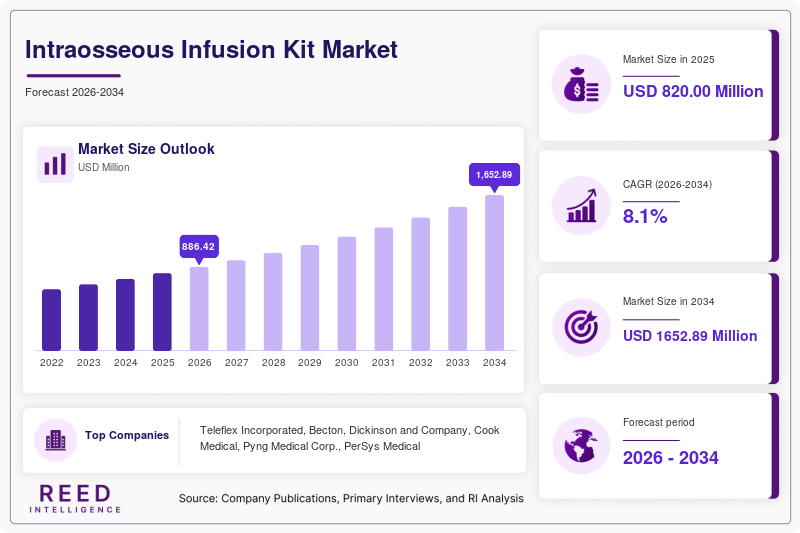
The global Intraosseous Infusion Kit Market size was valued at USD 820 million in 2026 and is projected to reach USD 1.54 billion by 2034, expanding at a CAGR of 8.1% during the forecast period (2026–2034). The market is witnessing steady growth due to the increasing need for rapid vascular access in emergency medical situations, particularly when intravenous access is difficult or time-consuming. Intraosseous infusion systems provide a critical alternative for delivering fluids, blood products, and medications directly into the bone marrow, enabling faster clinical intervention.
A key global factor supporting the growth of the Intraosseous Infusion Kit Market is the rising incidence of trauma, cardiac arrest, and emergency care cases worldwide. As healthcare systems emphasize faster response times and improved patient outcomes, intraosseous access has become a standard procedure in advanced life support protocols. This has contributed to the growing adoption of intraosseous infusion kits across hospitals, emergency medical services (EMS), and military healthcare settings.
Key Highlights:
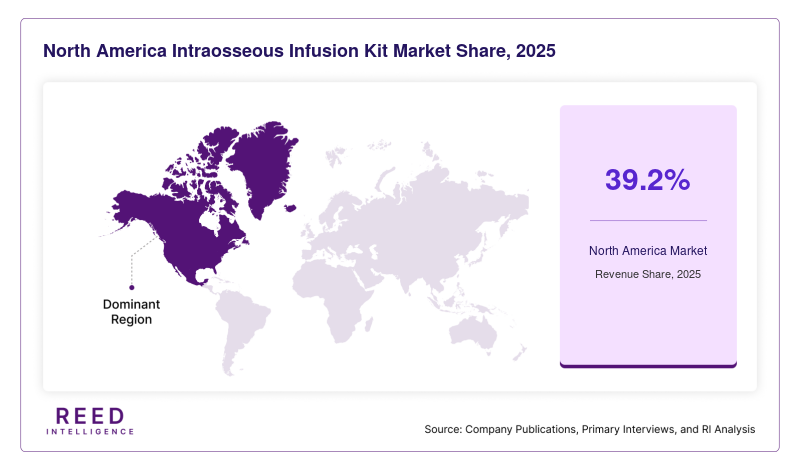
- North America dominated the market with a 39.2% share in 2025, while Asia Pacific is projected to register the fastest CAGR of 9.6% through 2034.
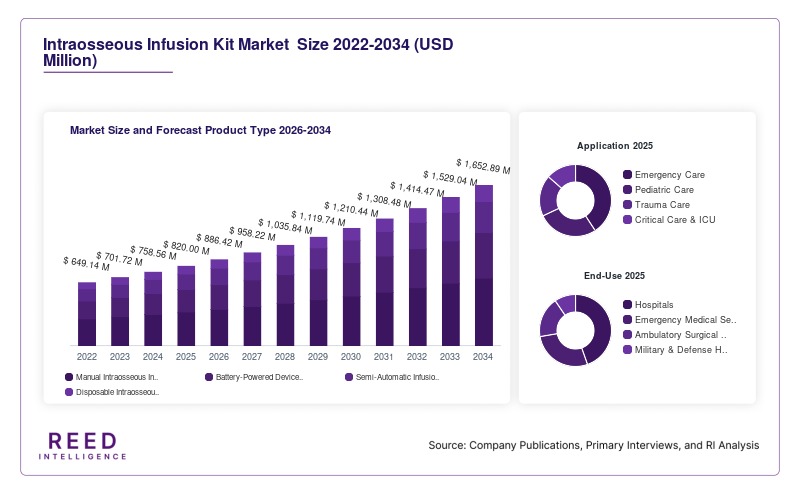
- The manual intraosseous infusion kits segment led with a 46.5% share in 2025, while battery-powered devices are expected to grow at a CAGR of 9.2%.
- Hospitals were the leading end-use segment with a 52.8% share, while emergency medical services are forecasted to grow at a CAGR of 9.8%.
- The U.S. accounted for USD 275 million in 2024 and reached USD 292 million in 2025, maintaining its dominant position globally.
Market Trends
Increasing Integration of Automated Infusion Systems
The Intraosseous Infusion Kit Market is witnessing a shift toward automated and battery-powered infusion devices that enhance precision and ease of use. These systems reduce manual effort, minimize insertion errors, and improve patient safety outcomes in high-pressure emergency environments. Healthcare providers are increasingly adopting such devices due to their reliability in critical care scenarios, including pediatric and geriatric applications. Additionally, technological improvements in needle design and insertion mechanisms are improving procedural success rates, further supporting market expansion.
Expansion of Prehospital Emergency Care Infrastructure
Another key trend shaping the Intraosseous Infusion Kit Market is the expansion of prehospital emergency care services. Governments and private healthcare organizations are investing in advanced emergency response systems, including ambulances equipped with modern life-saving tools. Intraosseous infusion kits are becoming a standard component in these setups due to their rapid deployment capability. The growing emphasis on training paramedics and first responders in intraosseous access techniques is also contributing to higher adoption rates. This trend is particularly notable in developing regions where emergency care infrastructure is rapidly evolving.
Market Drivers
Rising Demand for Rapid Vascular Access in Emergencies
The increasing demand for immediate vascular access in emergency medical situations is a major driver of the Intraosseous Infusion Kit Market. In cases such as cardiac arrest, severe trauma, or shock, traditional intravenous access can be challenging. Intraosseous infusion provides a reliable and fast alternative, enabling healthcare professionals to administer life-saving treatments without delay. The growing adoption of advanced life support protocols globally is reinforcing the importance of intraosseous access, thereby boosting market growth.
Growth in Training and Awareness Programs
Another key driver is the expansion of training programs and awareness initiatives focused on intraosseous infusion techniques. Healthcare institutions and regulatory bodies are increasingly emphasizing skill development among medical professionals, including paramedics and emergency responders. Simulation-based training and certification programs are improving procedural proficiency, leading to higher adoption rates of intraosseous infusion kits. This growing awareness is positively influencing the Intraosseous Infusion Kit Market across both developed and emerging economies.
Market Restraint
Risk of Complications and Limited Skilled Professionals
One of the primary challenges in the Intraosseous Infusion Kit Market is the risk of complications associated with improper use. These may include infections, bone fractures, or incorrect needle placement, which can impact patient safety. Additionally, the availability of skilled professionals trained in intraosseous infusion techniques remains limited in certain regions, particularly in low-resource settings.
The lack of standardized training protocols and variability in clinical practices further contribute to this restraint. Healthcare providers may hesitate to adopt intraosseous infusion kits without adequate training and support infrastructure. Moreover, concerns regarding patient discomfort and procedural risks may limit their use in non-critical scenarios. Addressing these challenges requires consistent training programs and improved device design to minimize complications and enhance usability.
Market Opportunities
Technological Advancements in Device Design
Advancements in device design present a significant opportunity for the Intraosseous Infusion Kit Market. Manufacturers are focusing on developing lightweight, portable, and user-friendly devices that improve ease of use and reduce procedural time. Innovations such as smart sensors and automated insertion mechanisms are enhancing device efficiency and safety. These developments are expected to expand the application scope of intraosseous infusion kits across various healthcare settings.
Expansion in Emerging Healthcare Markets
Emerging economies offer substantial growth opportunities for the Intraosseous Infusion Kit Market. Rapid improvements in healthcare infrastructure, increasing government investments, and rising awareness of emergency care solutions are driving demand in these regions. Countries in Asia Pacific, Latin America, and Africa are witnessing a surge in healthcare modernization initiatives, creating a favorable environment for market expansion. The growing presence of international medical device companies in these markets is further supporting adoption.
Segmental Analysis
By Product Type
Manual intraosseous infusion kits held the largest share of 46.5% in 2025 due to their cost-effectiveness and ease of use in various healthcare settings. These kits were widely used in both hospital and prehospital environments.
Battery-powered intraosseous devices are expected to grow at a CAGR of 9.2% during the forecast period. Their ability to provide consistent insertion performance and reduce operator fatigue will drive their adoption, particularly in high-pressure emergency situations.
By Application
Emergency care applications accounted for the largest share of 58.3% in 2025, driven by the frequent use of intraosseous infusion in trauma and cardiac arrest cases. These applications require rapid and reliable vascular access.
Pediatric applications are projected to grow at a CAGR of 9.4% due to the increasing need for specialized devices that cater to children, where intravenous access is often more challenging.
By End-Use
Hospitals dominated the Intraosseous Infusion Kit Market with a 52.8% share in 2025, supported by the availability of trained professionals and advanced medical infrastructure.
Emergency medical services are expected to register the fastest CAGR of 9.8% as prehospital care becomes more advanced and widespread, increasing the demand for portable and efficient infusion kits.
By Distribution Channel
Direct sales accounted for 61.7% of the market share in 2025 due to strong relationships between manufacturers and healthcare institutions.
Online distribution channels are projected to grow at a CAGR of 10.1% as digital procurement platforms gain popularity and improve accessibility for healthcare providers.
Regional Analysis
North America
North America accounted for 39.2% of the Intraosseous Infusion Kit Market share in 2025 and is expected to grow at a CAGR of 7.5% from 2026 to 2034. The region benefited from a well-established healthcare system and widespread adoption of advanced emergency care technologies.
The United States dominated the regional market due to its strong emergency medical services network. A key growth factor was the high adoption of standardized emergency protocols that include intraosseous access, supported by continuous advancements in medical device technologies.
Europe
Europe held a 27.6% share of the Intraosseous Infusion Kit Market in 2025 and is projected to expand at a CAGR of 7.8% during the forecast period. The region experienced steady growth driven by increasing healthcare investments and focus on improving emergency care services.
Germany emerged as the leading country due to its robust healthcare infrastructure. The country’s emphasis on clinical training and adoption of advanced medical devices contributed to the widespread use of intraosseous infusion kits.
Asia Pacific
Asia Pacific captured 18.9% of the market share in 2025 and is expected to grow at the fastest CAGR of 9.6% through 2034. The region showed strong growth potential due to expanding healthcare infrastructure and increasing awareness of emergency medical procedures.
China dominated the regional market, driven by rapid healthcare modernization and rising investments in emergency care systems. The growing number of hospitals and emergency response units supported the adoption of intraosseous infusion kits.
Middle East & Africa
The Middle East & Africa region held a 7.1% share in 2025 and is forecasted to grow at a CAGR of 8.4% during the forecast period. Growth in the region was supported by increasing investments in healthcare infrastructure and emergency medical services.
Saudi Arabia led the regional market due to its focus on improving healthcare quality and expanding emergency care facilities. Government initiatives aimed at enhancing medical services contributed to market growth.
Latin America
Latin America accounted for 7.2% of the Intraosseous Infusion Kit Market share in 2025 and is projected to grow at a CAGR of 8.2% through 2034. The region experienced growth due to rising healthcare awareness and improving access to medical technologies.
Brazil dominated the market, supported by its expanding healthcare sector and increasing adoption of advanced medical devices. The country’s focus on strengthening emergency care systems played a key role in driving demand.
Competitive Landscape
The Intraosseous Infusion Kit Market is moderately competitive, with several global and regional players focusing on product innovation and strategic partnerships. Leading companies are investing in research and development to enhance device efficiency and safety.
Teleflex Incorporated is a key market leader, recognized for its advanced intraosseous access systems. The company recently introduced an upgraded battery-powered device with improved insertion accuracy and user-friendly features, strengthening its market position.
Other prominent players are expanding their geographic presence and product portfolios to capture emerging opportunities. Collaborations with healthcare institutions and training programs are also common strategies to increase product adoption.
Key Players List
- Teleflex Incorporated
- Becton, Dickinson and Company
- Cook Medical
- Pyng Medical Corp.
- PerSys Medical
- Vygon SA
- Cardinal Health
- Smiths Medical
- SAM Medical
- Aero Healthcare
- Stryker Corporation
- Medtronic plc
- Merit Medical Systems
- Argon Medical Devices
- Ambu A/S
Recent Developments
- Teleflex Incorporated launched an advanced intraosseous infusion system with improved ergonomic design in 2025.
- Becton, Dickinson and Company expanded its emergency care product portfolio with new infusion solutions.
- Stryker Corporation entered strategic partnerships to enhance its presence in emergency medical devices.
- Cardinal Health strengthened its distribution network across emerging markets.
- Vygon SA introduced new training programs to improve intraosseous infusion adoption.
Intraosseous Infusion Kit Market Segments
Product Type
- Manual Intraosseous Infusion Kits
- Battery-Powered Devices
- Semi-Automatic Infusion Systems
- Disposable Intraosseous Kits
Application
- Emergency Care
- Pediatric Care
- Trauma Care
- Critical Care & ICU
End-Use
- Hospitals
- Emergency Medical Services (EMS)
- Ambulatory Surgical Centers
- Military & Defense Healthcare
Distribution Channel
- Direct Sales
- Distributors & Wholesalers
- Online Platforms
- Hospital Procurement Systems
By Region
- North America
- Europe
- APAC
- Middle East and Africa
- LATAM