Intravascular Temperature Management Market Size, Share & Demand Report By Product Type (Intravascular Cooling Systems, Temperature Monitoring Catheters, Warming Systems, Accessories and Consumables), By Application (Surgical Procedures, Trauma Management, Neonatal Care), By End Use (Hospitals, Ambulatory Surgical Centers, Specialty Clinics, Emergency Care Centers, Academic and Research Institutes), By Region & Segment Forecasts, 2026–2034
USD 3950
Market Overview
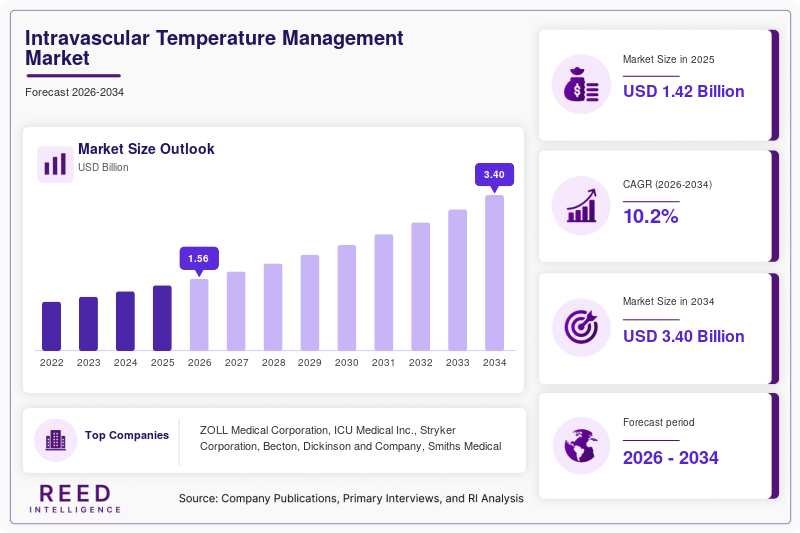
The global Intravascular Temperature Management Market size was valued at approximately USD 1.42 billion in 2026 and is projected to reach nearly USD 3.08 billion by 2034, expanding at a compound annual growth rate (CAGR) of 10.2% during the forecast period from 2026 to 2034. The market continues to gain momentum due to the growing adoption of targeted temperature management systems in critical care, surgical procedures, and emergency medicine. Hospitals and specialty care centers are increasingly using intravascular temperature management devices to improve patient outcomes during cardiac arrest treatment, neurological interventions, trauma management, and post-operative recovery.
One of the major global factors supporting market expansion is the increasing prevalence of cardiovascular diseases and neurological disorders. Healthcare providers are placing greater emphasis on advanced patient temperature regulation technologies to reduce complications associated with hypothermia and hyperthermia. Intravascular temperature management systems provide controlled cooling and warming capabilities with higher precision than traditional surface-based systems. This has encouraged adoption in intensive care units and operating rooms across developed and emerging healthcare markets.
Key Highlights
- North America dominated the market with a 36.4% share in 2025.
- Asia Pacific is expected to grow at the fastest CAGR of 11.8% during 2026–2034.
- By product type, intravascular cooling systems accounted for the largest share of 43.1%.
- while temperature monitoring catheters are projected to grow at a CAGR of 12.3%.
- By application, cardiac care led with a 39.8% share, whereas neurological care is expected to expand at a CAGR of 12.1%.
- By end use, hospitals represented the dominant share of 58.7%, while ambulatory surgical centers are projected to grow at a CAGR of 10.9%.
- The United States remained the dominant country, with market values of USD 530 million in 2024 and USD 585 million in 2025.
Market Trends
Integration of automated temperature control platforms in intensive care settings
Healthcare facilities are increasingly integrating automated intravascular temperature management platforms into critical care environments to improve clinical precision and workflow management. Advanced systems equipped with digital interfaces, predictive monitoring algorithms, and automated cooling controls are replacing manual temperature regulation approaches. Hospitals are adopting these solutions because they reduce response time during emergency interventions and support standardized patient care protocols. Automated systems also minimize nursing workload by maintaining stable patient temperatures with limited manual adjustments.
The growing focus on ICU efficiency and patient safety has further accelerated demand for smart intravascular management technologies. Several manufacturers are introducing systems that integrate with electronic health records and central monitoring infrastructure. This integration enables real-time temperature tracking and data-driven clinical decisions. Demand for automated systems is particularly strong in North America and Western Europe, where hospitals continue investing in advanced critical care infrastructure. Increasing awareness regarding therapeutic hypothermia for cardiac arrest recovery is also contributing to wider adoption of digitally enabled cooling and warming systems.
Rising use of minimally invasive temperature management procedures
The market is witnessing increasing preference for minimally invasive temperature management solutions due to reduced complications and faster patient recovery. Intravascular catheters provide precise temperature regulation directly through the bloodstream, making them more effective in many critical care applications compared to surface cooling systems. Healthcare professionals are using catheter-based systems in neurological procedures, trauma care, and post-cardiac arrest management because they allow rapid induction and maintenance of target temperatures.
Manufacturers are responding to this demand by developing thinner catheters, improved biocompatible materials, and systems with enhanced safety features. The trend is especially visible in tertiary hospitals and specialty surgical centers where clinicians seek efficient temperature management solutions with reduced infection risks. Increasing procedural volumes in cardiovascular and neurological surgeries are supporting this transition toward minimally invasive technologies. In addition, expanding training programs for physicians and critical care specialists are improving clinical familiarity with intravascular systems, strengthening overall market growth.
Market Drivers
Increasing prevalence of cardiovascular and neurological disorders
The growing incidence of cardiovascular diseases, stroke, traumatic brain injuries, and neurological complications is a major driver for the Intravascular Temperature Management Market. Temperature regulation has become an important component of post-cardiac arrest care and neurological recovery management. Intravascular systems help reduce metabolic stress and prevent secondary tissue damage by maintaining precise body temperature ranges during critical treatment phases. Hospitals are increasingly adopting these systems to improve survival rates and reduce long-term neurological complications.
Aging global populations and rising lifestyle-related health disorders are further increasing patient volumes in intensive care units and emergency departments. Many healthcare organizations have incorporated targeted temperature management protocols into advanced cardiac life support programs. This has generated consistent demand for high-performance cooling catheters and temperature monitoring solutions. Emerging economies are also improving access to specialized critical care services, creating additional opportunities for market expansion. As healthcare systems focus more on outcome-based treatment strategies, demand for reliable intravascular temperature management technologies is expected to increase steadily.
Expansion of surgical procedures and critical care infrastructure
The rapid expansion of critical care infrastructure and surgical procedures worldwide is supporting significant growth in the market. Hospitals are increasing investments in operating rooms, emergency care units, and specialized intensive care departments equipped with advanced patient monitoring systems. Intravascular temperature management devices are increasingly used during complex surgeries, including cardiac procedures, transplant operations, and neurosurgical interventions, where maintaining precise body temperature is clinically essential.
The rise in healthcare expenditure across Asia Pacific, the Middle East, and Latin America is contributing to infrastructure modernization in both public and private hospitals. Governments and healthcare providers are focusing on improving critical care capabilities following lessons learned from global healthcare emergencies. This has accelerated procurement of advanced patient management systems, including temperature control technologies. Device manufacturers are also introducing portable and user-friendly systems suitable for smaller hospitals and ambulatory facilities. These developments are expanding market accessibility and strengthening long-term adoption across multiple healthcare settings.
Market Restraints
High equipment costs and limited accessibility in developing healthcare systems
The relatively high cost associated with intravascular temperature management systems remains a significant challenge for broader market adoption. Advanced cooling and warming systems require substantial investment in specialized equipment, disposable catheters, and maintenance services. Smaller healthcare facilities and resource-constrained hospitals often struggle to justify these expenses, particularly in regions where healthcare budgets remain limited. The cost burden becomes more significant when combined with staff training requirements and infrastructure upgrades needed for implementation.
Limited reimbursement policies in several developing countries also restrict purchasing decisions for advanced temperature management technologies. Many hospitals continue relying on traditional surface cooling techniques because they are more affordable despite lower precision and efficiency. In some emerging healthcare systems, lack of awareness regarding the long-term clinical benefits of targeted temperature management further delays adoption. Infection risks related to invasive catheter procedures also contribute to cautious usage among certain healthcare providers. As a result, manufacturers face challenges in achieving wider penetration in low-income and middle-income regions, despite growing demand for advanced critical care solutions.
Market Opportunities
Growth potential in emerging healthcare markets
Emerging healthcare markets across Asia Pacific, Latin America, and parts of the Middle East are creating substantial opportunities for manufacturers operating in the Intravascular Temperature Management Market. Governments in countries such as China, India, Brazil, and Saudi Arabia are increasing healthcare investments to improve intensive care infrastructure and emergency response capabilities. Expansion of private hospital networks and rising medical tourism activities are also supporting demand for advanced patient management technologies.
Healthcare providers in these regions are increasingly recognizing the benefits of targeted temperature management in improving clinical outcomes for cardiac arrest and neurological patients. International manufacturers are entering these markets through strategic partnerships, distributor agreements, and localized manufacturing initiatives. The growing availability of trained healthcare professionals and improved access to critical care equipment are strengthening adoption potential. As healthcare modernization continues in emerging economies, demand for cost-effective and technologically advanced intravascular systems is expected to increase steadily during the forecast period.
Development of next-generation smart monitoring technologies
The development of next-generation smart monitoring technologies presents another strong opportunity for market participants. Companies are investing in artificial intelligence, predictive analytics, and cloud-connected monitoring platforms to improve patient temperature management accuracy. These innovations allow clinicians to receive automated alerts, real-time temperature analytics, and personalized treatment recommendations during critical care procedures.
The integration of smart technologies with intravascular systems can improve workflow efficiency while reducing complications associated with manual temperature regulation. Manufacturers are also exploring wireless monitoring solutions and remote patient management capabilities to support healthcare providers in high-volume critical care settings. Demand for integrated systems is increasing because hospitals are seeking solutions that enhance operational efficiency and data-driven decision-making. Continued innovation in sensor technology, catheter design, and automated feedback mechanisms is likely to create long-term growth opportunities for both established manufacturers and emerging medical device companies.
Segmental Analysis
By Product Type
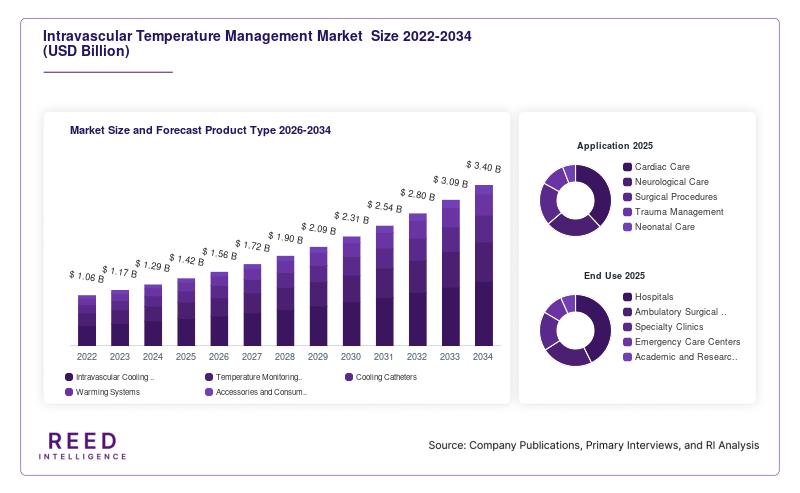
Intravascular cooling systems represented the dominant product segment in 2024, accounting for approximately 43.1% of the global market share. These systems are widely used in intensive care units, emergency departments, and operating rooms because they provide accurate and rapid temperature control for critically ill patients. Hospitals prefer intravascular cooling systems due to their effectiveness in managing therapeutic hypothermia and maintaining precise patient temperatures during complex medical procedures. Increased incidence of cardiac arrest, stroke, and trauma-related complications has strengthened demand for these systems across developed healthcare markets.
Healthcare providers are increasingly integrating advanced cooling platforms with automated monitoring technologies to improve patient management efficiency. Large hospitals and tertiary care centers remain the primary adopters because they require high-performance temperature regulation systems for critical care applications. In addition, continuous product innovation, including portable cooling systems and improved catheter compatibility, is contributing to wider market penetration. The growing emphasis on evidence-based critical care practices is expected to support sustained demand for intravascular cooling systems throughout the forecast period.
By Application
Cardiac care emerged as the leading application segment in 2024, accounting for nearly 39.8% of the overall market share. Intravascular temperature management systems are widely used in post-cardiac arrest treatment and cardiovascular surgical procedures to reduce neurological damage and improve patient survival rates. Hospitals are increasingly implementing therapeutic hypothermia protocols as part of advanced cardiac life support programs. This has generated strong demand for efficient cooling and warming technologies capable of maintaining stable patient temperatures during critical treatment stages.
The increasing prevalence of cardiovascular diseases worldwide continues to support strong demand for temperature management systems within cardiac care applications. Developed healthcare systems in North America and Europe are investing heavily in specialized cardiac treatment centers equipped with advanced patient monitoring technologies. Device manufacturers are also collaborating with healthcare institutions to improve clinical guidelines and develop more efficient temperature management solutions. Growing awareness regarding the benefits of targeted temperature management in reducing complications after cardiac arrest is expected to sustain segment dominance over the coming years.
By End Use
Hospitals accounted for the largest end-use segment in 2024, representing approximately 58.7% of the global market share. The dominance of hospitals is primarily attributed to high patient volumes, availability of advanced intensive care infrastructure, and increasing adoption of targeted temperature management protocols. Large healthcare institutions are major users of intravascular cooling systems and monitoring catheters due to their extensive involvement in cardiac surgery, trauma care, and neurological treatment procedures.
Hospitals also benefit from stronger financial capabilities that allow investment in technologically advanced patient management systems. Growing emphasis on reducing post-operative complications and improving clinical outcomes has accelerated adoption across emergency departments and critical care units. Many hospitals are implementing integrated patient monitoring systems that combine temperature regulation with real-time data analytics and automated alerts. In addition, increasing government healthcare investments and expansion of tertiary care facilities in emerging markets are expected to sustain strong segment growth during the forecast period.
Regional Analysis
North America
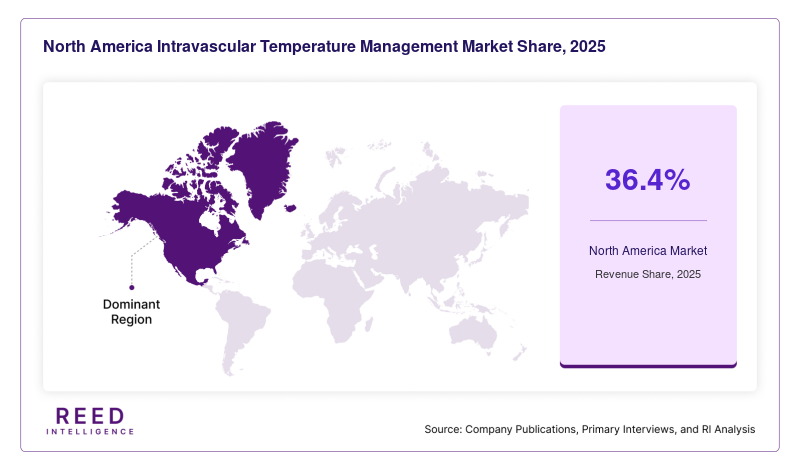
North America accounted for the largest share of the Intravascular Temperature Management Market in 2025, representing approximately 36.4% of global revenue. The region is projected to maintain stable growth at a CAGR of 9.7% through 2034 due to advanced healthcare infrastructure and high adoption of critical care technologies. Hospitals across the United States and Canada continue integrating targeted temperature management systems into emergency medicine and cardiac care protocols. Strong reimbursement frameworks and increasing awareness regarding therapeutic hypothermia are further contributing to sustained market demand.
The United States remains the dominant country in the region due to its large critical care patient population and strong healthcare expenditure. The country benefits from widespread availability of technologically advanced hospitals and specialized neurological treatment centers. Increasing adoption of minimally invasive cooling systems in cardiac arrest management is a major growth factor supporting market expansion. Medical device companies are also focusing on research collaborations with healthcare institutions to develop next-generation temperature management solutions tailored for intensive care settings.
Europe
Europe represented nearly 27.1% of the global market in 2025 and is expected to witness a CAGR of 9.3% during the forecast period. The region benefits from strong healthcare infrastructure, rising elderly populations, and increasing incidence of cardiovascular disorders. Hospitals in Germany, France, and the United Kingdom are actively implementing advanced patient temperature management protocols across critical care departments. Favorable regulatory frameworks for medical devices and expanding investments in hospital modernization are also supporting regional market growth.
Germany emerged as the leading country within Europe due to its strong medical technology sector and high adoption of intensive care innovations. The country has a large number of tertiary care hospitals equipped with advanced surgical and monitoring technologies. A unique growth factor driving the German market is the increasing focus on perioperative temperature management in complex surgical procedures. Healthcare providers are using intravascular systems to reduce surgical complications and improve patient recovery outcomes, contributing to sustained demand across hospital networks.
Asia Pacific
Asia Pacific is expected to register the fastest growth rate in the global market, with a projected CAGR of 11.8% from 2026 to 2034. The region accounted for approximately 22.5% of global revenue in 2025 and continues to attract significant investments in healthcare infrastructure development. Rapid urbanization, rising healthcare awareness, and increasing incidence of chronic diseases are contributing to market expansion. Hospitals in China, Japan, South Korea, and India are increasingly adopting advanced temperature management technologies for critical care and surgical applications.
China dominates the Asia Pacific market due to rapid expansion of hospital infrastructure and strong government healthcare initiatives. The country is investing heavily in intensive care modernization and emergency medical response systems. A unique factor driving market growth in China is the rapid expansion of domestic medical device manufacturing capabilities. Local manufacturers are introducing cost-effective temperature management solutions that improve accessibility across regional healthcare institutions. Growing medical tourism and increased physician training programs are also supporting broader technology adoption.
Middle East & Africa
The Middle East & Africa region accounted for nearly 7.2% of global market revenue in 2025 and is anticipated to grow at a CAGR of 8.8% during the forecast period. Increasing healthcare investments and expanding hospital infrastructure are creating opportunities for advanced patient management technologies across the region. Governments in Gulf Cooperation Council countries are focusing on improving emergency care services and specialized treatment capabilities. Rising prevalence of cardiovascular diseases and diabetes-related complications is also contributing to higher demand for critical care technologies.
Saudi Arabia remains the leading market in the region due to significant healthcare modernization initiatives and increasing public healthcare expenditure. The country is actively investing in specialized medical facilities and advanced surgical centers to reduce dependence on overseas treatment. A unique growth factor supporting the Saudi Arabian market is the rapid expansion of public-private healthcare partnerships. These collaborations are improving access to advanced medical technologies, including intravascular temperature management systems, particularly in urban tertiary care hospitals.
Latin America
Latin America represented approximately 6.8% of the global market in 2025 and is forecast to grow at a CAGR of 8.9% through 2034. The region is experiencing gradual improvements in healthcare infrastructure, particularly in Brazil, Mexico, and Argentina. Increasing awareness regarding advanced critical care management and rising healthcare spending are supporting market growth. Hospitals are expanding their intensive care capabilities to address growing incidences of cardiac emergencies and neurological disorders, creating demand for advanced temperature management systems.
Brazil dominates the Latin American market due to its large healthcare network and increasing adoption of technologically advanced medical equipment. The country benefits from strong private healthcare participation and growing investments in hospital modernization projects. A unique growth factor driving the Brazilian market is the expansion of specialized cardiac treatment centers in major urban areas. These facilities are increasingly implementing targeted temperature management protocols to improve patient outcomes following cardiac arrest and high-risk surgical procedures.
Competitive Landscape
The Intravascular Temperature Management Market remains moderately consolidated, with several global medical device manufacturers competing through product innovation, strategic partnerships, and geographic expansion. Leading companies are focusing on advanced catheter technologies, automated monitoring systems, and integrated critical care solutions to strengthen their market positions. The competitive environment is characterized by continuous investments in research and development aimed at improving clinical accuracy, patient safety, and workflow efficiency.
ZOLL Medical Corporation continues to hold a leading market position due to its broad product portfolio and strong distribution network across major healthcare markets. The company has expanded its targeted temperature management offerings through advanced cooling platforms designed for emergency and critical care settings. Recent product upgrades focused on improved automation and user-friendly monitoring interfaces have strengthened its competitive position.
Key Players
- ZOLL Medical Corporation
- ICU Medical Inc.
- Stryker Corporation
- Becton, Dickinson and Company
- Smiths Medical
- Geratherm Medical AG
- Medtronic plc
- Belmont Medical Technologies
- Cincinnati Sub-Zero Products LLC
- Terumo Corporation
- Asahi Kasei Medical Co., Ltd.
- Drägerwerk AG
- Atom Medical Corporation
- Vyaire Medical Inc.
Recent Developments
- ZOLL Medical Corporation introduced an upgraded automated intravascular cooling platform in 2025 with integrated predictive monitoring features for intensive care applications.
- ICU Medical Inc. expanded its temperature management catheter manufacturing capabilities in Asia Pacific to strengthen regional supply chain efficiency during 2025.
- Stryker Corporation partnered with multiple hospital networks in Europe during 2024 to enhance adoption of advanced targeted temperature management systems in critical care departments.
Intravascular Temperature Management Market Segments
Product Type
- Intravascular Cooling Systems
- Temperature Monitoring Catheters
- Cooling Catheters
- Warming Systems
- Accessories and Consumables
Application
- Cardiac Care
- Neurological Care
- Surgical Procedures
- Trauma Management
- Neonatal Care
End Use
- Hospitals
- Ambulatory Surgical Centers
- Specialty Clinics
- Emergency Care Centers
- Academic and Research Institutes
By Region
- North America
- Europe
- APAC
- Middle East and Africa
- LATAM