Intravascular Warming System Market Size, Share & Demand Report By Product Type (Intravascular Catheters, Portable Warming Systems, Console Systems), By Application (Perioperative Care, Emergency & Trauma Care, Critical Care), By End-Use (Hospitals, Ambulatory Surgical Centers, Specialty Clinics), By Technology (Conventional Systems, Smart & Automated Systems), By Region & Segment Forecasts, 2026–2034
USD 3950
Market Overview
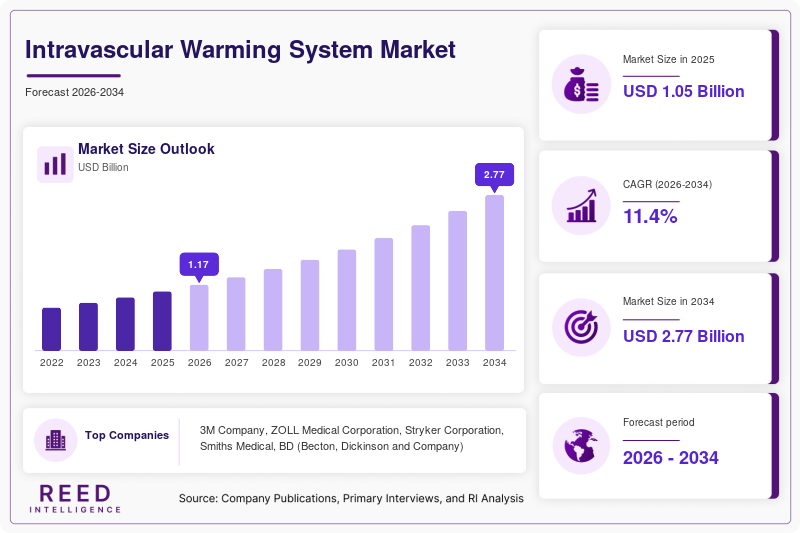
The global Intravascular Warming System Market size was valued at approximately USD 1.05 billion in 2026 and is projected to reach USD 2.48 billion by 2034, expanding at a CAGR of 11.4% during the forecast period (2026–2034). The market is witnessing steady growth driven by the increasing need for precise temperature management in surgical and critical care settings. Intravascular warming systems are widely utilized in perioperative care, trauma management, and intensive care units to prevent hypothermia-related complications.
A key global factor supporting market growth is the rising volume of surgical procedures worldwide. With an aging population and increasing prevalence of chronic diseases, the demand for advanced patient warming technologies has surged. Hospitals are increasingly adopting intravascular warming systems due to their ability to provide accurate core temperature control compared to conventional surface warming methods.
Key Highlights:
- North America dominated the market with a 38.6% share in 2025, while Asia Pacific is expected to register the fastest CAGR of 13.2% during 2026–2034.
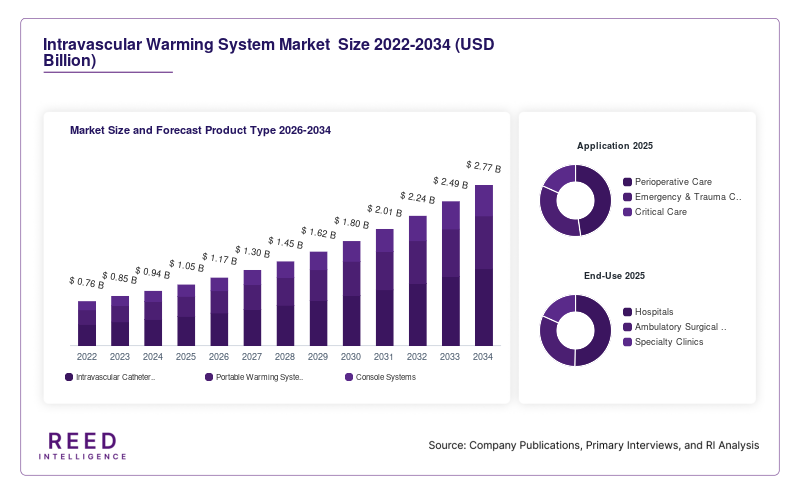
- By product type, intravascular catheters led with a 46.3% share, while portable warming systems are projected to grow fastest at a CAGR of 12.7%.
- By application, perioperative care held the largest share at 51.8%, whereas emergency/trauma care is anticipated to expand at a CAGR of 13.5%.
- The U.S. remained the dominant country, with market values of USD 362 million in 2024 and USD 389 million in 2025.
Market Trends
Integration of Smart Temperature Monitoring Systems
A notable trend in the Intravascular Warming System Market is the integration of smart monitoring technologies. Advanced systems now incorporate real-time temperature tracking, automated feedback loops, and connectivity with hospital information systems. These innovations enhance patient safety by ensuring precise thermal regulation throughout surgical procedures. Additionally, the integration of artificial intelligence-based alerts helps clinicians identify deviations quickly, reducing the risk of complications such as perioperative hypothermia. This trend is particularly prominent in developed healthcare systems where digital infrastructure supports seamless device integration.
Shift Toward Minimally Invasive Temperature Management
Another significant trend shaping the market is the growing preference for minimally invasive temperature management techniques. Intravascular warming systems offer direct core temperature control with reduced patient discomfort compared to external warming blankets. This has led to increased adoption in critical care and emergency settings. Furthermore, advancements in catheter design, including improved flexibility and biocompatibility, have enhanced procedural efficiency. Healthcare providers are increasingly opting for intravascular solutions to achieve faster and more consistent warming outcomes, especially in high-risk surgical cases.
Market Drivers
Rising Demand for Advanced Surgical Care
The increasing number of complex surgical procedures globally is a major driver of the Intravascular Warming System Market. As healthcare systems expand their capabilities in cardiac, orthopedic, and neurological surgeries, the need for precise temperature control has become essential. Hypothermia during surgery can lead to complications such as increased blood loss and prolonged recovery time. Intravascular warming systems address these challenges by maintaining stable core temperatures, thereby improving patient outcomes and reducing hospital stays.
Growing Awareness of Hypothermia Management
Another key driver is the growing awareness among healthcare professionals regarding the importance of maintaining normothermia. Clinical guidelines increasingly emphasize temperature management as a critical component of patient care. Hospitals and surgical centers are investing in advanced warming technologies to comply with these standards. Additionally, training programs and clinical research have highlighted the benefits of intravascular systems, further boosting their adoption across healthcare facilities.
Market Restraint
High Cost of Intravascular Warming Systems
One of the primary restraints in the Intravascular Warming System Market is the high cost associated with these devices. The initial investment for acquiring intravascular warming systems, along with recurring expenses for disposable components such as catheters, can be significant. This cost factor limits adoption, particularly in small healthcare facilities and emerging economies with constrained budgets.
Additionally, the need for skilled professionals to operate these systems adds to the overall cost burden. Training requirements and maintenance expenses further impact the total cost of ownership. While large hospitals can justify these investments due to higher patient volumes, smaller institutions often rely on traditional warming methods.
The pricing challenge is further compounded by limited reimbursement policies in certain regions, which discourages healthcare providers from adopting advanced technologies. As a result, cost considerations continue to act as a barrier to widespread market penetration, especially in price-sensitive markets.
Market Opportunities
Expansion in Emerging Healthcare Markets
Emerging economies present significant growth opportunities for the Intravascular Warming System Market. Rapid improvements in healthcare infrastructure, coupled with increasing healthcare expenditure, are driving demand for advanced medical devices. Countries in Asia Pacific and Latin America are investing in modernizing hospitals and expanding surgical capabilities. This creates a favorable environment for the adoption of intravascular warming systems.
Development of Portable and Cost-Effective Devices
The development of portable and cost-efficient intravascular warming systems is another promising opportunity. Manufacturers are focusing on designing compact devices that can be easily deployed in emergency and field settings. These innovations are expected to expand the use of intravascular warming systems beyond traditional hospital environments. By addressing cost and accessibility challenges, portable solutions have the potential to unlock new market segments and drive future growth.
Segmental Analysis
By Product Type
Intravascular catheters dominated the Intravascular Warming System Market in 2025, accounting for 46.3% of the total share. Their widespread use in critical care and surgical procedures has contributed to their leading position. These catheters enable direct temperature control within the bloodstream, offering precise and efficient warming.
Regional Analysis
North America
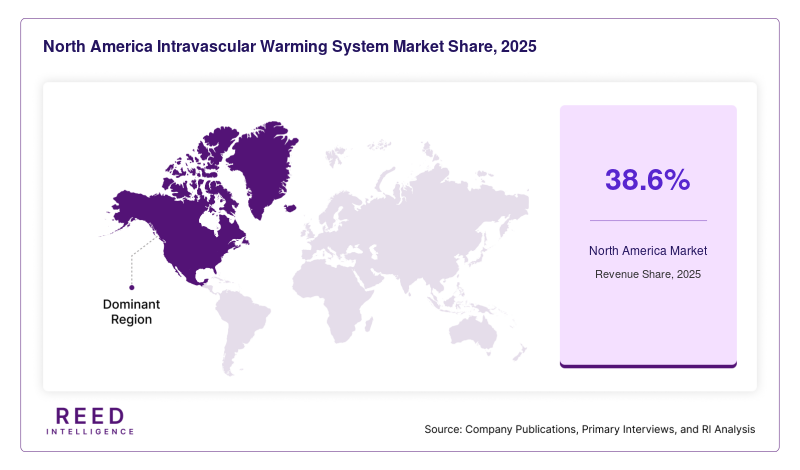
North America accounted for 38.6% of the global Intravascular Warming System Market share in 2025 and is expected to grow at a CAGR of 10.8% during the forecast period. The region’s well-established healthcare infrastructure and high adoption of advanced medical technologies have supported its dominant position.
The United States led the regional market due to its high volume of surgical procedures and strong presence of leading medical device manufacturers. The country’s focus on improving patient outcomes through advanced perioperative care has driven the adoption of intravascular warming systems. Additionally, favorable reimbursement policies and continuous investments in healthcare innovation have contributed to sustained market growth.
Europe
Europe held a 27.4% market share in 2025 and is projected to expand at a CAGR of 10.5% from 2026 to 2034. The region has demonstrated steady growth due to increasing awareness of patient temperature management and the implementation of stringent clinical guidelines.
Germany emerged as the dominant country in Europe, driven by its advanced healthcare system and emphasis on quality patient care. The country’s strong focus on medical research and adoption of innovative technologies has facilitated the integration of intravascular warming systems in hospitals. Additionally, government initiatives aimed at improving surgical outcomes have supported market expansion.
Asia Pacific
Asia Pacific captured 18.9% of the market share in 2025 and is anticipated to register the fastest CAGR of 13.2% during the forecast period. The region’s rapid economic development and expanding healthcare infrastructure have fueled demand for advanced medical devices.
China dominated the regional market due to its large patient population and increasing number of surgical procedures. The government’s efforts to modernize healthcare facilities and improve access to quality care have accelerated the adoption of intravascular warming systems. Furthermore, rising investments in medical technology have contributed to market growth.
Middle East & Africa
The Middle East & Africa region accounted for 8.1% of the market share in 2025 and is expected to grow at a CAGR of 9.7% during 2026–2034. The market is gradually expanding due to improvements in healthcare infrastructure and increasing awareness of advanced medical technologies.
Saudi Arabia emerged as the leading country in the region, driven by its focus on healthcare modernization and investment in hospital infrastructure. The country’s efforts to enhance surgical care capabilities have supported the adoption of intravascular warming systems.
Latin America
Latin America held a 7.0% share of the global market in 2025 and is projected to grow at a CAGR of 9.9% during the forecast period. The region’s growth is supported by increasing healthcare expenditure and expanding access to medical services.
Brazil dominated the regional market due to its large healthcare system and rising number of surgical procedures. The country’s focus on improving healthcare quality and patient outcomes has driven the adoption of advanced warming technologies.
rtable warming systems are expected to be the fastest-growing subsegment, with a projected CAGR of 12.7%. The increasing demand for mobility and flexibility in healthcare settings will drive their growth. Portable systems are particularly useful in emergency and field applications, where quick deployment is essential.
By Application
Perioperative care held the largest share of 51.8% in 2025, reflecting the extensive use of intravascular warming systems during surgical procedures. Maintaining normothermia during surgery is critical to reducing complications and improving recovery outcomes.
Emergency and trauma care is anticipated to grow at the fastest CAGR of 13.5%. The rising incidence of accidents and trauma cases will drive demand for rapid and effective warming solutions. Intravascular systems offer quick temperature stabilization, making them ideal for emergency scenarios.
By End-Use
Hospitals dominated the market with a 62.4% share in 2025. Their high patient volume and access to advanced medical equipment have supported the widespread adoption of intravascular warming systems. Hospitals are also more likely to invest in cutting-edge technologies to enhance patient care.
Ambulatory surgical centers are expected to grow at a CAGR of 12.1%. The increasing shift toward outpatient procedures will drive demand for efficient and compact warming systems. These centers are adopting advanced technologies to improve operational efficiency and patient outcomes.
By Technology
Conventional intravascular warming systems accounted for 58.2% of the market share in 2025. Their established presence and proven effectiveness have contributed to their dominance.
Smart and automated systems are projected to grow at a CAGR of 13.0%. The integration of digital technologies and real-time monitoring capabilities will drive their adoption. These systems offer enhanced precision and ease of use, making them increasingly popular in modern healthcare settings.
Regional Analysis
North America
North America accounted for 38.6% of the global Intravascular Warming System Market share in 2025 and is expected to grow at a CAGR of 10.8% during the forecast period. The region’s well-established healthcare infrastructure and high adoption of advanced medical technologies have supported its dominant position.
The United States led the regional market due to its high volume of surgical procedures and strong presence of leading medical device manufacturers. The country’s focus on improving patient outcomes through advanced perioperative care has driven the adoption of intravascular warming systems. Additionally, favorable reimbursement policies and continuous investments in healthcare innovation have contributed to sustained market growth.
Europe
Europe held a 27.4% market share in 2025 and is projected to expand at a CAGR of 10.5% from 2026 to 2034. The region has demonstrated steady growth due to increasing awareness of patient temperature management and the implementation of stringent clinical guidelines.
Germany emerged as the dominant country in Europe, driven by its advanced healthcare system and emphasis on quality patient care. The country’s strong focus on medical research and adoption of innovative technologies has facilitated the integration of intravascular warming systems in hospitals. Additionally, government initiatives aimed at improving surgical outcomes have supported market expansion.
Asia Pacific
Asia Pacific captured 18.9% of the market share in 2025 and is anticipated to register the fastest CAGR of 13.2% during the forecast period. The region’s rapid economic development and expanding healthcare infrastructure have fueled demand for advanced medical devices.
China dominated the regional market due to its large patient population and increasing number of surgical procedures. The government’s efforts to modernize healthcare facilities and improve access to quality care have accelerated the adoption of intravascular warming systems. Furthermore, rising investments in medical technology have contributed to market growth.
Middle East & Africa
The Middle East & Africa region accounted for 8.1% of the market share in 2025 and is expected to grow at a CAGR of 9.7% during 2026–2034. The market is gradually expanding due to improvements in healthcare infrastructure and increasing awareness of advanced medical technologies.
Saudi Arabia emerged as the leading country in the region, driven by its focus on healthcare modernization and investment in hospital infrastructure. The country’s efforts to enhance surgical care capabilities have supported the adoption of intravascular warming systems.
Latin America
Latin America held a 7.0% share of the global market in 2025 and is projected to grow at a CAGR of 9.9% during the forecast period. The region’s growth is supported by increasing healthcare expenditure and expanding access to medical services.
Brazil dominated the regional market due to its large healthcare system and rising number of surgical procedures. The country’s focus on improving healthcare quality and patient outcomes has driven the adoption of advanced warming technologies.
Competitive Landscape
The Intravascular Warming System Market is moderately competitive, with several established players focusing on innovation and product development. The market leader, 3M Company, has maintained its position through continuous advancements in patient warming technologies and a strong global distribution network. The company recently introduced an upgraded intravascular warming system with enhanced temperature monitoring capabilities.
Other key players are actively investing in research and development to expand their product portfolios and strengthen their market presence. Strategic collaborations, mergers, and acquisitions are common strategies adopted by companies to gain a competitive edge. Additionally, manufacturers are focusing on developing cost-effective solutions to cater to emerging markets, further intensifying competition.
Key Players List
- 3M Company
- ZOLL Medical Corporation
- Stryker Corporation
- Smiths Medical
- BD (Becton, Dickinson and Company)
- ICU Medical, Inc.
- Medtronic plc
- Belmont Medical Technologies
- GE Healthcare
- Drägerwerk AG
- Terumo Corporation
- Baxter International Inc.
- Cardinal Health
- Mindray Medical International Limited
- Fresenius Medical Care
Recent Developments
- 3M Company launched an advanced intravascular warming system with improved digital monitoring features in 2025.
- ZOLL Medical Corporation expanded its product portfolio with a new portable warming solution designed for emergency care.
- Stryker Corporation invested in R&D to develop next-generation catheter-based warming technologies.
- Medtronic plc announced a strategic partnership to enhance distribution channels in Asia Pacific.
- BD introduced a cost-efficient intravascular warming device targeting emerging markets.
Intravascular Warming System Market Segments
Product Type
- Intravascular Catheters
- Portable Warming Systems
- Console Systems
Application
- Perioperative Care
- Emergency & Trauma Care
- Critical Care
End-Use
- Hospitals
- Ambulatory Surgical Centers
- Specialty Clinics
Technology
- Conventional Systems
- Smart & Automated Systems
By Region
- North America
- Europe
- APAC
- Middle East and Africa
- LATAM