Invar Tooling In Composite Market Size, Share, Demand Report By Tooling Type (Invar Molds, Invar Master Models, Invar Layup Tools, Invar Assembly Fixtures, Others), By Application (Aerospace Components, Wind Energy Structures, Automotive Components, Marine Structures, Industrial Equipment), By End-Use Industry (Aerospace and Defense, Automotive, Renewable Energy, Marine, Industrial Manufacturing) By Region & Segment Forecasts, 2026–2034
USD 3950
Market Overview
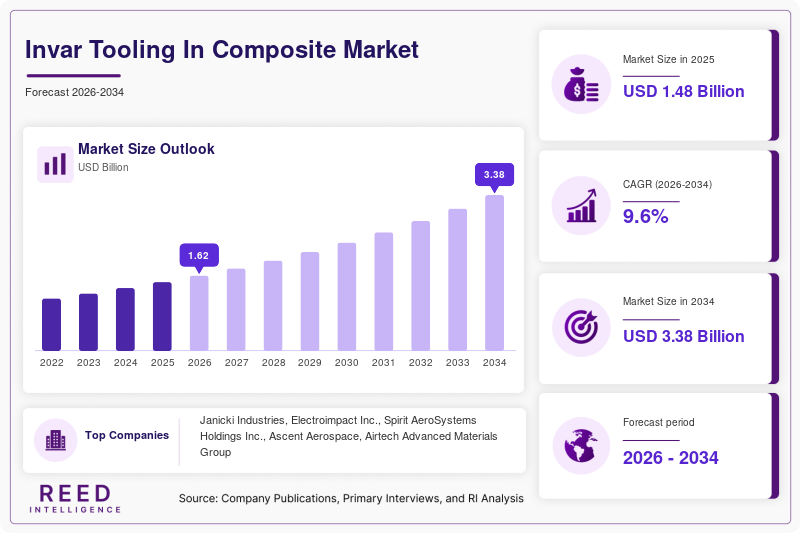
The global Invar Tooling In Composite Market size was valued at USD 1.48 billion in 2026 and is projected to reach USD 3.07 billion by 2034, expanding at a CAGR of 9.6% during the forecast period from 2026 to 2034. The market is witnessing consistent expansion due to the rising adoption of lightweight composite materials across aerospace, automotive, marine, and wind energy manufacturing applications. Invar tooling is widely used in composite manufacturing because of its low coefficient of thermal expansion, dimensional stability, and compatibility with carbon fiber composite structures. These characteristics support precision manufacturing processes where thermal consistency and surface accuracy remain critical.
A major global factor supporting the growth of the Invar Tooling In Composite Market is the rapid increase in commercial aircraft production and advanced aerospace programs. Aircraft manufacturers are investing in next-generation composite fuselage structures, wing assemblies, and interior components to reduce aircraft weight and improve fuel efficiency. Invar tooling systems help manufacturers maintain structural accuracy during autoclave curing processes, particularly in large aerospace components. The growing use of automated composite manufacturing technologies, including automated fiber placement and resin transfer molding, is further increasing the demand for durable and thermally stable tooling materials.
Key Highlights
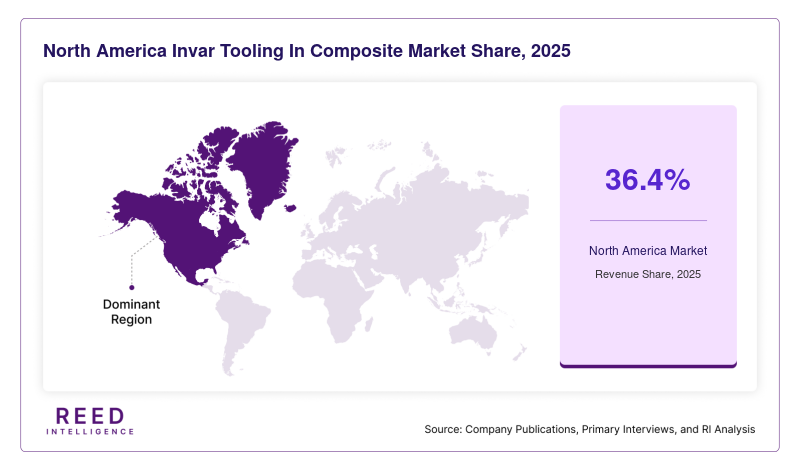
- North America dominated the market with a 36.4% share in 2025, while Asia Pacific is expected to grow at the fastest CAGR of 11.8% during 2026–2034.
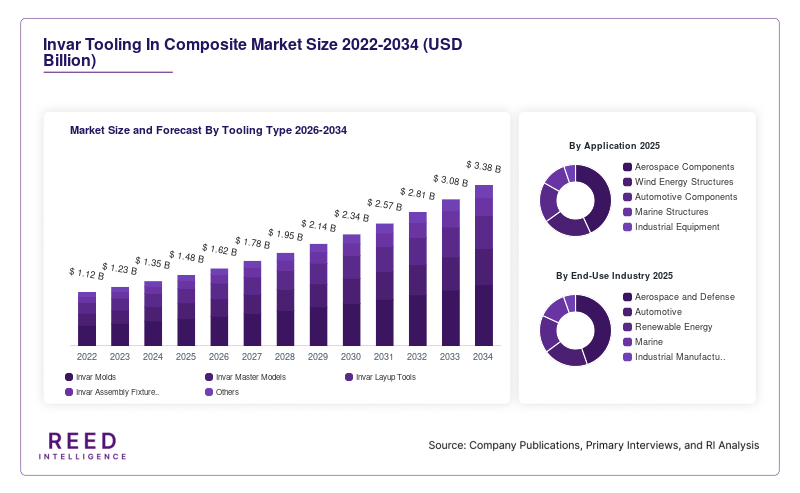
- By tooling type, Invar molds accounted for the largest share of 42.7%, while Invar master models are projected to grow at a CAGR of 10.9%.
- By application, aerospace components led with a 48.1% share, whereas wind energy structures are expected to expand at a CAGR of 11.6%.
- The United States remained the dominant country, with market values of USD 420 million in 2024 and USD 462 million in 2025.
Market Trends
Increasing Integration of Automated Composite Manufacturing Technologies
The growing implementation of automated composite manufacturing technologies is significantly influencing the Invar Tooling In Composite Market. Aerospace and automotive manufacturers are increasingly integrating automated fiber placement systems, robotic layup processes, and precision curing technologies into production facilities. These advanced systems require tooling materials capable of maintaining dimensional accuracy under varying thermal conditions. Invar tooling provides stable thermal performance and reduces the risk of component deformation during high-temperature composite curing cycles. As manufacturers seek to improve production efficiency and reduce material waste, the demand for tooling solutions that support repeatability and precision is increasing. This trend is particularly visible in aircraft wing structures, fuselage sections, and advanced electric vehicle components where tight manufacturing tolerances are essential.
Growing Demand for Large-Scale Wind Turbine Blade Production
The expansion of the renewable energy industry is creating notable growth opportunities for the Invar Tooling In Composite Market. Wind turbine manufacturers are developing larger blades to improve energy generation efficiency and reduce operational costs. The production of these large composite structures requires tooling systems capable of maintaining dimensional consistency across extended curing cycles. Invar tooling materials are increasingly preferred because they provide high thermal stability and lower expansion rates compared to conventional tooling materials. Manufacturers are investing in larger composite manufacturing facilities in Asia Pacific and Europe to support offshore wind energy projects. The rising focus on renewable energy capacity expansion, especially in China, Germany, and the United States, is strengthening the adoption of precision composite tooling systems across the wind energy value chain.
Market Drivers
Rising Production of Advanced Composite Aircraft Structures
The continuous increase in global aircraft production is acting as a major driver for the Invar Tooling In Composite Market. Aerospace manufacturers are expanding the use of carbon fiber reinforced composites to reduce aircraft weight, improve fuel efficiency, and lower emissions. Modern aircraft programs increasingly rely on large composite fuselage sections, empennage structures, and wing assemblies that require highly accurate tooling systems. Invar tooling is preferred because it minimizes thermal distortion during autoclave curing and supports dimensional precision for large structural components. The growth of commercial aviation in emerging economies and the expansion of defense aircraft manufacturing programs are further increasing demand for high-performance composite tooling systems. Suppliers are also introducing modular tooling solutions to support faster production cycles and improved operational flexibility.
Expansion of Electric Vehicle Lightweighting Initiatives
The automotive industry is accelerating the use of lightweight composite materials in electric vehicle production, creating strong demand for advanced tooling technologies. Electric vehicle manufacturers are focusing on reducing vehicle weight to improve battery efficiency and driving range. Composite body panels, battery enclosures, roof systems, and structural reinforcements are increasingly produced using carbon fiber and hybrid composite materials. Invar tooling systems provide the thermal stability required for precision composite curing processes, particularly in high-volume automotive production environments. Automotive suppliers are investing in faster composite manufacturing methods and automated tooling systems to meet rising production targets. The increasing number of electric vehicle manufacturing facilities in Asia Pacific and Europe is expected to support sustained growth in the Invar Tooling In Composite Market over the forecast period.
Market Restraint
High Production and Maintenance Costs of Invar Tooling Systems
The relatively high cost associated with Invar tooling production and maintenance remains a major restraint for the Invar Tooling In Composite Market. Invar alloys contain nickel and iron compositions that require specialized manufacturing processes, increasing overall tooling costs compared to aluminum or composite tooling alternatives. Large aerospace and wind energy molds often involve significant material expenses, precision machining requirements, and extended fabrication timelines. Small and medium-sized manufacturers may face financial limitations when investing in high-cost tooling systems, especially in price-sensitive industrial sectors.
In addition to initial investment costs, Invar tooling systems require regular maintenance, surface treatment, and inspection procedures to maintain dimensional precision and operational reliability. Transportation and handling costs for large Invar tooling structures also increase operational expenses because of the material’s weight. In industries with shorter production runs or prototype-focused manufacturing environments, some companies prefer lower-cost tooling materials despite reduced thermal performance. These cost-related challenges can slow adoption rates in developing economies and among smaller composite component manufacturers.
Market Opportunities
Increasing Adoption of Composite Structures in Urban Air Mobility Programs
The rapid development of urban air mobility platforms and electric vertical takeoff and landing aircraft is creating new opportunities for the Invar Tooling In Composite Market. Aircraft developers are focusing on lightweight composite airframes to improve energy efficiency and extend flight range in urban aviation applications. These aircraft designs require highly accurate tooling systems to support aerodynamic precision and structural reliability. Invar tooling materials are gaining attention because they provide excellent thermal stability for complex composite curing operations. Startups and aerospace companies are increasing investments in advanced air mobility manufacturing facilities across North America and Europe. The growing commercialization of urban aviation platforms is expected to generate additional demand for precision composite tooling solutions during the forecast period.
Development of Next-Generation Hydrogen and Space Exploration Programs
The increasing investment in hydrogen-powered transportation systems and space exploration programs is opening new growth avenues for the Invar Tooling In Composite Market. Aerospace and defense organizations are developing lightweight cryogenic tanks, reusable launch systems, and high-performance structural components using advanced composite materials. These applications require tooling systems capable of maintaining dimensional consistency under demanding manufacturing conditions. Invar tooling solutions support the production of large and structurally complex composite parts used in launch vehicles, satellite systems, and hydrogen storage structures. Government-backed aerospace programs and private space companies are expanding manufacturing capacities to support future missions and commercial space activities. This transition toward advanced aerospace technologies is expected to strengthen long-term demand for durable and high-precision composite tooling materials.
Segmental Analysis
By Tooling Type
Invar molds accounted for the largest share of the Invar Tooling In Composite Market in 2024, representing approximately 42.7% of total revenue. These molds are extensively used in aerospace and wind energy manufacturing because they provide excellent dimensional stability during high-temperature curing processes. Manufacturers prefer Invar molds for large composite structures where precision and repeatability are essential. The low coefficient of thermal expansion associated with Invar materials minimizes tooling distortion and improves final component accuracy. Aerospace manufacturers increasingly rely on large Invar molds for aircraft fuselage sections, wing assemblies, and interior structures. The demand for high-performance composite manufacturing systems in electric vehicles and renewable energy applications is also contributing to the continued dominance of this subsegment.
Invar master models are projected to witness the fastest growth during the forecast period, expanding at a CAGR of 10.9% from 2026 to 2034. These tooling systems are gaining popularity because they support precision prototype development and complex composite part production. Manufacturers are using advanced master models to accelerate product development cycles and improve tooling consistency across multiple manufacturing stages. The increasing adoption of digital manufacturing technologies and automated machining systems is supporting demand for highly accurate master models. Aerospace suppliers and automotive manufacturers are investing in flexible tooling solutions capable of supporting customized composite production requirements. The growing emphasis on lightweight structural components and rapid prototyping capabilities is expected to strengthen the demand for Invar master models in the coming years.
By Application
Aerospace components represented the dominant application segment in the Invar Tooling In Composite Market in 2024, accounting for nearly 48.1% of global revenue. The aerospace industry continues to expand the use of advanced composites in commercial aircraft, military aircraft, and space systems to improve fuel efficiency and reduce structural weight. Invar tooling plays a critical role in the production of large and geometrically complex aircraft structures that require high dimensional precision. Composite fuselage panels, wing skins, nacelles, and empennage components are commonly manufactured using precision tooling systems capable of withstanding repeated autoclave curing cycles. The increasing global aircraft backlog and the development of next-generation aerospace platforms are supporting sustained demand for high-performance composite tooling technologies.
Wind energy structures are expected to register the fastest CAGR of 11.6% during the forecast period due to the growing installation of onshore and offshore wind farms worldwide. Wind turbine manufacturers are producing longer and more aerodynamically efficient blades that require large tooling systems with excellent thermal stability. Invar tooling materials provide consistent dimensional performance during composite curing, helping manufacturers reduce defects and improve blade durability. Governments across Asia Pacific and Europe are expanding renewable energy investments to meet long-term sustainability targets, increasing demand for advanced blade manufacturing infrastructure. In addition, the shift toward higher-capacity offshore turbines is encouraging the adoption of larger composite tooling systems capable of supporting high-volume blade production.
By End-Use Industry
The aerospace and defense industry held the largest share of the Invar Tooling In Composite Market in 2024, contributing approximately 51.4% of total market revenue. The industry relies heavily on precision composite structures to improve aircraft performance, reduce fuel consumption, and meet stringent regulatory standards. Invar tooling solutions are widely adopted in the manufacturing of commercial aircraft, fighter jets, unmanned aerial vehicles, and space launch systems. These tooling systems support dimensional accuracy during complex composite curing operations and enable consistent large-scale production. Aerospace manufacturers are increasing investments in advanced composite manufacturing facilities and automation technologies to address rising aircraft demand. The expansion of defense modernization programs and private space exploration activities is further strengthening market growth within this segment.
The automotive industry is anticipated to emerge as the fastest-growing end-use segment, expanding at a CAGR of 10.7% from 2026 to 2034. Automotive manufacturers are increasing the use of carbon fiber reinforced composites in electric vehicles to reduce vehicle weight and improve battery efficiency. Invar tooling systems are becoming essential for precision manufacturing of lightweight body panels, battery housings, and structural reinforcements. The growing adoption of automated composite production technologies in automotive assembly operations is also accelerating demand for durable tooling materials. Manufacturers in Europe and Asia Pacific are investing in high-volume composite production facilities to support expanding electric vehicle sales. The increasing focus on sustainable mobility solutions and advanced lightweight engineering is expected to drive substantial growth within this segment.
Regional Analysis
North America
North America accounted for 36.4% of the global Invar Tooling In Composite Market share in 2025 and is expected to maintain a strong growth trajectory during the forecast period. The region is projected to expand at a CAGR of 9.1% between 2026 and 2034 due to the presence of advanced aerospace manufacturing infrastructure and high investments in composite production technologies. Aircraft manufacturers and defense contractors across the United States and Canada continue to increase the use of carbon fiber composites in commercial and military aircraft programs. The growing integration of automation in composite manufacturing processes is also supporting the adoption of thermally stable tooling systems.
The United States remains the dominant country within North America due to its extensive aerospace production ecosystem and large-scale defense modernization programs. The country recorded a market value of approximately USD 462 million in 2025, supported by increasing aircraft deliveries and advanced space exploration initiatives. A unique growth factor in the United States is the rising investment in reusable space launch systems and private aerospace manufacturing facilities. Companies involved in satellite launches and commercial space programs are adopting large composite structures that require highly precise Invar tooling solutions for dimensional accuracy and repeatable production performance.
Europe
Europe represented 27.3% of the global Invar Tooling In Composite Market in 2025 and is anticipated to grow at a CAGR of 8.8% over the forecast period. The region is benefiting from strong investments in renewable energy infrastructure and sustainable transportation technologies. European aerospace manufacturers continue to expand the use of advanced composite materials in aircraft structures to comply with emission reduction targets and fuel efficiency standards. In addition, wind energy developers are increasing offshore wind installations across Northern Europe, creating sustained demand for precision tooling systems used in large composite blade manufacturing.
Germany emerged as the dominant country in the European market due to its advanced engineering capabilities and strong automotive manufacturing base. The country is experiencing increasing adoption of lightweight composite components in electric vehicles and industrial machinery applications. A unique growth factor supporting the German market is the expansion of high-performance composite research collaborations between automotive suppliers, research institutes, and aerospace manufacturers. These collaborations are encouraging innovation in precision tooling technologies and advanced composite manufacturing methods, contributing to steady market growth across the region.
Asia Pacific
Asia Pacific held 22.8% of the global Invar Tooling In Composite Market share in 2025 and is projected to register the fastest CAGR of 11.8% from 2026 to 2034. The region is witnessing rapid industrialization, expansion of aerospace production capabilities, and increasing investments in renewable energy manufacturing facilities. Countries such as China, Japan, South Korea, and India are strengthening domestic composite manufacturing ecosystems to support automotive, aerospace, and wind energy industries. The growing adoption of automated production technologies and cost-efficient manufacturing systems is also contributing to the increasing use of Invar tooling solutions.
China dominated the Asia Pacific market due to its expanding aerospace manufacturing sector and significant investments in wind energy infrastructure. The country is rapidly increasing domestic aircraft production and composite material processing capabilities to reduce dependency on imports. A unique growth factor supporting the Chinese market is the aggressive expansion of offshore wind energy projects requiring large composite turbine blades. Manufacturers are investing in advanced tooling facilities capable of supporting high-volume blade production with improved dimensional precision and thermal stability.
Middle East & Africa
The Middle East & Africa region accounted for 7.1% of the global Invar Tooling In Composite Market in 2025 and is expected to grow at a CAGR of 7.6% during the forecast period. The market is gradually expanding due to rising investments in aerospace maintenance facilities, renewable energy projects, and industrial diversification initiatives. Gulf countries are focusing on developing local manufacturing capabilities to support aviation and energy infrastructure development. In addition, composite materials are increasingly being used in industrial equipment and transportation systems across the region.
The United Arab Emirates remains the dominant country within the Middle East & Africa market due to its growing aerospace ecosystem and investments in advanced manufacturing technologies. The country is expanding aircraft maintenance, repair, and overhaul operations while supporting domestic aerospace production initiatives. A unique growth factor in the United Arab Emirates is the government’s focus on economic diversification through high-technology industries and renewable energy development. These initiatives are encouraging the adoption of precision composite manufacturing technologies and associated tooling systems.
Latin America
Latin America captured 6.4% of the global Invar Tooling In Composite Market share in 2025 and is expected to expand at a CAGR of 7.9% between 2026 and 2034. The market is supported by growing aerospace component manufacturing activities and increasing investments in renewable energy projects. Countries across the region are gradually adopting advanced composite materials in transportation, industrial equipment, and energy applications. The expansion of wind energy installations in coastal regions is creating additional demand for tooling systems capable of supporting large composite blade production.
Brazil remains the leading country in the Latin American market due to its established aerospace manufacturing sector and growing industrial base. The country continues to invest in aircraft component production and regional aviation programs that utilize advanced composite structures. A unique growth factor in Brazil is the increasing development of domestic wind energy manufacturing facilities designed to support regional renewable energy expansion. This trend is encouraging investments in advanced tooling technologies that improve composite production efficiency and reduce manufacturing defects.
Competitive Landscape
The Invar Tooling In Composite Market is characterized by the presence of established tooling manufacturers, specialized alloy producers, and composite engineering companies competing on the basis of precision manufacturing capabilities, thermal stability performance, and production scalability. Leading companies are focusing on strategic partnerships, product innovation, and expansion of advanced machining facilities to strengthen their market positions. The market is moderately consolidated, with a few global companies controlling a significant share of aerospace and industrial tooling contracts.
Janicki Industries remains one of the leading companies in the market due to its strong aerospace tooling expertise and large-scale composite manufacturing capabilities. The company has expanded investments in automated machining technologies and high-performance tooling solutions for aerospace and space exploration applications. Another notable development includes the increasing collaboration between tooling manufacturers and electric vehicle producers to support lightweight automotive component production.
Key Players
- Janicki Industries
- Electroimpact Inc.
- Spirit AeroSystems Holdings Inc.
- Ascent Aerospace
- Airtech Advanced Materials Group
- Gurit Holding AG
- Hexcel Corporation
- Premium AEROTEC GmbH
- CTC GmbH
- Fives Group
- Solvay S.A.
- Mitsubishi Heavy Industries Ltd.
- Toray Industries Inc.
- Composites Horizons
- Coriolis Composites
Recent Developments
- In March 2025, Janicki Industries expanded its advanced composite tooling facility in North America to support increasing demand for aerospace-grade Invar tooling systems and large composite structure manufacturing.
- In January 2025, Hexcel Corporation introduced next-generation high-temperature tooling prepreg materials designed to improve dimensional stability and reduce curing cycle times in aerospace composite production.
- In September 2024, Gurit Holding AG partnered with offshore wind energy manufacturers in Europe to develop precision Invar tooling solutions for next-generation wind turbine blade production.
- In June 2024, Spirit AeroSystems Holdings Inc. increased investments in automated composite manufacturing technologies to enhance production efficiency for aircraft fuselage and wing structures.
- In April 2024, Solvay S.A. launched advanced tooling resin systems aimed at improving thermal resistance and operational durability in high-performance composite manufacturing applications.
Invar Tooling In Composite Market Segments
By Tooling Type
- Invar Molds
- Invar Master Models
- Invar Layup Tools
- Invar Assembly Fixtures
- Others
By Application
- Aerospace Components
- Wind Energy Structures
- Automotive Components
- Marine Structures
- Industrial Equipment
By End-Use Industry
- Aerospace and Defense
- Automotive
- Renewable Energy
- Marine
- Industrial Manufacturing
By Region
- North America
- Europe
- APAC
- Middle East and Africa
- LATAM