Ion Selective Permeation Resin Market Size, Share & Demand Report By Resin Type (Cation Selective Permeation Resins, Anion Selective Permeation Resins, Hybrid Selective Resins, Specialty Functional Resins), By Application (Water Treatment and Desalination, Chemical Processing, Battery and Energy Storage, Pharmaceutical Purification, Semiconductor Manufacturing, Industrial Waste Recovery), By End-Use Industry (Chemical and Petrochemical, Water and Wastewater Utilities, Pharmaceutical and Biotechn
USD 3950
Market Overview
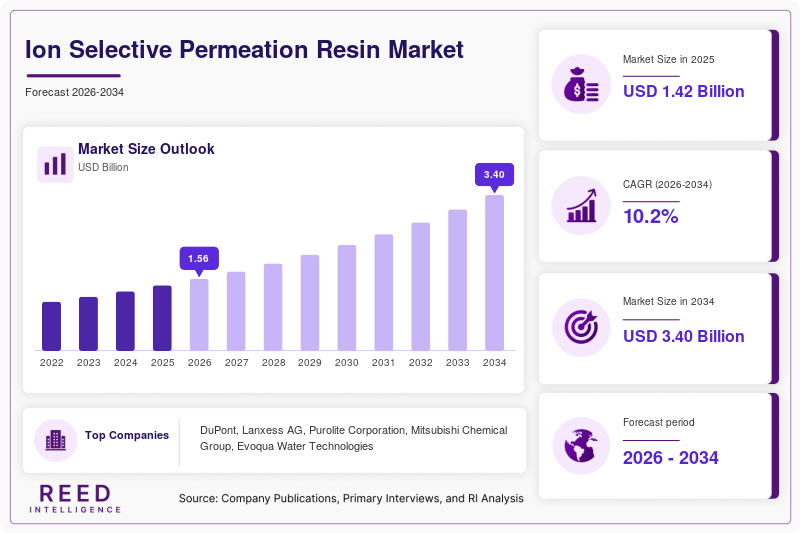
The global Ion Selective Permeation Resin Market size was valued at USD 1.42 billion in 2026 and is projected to reach USD 3.08 billion by 2034, expanding at a CAGR of 10.2% during the forecast period from 2026 to 2034. The market is witnessing stable expansion due to the increasing use of selective membrane technologies across water treatment, pharmaceutical purification, energy storage, and industrial separation processes. Ion selective permeation resins are designed to improve selective ion transport and separation efficiency, making them highly suitable for industries that require advanced purification and controlled ion exchange applications.
Growing pressure on industries to reduce water contamination and improve resource recovery has supported the adoption of ion selective permeation resin systems across developed and emerging economies. Manufacturing industries are investing in efficient separation technologies to meet environmental compliance standards and reduce operational losses. In addition, rapid growth in semiconductor manufacturing, biotechnology processing, and energy storage applications has accelerated demand for advanced resin materials capable of delivering higher ion selectivity and improved chemical stability.
Key Highlights
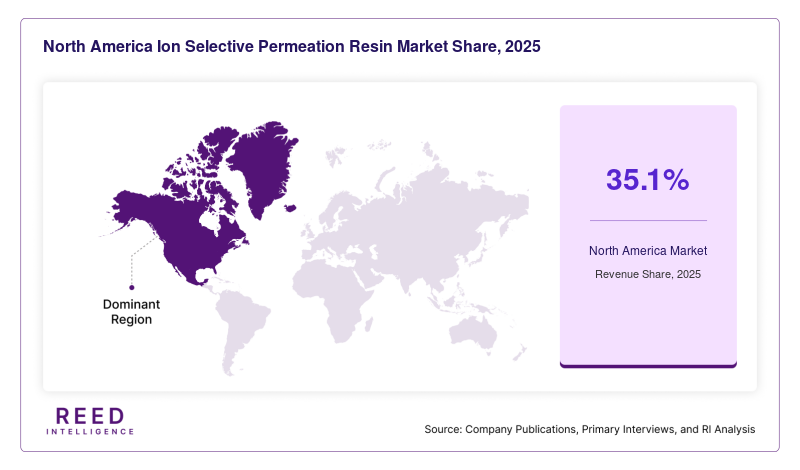
- North America dominated the market with a 35.1% share in 2025, while Asia Pacific is expected to grow at the fastest CAGR of 11.8% during 2026–2034.
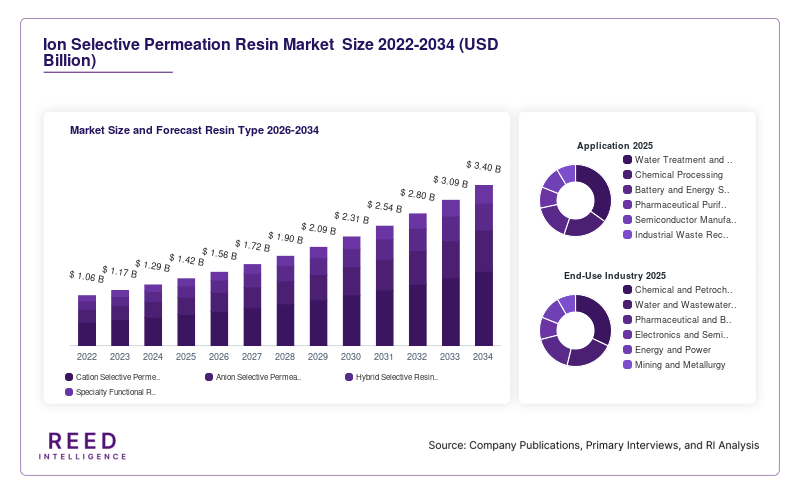
- By resin type, cation selective permeation resins accounted for the largest share of 39.4%, while hybrid selective resins are projected to grow at a CAGR of 12.6%.
- By application, water treatment and desalination led with a 43.8% share, whereas battery and energy storage applications are expected to expand at a CAGR of 13.1%.
- By end-use industry, chemical and petrochemical industries held the dominant share of 34.5%, while pharmaceutical and biotechnology industries are projected to grow at a CAGR of 12.9%.
- The United States remained the dominant country, with market values of USD 428 million in 2024 and USD 472 million in 2025.
Market Trends
Rising Integration of Advanced Resin Technologies in Water Treatment Systems
Industrial water treatment operators are increasingly integrating advanced ion selective permeation resin technologies into desalination and wastewater recycling systems to improve ion separation efficiency and reduce environmental discharge levels. Growing industrialization and rising freshwater scarcity have encouraged governments and private organizations to invest in high-performance purification technologies. Modern resin systems are being engineered with enhanced selectivity for lithium, sodium, calcium, and heavy metal ions, improving operational performance across large-scale filtration plants. The trend is particularly visible in regions with strict wastewater disposal regulations, including North America and Europe, where industrial facilities are upgrading traditional ion exchange systems with selective permeation technologies to achieve higher recovery rates and lower energy consumption.
The adoption of automated filtration infrastructure has further accelerated the use of ion selective permeation resins in smart water management systems. Manufacturers are focusing on developing resins with improved thermal resistance and longer operating cycles to reduce maintenance requirements. Industries such as mining, food processing, and chemical manufacturing are also incorporating selective permeation systems to recover valuable minerals and improve water reuse efficiency. This transition toward sustainable industrial operations is expected to support long-term demand for advanced resin materials.
Expanding Demand for Selective Ion Separation in Energy Storage Applications
The rapid expansion of battery manufacturing and energy storage infrastructure is creating strong demand for ion selective permeation resins used in electrolyte purification and metal ion recovery processes. Lithium-ion battery manufacturers are increasingly adopting selective permeation technologies to improve lithium extraction efficiency and reduce contamination during electrolyte production. The growing transition toward electric mobility and renewable energy storage systems has intensified investments in high-purity battery material processing, particularly in Asia Pacific and North America.
Research institutions and chemical manufacturers are developing resin systems capable of selectively separating critical minerals such as lithium, cobalt, and nickel from complex industrial streams. This trend is helping improve supply chain efficiency for battery material producers while supporting recycling initiatives in the energy sector. The use of ion selective permeation resins in redox flow batteries and advanced electrochemical systems is also increasing due to their ability to improve ionic conductivity and enhance energy efficiency. As governments continue to support clean energy infrastructure and battery manufacturing expansion, demand for specialized selective resin technologies is expected to increase steadily.
Market Drivers
Increasing Industrial Wastewater Treatment Requirements Across Manufacturing Sectors
The growing volume of industrial wastewater generated by manufacturing facilities has become a major driver for the Ion Selective Permeation Resin Market. Industries including chemicals, pharmaceuticals, mining, textiles, and food processing are facing increasing pressure to comply with environmental regulations related to wastewater discharge and water reuse. Ion selective permeation resins enable industries to remove targeted contaminants and recover valuable ions more efficiently than conventional filtration methods. Their ability to support selective separation processes while reducing operational costs has strengthened adoption across industrial treatment facilities.
Governments across developed and developing economies are implementing stricter environmental standards to reduce water pollution and encourage sustainable manufacturing practices. As a result, industrial operators are investing in advanced purification systems that can achieve higher separation precision and improve water recycling rates. Ion selective permeation resins also help reduce chemical usage and sludge generation, making them suitable for companies seeking environmentally responsible treatment technologies. Rising industrial water scarcity in Asia Pacific and the Middle East is further accelerating investments in efficient ion separation solutions.
Growing Demand for High-Purity Materials in Semiconductor and Pharmaceutical Production
The increasing need for ultra-pure processing materials in semiconductor fabrication and pharmaceutical manufacturing is contributing significantly to market growth. Semiconductor manufacturers require precise ion control during wafer processing and chemical purification to maintain production quality and reduce contamination risks. Ion selective permeation resins are widely used in ultrapure water systems and specialized separation processes due to their high selectivity and chemical stability.
Pharmaceutical and biotechnology companies are also adopting selective permeation technologies to improve purification efficiency in drug manufacturing and laboratory applications. The rising production of biologics, vaccines, and specialty chemicals has increased the need for advanced separation materials capable of maintaining strict purity standards. In addition, research laboratories are investing in customized resin systems designed for selective ion recovery and precision filtration applications. Expanding investments in semiconductor manufacturing facilities across the United States, China, South Korea, and Taiwan are expected to create long-term demand for ion selective permeation resin technologies.
Market Restraint
High Production Costs and Technical Complexity Limiting Wider Adoption
The relatively high manufacturing cost associated with ion selective permeation resins remains a significant challenge for market expansion, particularly among small and medium-sized industrial operators. Advanced resin systems often require specialized polymer materials, precision engineering, and controlled manufacturing processes to achieve high ion selectivity and chemical resistance. These factors increase overall production costs and make advanced resin technologies more expensive compared to conventional ion exchange materials.
Technical complexity associated with installation, maintenance, and operational optimization also limits adoption in cost-sensitive industries. Many end users require skilled personnel to monitor membrane performance, maintain filtration efficiency, and manage selective ion recovery systems effectively. In addition, performance degradation caused by fouling, chemical exposure, and temperature fluctuations can increase replacement frequency and maintenance expenses. Industries operating in developing economies may hesitate to adopt advanced selective permeation systems due to limited technical expertise and infrastructure constraints.
The market is also affected by fluctuating raw material prices, particularly for specialty polymers and chemical additives used in resin manufacturing. Supply chain disruptions and rising energy costs can influence production economics and reduce profit margins for manufacturers. Although ongoing research is improving resin durability and reducing operational limitations, high initial investment requirements continue to restrain broader market penetration in several industrial sectors.
Market Opportunities
Expansion of Lithium Extraction and Battery Recycling Operations
The increasing focus on lithium extraction and battery recycling presents substantial growth opportunities for ion selective permeation resin manufacturers. Global demand for lithium-ion batteries continues to rise due to the rapid adoption of electric vehicles, renewable energy storage systems, and portable electronic devices. This trend is driving investments in advanced lithium extraction technologies capable of improving recovery rates while minimizing environmental impact. Ion selective permeation resins are becoming essential in lithium brine processing and battery recycling operations because they enable selective ion separation with higher efficiency.
Battery recycling companies are adopting advanced permeation systems to recover valuable metals such as lithium, cobalt, and nickel from used batteries and industrial waste streams. Governments in Europe, North America, and Asia Pacific are introducing policies supporting battery recycling infrastructure and circular economy initiatives, creating additional opportunities for resin suppliers. Research organizations are also developing customized resin formulations designed specifically for high-value metal recovery applications. As battery production capacity expands globally, demand for selective separation technologies is expected to increase steadily.
Increasing Adoption of Sustainable Desalination Infrastructure in Emerging Economies
Emerging economies are investing heavily in desalination infrastructure to address growing water scarcity and industrial water demand, creating new opportunities for the Ion Selective Permeation Resin Market. Countries across the Middle East, Africa, and parts of Asia Pacific are expanding seawater desalination projects to improve long-term water security. Ion selective permeation resins are increasingly integrated into advanced desalination systems to improve ion removal efficiency and reduce energy consumption during purification processes.
Industrial facilities operating in water-stressed regions are also adopting selective permeation technologies to improve wastewater recovery and reduce freshwater dependency. Governments are supporting investments in sustainable water treatment infrastructure through public-private partnerships and industrial modernization programs. In addition, rising urbanization and population growth are increasing pressure on municipal water systems, encouraging the use of advanced filtration technologies. Resin manufacturers that develop durable and energy-efficient selective permeation materials are expected to benefit from expanding desalination investments across emerging markets.
Segmental Analysis
By Resin Type
Cation selective permeation resins accounted for the largest share of 39.4% in 2024 due to their extensive use in industrial water purification, chemical processing, and desalination systems. These resins are widely preferred because of their strong ion exchange capacity and ability to selectively remove positively charged ions from complex solutions. Industries including power generation, food processing, and pharmaceuticals rely on cation selective systems to improve water quality and maintain operational efficiency. The growing demand for efficient water recycling infrastructure has further strengthened the adoption of cation selective permeation resins across industrial facilities.
Manufacturers continue to improve resin durability and selectivity to support demanding industrial applications involving high temperatures and chemically aggressive environments. In addition, the expansion of municipal water treatment projects has increased the use of cation selective resins in advanced purification systems. Their compatibility with automated treatment infrastructure and lower maintenance requirements compared to traditional separation technologies have also contributed to market dominance. As industrial water reuse programs continue to expand globally, cation selective permeation resins are expected to maintain strong market demand.
By Application
Water treatment and desalination applications held the dominant market share of 43.8% in 2024 due to rising concerns regarding water scarcity, industrial contamination, and wastewater recycling requirements. Ion selective permeation resins are increasingly integrated into desalination facilities and industrial filtration systems to improve selective ion removal and reduce energy consumption. Municipal water treatment operators are adopting advanced resin systems to achieve higher purification standards and improve long-term operational efficiency.
Industries including chemicals, mining, food processing, and pharmaceuticals are also investing in selective permeation technologies to reduce freshwater dependency and comply with environmental regulations. The growing use of automated water management systems has further increased demand for durable and high-performance resin materials. In addition, the expansion of industrial recycling initiatives across North America, Europe, and Asia Pacific continues to strengthen market demand for selective ion separation technologies used in water treatment applications.
By End-Use Industry
Chemical and petrochemical industries accounted for the largest market share of 34.5% in 2024 because of the extensive use of ion selective permeation resins in purification, catalyst recovery, and industrial separation processes. Petrochemical facilities require advanced ion separation systems to improve process efficiency, reduce contamination, and optimize chemical recovery operations. Ion selective permeation resins provide higher selectivity and improved chemical resistance compared to conventional separation technologies, making them suitable for demanding industrial applications.
The growing implementation of wastewater recycling systems within petrochemical complexes has further increased adoption of selective permeation technologies. Companies operating in the chemical sector are also investing in sustainable manufacturing infrastructure to reduce waste generation and improve environmental compliance. Increasing demand for specialty chemicals, industrial solvents, and high-purity materials is expected to maintain strong consumption of advanced resin systems across chemical and petrochemical facilities globally.
Regional Analysis
North America
North America accounted for 35.1% of the global Ion Selective Permeation Resin Market share in 2025 and is expected to maintain a stable growth trajectory with a forecast CAGR of 9.4% during the assessment period. The region benefits from strong industrial infrastructure, advanced water treatment systems, and growing investments in semiconductor manufacturing. Industrial wastewater treatment regulations implemented by environmental agencies have encouraged companies to adopt high-performance ion separation technologies. The presence of established chemical processing and biotechnology industries has also contributed to sustained demand for selective permeation resin systems across the United States and Canada.
The United States remained the dominant country within North America due to expanding investments in clean energy storage systems and semiconductor fabrication facilities. The country continues to support domestic manufacturing of advanced battery materials and high-purity chemicals, increasing the need for selective ion separation technologies. Another important growth factor is the modernization of municipal water treatment infrastructure in several states affected by water quality concerns. Increased adoption of recycling-based industrial water systems has further supported the use of ion selective permeation resins in large-scale treatment operations.
Europe
Europe represented 27.4% of the global market share in 2025 and is projected to expand at a CAGR of 9.7% during the forecast period. Strong environmental regulations related to industrial discharge management and wastewater recycling continue to support market growth across the region. European industries are increasingly investing in sustainable separation technologies to improve compliance with environmental standards and reduce operational waste generation. The region has also experienced rising demand for advanced resin systems in pharmaceutical manufacturing, food processing, and chemical purification applications.
Germany emerged as the leading country in the European market due to its advanced industrial manufacturing sector and growing focus on sustainable water treatment technologies. The country has witnessed increasing adoption of ion selective permeation resins in automotive battery production and specialty chemical processing. Another significant growth factor is the expansion of industrial recycling initiatives supported by European Union sustainability policies. Companies operating in Germany are investing in selective recovery technologies to reduce raw material consumption and improve production efficiency across multiple industrial sectors.
Asia Pacific
Asia Pacific held a market share of 24.6% in 2025 and is expected to register the fastest CAGR of 11.8% from 2026 to 2034. Rapid industrialization, urban population growth, and increasing investments in desalination infrastructure are driving demand for ion selective permeation resin systems across the region. Countries including China, India, Japan, and South Korea are expanding industrial wastewater treatment facilities to address environmental concerns and water scarcity challenges. The growth of electronics manufacturing and battery production industries has also increased the use of advanced ion separation technologies.
China dominated the Asia Pacific market owing to large-scale investments in battery manufacturing, industrial water treatment, and semiconductor production. The country has become a major hub for lithium-ion battery supply chains, increasing demand for selective ion recovery systems and purification technologies. Another key growth factor is the rapid expansion of industrial recycling infrastructure supported by government sustainability initiatives. Chinese manufacturers are increasingly adopting advanced permeation resins to improve process efficiency and recover valuable metals from industrial waste streams.
Middle East & Africa
The Middle East & Africa region accounted for 7.1% of the global market share in 2025 and is projected to grow at a CAGR of 10.6% during the forecast period. Water scarcity and increasing demand for sustainable desalination technologies are major factors driving market expansion in the region. Governments are investing in advanced water treatment infrastructure to improve long-term water availability for industrial and municipal applications. Ion selective permeation resins are gaining popularity in seawater desalination systems due to their ability to improve filtration efficiency and reduce operational costs.
Saudi Arabia remained the dominant country within the region because of its large-scale desalination projects and industrial modernization initiatives. The country continues to invest in advanced water purification technologies to support population growth and industrial expansion. Another important growth factor is the increasing development of petrochemical and energy infrastructure, which requires efficient wastewater treatment and chemical separation systems. Rising investments in industrial sustainability programs are expected to further support the adoption of selective permeation resin technologies across the country.
Latin America
Latin America captured 5.8% of the global market share in 2025 and is anticipated to expand at a CAGR of 9.1% during the forecast period. Growing industrial activities and increasing concerns regarding water pollution are contributing to market development across the region. Mining, food processing, and chemical industries are adopting advanced ion separation technologies to improve wastewater management and resource recovery efficiency. Governments are also promoting sustainable industrial operations through environmental regulations focused on reducing contamination and improving water reuse rates.
Brazil dominated the Latin American market due to the expansion of mining operations and industrial wastewater treatment investments. The country has witnessed growing adoption of selective permeation systems in mineral processing applications, particularly for metal recovery and purification processes. Another major growth factor is the modernization of industrial infrastructure aimed at improving operational sustainability and reducing environmental impact. Rising investments in renewable energy and battery-related industries are also expected to increase long-term demand for ion selective permeation resin technologies across Brazil.
Competitive Landscape
The Ion Selective Permeation Resin Market is moderately consolidated, with leading companies focusing on product innovation, strategic collaborations, and regional expansion to strengthen their market position. Major participants are investing in advanced polymer engineering technologies and selective ion recovery systems to improve operational efficiency and expand application areas. Companies are also increasing investments in research activities aimed at developing environmentally sustainable resin materials with improved chemical stability and longer service life.
DuPont remained one of the leading players in the market due to its extensive product portfolio, global manufacturing presence, and strong research capabilities in advanced membrane and resin technologies. In 2025, the company introduced a new high-selectivity permeation resin designed for lithium extraction and industrial wastewater treatment applications. Other major companies are focusing on acquisitions and partnerships with water treatment operators and battery recycling firms to strengthen their customer base.
Key Players
- DuPont
- Lanxess AG
- Purolite Corporation
- Mitsubishi Chemical Group
- Evoqua Water Technologies
- ResinTech Inc.
- Thermax Limited
- SUEZ Water Technologies & Solutions
- Samyang Corporation
- Sunresin New Materials Co. Ltd.
- Ion Exchange India Limited
- BASF SE
- Dow Inc.
- Kuraray Co. Ltd.
- Membranium
Recent Developments
- In March 2025, DuPont launched a new ion selective permeation resin series designed for lithium extraction and battery recycling applications with improved ion recovery efficiency.
- In September 2024, Lanxess AG expanded its specialty resin manufacturing capacity in Germany to support increasing demand from pharmaceutical and industrial water treatment sectors.
- In January 2025, Sunresin New Materials Co. Ltd. announced a strategic partnership with a battery recycling company in China to develop advanced selective ion recovery systems for lithium and cobalt extraction.
- In June 2024, Veolia Water Technologies introduced a new desalination solution integrating high-performance permeation resin systems for industrial water reuse facilities in the Middle East.
- In November 2025, Purolite Corporation invested in research programs focused on nano-enhanced selective resin technologies aimed at improving separation efficiency in semiconductor manufacturing applications.
Ion Selective Permeation Resin Market Segments
Resin Type
- Cation Selective Permeation Resins
- Anion Selective Permeation Resins
- Hybrid Selective Resins
- Specialty Functional Resins
Application
- Water Treatment and Desalination
- Chemical Processing
- Battery and Energy Storage
- Pharmaceutical Purification
- Semiconductor Manufacturing
- Industrial Waste Recovery
End-Use Industry
- Chemical and Petrochemical
- Water and Wastewater Utilities
- Pharmaceutical and Biotechnology
- Electronics and Semiconductor
- Energy and Power
- Mining and Metallurgy
By Region
- North America
- Europe
- APAC
- Middle East and Africa
- LATAM