Ionomer Resins Market Size, Share & Demand Report By Type (Ethylene Methacrylic Acid (EMAA), Ethylene Acrylic Acid (EAA), Others), By Application (Packaging, Automotive, Construction, Electronics, Others), By End-Use Industry (Food & Beverage, Healthcare, Consumer Goods, Industrial), By Form (Granules, Films, Sheets), By Region & Segment Forecasts, 2025–2034
USD 3950
Market Overview
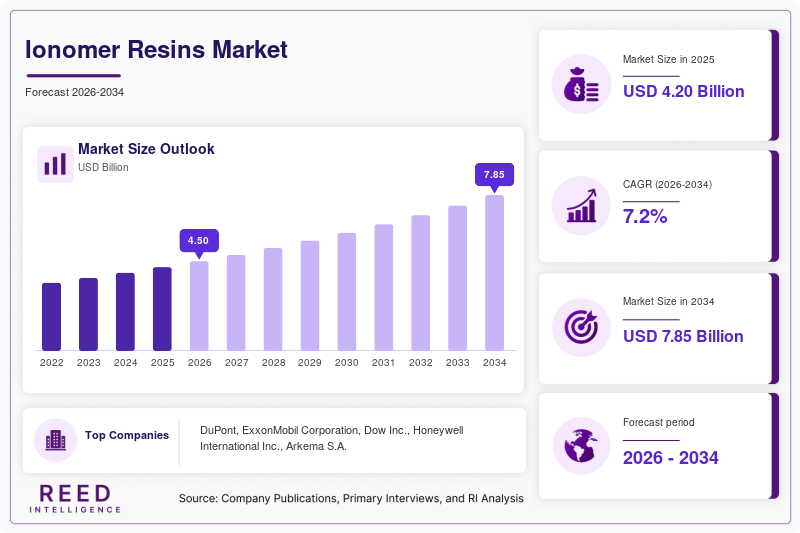
The global Ionomer Resins Market size was valued at USD 4.2 billion in 2025 and is projected to reach USD 7.9 billion by 2034, expanding at a compound annual growth rate (CAGR) of 7.2% during the forecast period (2025–2034). The market has demonstrated consistent growth due to its increasing utilization across packaging, automotive, and construction industries, driven by the material’s superior durability, transparency, and chemical resistance.
A key global factor supporting the growth of the Ionomer Resins Market is the rising demand for high-performance and sustainable packaging materials. Ionomer resins are widely used in food and pharmaceutical packaging due to their excellent sealing properties, puncture resistance, and clarity. As global consumption patterns shift toward convenience foods and e-commerce-driven packaging needs, manufacturers are increasingly adopting ionomer resins to enhance product protection and shelf appeal.
Key Highlights
- Asia Pacific dominated the market with a 38% share in 2025 and is expected to register the fastest CAGR of 8.1% during the forecast period.
- By type, ethylene methacrylic acid (EMAA) ionomers led with a 46% share, while sodium-ion-based ionomers are projected to grow fastest at a CAGR of 7.8%.
- By application, packaging accounted for the largest share at 52%, whereas automotive applications are expected to grow fastest at a CAGR of 7.6%.
- The United States remained the dominant country, with a market value of USD 1.05 billion in 2025 and projected to reach USD 1.12 billion in 2026.
Market Trends
Rising Adoption in Sustainable Packaging Solutions
The Ionomer Resins Market is witnessing a notable shift toward sustainable and recyclable packaging materials. Manufacturers are increasingly developing ionomer resins that support mono-material packaging structures, improving recyclability while maintaining performance. The material’s ability to reduce packaging thickness without compromising strength is contributing to its adoption in flexible packaging applications. This trend aligns with global sustainability goals and regulatory pressures to reduce plastic waste.
Technological Advancements in High-Performance Applications
Technological innovation is driving the expansion of ionomer resins into high-performance sectors such as automotive components and electronics. Advanced ionomer formulations offer enhanced impact resistance, adhesion, and thermal stability, making them suitable for demanding environments. Additionally, research into bio-based ionomer resins is gaining traction, opening new avenues for eco-friendly material development. These advancements are strengthening the market outlook and enabling manufacturers to diversify their product portfolios.
Market Drivers
Increasing Demand from Packaging Industry
The growing demand for durable and flexible packaging materials is a major driver of the Ionomer Resins Market. Ionomer resins provide excellent sealing properties and resistance to punctures, making them ideal for food and pharmaceutical packaging. The rise in online retail and global food consumption patterns has significantly increased the need for reliable packaging solutions, thereby boosting demand for ionomer resins.
Expansion of Automotive Applications
The automotive industry is increasingly adopting ionomer resins for interior and exterior components due to their lightweight properties and high impact resistance. These materials contribute to vehicle weight reduction, which enhances fuel efficiency and reduces emissions. As automotive manufacturers continue to focus on performance and sustainability, the demand for ionomer resins is expected to grow steadily.
Market Restraint
High Production Costs and Raw Material Dependency
One of the primary challenges in the Ionomer Resins Market is the relatively high production cost associated with these materials. The manufacturing process involves specialized technology and relies heavily on petrochemical-based raw materials, which are subject to price volatility. This cost factor limits the adoption of ionomer resins in price-sensitive markets and industries.
Additionally, fluctuations in crude oil prices directly impact the cost structure of ionomer resin production, creating uncertainty for manufacturers. Smaller players may find it difficult to compete with established companies due to the capital-intensive nature of production. These factors collectively restrain market growth, particularly in emerging economies where cost efficiency is a key consideration.
Market Opportunities
Growth in Emerging Economies
Emerging markets in Asia Pacific, Latin America, and the Middle East present significant growth opportunities for the Ionomer Resins Market. Rapid industrialization, urbanization, and increasing consumer demand for packaged goods are driving the need for advanced materials. Manufacturers are expanding their presence in these regions to capitalize on untapped potential and cost advantages.
Development of Bio-Based Ionomer Resins
The development of bio-based ionomer resins offers a promising opportunity for market players. As environmental concerns continue to rise, there is increasing demand for sustainable alternatives to conventional plastics. Bio-based ionomers can reduce carbon footprints while maintaining performance characteristics, making them attractive for various applications. This innovation is expected to open new growth avenues and enhance market competitiveness.
Regional Analysis
North America
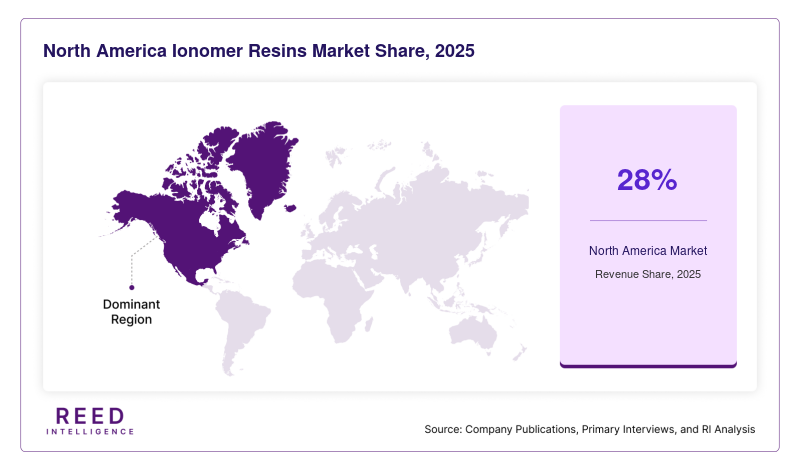
North America accounted for approximately 28% of the Ionomer Resins Market share in 2025 and is expected to grow at a CAGR of 6.5% during the forecast period. The region’s growth is supported by strong demand from packaging and automotive industries, along with advanced manufacturing capabilities.
The United States dominated the regional market due to its well-established industrial base and continuous innovation in material science. The presence of major manufacturers and increasing investment in research and development have contributed to sustained growth.
Europe
Europe held around 24% of the market share in 2025 and is projected to grow at a CAGR of 6.8% through 2034. The region has shown steady growth driven by stringent environmental regulations and a focus on sustainable materials.
Germany emerged as the leading country in the region, supported by its robust automotive and industrial sectors. The country’s emphasis on high-quality materials and engineering excellence has boosted the adoption of ionomer resins in various applications.
Asia Pacific
Asia Pacific dominated the Ionomer Resins Market with a 38% share in 2025 and is anticipated to grow at the fastest CAGR of 8.1% during the forecast period. Rapid industrialization, expanding packaging industry, and increasing consumer demand have driven market growth.
China led the regional market due to its large manufacturing base and growing demand for packaging materials. Government initiatives supporting industrial growth and infrastructure development have further accelerated market expansion.
Middle East & Africa
The Middle East & Africa region accounted for approximately 5% of the market share in 2025 and is expected to grow at a CAGR of 6.2% over the forecast period. Growth in this region is supported by increasing investments in infrastructure and packaging industries.
Saudi Arabia dominated the regional market, driven by its expanding petrochemical industry and focus on diversifying its economy. The country’s strategic investments in industrial development have contributed to market growth.
Latin America
Latin America held around 5% of the market share in 2025 and is projected to grow at a CAGR of 6.4% during the forecast period. The region is experiencing gradual growth due to rising demand for packaged goods and industrial materials.
Brazil led the regional market, supported by its growing manufacturing sector and increasing adoption of advanced materials. Economic development and urbanization have played a key role in driving demand for ionomer resins.
Segmental Analysis
By Type
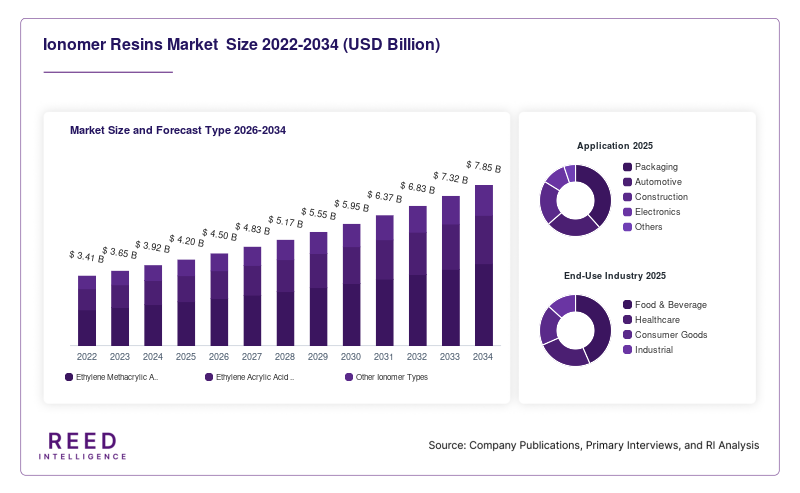
Ethylene methacrylic acid (EMAA) ionomers dominated the Ionomer Resins Market, accounting for 46% of the share in 2025. Their superior flexibility, adhesion properties, and compatibility with various polymers have made them widely used across multiple applications.
Sodium-ion-based ionomers are expected to witness the fastest growth, with a projected CAGR of 7.8% during the forecast period. Their enhanced mechanical strength and improved thermal stability will drive adoption in high-performance applications, particularly in automotive and industrial sectors.
By Application
Packaging emerged as the dominant application segment, capturing 52% of the market share in 2025. The widespread use of ionomer resins in food packaging due to their sealing and protective properties has significantly contributed to this dominance.
The automotive segment is projected to grow at the fastest CAGR of 7.6% during the forecast period. Increasing demand for lightweight and durable materials will drive the adoption of ionomer resins in vehicle components, supporting segment growth.
By End-Use Industry
The food and beverage industry dominated the market with a 41% share in 2025, driven by the growing need for safe and efficient packaging solutions. Ionomer resins are widely used to enhance product shelf life and maintain quality.
The healthcare sector is expected to grow at the fastest CAGR of 7.9% due to rising demand for pharmaceutical packaging and medical devices. The material’s resistance to contamination and ability to maintain sterility will support its increasing adoption.
By Form
Granules accounted for the largest share of 58% in 2025, as they are easy to process and widely used in manufacturing applications. Their versatility and compatibility with various processing techniques have contributed to their dominance.
Films are expected to grow at the fastest CAGR of 7.7% during the forecast period. The increasing demand for flexible packaging solutions will drive the adoption of ionomer resin films, particularly in food and consumer goods packaging.
Competitive Landscape
The Ionomer Resins Market is characterized by the presence of several established players focusing on product innovation and strategic expansion. Leading companies are investing in research and development to enhance material performance and sustainability.
DuPont is recognized as a market leader, leveraging its strong product portfolio and global presence. The company recently introduced advanced ionomer resin grades designed for sustainable packaging applications, strengthening its competitive position.
Other key players include ExxonMobil Corporation, Dow Inc., and Honeywell International Inc., which continue to expand their production capacities and invest in new technologies. Strategic partnerships and mergers are also common in the market, enabling companies to enhance their capabilities and market reach.
Key Players List
- DuPont
- ExxonMobil Corporation
- Dow Inc.
- Honeywell International Inc.
- Arkema S.A.
- SABIC
- BASF SE
- LG Chem Ltd.
- Kuraray Co., Ltd.
- Sumitomo Chemical Co., Ltd.
- Mitsui Chemicals, Inc.
- Eastman Chemical Company
- Celanese Corporation
- Solvay S.A.
- Braskem S.A.
Recent Developments
- DuPont launched a new range of recyclable ionomer resins aimed at sustainable packaging solutions in 2024.
- ExxonMobil expanded its production capacity for specialty polymers, including ionomer resins, in Asia Pacific.
- Dow Inc. introduced advanced ionomer formulations for automotive applications to enhance durability and performance.
- Arkema invested in research to develop bio-based ionomer resins, aligning with sustainability goals.
- SABIC collaborated with packaging manufacturers to develop innovative flexible packaging solutions using ionomer resins.
Ionomer Resins Market Segments
Type
- Ethylene Methacrylic Acid (EMAA)
- Ethylene Acrylic Acid (EAA)
- Other Ionomer Types
Application
- Packaging
- Automotive
- Construction
- Electronics
- Others
End-Use Industry
- Food & Beverage
- Healthcare
- Consumer Goods
- Industrial
Form
- Granules
- Films
- Sheets
Region
- North America
- Europe
- Asia Pacific
- Middle East & Africa
- Latin America
By Region
- North America
- Europe
- APAC
- Middle East and Africa
- LATAM