IoT in Aerospace Defence Market Size, Share Demand Report By Product Type (Hardware, Software, Services), By Application (Flight Operations, Maintenance & Repair, Surveillance & Security, Supply Chain Management, Others), By Connectivity (Cellular, Satellite, Wi-Fi, LPWAN) & Segment Forecasts, 2026–2034
USD 3950
IoT in Aerospace Defence Market Size
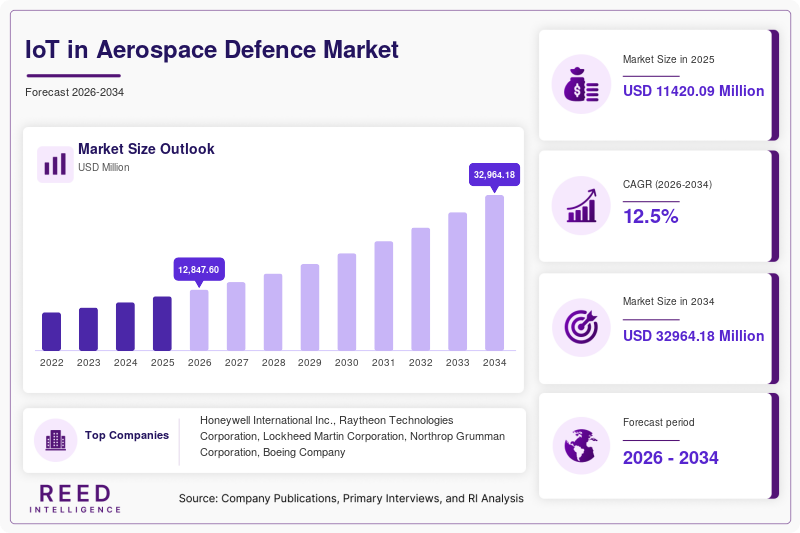
IoT in Aerospace Defence market size is projected at USD 12,847.6 million in 2026 and is expected to hit USD 32,847.5 million by 2034 with a CAGR of 12.5% during the forecast period. The increasing need for enhanced operational efficiency, predictive maintenance, and real-time situational awareness in aerospace and defense, coupled with the growing adoption of connected devices and advanced analytics, underpins market expansion. This report delivers a comprehensive analysis of the IoT in Aerospace Defence market, including segmentation by type and application, competitive dynamics, and regional growth patterns, equipping stakeholders with critical intelligence. The IoT in Aerospace Defence market continues to demonstrate exceptional growth potential, fueled by the digital transformation of the defense sector, the increasing focus on fleet management and asset tracking, and continuous innovation in sensor and communication technologies.
IoT in Aerospace and Defense refers to the integration of Internet of Things technologies, including sensors, connectivity, and analytics, into aircraft, ground systems, and defense infrastructure. This enables real-time data collection, remote monitoring, and improved decision-making. The global IoT in Aerospace Defence market is experiencing significant growth, with the number of connected devices exceeding 850 million in 2025, reflecting a 14% increase from 2023, driven by the increasing deployment of IoT solutions in military and commercial aviation. Adoption patterns reveal that the Hardware type dominates the market, accounting for 45% of total demand, followed by Software at 32%, and Services at 23%. The IoT in Aerospace Defence market's trajectory is closely linked to the growth of the global aerospace and defense market, which is projected to reach USD 1.5 trillion by 2028, and the increasing need for data-driven decision-making and operational resilience.
IoT in Aerospace Defence Market Trends
Integration of AI and Edge Computing for Real-Time Analytics
The IoT in Aerospace Defence market is witnessing a significant trend toward the integration of AI and edge computing, driven by the need for real-time data processing and actionable insights at the point of collection. The revenue from AI-enabled IoT solutions grew to USD 4.2 billion in 2025, a year-on-year increase of 22%, as 45% of new IoT deployments in 2025 specified AI and edge capabilities. Adoption rates of edge computing in flight operations and maintenance reached 35%, with this figure projected to exceed 65% by 2030. The IoT in Aerospace Defence market's trend toward AI and edge is reinforced by the need for reduced latency, the increasing volume of sensor data, and the continuous innovation in AI algorithms and edge hardware.
Growing Focus on Cybersecurity and Resilient Communication
The increasing focus on cybersecurity and resilient communication is a major trend shaping the IoT in Aerospace Defence market, with the development of secure and robust IoT frameworks to protect sensitive data and ensure reliable operations. The market has seen a 20% increase in the demand for secure IoT solutions since 2022, with 30% of new product developments in 2025 featuring advanced encryption and security protocols. The use of secure communication channels for mission-critical applications has also gained significant traction. The IoT in Aerospace Defence market's trend toward security is reinforced by the need to protect against cyber threats, the increasing reliance on networked systems, and the continuous innovation in cybersecurity technologies.
IoT in Aerospace Defence Market Drivers
The IoT in Aerospace Defence market's expansion is primarily driven by the increasing need for operational efficiency and cost reduction in the aerospace and defense sectors, with the global aerospace and defense market valued at USD 1.2 trillion in 2025 and growing at a steady pace. The need for predictive maintenance to reduce aircraft downtime and improve fleet availability has been a major driver, with IoT enabling condition-based monitoring. The rising adoption of unmanned systems and autonomous platforms has also fueled market growth. Additionally, the increasing focus on enhancing situational awareness and surveillance capabilities has spurred demand. The IoT in Aerospace Defence market's growth is further reinforced by the continuous improvement in sensor technology and connectivity, leading to better performance and lower costs.
IoT in Aerospace Defence Market Restraints
Despite favorable growth prospects, the IoT in Aerospace Defence market faces significant constraints, primarily related to the high cost of implementing and maintaining IoT systems in complex aerospace and defense environments, which can be 20-40% higher than in commercial applications. The challenges of integrating IoT with legacy systems and the need for robust cybersecurity can also be a limitation. The IoT in Aerospace Defence market's growth is also tempered by the stringent regulatory requirements and the long development cycles in the defense sector.
IoT in Aerospace Defence Market Opportunities
The IoT in Aerospace Defence market presents significant opportunities in the rapidly expanding market for autonomous and unmanned systems, where IoT is essential for navigation and control. The development of digital twin technologies for aircraft and fleet management is expected to grow at a CAGR of 15% through 2034. Emerging opportunities also exist in the use of IoT for supply chain optimization and logistics in defense. The IoT in Aerospace Defence market's opportunity profile is further enhanced by the growing trend of data-sharing and interoperability among allied forces.
Challenges in IoT in Aerospace Defence Market
The IoT in Aerospace Defence market faces persistent challenges related to the need for continuous innovation to keep pace with evolving threats and technology standards. The complexity of ensuring secure and reliable communication in contested environments can also be a challenge. The market is also contending with the challenge of managing and analyzing the massive volume of data generated by IoT devices. Additionally, the IoT in Aerospace Defence market is challenged by the need to address the skills gap in IoT and data analytics.
IoT in Aerospace Defence Market Segmentation
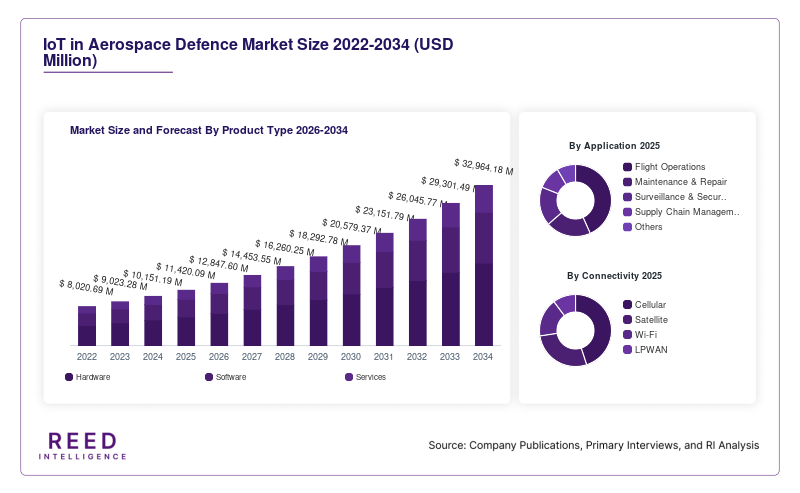
The IoT in Aerospace Defence market is segmented by Type and Application to provide a comprehensive market perspective. By Type, Hardware dominates with a 45% market share, driven by the need for sensors and connectivity devices. The Application segment is led by Flight Operations, which accounts for 28% of the market, followed by Maintenance & Repair at 25%, Surveillance & Security at 22%, Supply Chain Management at 15%, and Others at 10%.
By Type
Hardware represent the largest segment in the IoT in Aerospace Defence market, commanding a 45% share, with revenue exceeding USD 5.8 billion in 2025. These are characterized by their use in sensors, actuators, and connectivity modules. Technical specifications include communication protocols, power consumption, and environmental durability. The IoT in Aerospace Defence market's Hardware segment is driven by its use in aircraft, ground systems, and wearable devices.
Software capture a 32% share of the IoT in Aerospace Defence market, with revenue of USD 4.1 billion in 2025. These are characterized by their use in data analytics, platform management, and application development. Technical specifications include data processing capabilities, security features, and integration APIs. The IoT in Aerospace Defence market's Software segment is driven by its use in fleet management, maintenance, and analytics.
Services represent the remaining 23% of the IoT in Aerospace Defence market, with revenue of USD 2.9 billion in 2025. These are characterized by their provision of consulting, integration, and managed services. Technical specifications include service-level agreements, expertise, and support. The IoT in Aerospace Defence market's Services segment is driven by its use in system deployment and ongoing support.
By Application
Flight Operations dominates the IoT in Aerospace Defence market, accounting for 28% of sales, representing USD 3.6 billion in 2025. This segment includes use in real-time monitoring, navigation, and communication. Usage penetration exceeds 30% in the sector. The IoT in Aerospace Defence market's Flight Operations segment is characterized by its focus on safety and efficiency.
Maintenance & Repair accounts for 25% of the IoT in Aerospace Defence market, with revenue of USD 3.2 billion in 2025. This segment encompasses use in predictive maintenance, diagnostics, and health monitoring. The segment is growing at a robust CAGR, driven by the need to reduce downtime. The IoT in Aerospace Defence market's Maintenance segment is characterized by its focus on reliability and cost savings.
Surveillance & Security represents 22% of the IoT in Aerospace Defence market, with revenue of USD 2.8 billion in 2025. This segment includes use in perimeter security, threat detection, and reconnaissance. The segment is growing at a significant rate, driven by security concerns. The IoT in Aerospace Defence market's Surveillance segment is characterized by its focus on real-time situational awareness.
Supply Chain Management accounts for 15% of the IoT in Aerospace Defence market, with revenue of USD 1.9 billion in 2025. This segment includes use in asset tracking, logistics, and inventory management. The segment is growing at a steady pace. The IoT in Aerospace Defence market's Supply Chain segment is characterized by its focus on efficiency and visibility.
Others comprises the remainder of the IoT in Aerospace Defence market, accounting for 10% of total revenue, with USD 1.3 billion in 2025. This includes use in training, simulation, and other niche applications. The segment is projected to grow at a moderate CAGR through 2034. The IoT in Aerospace Defence market's Others segment is characterized by its diverse and evolving applications.
IoT in Aerospace Defence Market Regional Outlook
North America IoT in Aerospace Defence Market
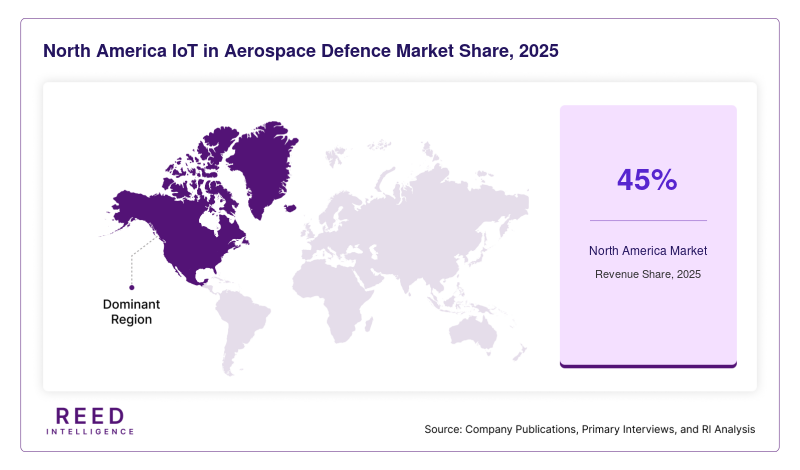
Leads the IoT in Aerospace Defence market, commanding a 45% share, with a revenue of USD 5.8 billion in 2025. The United States is the primary driver, accounting for 85% of regional demand, driven by the large defense budget, strong aerospace industry, and early adoption of advanced technologies. The North American IoT in Aerospace Defence market is characterized by its focus on innovation and high-performance solutions.
Europe IoT in Aerospace Defence Market
Represents the second-largest market, capturing a 25% share with a revenue of USD 3.2 billion in 2025. The UK, France, and Germany are the primary drivers, collectively accounting for 60% of regional demand, driven by the strong defense and aerospace sectors, and a focus on technological sovereignty. The European IoT in Aerospace Defence market is characterized by its focus on quality and security.
Asia-Pacific IoT in Aerospace Defence Market
Accounts for 20% of the global IoT in Aerospace Defence market, with a revenue of USD 2.6 billion in 2025. China, India, and Japan are the primary drivers, together accounting for 70% of regional demand, driven by increasing defense spending, modernization programs, and the growth of commercial aviation. The Asia-Pacific IoT in Aerospace Defence market is projected to grow at the fastest CAGR of 14% through 2034.
Middle East & Africa and Latin America IoT in Aerospace Defence Market
Together account for the remaining 10% of the IoT in Aerospace Defence market, with the UAE leading the Middle East market and Brazil leading the Latin American market. Both regions are projected to grow at CAGRs exceeding 12%, driven by defense modernization and infrastructure development.
Top players in IoT in Aerospace Defence Market
- Honeywell International Inc.
- Raytheon Technologies Corporation
- Lockheed Martin Corporation
- Northrop Grumman Corporation
- Boeing Company
- Airbus SE
- General Electric Company
- IBM Corporation
- Cisco Systems, Inc.
- Microsoft Corporation
- Amazon Web Services (AWS)
- L3Harris Technologies, Inc.
- Teledyne Technologies Incorporated
- Thales Group
- Siemens AG
Honeywell International Inc.
Honeywell International holds a dominant position in the IoT in Aerospace Defence market, with an estimated 16% global market share, particularly strong in the North American and European segments. The company's portfolio of IoT solutions for aerospace and defense is widely recognized for its quality, reliability, and innovation. Honeywell's market leadership is reinforced by its significant R&D investment, its comprehensive aerospace expertise, and its strong relationships with major defense and aviation customers. Honeywell commands over 18% of the North American market and 14% of the European market, positioning it as a key player in the IoT in Aerospace Defence market.
Raytheon Technologies Corporation
Raytheon Technologies is a leading player in the IoT in Aerospace Defence market, commanding approximately 14% of the global market share through its comprehensive portfolio of advanced technologies and systems. The company's expertise in defense electronics and its focus on connected solutions have solidified its position. Raytheon's IoT offerings are known for their robustness, security, and mission-critical performance. The company's commitment to innovation and its strong presence in the North American and European markets have enhanced its competitive advantage.
Lockheed Martin Corporation holds a significant 12% market share, with particular strength in the defense systems and solutions segment. Northrop Grumman Corporation is a major player in the aerospace and defense technology market, holding a 10% share.
Recent Developments in IoT in Aerospace Defence Market
- 2025: Honeywell launched a new IoT platform for predictive maintenance in military aircraft, integrating advanced analytics and real-time health monitoring.
- 2025: Raytheon Technologies introduced a new secure IoT communication system for defense networks, targeting enhanced data protection and resilience.
IoT in Aerospace Defence Market Segments
By Product Type
- Hardware
- Software
- Services
By Application
- Flight Operations
- Maintenance & Repair
- Surveillance & Security
- Supply Chain Management
- Others
By Connectivity
- Cellular
- Satellite
- Wi-Fi
- LPWAN
By Region
- North America
- Europe
- APAC
- Middle East and Africa
- LATAM