Iron Chromium Aluminum Alloy Wire Market Size, Share & Demand Report By Type (Round Wire, Flat Wire, Ribbon Wire), By Alloy Composition (FeCrAl A-1, FeCrAl D, Advanced Alloys), By Application (Industrial Heating, Automotive Heating Systems, Electronics, Appliances), By End-Use Industry (Metallurgy, Automotive, Electronics, Energy), By Distribution Channel (Direct Sales, Distributors, Online Platforms), By Region & Segment Forecasts, 2025–2034
USD 3950
Market Overview
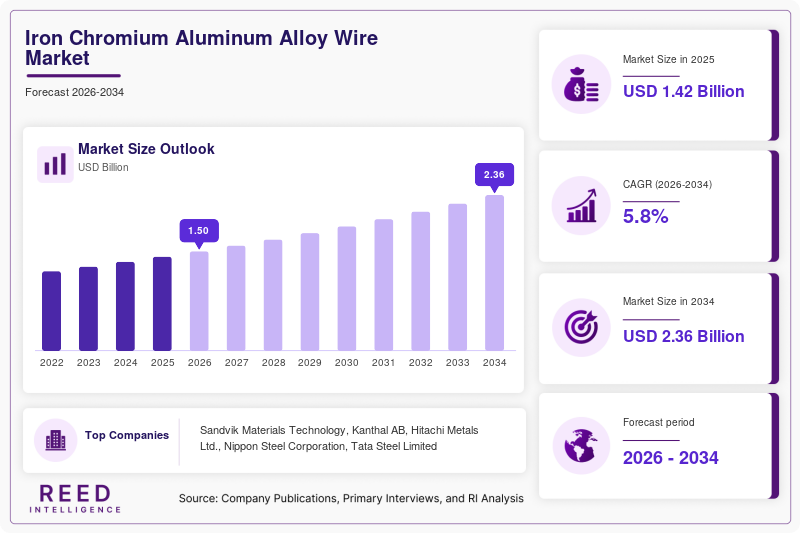
The Iron Chromium Aluminum Alloy Wire Market size was valued at approximately USD 1.42 billion in 2025 and is projected to reach USD 2.36 billion by 2034, expanding at a CAGR of 5.8% during 2025–2034. The market growth is primarily supported by the rising global demand for high-temperature resistant materials across industrial heating applications, particularly in sectors such as metallurgy, automotive, and electronics manufacturing.
Iron chromium aluminum (FeCrAl) alloy wires are widely utilized for their excellent oxidation resistance, long service life, and ability to withstand extreme temperatures. These properties make them a preferred choice for heating elements in furnaces, ovens, and industrial kilns. Increasing industrialization and energy efficiency initiatives have further accelerated their adoption, especially in emerging economies.
Additionally, the growing emphasis on sustainable and energy-efficient systems has encouraged manufacturers to adopt materials that offer durability and reduced maintenance costs. FeCrAl wires, with their superior lifespan compared to conventional alternatives, align well with these industry requirements, contributing to steady market expansion.
Key Highlights
- Asia Pacific dominated the market with 41.3% share in 2025, while North America is projected to grow fastest at a CAGR of 6.4%
- Round wire segment led by type with 48.7% share, while flat wire is expected to grow fastest at 6.6% CAGR
- Industrial heating application dominated with 52.1% share, while automotive heating systems are projected to grow at 6.9% CAGR
- China led globally with USD 382 million in 2025 and is estimated to reach USD 405 million in 2026
Market Trends
Increasing Adoption in Energy-Efficient Heating Systems
The market is witnessing a shift toward energy-efficient industrial heating solutions, where FeCrAl wires are increasingly used due to their high electrical resistivity and low energy loss. Industries are focusing on reducing operational costs and emissions, driving the replacement of traditional materials with advanced alloy wires. This trend is particularly evident in modern furnace technologies and electric heating equipment.
Expansion of Electric Vehicle and Electronics Manufacturing
The growth of electric vehicles (EVs) and advanced electronics manufacturing is influencing the Iron Chromium Aluminum Alloy Wire Market trends. These wires are used in battery heating systems and electronic components requiring thermal stability. As EV production scales globally, the demand for reliable heating materials is increasing, thereby supporting market growth. Additionally, miniaturization in electronics has created demand for precision alloy wires, further expanding application areas.
Market Drivers
Rising Demand from Industrial Heating Applications
The increasing use of industrial furnaces and kilns across metallurgy, ceramics, and glass industries is a major growth driver. FeCrAl alloy wires are preferred due to their ability to operate at high temperatures exceeding 1,300°C. Their durability reduces downtime and maintenance costs, making them a cost-effective solution for industrial operators.
Growth in Infrastructure and Manufacturing Activities
Rapid industrialization and infrastructure development, especially in developing regions, have led to increased manufacturing activities. This has boosted the demand for heating elements in production processes. The expansion of sectors such as construction materials, steel production, and chemical processing continues to drive the adoption of FeCrAl alloy wires globally.
Market Restraint
Volatility in Raw Material Prices
Fluctuations in the prices of key raw materials such as chromium and aluminum pose a significant challenge to the Iron Chromium Aluminum Alloy Wire Market. These metals are subject to supply-demand imbalances, geopolitical factors, and mining constraints, which can impact production costs.
Manufacturers often face pressure to maintain competitive pricing while managing increasing input costs. This can lead to reduced profit margins and hinder investment in research and development. Additionally, price volatility can disrupt supply chains and create uncertainty among end users, affecting purchasing decisions.
Market Opportunities
Expansion in Renewable Energy Applications
The growing adoption of renewable energy systems, including solar and wind technologies, presents new opportunities for FeCrAl alloy wires. These materials are increasingly used in thermal energy storage systems and heating components within renewable infrastructure, supporting market growth.
Technological Advancements in Alloy Composition
Ongoing research and development in alloy formulations are enabling the production of enhanced FeCrAl wires with improved oxidation resistance and mechanical strength. These innovations are expected to expand the scope of applications, particularly in high-performance and specialized industrial environments, creating new growth avenues.
Segmental Analysis
By Type
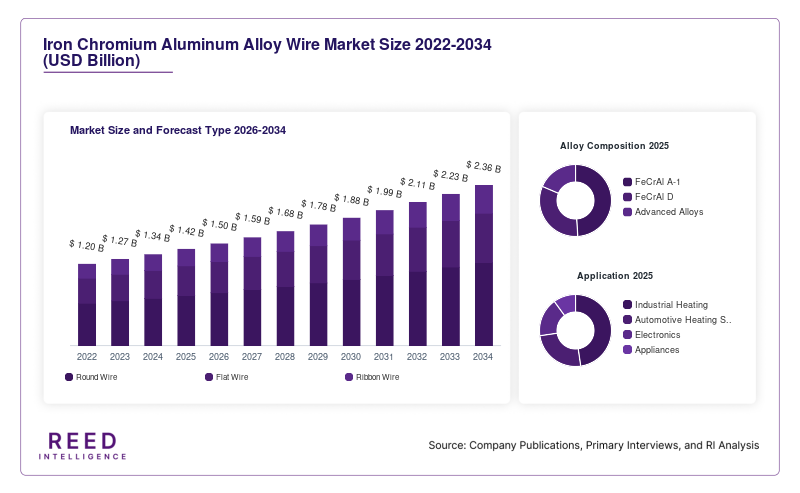
The round wire segment dominated the Iron Chromium Aluminum Alloy Wire Market, accounting for 48.7% share in 2025. Its widespread use in standard heating elements and ease of manufacturing contributed to its leading position.
The flat wire segment is projected to grow at the fastest CAGR of 6.6%, driven by its increasing use in specialized heating applications where uniform heat distribution is required. Its design advantages will support adoption in advanced industrial systems.
By Alloy Composition
The FeCrAl A-1 grade segment held the largest share of 44.2% in 2025, owing to its superior high-temperature resistance and durability.
The advanced alloy variants segment is expected to grow at a CAGR of 6.7%, supported by innovations that enhance oxidation resistance and mechanical strength, enabling usage in extreme environments.
By Application
The industrial heating segment dominated with a 52.1% share in 2025, driven by extensive use in furnaces, kilns, and ovens.
The automotive heating systems segment is projected to grow at a CAGR of 6.9%, fueled by increasing demand for electric vehicles and advanced thermal management systems.
By End-Use Industry
The metallurgy industry segment accounted for 39.5% share in 2025, as FeCrAl wires are essential for high-temperature metal processing.
The electronics industry segment is expected to grow at a CAGR of 6.5%, supported by rising demand for compact and efficient heating components in electronic devices.
By Sales Channel
The direct sales segment dominated with 57.3% share in 2025, as manufacturers prefer direct procurement for quality assurance and customization.
The online distribution segment is projected to grow at a CAGR of 6.8%, driven by digitalization and increasing adoption of e-commerce platforms in industrial procurement.
Regional Analysis
North America
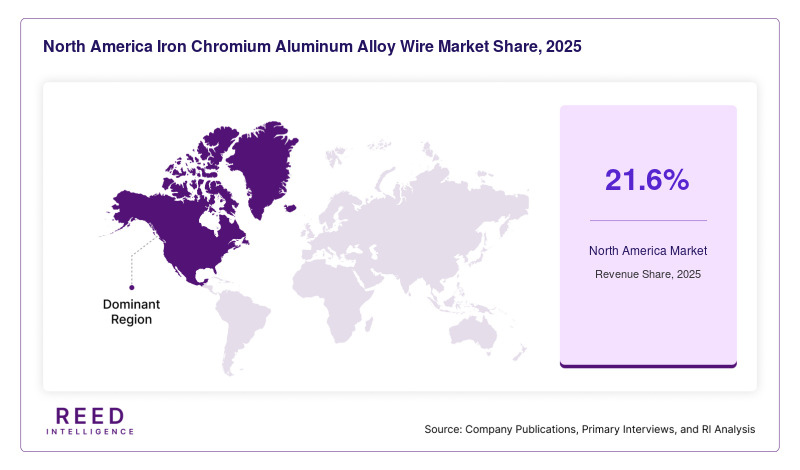
North America accounted for 21.6% of the Iron Chromium Aluminum Alloy Wire Market share in 2025 and is projected to grow at a CAGR of 6.4% during the forecast period. The region’s growth will be driven by the modernization of industrial heating systems and increasing demand for energy-efficient solutions.
The United States dominated the regional market due to its advanced manufacturing sector and strong adoption of automation technologies. The presence of high-end industrial facilities and continuous investment in upgrading heating equipment contributed to steady demand for FeCrAl alloy wires.
Europe
Europe held 24.8% market share in 2025 and is expected to grow at a CAGR of 5.5% through 2034. The region will benefit from stringent environmental regulations encouraging energy-efficient industrial operations.
Germany emerged as the dominant country, supported by its robust automotive and engineering industries. The focus on reducing emissions and improving production efficiency has increased the adoption of high-performance heating materials across manufacturing facilities.
Asia Pacific
Asia Pacific dominated with 41.3% market share in 2025 and is projected to expand at a CAGR of 6.1%. The region’s rapid industrialization and infrastructure development will continue to drive demand.
China led the regional market due to its extensive manufacturing base and large-scale steel and electronics production. The country’s continuous investment in industrial expansion and export-oriented manufacturing has significantly contributed to the demand for FeCrAl alloy wires.
Middle East & Africa
The Middle East & Africa region accounted for 6.2% of the market in 2025 and is anticipated to grow at a CAGR of 5.2%. Growth will be supported by expanding industrial and energy sectors.
Saudi Arabia dominated the region, driven by increasing investments in industrial diversification and infrastructure development. The focus on establishing local manufacturing capabilities has boosted demand for industrial heating materials.
Latin America
Latin America held 6.1% market share in 2025 and is expected to grow at a CAGR of 5.0%. The region’s growth will be supported by gradual industrial expansion and modernization initiatives.
Brazil emerged as the leading country due to its growing manufacturing sector and increasing demand for industrial equipment. Investments in infrastructure and energy projects have contributed to steady market growth.
Competitive Landscape
The Iron Chromium Aluminum Alloy Wire Market is moderately fragmented, with several global and regional players competing based on product quality, innovation, and pricing strategies. Companies are focusing on expanding production capacities and investing in research to develop advanced alloy compositions.
A leading player, Sandvik Materials Technology, has maintained a strong market position through continuous innovation and expansion of its high-performance alloy portfolio. The company recently introduced improved FeCrAl wire variants designed for extended lifespan in high-temperature environments, enhancing its competitive edge.
Other key players are emphasizing strategic partnerships and regional expansions to strengthen their market presence and meet growing demand across industries.
Key Players List
- Sandvik Materials Technology
- Kanthal AB
- Hitachi Metals Ltd.
- Nippon Steel Corporation
- Tata Steel Limited
- Aperam S.A.
- Thyssenkrupp AG
- VDM Metals GmbH
- HAYNES International Inc.
- Danyang Daming Alloy Co., Ltd.
- Jiangsu Chunhai Electric Heating Co., Ltd.
- Hengtai Special Alloy Co., Ltd.
- Phoenix Alloy Company
- Yuyao Jinyuan Alloy Co., Ltd.
- Shanghai Tankii Alloy Material Co., Ltd.
Recent Developments
- In 2024, leading manufacturers introduced next-generation FeCrAl wires with enhanced oxidation resistance for high-temperature applications.
- Several companies expanded production facilities in Asia Pacific to meet rising regional demand.
- Strategic collaborations between alloy producers and industrial equipment manufacturers increased product integration.
- Advancements in manufacturing processes improved wire precision and durability.
- Companies invested in sustainable production technologies to reduce environmental impact.
Iron Chromium Aluminum Alloy Wire Market Segments
Type
- Round Wire
- Flat Wire
- Ribbon Wire
Alloy Composition
- FeCrAl A-1
- FeCrAl D
- Advanced Alloys
Application
- Industrial Heating
- Automotive Heating Systems
- Electronics
- Appliances
End-Use Industry
- Metallurgy
- Automotive
- Electronics
- Energy
Distribution Channel
- Direct Sales
- Distributors
- Online Platforms
By Region
- North America
- Europe
- APAC
- Middle East and Africa
- LATAM