Irrigation Timers And Controllers Market Size, Share, Demand Report By Product Type (Basic Irrigation Timers,Weather-Based Controllers, Wi-Fi & IoT-Enabled Controllers), By Application (Agricultural Irrigation, Residential Landscaping, Commercial Landscaping), By End-Use (Farms & Agricultural Fields, Urban Infrastructure & Municipal Projects), Regional Outlook and Segment Forecasts, 2026–2034
USD 3950
Market Overview
The Irrigation Timers And Controllers Market sizeis projected to reach a valuation of approximately USD 4.85 billion in 2026 and is expected to expand to nearly USD 9.42 billion by 2034, registering a compound annual growth rate (CAGR) of 8.6% during the forecast period 2026–2034. The market growth is primarily driven by increasing global concerns regarding water conservation and efficient agricultural practices, especially in regions experiencing water scarcity and climate variability. The integration of automation technologies into irrigation systems has significantly improved water-use efficiency, reducing wastage and optimizing agricultural output across both developed and emerging economies.
A major global factor supporting market growth is the rising adoption of smart agriculture practices, where irrigation timers and controllers are integrated with IoT-based systems, weather forecasting tools, and soil moisture sensors. These advancements enable real-time irrigation scheduling and remote monitoring, improving crop yield and reducing operational costs. Government initiatives promoting sustainable water management and precision farming have further strengthened demand across agricultural and non-agricultural applications such as landscaping and turf management.
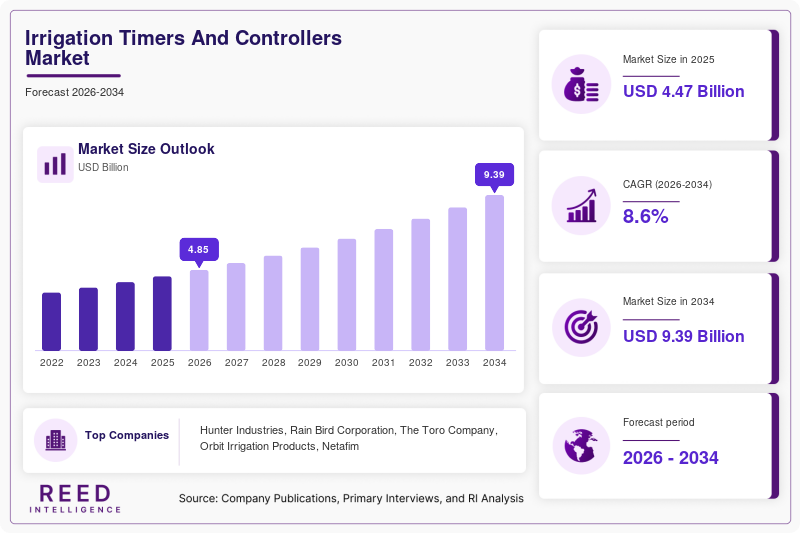
Key Highlights
- North America dominated the market with a 34.2% share in 2025.
- Asia Pacific is expected to grow at the fastest CAGR of 11.2% during 2026–2034.
- By product type, smart irrigation controllers accounted for the largest share of 38.5%.
- while Wi-Fi and IoT-based controllers are projected to grow at a CAGR of 12.4%.
- By application, agricultural irrigation led with a 41.7% share, whereas residential landscaping is expected to expand at a CAGR of 11.8%.
- The United States remained the dominant country, with market values of USD 510 million in 2024 and USD 560 million in 2025.
Market Trends
Integration of IoT and Smart Irrigation Systems
The Irrigation Timers And Controllers Market is witnessing a strong shift toward IoT-enabled irrigation solutions that allow farmers and land managers to remotely control and monitor irrigation systems. These systems use real-time data from soil moisture sensors, weather stations, and cloud platforms to optimize irrigation schedules. This trend is particularly prominent in commercial agriculture, where large-scale farms require precise water management. Smart irrigation controllers are increasingly being integrated with mobile applications, enabling users to adjust watering cycles remotely, reducing water wastage and improving crop productivity. The adoption of connected farming solutions is expected to further strengthen over the forecast period.
Growing Adoption in Residential Landscaping
Another key trend is the rising use of irrigation timers and controllers in residential landscaping and urban gardening applications. Homeowners and property managers are increasingly adopting automated irrigation systems to maintain lawns, gardens, and green spaces with minimal manual intervention. Smart controllers with weather-based adjustments and app-based controls are gaining traction in urban households. The expansion of smart city initiatives and increased awareness regarding water conservation in residential areas are supporting this trend. Additionally, the availability of cost-effective irrigation systems is making automation more accessible to middle-income households.
Market Drivers
Increasing Water Scarcity and Need for Efficient Irrigation
Rising global water scarcity is a major driver influencing the Irrigation Timers And Controllers Market. Agricultural activities account for a significant share of global freshwater consumption, creating pressure on water resources. Governments and agricultural organizations are encouraging the adoption of efficient irrigation systems to minimize wastage. Irrigation timers and controllers help regulate water usage by ensuring precise watering schedules based on soil conditions and environmental factors. This reduces over-irrigation and improves crop yield efficiency. Regions with arid and semi-arid climates are particularly adopting these technologies to sustain agricultural productivity under water-stressed conditions.
Expansion of Precision Agriculture Practices
The rapid adoption of precision agriculture is another key growth driver for the market. Precision farming techniques rely heavily on data-driven decision-making, where irrigation controllers play a critical role in optimizing water distribution. Farmers are increasingly integrating sensors, GPS technology, and automation systems into irrigation infrastructure. These systems allow real-time monitoring of field conditions and automated adjustments to irrigation cycles. The rising demand for higher agricultural productivity, coupled with limited arable land availability, is pushing farmers toward technology-driven irrigation solutions, thereby accelerating market expansion.
Market Restraint
High Installation and Maintenance Costs
One of the primary restraints affecting the Irrigation Timers And Controllers Market is the relatively high installation and maintenance cost associated with advanced smart irrigation systems. While basic timers are affordable, IoT-enabled controllers and sensor-integrated systems require significant upfront investment. Small and medium-scale farmers, particularly in developing regions, often face financial limitations that restrict adoption. Additionally, maintenance costs, software upgrades, and technical support requirements add to the overall expense. This cost barrier slows down market penetration in price-sensitive regions, limiting widespread adoption despite long-term water-saving benefits.
Market Opportunities
Expansion of Smart City and Green Infrastructure Projects
The development of smart cities and sustainable urban infrastructure presents a significant opportunity for the Irrigation Timers And Controllers Market. Governments across various countries are investing in green spaces, parks, and urban landscaping projects that require efficient irrigation systems. Smart irrigation controllers help maintain vegetation with optimized water usage, aligning with sustainability goals. Integration with municipal water management systems further enhances efficiency. As urbanization continues to grow globally, demand for automated irrigation solutions in public infrastructure is expected to rise steadily.
Rising Adoption in Commercial Turf and Sports Fields
Another emerging opportunity lies in the increasing use of irrigation controllers in sports fields, golf courses, and commercial turf management. These applications require precise and consistent irrigation to maintain surface quality. Automated irrigation systems help reduce manual labor and ensure uniform water distribution across large areas. The growing popularity of recreational sports facilities and professional landscaping services is driving demand. Additionally, sustainability regulations encouraging reduced water consumption in commercial landscaping are further supporting the adoption of advanced irrigation technologies.
Segmental Analysis
By Product Type
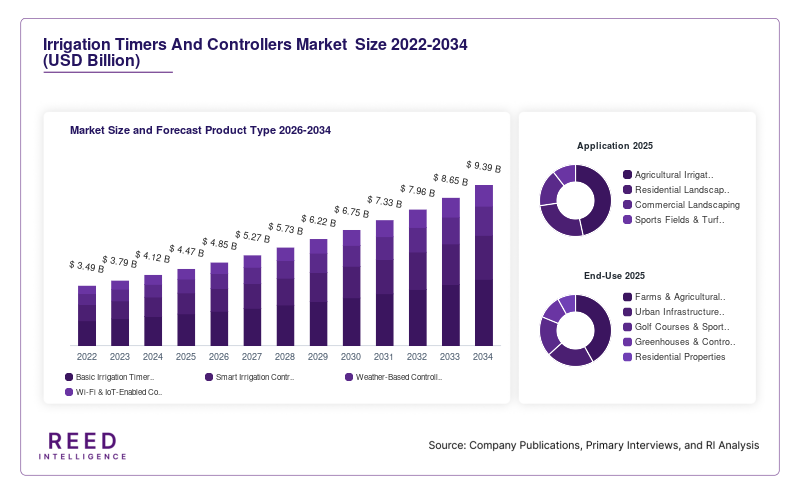
Smart irrigation controllers accounted for approximately 38.5% share in 2024, driven by increasing demand for automated and data-driven irrigation systems. These controllers are widely used in both agricultural and residential applications due to their ability to optimize water usage efficiently.
The fastest-growing segment is Wi-Fi and IoT-based controllers, projected to grow at a CAGR of 12.4%. Growth is supported by increasing smartphone penetration and integration of cloud-based monitoring systems in irrigation infrastructure.
By Application
Agricultural irrigation dominated the market with a 41.7% share in 2024, supported by large-scale adoption in crop production and farm management. Water optimization remains a key requirement in this segment.
Residential landscaping is the fastest-growing application segment, expanding at a CAGR of 11.8%, driven by rising urbanization and smart home adoption trends.
By End-Use
The agricultural sector held a 46.2% share in 2024, reflecting strong dependence on irrigation systems for crop productivity. Large farms increasingly rely on automated irrigation scheduling.
Commercial landscaping is expected to grow at a CAGR of 10.9%, supported by demand from golf courses, sports facilities, and urban infrastructure development projects.
Regional Analysis
North America
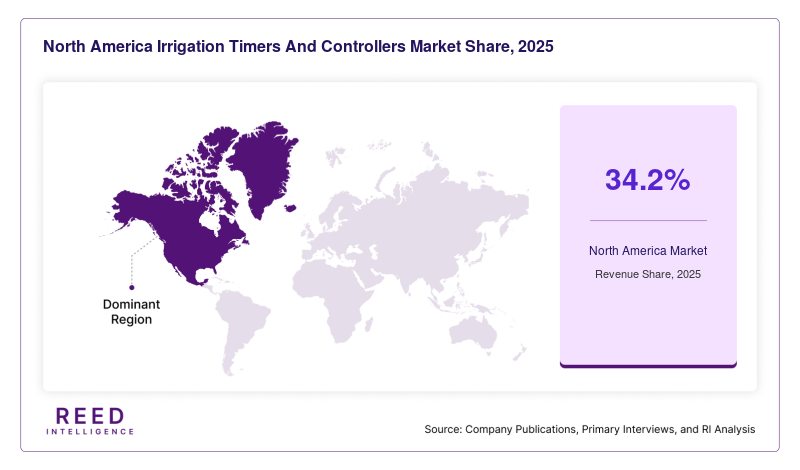
North America accounted for approximately 34.2% of the Irrigation Timers And Controllers Market in 2025, with a projected CAGR of around 8.1% through 2034. The region benefits from advanced agricultural practices and strong adoption of smart farming technologies. Increasing focus on water conservation and automation in irrigation systems continues to drive market expansion.
The United States remains the dominant country in this region due to widespread adoption of precision agriculture technologies and large-scale commercial farming operations. A key growth factor is the integration of IoT-enabled irrigation systems across farms and residential landscaping projects, supported by government sustainability initiatives.
Europe
Europe held nearly 27.5% share of the Irrigation Timers And Controllers Market in 2025, with a projected CAGR of 7.8% from 2026 to 2034. The region’s growth is driven by strict environmental regulations focused on water conservation and sustainable agricultural practices. Increasing demand for automated irrigation solutions in commercial farming, vineyards, and urban landscaping is further strengthening market expansion. Adoption of smart irrigation systems is rising steadily across both Western and Eastern Europe.
Germany leads the regional market due to its advanced agricultural engineering sector and strong emphasis on environmental sustainability. A key growth factor is the integration of smart irrigation systems into precision farming practices supported by EU-level sustainability policies. France, Italy, and Spain also contribute significantly due to extensive vineyard cultivation and high-value crop production requiring efficient irrigation management systems.
Asia Pacific
Asia Pacific is expected to grow at the fastest CAGR of 11.2% during 2026–2034, accounting for approximately 22.4% share in 2025. The region’s rapid expansion is driven by large agricultural economies, increasing food demand, and rising water scarcity concerns. Governments across the region are actively promoting modern irrigation techniques to improve agricultural productivity and reduce water consumption. The adoption of smart irrigation technologies is gaining momentum in both rural farming and urban landscaping sectors.
China and India dominate the regional market due to vast agricultural land and strong government initiatives supporting micro-irrigation and smart farming technologies. A key growth factor is the rapid expansion of precision agriculture programs combined with increasing penetration of low-cost IoT-based irrigation controllers. Australia also contributes significantly due to drought-prone conditions and high adoption of water-efficient irrigation systems in commercial farming.
Middle East & Africa
The Middle East & Africa region held around 8.3% share of the Irrigation Timers And Controllers Market in 2025, with a projected CAGR of 9.5% during 2026–2034. Growth in this region is strongly influenced by extreme water scarcity conditions and increasing reliance on advanced irrigation systems to support agriculture in arid environments. Governments are investing heavily in agricultural modernization projects and sustainable water management systems.
Saudi Arabia leads the regional market due to large-scale investments in desert agriculture and advanced irrigation infrastructure under national food security programs. A key growth factor is the adoption of automated irrigation systems integrated with desalinated water supply networks and smart farming initiatives. The United Arab Emirates and South Africa also show strong growth due to expanding greenhouse farming and commercial landscaping developments.
Latin America
Latin America accounted for approximately 7.6% share of the Irrigation Timers And Controllers Market in 2025, and it is expected to grow at a CAGR of 8.9% through 2026–2034. The region’s growth is supported by expanding agricultural exports, modernization of farming practices, and increasing adoption of efficient irrigation systems in large-scale crop production. Countries are gradually transitioning from traditional irrigation methods to automated and sensor-based systems.
Brazil dominates the regional market due to its extensive agricultural sector and growing use of precision irrigation technologies in soybean, sugarcane, and coffee production. A key growth factor is the increasing adoption of smart irrigation controllers in commercial farming operations aimed at improving yield efficiency and reducing water usage. Argentina and Chile also contribute to market expansion through irrigation modernization in fruit and vineyard cultivation.
Competitive Landscape
The Irrigation Timers And Controllers Market is moderately fragmented with the presence of global and regional players focusing on innovation and smart irrigation technologies. Key companies include Hunter Industries, Rain Bird Corporation, Toro Company, Orbit Irrigation Products, and Netafim. These companies are investing in IoT integration, mobile-enabled controllers, and AI-based irrigation systems to enhance product efficiency and expand market reach. Recent developments include expansion of cloud-based irrigation platforms and partnerships with agricultural technology providers to strengthen precision farming solutions.
Key Players List
- Hunter Industries
- Rain Bird Corporation
- The Toro Company
- Orbit Irrigation Products
- Netafim
- Rachio Inc.
- Galcon
- Lindsay Corporation
- HydroPoint Data Systems
- Weathermatic
- Skydrop
- Jain Irrigation Systems
- Valmont Industries
- Gardena GmbH
- Scotts Miracle-Gro
Recent Developments
- Recent industry developments include the launch of AI-integrated irrigation controllers designed to automatically adjust watering schedules based on predictive weather analytics.
- Several companies have expanded their cloud-based irrigation platforms, enabling remote access and centralized control for large agricultural operations.
- Strategic partnerships between irrigation technology providers and agri-tech firms have also increased, focusing on improving precision farming capabilities.
- Additionally, new product innovations emphasize energy-efficient and solar-powered irrigation controllers to support sustainable agriculture initiatives globally.
Irrigation Timers And Controllers Market Segments
Product Type
- Basic Irrigation Timers
- Smart Irrigation Controllers
- Weather-Based Controllers
- Wi-Fi & IoT-Enabled Controllers
Application
- Agricultural Irrigation
- Residential Landscaping
- Commercial Landscaping
- Sports Fields & Turf Management
End-Use
- Farms & Agricultural Fields
- Urban Infrastructure & Municipal Projects
- Golf Courses & Sports Complexes
- Greenhouses & Controlled Environments
- Residential Properties
By Region
- North America
- Europe
- APAC
- Middle East and Africa
- LATAM