ISDN Modem Market Size, Share & Demand Report By Type (External ISDN Modems, Internal ISDN Modems, ISDN Terminal Adapters), By Interface Type (Basic Rate Interface (BRI) Modems), By Application (Industrial Communication Systems, Network Backup & Disaster Recovery), By End User (Telecommunications & Network Service Providers, Government Organizations, Utilities & Energy Operators), By Region & Segment Forecasts, 2026–2034
USD 3950
Market Overview
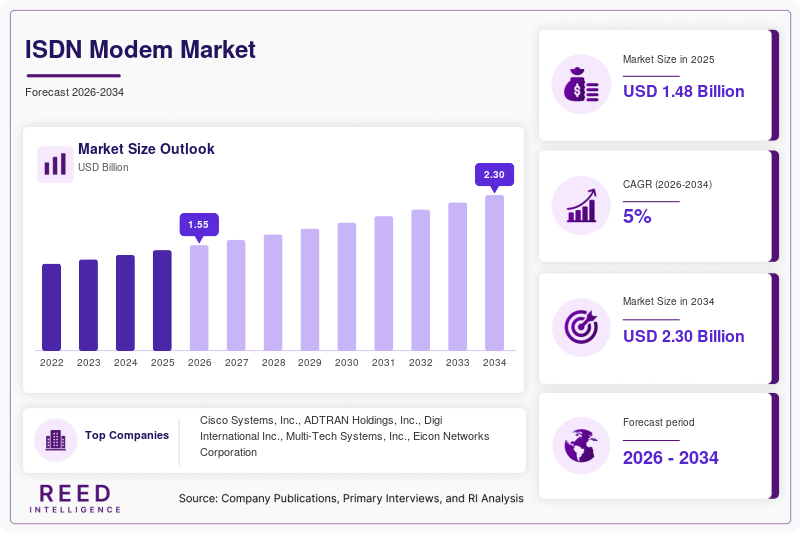
The Isdn Modem Market Size was valued at USD 1.48 billion in 2026 and is projected to reach USD 2.19 billion by 2034, expanding at a CAGR of 5.0% during the forecast period (2026–2034). Despite the widespread adoption of broadband and fiber-based communication networks, ISDN modem technology continues to maintain relevance in specialized communication environments requiring dependable, low-latency, and secure digital transmission. Industries including government services, public safety, industrial automation, utilities, transportation, and financial institutions continue to utilize ISDN-based infrastructure for mission-critical operations where network stability remains essential.
A major global factor supporting growth in the Isdn Modem Market has been the continued operation of legacy telecommunications infrastructure across both developed and emerging economies. Numerous organizations continue to rely on ISDN connectivity for backup communication systems, industrial monitoring, remote access applications, and secure data exchange environments. The high reliability of ISDN networks, combined with established deployment ecosystems, has sustained market demand even as modern communication technologies expand globally.
Key Highlights
- Europe accounted for the largest market share of 34.6% in 2025, while Asia Pacific is expected to register the fastest CAGR of 6.4% during 2026–2034.
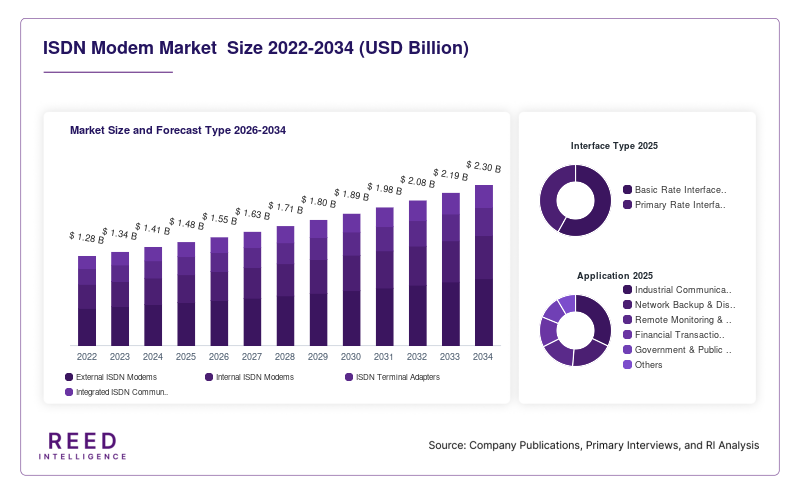
- By Type, External ISDN Modems held the dominant market share of 57.3% in 2025, while Integrated ISDN Communication Gateways are projected to grow at a CAGR of 6.8%.
- By Interface Type, Basic Rate Interface (BRI) Modems represented 61.2% share in 2025, whereas Primary Rate Interface (PRI) Modems are forecast to expand at 5.9% CAGR.
- By Application, Industrial Communication Systems accounted for 31.8% share in 2025, while Network Backup & Disaster Recovery applications are anticipated to grow at 6.7% CAGR.
- By End User, Telecommunications & Network Service Providers captured 29.5% share in 2025, whereas Utilities & Energy Operators are expected to register a CAGR of 6.3%.
- Germany, the leading national market, recorded market values of USD 148 million in 2024 and USD 156 million in 2025.
Market Trends
Integration of Hybrid ISDN-IP Communication Platforms
Organizations are increasingly deploying communication systems capable of supporting both ISDN and IP-based networks. Hybrid modem platforms enable businesses to preserve existing telecommunications investments while gradually transitioning toward modern digital infrastructure. This trend is encouraging vendors to develop interoperable communication devices that improve compatibility and operational flexibility.
Growing Demand for Redundant Communication Infrastructure
Business continuity planning has become increasingly important across industries that require uninterrupted connectivity. ISDN modem solutions are being adopted as secondary communication channels for critical applications including emergency response systems, industrial monitoring, financial transactions, and transportation management networks. This trend continues to support stable market demand despite broader telecommunications modernization initiatives.
Market Drivers
Expansion of Critical Infrastructure Monitoring Systems
The growing deployment of infrastructure monitoring solutions across utilities, transportation networks, and industrial facilities has increased demand for dependable communication equipment. ISDN modems provide stable connectivity for monitoring stations, remote control systems, and supervisory communication applications. Their reliability under demanding operational conditions supports continued utilization across essential infrastructure environments.
Increasing Need for Secure Dedicated Communication Channels
Organizations handling sensitive operational data often require communication networks with predictable performance characteristics and controlled access. ISDN-based connectivity offers dedicated digital communication channels that support secure data transmission. The growing emphasis on operational security has contributed to ongoing demand across government agencies, industrial operators, and financial institutions.
Market Restraint
Migration Toward Broadband and Fiber Communication Technologies
The gradual replacement of traditional telecommunications infrastructure with fiber-optic, broadband, and wireless communication technologies remains the primary restraint affecting the Isdn Modem Market. Telecommunications operators in several countries continue reducing ISDN network support, limiting long-term deployment opportunities and encouraging migration toward modern networking alternatives.
Market Opportunities
Modernization of Legacy Industrial Communication Networks
Many industrial facilities continue operating legacy communication infrastructure that requires modernization without complete system replacement. ISDN modem vendors can capitalize on opportunities by providing upgrade solutions that integrate existing systems with newer digital communication environments while minimizing operational disruption.
Growth in Utility Backup Communication Systems
Utility operators increasingly prioritize resilient communication architectures capable of maintaining connectivity during network interruptions. ISDN modem technologies offer dependable backup communication capabilities for power grids, water management systems, and energy distribution networks. Expanding infrastructure resilience initiatives are expected to support market opportunities throughout the forecast period.
Segmental Analysis
By Type
The Isdn Modem Market is segmented into:
- External ISDN Modems
- Internal ISDN Modems
- ISDN Terminal Adapters
- Integrated ISDN Communication Gateways
External ISDN Modems accounted for the largest market share of 57.3% in 2025. Their widespread adoption was attributed to ease of installation, maintenance flexibility, and compatibility with multiple communication systems. These devices remain widely deployed across industrial and commercial communication environments.
Integrated ISDN Communication Gateways are expected to witness the fastest growth at a CAGR of 6.8% during the forecast period. Increasing demand for hybrid communication architectures supporting both ISDN and IP protocols will drive adoption. Organizations seeking simplified migration pathways are expected to invest in integrated gateway solutions.
By Interface Type
The market is categorized into:
- Basic Rate Interface (BRI) Modems
- Primary Rate Interface (PRI) Modems
Basic Rate Interface (BRI) Modems held 61.2% market share in 2025 due to extensive utilization across small business communication systems, remote connectivity applications, and industrial monitoring environments. Their cost efficiency and operational simplicity contributed to widespread adoption.
Primary Rate Interface (PRI) Modems are anticipated to grow at a CAGR of 5.9% through 2034. Larger organizations requiring higher communication capacity and multi-channel connectivity will continue investing in PRI-based modem solutions to support operational requirements.
By Application
The market includes:
- Industrial Communication Systems
- Network Backup & Disaster Recovery
- Remote Monitoring & Control
- Financial Transaction Networks
- Government & Public Safety Communications
- Others
Industrial Communication Systems represented 31.8% of market revenue in 2025. Adoption remained strong across manufacturing facilities, utility networks, and process automation environments requiring reliable communication performance.
Network Backup & Disaster Recovery applications are projected to expand at a CAGR of 6.7% during the assessment period. Organizations implementing resilient communication architectures will increasingly deploy backup modem solutions to ensure operational continuity during network outages.
By End User
The market is segmented into:
- Telecommunications & Network Service Providers
- Government Organizations
- Utilities & Energy Operators
- Manufacturing Companies
- Financial Institutions
- Transportation & Logistics
Telecommunications & Network Service Providers accounted for 29.5% share in 2025 due to continued operation and maintenance of ISDN communication infrastructure supporting enterprise customers and specialized communication services.
Utilities & Energy Operators are expected to register the highest CAGR of 6.3% throughout the forecast period. Growing emphasis on infrastructure resilience, remote monitoring, and operational continuity will encourage deployment of dependable communication solutions.
Regional Analysis
North America
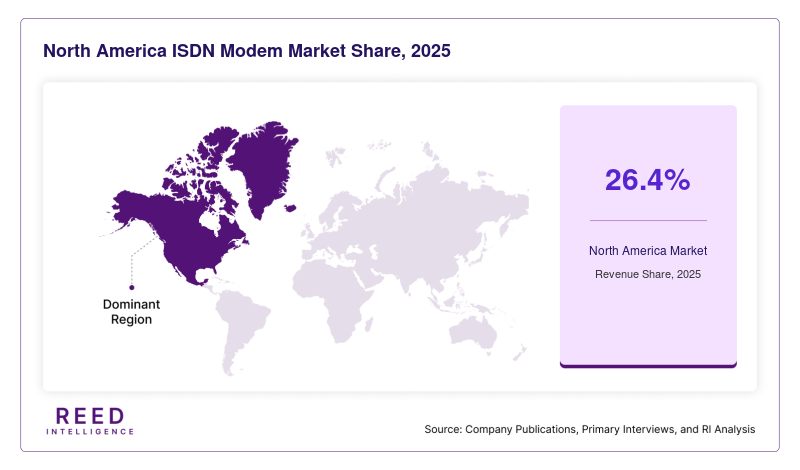
North America accounted for 26.4% of the Isdn Modem Market share in 2025 and is projected to grow at a CAGR of 4.5% during 2026–2034. The region maintains demand for ISDN modem technologies within government communication networks, financial institutions, and industrial monitoring environments. Organizations continue utilizing established communication infrastructure to support mission-critical operations.
The United States dominated the regional market due to the continued deployment of backup communication systems across utilities, transportation networks, and emergency management agencies. Investments in communication redundancy programs contributed to stable demand.
Europe
Europe held the largest market share of 34.6% in 2025 and is anticipated to expand at a CAGR of 4.7% through 2034. The region benefits from extensive deployment of legacy telecommunications infrastructure across industrial and public-sector environments. Demand remains supported by organizations extending the operational lifecycle of existing communication networks.
Germany remained the dominant country due to widespread utilization of industrial automation systems requiring dependable communication connectivity. Strong manufacturing activity and established telecommunications infrastructure supported market growth.
Asia Pacific
Asia Pacific represented 24.8% of the global market in 2025 and is forecast to register the fastest CAGR of 6.4% during 2026–2034. Rapid industrial development and ongoing deployment of communication infrastructure across developing economies continue to support demand for ISDN modem solutions.
China led the regional market owing to the presence of large industrial facilities and expanding infrastructure monitoring requirements. Continued modernization of industrial communication networks has encouraged adoption of hybrid modem solutions.
Middle East & Africa
The Middle East & Africa accounted for 7.1% market share in 2025 and is expected to grow at a CAGR of 5.1% over the forecast period. The market is supported by investments in utility infrastructure, transportation systems, and government communication networks requiring reliable connectivity.
Saudi Arabia emerged as the leading national market due to increasing deployment of communication technologies within energy and utility sectors. Infrastructure modernization programs contributed to ongoing demand.
Latin America
Latin America captured 7.1% market share in 2025 and is projected to expand at a CAGR of 5.3% between 2026 and 2034. Demand is primarily driven by industrial communication applications and utility monitoring systems operating in remote locations where dependable connectivity remains essential.
Brazil dominated the regional market due to ongoing investments in industrial automation and communication network resilience initiatives. Utility operators continued implementing backup communication infrastructure across critical facilities.
Competitive Landscape
The Isdn Modem Market remains moderately fragmented, with established communication equipment manufacturers focusing on product reliability, interoperability, and infrastructure modernization capabilities. Companies are developing hybrid modem solutions that integrate traditional ISDN functionality with modern IP networking technologies to address evolving customer requirements.
Cisco Systems, Inc. remains a leading market participant due to its broad communication infrastructure portfolio and extensive enterprise customer base. The company recently expanded support for integrated communication gateway solutions designed to facilitate migration between legacy ISDN environments and next-generation digital communication networks.
Other key players continue emphasizing strategic partnerships, technical support services, and product enhancement initiatives to strengthen market positioning. Vendors are increasingly targeting industrial automation, utility communication, and network resilience applications where dependable connectivity remains a priority.
Key Players List
- Cisco Systems, Inc.
- ADTRAN Holdings, Inc.
- Digi International Inc.
- Multi-Tech Systems, Inc.
- Eicon Networks Corporation
- Patton Electronics Co.
- Zyxel Communications Corp.
- AVM Computersysteme Vertriebs GmbH
- Westermo Network Technologies AB
- DrayTek Corporation
- TP-Link Technologies Co., Ltd.
- Allied Telesis, Inc.
- RAD Data Communications Ltd.
- Teltonika Networks
- Black Box Corporation
Recent Developments
- In 2025, several manufacturers introduced hybrid communication gateways supporting both ISDN and IP-based connectivity to facilitate infrastructure modernization projects.
- Vendors expanded remote management capabilities for industrial modem solutions, improving monitoring efficiency and operational reliability.
- Utility operators increased deployment of backup communication systems utilizing ISDN technologies to strengthen infrastructure resilience.
- Communication equipment suppliers enhanced cybersecurity features within modem platforms to support secure data transmission requirements.
- Strategic partnerships between industrial automation providers and modem manufacturers accelerated deployment of integrated communication solutions across critical infrastructure environments.
ISDN Modem Market Segments
Type
- External ISDN Modems
- Internal ISDN Modems
- ISDN Terminal Adapters
- Integrated ISDN Communication Gateways
Interface Type
- Basic Rate Interface (BRI) Modems
- Primary Rate Interface (PRI) Modems
Application
- Industrial Communication Systems
- Network Backup & Disaster Recovery
- Remote Monitoring & Control
- Financial Transaction Networks
- Government & Public Safety Communications
- Others
End User
- Telecommunications & Network Service Providers
- Government Organizations
- Utilities & Energy Operators
- Manufacturing Companies
- Financial Institutions
- Transportation & Logistics
By Region
- North America
- Europe
- APAC
- Middle East and Africa
- LATAM