ISO Tank Container Market Size, Share & Demand Report By Tank Type (Standard ISO Tank Containers, Reefer Tank Containers, Heated Tank Containers, Gas Tank Containers), By Application (Industrial Gas Transportation, Petrochemical Transportation), By End User (Food Processing Companies, Pharmaceutical & Biotechnology Companies, Oil & Gas Companies, Logistics Service Providers), By Region & Segment Forecasts, 2026–2034
USD 3950
Market Overview
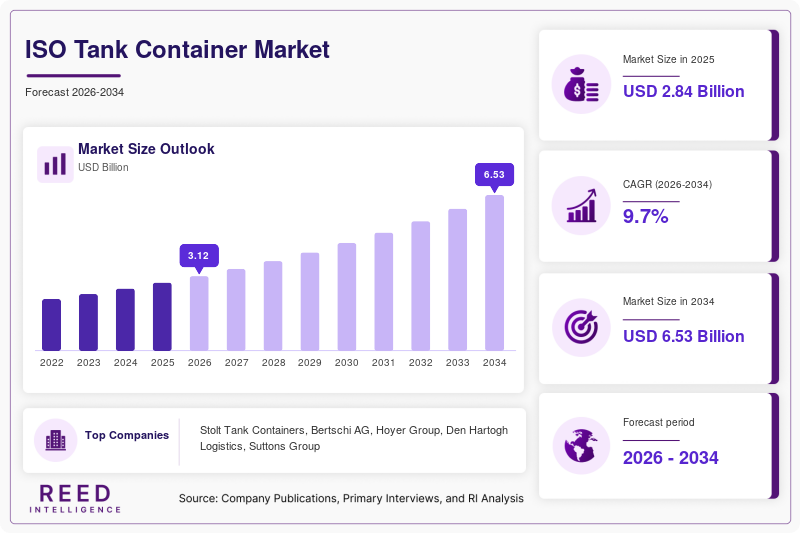
The global ISO Tank Container Market size was valued at USD 2.84 billion in 2026 and is projected to reach USD 5.97 billion by 2034, expanding at a CAGR of 9.7% during 2026–2034. The market continues to gain momentum as international trade volumes increase and industries seek safer, more efficient, and sustainable methods for transporting bulk liquids, gases, and hazardous chemicals. ISO tank containers have emerged as a preferred logistics solution due to their ability to reduce cargo handling risks, improve operational efficiency, and comply with international transportation standards.
Growing cross-border trade of chemicals, food-grade liquids, pharmaceuticals, and industrial gases has significantly contributed to market expansion. Manufacturers and logistics providers are increasingly investing in specialized tank containers capable of handling temperature-sensitive and hazardous materials. The adoption of multimodal transportation systems combining road, rail, and sea freight has further strengthened demand, as ISO tank containers enable seamless cargo movement without repeated loading and unloading procedures.
Key Highlights
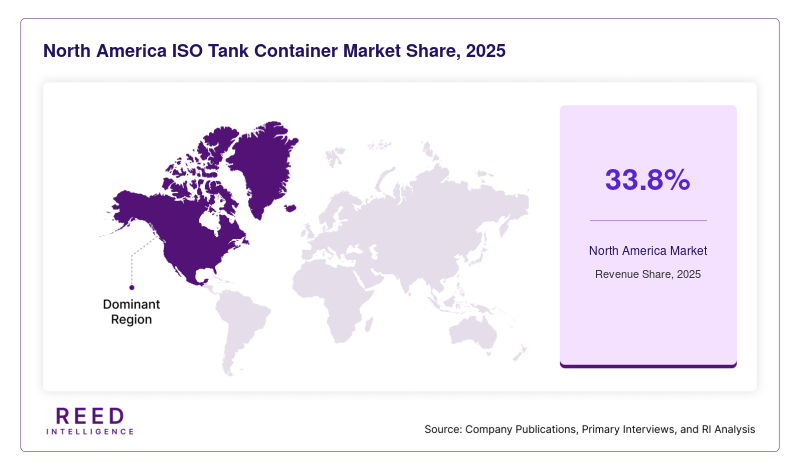
- North America dominated the market with a 33.8% share in 2025.
- while Asia Pacific is expected to grow at the fastest CAGR of 11.4% during 2026–2034.
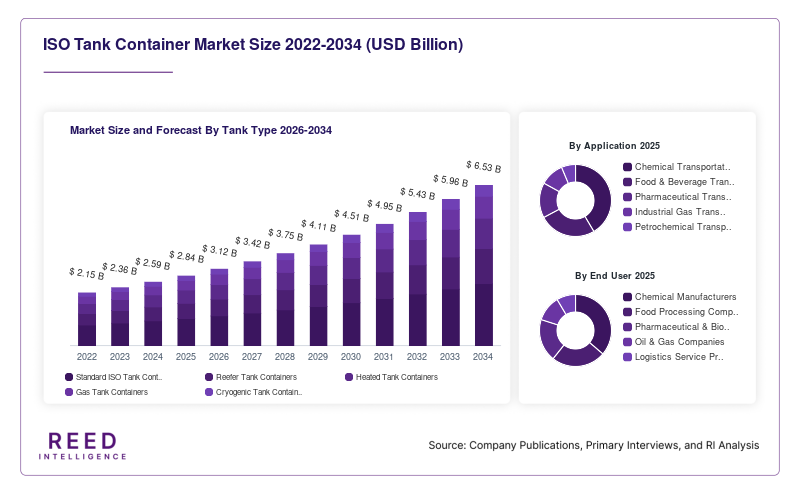
- By tank type, standard ISO tank containers accounted for the largest share of 46.7%.
- while reefer and heated tank containers are projected to grow at a CAGR of 12.2%.
- By application, chemical transportation led with a 44.9% share.
- whereas pharmaceutical transportation is expected to expand at a CAGR of 12.8%.
- The United States remained the dominant country, with market values of USD 645 million in 2024 and USD 703 million in 2025.
Market Trends
Digitalization of Tank Fleet Operations
Digital transformation is becoming a defining trend in the ISO Tank Container Market as fleet operators seek greater visibility across complex transportation networks. Companies are increasingly integrating telematics devices, GPS tracking systems, and cloud-based fleet management platforms into tank container operations. These technologies provide real-time information regarding location, temperature, pressure levels, cargo conditions, and maintenance requirements. Enhanced visibility helps reduce delays, optimize route planning, and improve customer service levels across international logistics chains.
The growing use of predictive analytics is also enabling operators to reduce downtime through proactive maintenance scheduling. Chemical and pharmaceutical companies benefit from improved cargo monitoring and compliance reporting capabilities. As supply chains become more data-driven, digital technologies are expected to become standard features in modern ISO tank fleets. This trend is encouraging investments in smart containers capable of supporting advanced monitoring functions and improving overall transportation efficiency.
Rising Preference for Sustainable Bulk Transportation
Sustainability initiatives across logistics and manufacturing industries are increasing the adoption of reusable ISO tank containers. Compared with drums, intermediate bulk containers, and single-use packaging, ISO tank containers reduce packaging waste while enabling higher cargo utilization. Businesses are actively seeking transportation solutions that align with environmental targets and support carbon reduction strategies.
Governments and regulatory authorities are also promoting sustainable freight transportation practices. ISO tank containers support multimodal transportation systems, reducing the need for excessive cargo handling and minimizing product loss. Their long operational lifespan further contributes to resource efficiency. Growing environmental awareness among shippers and logistics providers is encouraging fleet modernization programs focused on durable and recyclable transport assets. As organizations prioritize sustainable supply chains, demand for ISO tank containers is expected to strengthen steadily throughout the forecast period.
Market Drivers
Expansion of Global Chemical Trade
The continued expansion of international chemical production and trade remains a major driver of the ISO Tank Container Market. Chemical manufacturers require safe and standardized transportation systems capable of handling hazardous and non-hazardous liquid products across long distances. ISO tank containers provide superior safety features, lower contamination risks, and compliance with international transportation regulations, making them a preferred choice for chemical logistics operations.
Rapid industrialization across emerging economies is increasing demand for specialty chemicals, petrochemicals, solvents, and industrial liquids. Many manufacturers are expanding export activities to meet growing global demand, resulting in higher requirements for efficient bulk transportation solutions. The ability of ISO tank containers to support intermodal transportation further enhances their attractiveness. As chemical supply chains become increasingly international, transportation providers continue to expand their ISO tank fleets to accommodate rising cargo volumes and regulatory requirements.
Growth of Pharmaceutical and Food-Grade Logistics
The transportation of pharmaceutical ingredients, food products, edible oils, and beverage concentrates is creating significant demand for specialized ISO tank containers. These industries require strict hygiene standards, temperature control capabilities, and contamination-free transportation systems. ISO tank containers provide reliable solutions for maintaining product integrity throughout international supply chains.
Growing pharmaceutical manufacturing activity in Asia Pacific, North America, and Europe is increasing the movement of liquid active ingredients and specialty formulations. Similarly, rising global consumption of food-grade liquid products is driving transportation demand. Manufacturers increasingly prefer dedicated tank containers that comply with industry-specific regulations and quality standards. The expansion of cold-chain infrastructure and the development of advanced insulated tank designs are further supporting market growth. These factors collectively strengthen the role of ISO tank containers in high-value and sensitive cargo transportation.
Market Restraint
High Capital Investment and Maintenance Requirements
Despite strong growth prospects, the ISO Tank Container Market faces challenges associated with substantial capital expenditure and ongoing maintenance costs. Purchasing specialized tank containers requires significant investment, particularly for fleets designed to transport hazardous chemicals, cryogenic gases, or temperature-sensitive products. Small and medium-sized logistics providers often face financial constraints when expanding fleet capacity, limiting market penetration in certain regions.
Maintenance requirements also add operational complexity. Tank containers must undergo periodic inspections, cleaning procedures, pressure testing, and certification processes to comply with international safety standards. Failure to meet regulatory requirements can result in operational disruptions and increased costs. For example, chemical transportation fleets often require extensive cleaning and validation procedures between shipments to prevent contamination. These requirements can reduce equipment utilization rates and increase operating expenses. While large operators can spread costs across extensive fleets, smaller companies may experience profitability pressures, creating a barrier to broader market adoption.
Market Opportunities
Development of Specialized Tank Container Solutions
The growing need for customized transportation solutions presents substantial opportunities within the ISO Tank Container Market. Industries handling cryogenic gases, pharmaceutical ingredients, food-grade liquids, and temperature-sensitive chemicals increasingly require specialized tank designs. Manufacturers are responding by developing insulated, heated, refrigerated, and pressure-controlled containers capable of meeting unique cargo requirements.
Specialized containers allow logistics providers to serve high-value market segments with premium service offerings. Demand for liquefied gases, biotechnology products, and advanced chemical compounds is expanding globally, creating opportunities for innovative tank technologies. Fleet operators investing in specialized assets can achieve higher utilization rates and improve profitability through differentiated service capabilities. As cargo diversity increases across international trade networks, demand for customized ISO tank solutions is expected to grow significantly.
Increasing Infrastructure Investments in Emerging Economies
Emerging economies across Asia Pacific, the Middle East, Latin America, and Africa are investing heavily in transportation infrastructure, ports, industrial zones, and logistics corridors. These developments create favorable conditions for the expansion of ISO tank container operations. Improved connectivity supports greater movement of bulk liquids and chemicals across domestic and international markets.
Industrial growth in developing countries is increasing demand for efficient logistics solutions capable of supporting manufacturing expansion. Governments are also encouraging foreign investment in chemical processing, pharmaceuticals, and food manufacturing industries. These sectors rely heavily on safe bulk transportation systems. As infrastructure quality improves and trade volumes rise, fleet operators gain access to new markets and distribution channels. The resulting increase in logistics activity is expected to generate long-term opportunities for ISO tank container manufacturers, leasing companies, and transportation service providers.
Segmental Analysis
By Tank Type
Standard ISO tank containers represented the dominant subsegment, accounting for approximately 46.7% of market revenue in 2024. Their widespread adoption is attributed to versatility, regulatory compliance, and suitability for transporting a broad range of chemicals, food-grade liquids, and industrial products. Standard tanks offer cost advantages and compatibility with existing multimodal transportation systems. Logistics providers favor these containers because they simplify fleet management and support diverse cargo requirements across international shipping routes. Growing demand for bulk liquid transportation continues to reinforce the position of standard ISO tank containers as the preferred industry solution.
Reefer and heated tank containers are projected to register the fastest growth, expanding at a CAGR of 12.2% through 2034. The increasing transportation of temperature-sensitive pharmaceuticals, specialty chemicals, and food ingredients is driving demand for advanced thermal management capabilities. These containers help maintain product quality and regulatory compliance during long-distance transportation. Investments in pharmaceutical production and biotechnology industries are creating additional growth opportunities. Enhanced insulation technologies and improved temperature monitoring systems are further increasing adoption among logistics providers seeking premium transportation solutions.
By Application
Chemical transportation emerged as the leading application segment, accounting for approximately 44.9% of global revenue in 2024. The segment benefits from strong demand for safe and compliant transportation of industrial chemicals, petrochemicals, solvents, and specialty compounds. ISO tank containers provide high safety standards, reduced contamination risks, and efficient cargo handling processes. Chemical manufacturers increasingly rely on intermodal transportation networks to support international trade activities. The continued expansion of global chemical production and export operations is expected to sustain strong demand within this application segment.
Pharmaceutical transportation is anticipated to be the fastest-growing application segment, expanding at a CAGR of 12.8% during the forecast period. Rising pharmaceutical production volumes and increasing global distribution of liquid active ingredients are supporting market expansion. Strict regulatory requirements related to product integrity and contamination control encourage the use of specialized tank containers. Growing investment in biotechnology research and advanced healthcare manufacturing is creating additional transportation requirements. The need for reliable cold-chain logistics solutions further contributes to segment growth.
By End User
Chemical manufacturing companies constituted the largest end-user segment, accounting for approximately 48.3% of market revenue in 2024. These organizations require dependable transportation systems capable of handling large volumes of hazardous and non-hazardous liquids. ISO tank containers help manufacturers optimize supply chain efficiency while maintaining compliance with international transportation regulations. Strong demand from petrochemical, specialty chemical, and industrial chemical producers continues to drive fleet utilization and equipment investment across global markets.
Pharmaceutical and biotechnology companies are expected to witness the fastest growth, recording a CAGR of 13.1% through 2034. Increasing global demand for healthcare products and liquid pharmaceutical ingredients is supporting transportation requirements. These organizations prioritize product quality, temperature control, and contamination prevention, making specialized ISO tank containers an attractive solution. Expanding research activities, biologics production, and international pharmaceutical trade are creating favorable conditions for sustained market growth. Continued innovation in healthcare logistics is expected to strengthen this segment further.
Regional Analysis
North America
North America accounted for approximately 33.8% of the global ISO Tank Container Market in 2025, making it the largest regional market. The region is expected to maintain steady growth at a CAGR of 8.8% through 2034. Strong chemical manufacturing capabilities, advanced transportation infrastructure, and widespread adoption of multimodal logistics systems continue to support demand. The presence of major tank container leasing companies and logistics providers further contributes to regional market strength.
The United States remains the dominant country within the region. A key growth factor is the country's extensive petrochemical production network, which generates substantial demand for bulk liquid transportation. Rising exports of specialty chemicals and industrial gases have encouraged fleet expansion and investment in technologically advanced tank containers. Increasing supply chain digitization also supports market development.
Europe
Europe represented approximately 27.4% of global market revenue in 2025 and is projected to expand at a CAGR of 8.9% during the forecast period. The region benefits from mature transportation infrastructure, strict safety regulations, and strong cross-border trade activity. Chemical manufacturers across Europe increasingly utilize ISO tank containers to comply with environmental and safety standards while optimizing logistics efficiency.
Germany remains the leading national market in Europe. A major growth factor is the country's advanced chemical manufacturing sector and strong export orientation. German companies continue to invest in sustainable transportation practices and fleet modernization initiatives. Demand for specialized tank containers capable of handling high-value chemicals is supporting long-term regional expansion.
Asia Pacific
Asia Pacific held approximately 24.6% of the global market in 2025 and is expected to record the fastest CAGR of 11.4% through 2034. Rapid industrialization, manufacturing expansion, and increasing international trade activities are driving regional demand. Growth in chemical production, pharmaceutical manufacturing, and food processing industries continues to create significant opportunities for tank container operators.
China dominates the Asia Pacific market. The country's large-scale industrial base and expanding export activities generate substantial transportation requirements for chemicals and liquid commodities. Investments in logistics infrastructure, port modernization, and international trade corridors are strengthening market prospects. Rising demand for safe and efficient bulk transportation solutions further accelerates adoption.
Middle East & Africa
The Middle East & Africa accounted for approximately 7.5% of global revenue in 2025 and is anticipated to grow at a CAGR of 9.5% through 2034. Expanding petrochemical industries and increasing investments in logistics infrastructure are supporting market growth. Governments across the region are implementing diversification strategies that encourage industrial development and international trade.
Saudi Arabia represents the largest country market within the region. A key growth factor is the expansion of petrochemical production capacity and export activities. Large industrial projects and logistics corridor developments are increasing demand for bulk liquid transportation solutions. The country's strategic position in global trade networks further enhances market opportunities.
Latin America
Latin America captured approximately 6.7% of global market revenue in 2025 and is projected to grow at a CAGR of 9.1% during the forecast period. Economic development, industrial expansion, and increasing chemical trade are supporting demand for ISO tank containers. Improvements in transportation infrastructure and trade connectivity are also contributing to regional market growth.
Brazil remains the dominant country in Latin America. One unique growth factor is the country's expanding agricultural processing industry, which requires efficient transportation of food-grade liquids and related products. Rising industrial output and increasing export activities are encouraging logistics providers to invest in modern tank container fleets capable of supporting regional trade growth.
Competitive Landscape
The ISO Tank Container Market remains moderately consolidated, with leading participants focusing on fleet expansion, leasing services, technology integration, and strategic partnerships. Companies are investing in digital tracking capabilities, specialized tank designs, and global depot networks to improve operational efficiency and customer service. Competition is influenced by fleet size, geographic reach, asset quality, and compliance capabilities.
Stolt Tank Containers continues to maintain a leadership position due to its extensive global fleet, broad logistics network, and diversified service portfolio. Recent developments include investments in smart container technologies that improve cargo visibility and asset utilization. Other major participants are strengthening their market positions through acquisitions, fleet modernization initiatives, and expansion into emerging markets. The growing emphasis on sustainability and supply chain transparency is encouraging industry players to adopt innovative solutions that support long-term growth and operational excellence.
Key Players
- Stolt Tank Containers
- Bertschi AG
- Hoyer Group
- Den Hartogh Logistics
- Suttons Group
- NewPort Tank Containers
- Bulkhaul Limited
- Intermodal Tank Transport
- EXSIF Worldwide
- Eurotainer SA
- Raffles Lease
- Trifleet Leasing
- CSI Container Services International
- Peacock Container
- Sinotrans Limited
Recent Developments
- Stolt Tank Containers expanded its digital fleet monitoring platform to improve real-time cargo tracking and predictive maintenance capabilities.
- Hoyer Group increased investments in specialized tank containers designed for pharmaceutical and temperature-sensitive cargo transportation.
- Bertschi AG expanded logistics infrastructure capacity in Asia to support growing chemical transportation demand across regional markets.
- EXSIF Worldwide introduced additional sustainable fleet management initiatives focused on improving equipment utilization and reducing operational emissions.
- Den Hartogh Logistics strengthened its intermodal transportation network through strategic partnerships aimed at enhancing global service coverage.
ISO Tank Container Market Segments
By Tank Type
- Standard ISO Tank Containers
- Reefer Tank Containers
- Heated Tank Containers
- Gas Tank Containers
- Cryogenic Tank Containers
By Application
- Chemical Transportation
- Food & Beverage Transportation
- Pharmaceutical Transportation
- Industrial Gas Transportation
- Petrochemical Transportation
By End User
- Chemical Manufacturers
- Food Processing Companies
- Pharmaceutical & Biotechnology Companies
- Oil & Gas Companies
- Logistics Service Providers
By Region
- North America
- Europe
- APAC
- Middle East and Africa
- LATAM