Isobornyl Acrylate Market Size, Share & Trends Analysis Report By Purity (≥99%, Below 99%), By Application (Adhesives, Coatings, Inks, Plastics, Others), By End-User Industry (Automotive, Electronics, Construction, Packaging, Others), and By Region (North America, Europe, Asia Pacific, Latin America, Middle East & Africa) Forecasts, 2026–2034
USD 3950
Isobornyl Acrylate Market Size
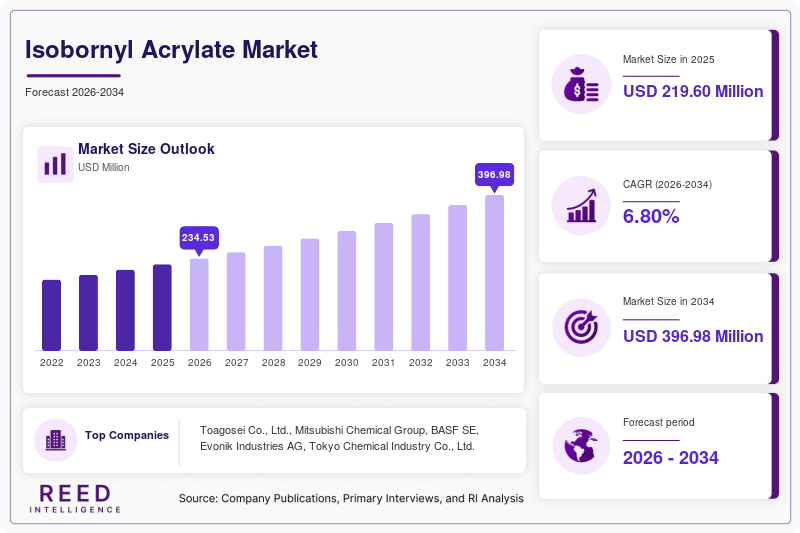
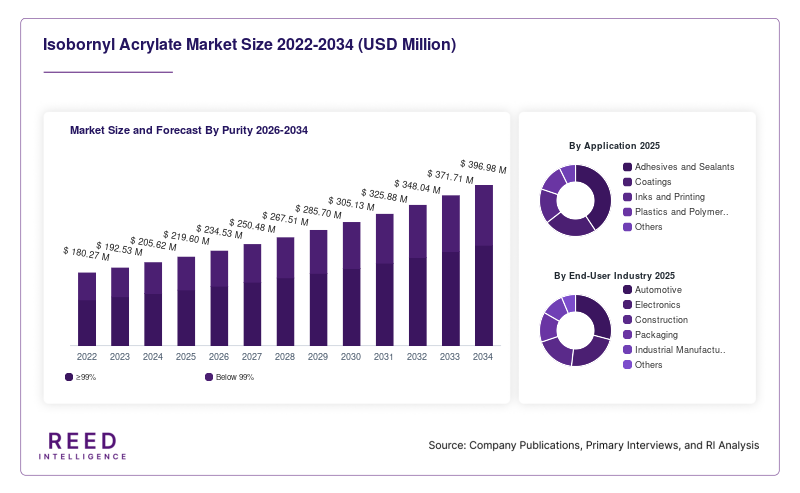
The global isobornyl acrylate market size was valued at USD 219.60 million in 2025 and is projected to grow from USD 234.53 million in 2026 to USD 396.98 million by 2034, registering a CAGR of 6.80% during the forecast period from 2026 to 2034.
sobornyl acrylate market is linked to demand for specialty acrylic monomers used in UV-curable coatings, inks, adhesives, optical materials, and selected polymer formulations. Isobornyl acrylate (IBOA) is valued in formulations where low volatility, a rigid molecular structure, weatherability, and film-performance characteristics are important. Its commercial demand therefore depends not only on overall coatings and adhesives consumption but also on whether formulators need the specific performance characteristics that IBOA can provide.
UV-curable formulations are an important demand channel because manufacturers use reactive monomers to adjust viscosity, crosslinking behavior, hardness, adhesion, and other finished-product properties. These requirements arise in printing, electronics, industrial finishing, and specialty coatings. IBOA can also be considered in formulations that seek to balance hardness with flexibility, although performance depends on the complete formulation rather than on the monomer alone.
Isobornyl Acrylate Market Drivers
UV-Curable Coatings and Inks Expand Demand for Reactive Monomers
The adoption of UV- and electron-beam-curable formulations supports demand for IBOA because formulators use reactive diluents to adjust viscosity and cured-film properties. Arkema's Sartomer technical documentation describes IBOA as a reactive diluent whose cyclic structure contributes to polymers with high glass-transition temperatures. Osaka Organic Chemical Industry also identifies applications in UV diluents, inks, pressure-sensitive adhesives, and coating resins.
The commercial mechanism is formulation-specific: when a coating or ink requires a particular combination of hardness, adhesion, flexibility, and curing performance, IBOA can be selected as one component of the formulation. This supports repeat demand from qualified industrial customers. However, the extent of substitution depends on competing monomers, formulation costs, and final-product testing. UV-curable systems do not automatically require IBOA, so growth in curing technology translates into IBOA demand only where its performance characteristics justify its use.
Specialty Polymer Formulations Support Performance-Led Purchasing
IBOA's relatively rigid bicyclic structure and monofunctional acrylate chemistry make it useful in polymer formulations where thermal performance, hardness, and flexibility must be balanced. Allnex's technical documentation describes IBOA-containing UV- and electron-beam-curable formulations as capable of delivering increased glass-transition temperature, low shrinkage, water resistance, and a combination of flexibility and impact resistance, depending on the complete formulation.
These properties create demand in specialty coatings, adhesives, printing inks, and advanced polymer modification. Buyers often evaluate monomers based on the performance of the cured formulation rather than purchase price alone. Once a formulation has been qualified, changing the monomer may require renewed compatibility, curing, and performance testing. That can support supplier continuity, although cost pressure and alternative monomers can still prompt reformulation.
Bio-Based Feedstock Options Create Product Differentiation
Some suppliers offer IBOA products with documented bio-based carbon content. Tokyo Chemical Industry lists a stabilized IBOA grade described as containing approximately 76% plant-based carbon. This gives formulators an option to investigate where feedstock origin is relevant to product-sustainability targets or customer specifications.
The commercial effect depends on the full product life cycle, the availability and traceability of bio-based inputs, and the customer's willingness to pay for the associated attributes. Bio-based content alone does not establish lower overall environmental impact; that requires appropriate life-cycle evidence. Suppliers that combine documented feedstock attributes with consistent purity, performance, and supply reliability may differentiate their offerings, but uptake can be limited by price, certification requirements, and the availability of alternative materials.
Isobornyl Acrylate Market Restraints
Chemical Handling and Environmental Requirements Increase Compliance Costs
IBOA requires appropriate handling, storage, and exposure controls. Tokyo Chemical Industry's safety information identifies potential skin sensitization and significant aquatic hazards for its listed product, while supplier safety data sheets provide handling and disposal precautions. These considerations can increase costs associated with workplace protection, staff training, packaging, transport, and waste management.
For manufacturers and downstream formulators, compliance requirements can influence supplier qualification and plant procedures. Customers may request detailed safety documentation and consistent product specifications before approving a new source. Appropriate engineering controls and handling practices can mitigate risks, but they do not eliminate the need for compliance. Environmental and occupational requirements may also influence formulation choices where alternative materials can meet performance needs with a different risk profile.
Raw-Material Costs and Formulation Qualification Constrain Substitution
IBOA purchasing decisions depend on raw-material availability, supplier consistency, logistics, purity, inhibitor concentration, and the cost of qualifying a material for a specific formulation. Technical documentation from suppliers specifies quality characteristics such as purity, color, viscosity, and storage conditions, illustrating why grades cannot always be treated as interchangeable.
A change in supplier or grade can require laboratory testing and production-scale validation. This creates time and cost barriers for new entrants, particularly in applications where the finished product has demanding performance specifications. Conversely, once qualified, a supplier may benefit from repeat orders. The same qualification process can slow market expansion when customers defer reformulation or when higher-cost specialty monomers face pressure from lower-cost alternatives.
Isobornyl Acrylate Market Opportunities
Higher-Performance UV-Curable Formulations
A specific opportunity exists in formulations requiring a combination of low monomer viscosity, hardness, thermal performance, adhesion, and flexibility. Arkema and Osaka Organic Chemical Industry identify IBOA applications in UV-curable coatings, inks, adhesives, and coating resins. These documented uses provide a technical basis for targeting formulators whose products need the performance profile associated with IBOA.
The commercial opportunity is strongest when the monomer solves a formulation problem that competing ingredients do not address as efficiently. Suppliers can support adoption through application testing, compatibility guidance, and reliable quality control. However, an application opportunity should not be confused with guaranteed volume growth: formulators must validate curing conditions, final-film properties, safety requirements, and cost-in-use before expanding consumption.
Traceable Bio-Based Monomers and Specialized Grades
IBOA suppliers can pursue differentiation through documented bio-based feedstock content, higher-purity grades, and application-specific technical support. Tokyo Chemical Industry lists a plant-derived-carbon IBOA grade, while Osaka Organic Chemical Industry describes the compound's use in specialty coatings, UV adhesives, and inks.
For downstream customers, such options may help address product specifications or sustainability objectives, provided claims are supported by suitable documentation. Suppliers can strengthen their commercial offering through traceability, consistent batch quality, and transparent technical and safety information. Adoption may nevertheless be constrained by price premiums, certification needs, limited willingness to reformulate, and the need to substantiate environmental benefits across the relevant supply chain.
Isobornyl Acrylate Market Segmental Analysis
By Purity
≥99% Purity
High-purity IBOA is relevant to formulations where impurities, color, consistency, or other material characteristics can affect downstream processing and finished-product performance. Customers with tighter specifications may require more stringent quality documentation and batch consistency. Supplier qualification can be important because differences in purity and inhibitor content may affect storage, polymerization behavior, and formulation performance.
Estimated share: The ≥99% purity category is assigned approximately 58% of the purity-segment market. This reflects the assumed concentration of demand in higher-specification industrial formulations; a publicly verified market-share series specifically separating IBOA by these purity thresholds is not available.
Below 99% Purity
Below-99% grades can serve applications whose specifications permit a broader purity range. Purchasing decisions depend on the grade's measured characteristics, inhibitor package, intended use, and the quality requirements of the finished product. The lower purity threshold alone does not establish a lower price or suitability for any particular application; customers need to compare technical documentation and test performance.
Indicative CAGR: 5.9% during 2026–2034.
Purity Outlook
Higher-purity products are relevant where downstream customers require tighter material specifications, while lower-purity grades may remain suitable for less demanding uses. The actual distribution depends on end-use formulation requirements and supplier product portfolios. The 58% share is an analytical allocation for this report rather than a published industry statistic.
By Application
Coatings
Coatings are an important IBOA application because the monomer can contribute to cured-film hardness, thermal characteristics, and other formulation properties. Supplier technical documentation identifies IBOA for coating resins and UV diluents, including UV-curable formulations.
Demand depends on the performance needs of the coating, curing method, substrate, and the other ingredients used in the formulation. Industrial and specialty coatings can require a different balance of properties from general-purpose coatings, so IBOA adoption varies across individual product systems.
Adhesives and Sealants
IBOA is used in selected adhesives and sealants where formulation characteristics and cured-polymer performance justify its inclusion. Documented applications include pressure-sensitive and UV-curable adhesives.
Adoption depends on adhesion requirements, substrate compatibility, curing conditions, and the mechanical properties of the final adhesive. Qualification can support repeat purchasing, but formulation changes may be constrained by testing requirements and the availability of alternative reactive monomers.
Inks and Printing
Inks and printing formulations use IBOA where its compatibility and contribution to cured-film properties suit the printing system. The monomer is listed for UV ink applications in specialty chemical product portfolios.
Demand depends on the formulation, printing technology, substrate, curing conditions, and required resistance characteristics. The shift toward UV-curable products can expand the addressable application base, but the benefit to IBOA depends on whether formulators select it over alternative monomers.
Plastics and Polymer Modification
IBOA can be used as a monomer or formulation component in polymer modification. Its rigid cyclic structure can affect the properties of resulting polymers, but the outcome depends on polymer composition, reaction conditions, and the other monomers involved.
Commercial demand is linked to the performance requirements of the target polymer and the economic feasibility of incorporating IBOA. Adoption requires testing to establish that the resulting material meets application specifications.
By End-User Industry
Automotive
Automotive-related uses may include specialty coatings, adhesives, and polymer formulations that require specific hardness, adhesion, or durability characteristics. Demand is indirect: automotive production does not automatically translate into IBOA consumption because material choices depend on individual component and coating specifications.
The relevant commercial opportunity lies in formulations where IBOA provides a useful performance balance and passes application qualification. Vehicle production, coating technology, and supplier qualification cycles influence demand.
Electronics
Electronics applications may require specialty coatings, encapsulation-related materials, adhesives, and polymer formulations with controlled physical and electrical characteristics. IBOA can be considered where its contribution to the complete formulation meets the application's performance requirements.
The segment's demand depends on the material specifications of individual electronics applications, the curing process, and the availability of suitable alternative monomers. Qualification requirements can slow adoption but can also support continuity once a material is approved.
Construction
Construction-related demand may arise through coatings, adhesives, and polymer products used in building materials and industrial finishing. The relevant market mechanism is the use of IBOA in formulations requiring particular film or polymer characteristics, rather than construction activity alone.
Demand varies with the types of coatings and adhesives used, the technical requirements of the substrate, and the economics of the formulation.
Packaging
Packaging applications can involve printing inks, coatings, and adhesives, including selected UV-curable systems. IBOA demand depends on the formulation requirements and whether the monomer is compatible with the curing process, substrate, and end-use specifications.
Packaging customers may require consistent quality and appropriate safety documentation. The adoption of a particular monomer depends on the finished product and cannot be inferred from packaging production alone.
Industrial Manufacturing
Industrial manufacturing encompasses specialty coatings, adhesives, inks, and polymer modification applications across a range of products. Purchasing decisions are influenced by formulation performance, processing requirements, quality consistency, and supply reliability.
Industrial customers may maintain qualified suppliers to limit the need for repeated formulation testing. However, cost-reduction programs and product redesigns can lead to substitution when other monomers meet performance requirements.
Isobornyl Acrylate Market Regional Analysis
Asia Pacific Isobornyl Acrylate Market
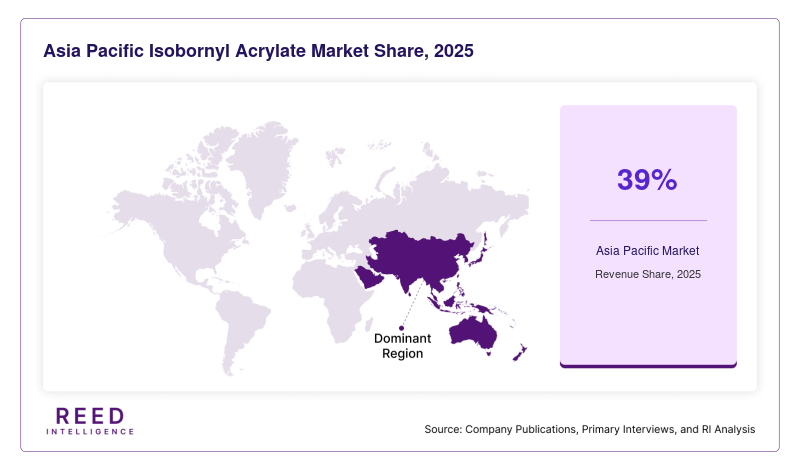
Asia Pacific is assigned an estimated 39% share of the global isobornyl acrylate market and is also projected to be the fastest-growing region, with an indicative CAGR of 7.7% during 2026–2034. The region's industrial manufacturing base, specialty chemical production, coatings demand, and expanding electronics supply chains provide channels for IBOA consumption. China, Japan, South Korea, and India are relevant markets because of their manufacturing, polymer, coatings, and industrial chemical activities.
Growth depends on whether downstream formulators adopt IBOA in performance-sensitive applications, rather than on manufacturing expansion alone. Japanese specialty chemical producers, Chinese chemical suppliers, South Korean industrial manufacturers, and Indian coatings and adhesive formulators represent potential customer groups. Competition from alternative monomers, supply consistency, handling requirements, and formulation qualification can constrain adoption. The regional share and CAGR above are analytical estimates aligned with the supplied global forecast; a comparable verified regional dataset was not identified.
North America Isobornyl Acrylate Market
North America is assigned an indicative CAGR of 6.2% for 2026–2034. Demand is associated with specialty coatings, UV-curable inks, adhesives, polymer modification, and industrial formulation activity. The United States is a key market for specialty chemical distribution and downstream industrial applications, while Canada and Mexico contribute through their manufacturing and industrial supply chains.
Purchasing decisions depend on formulation performance, product consistency, safety documentation, logistics, and the cost of qualifying new suppliers. Customers serving industrial and specialized applications may require detailed product specifications before changing monomer grades. Demand can be constrained by competition from alternative acrylates and by the cost of reformulation. A comparable, independently verified North American share of the global IBOA market is not available in the sources reviewed.
Europe Isobornyl Acrylate Market
Europe is assigned an indicative CAGR of 6.1% during 2026–2034. Demand channels include industrial coatings, printing inks, specialty adhesives, and polymer formulations. The region's chemical manufacturing and downstream formulation industries provide a customer base for monomers used to adjust cured-film properties. Established specialty chemical suppliers serve these applications with products for UV and electron-beam curing.
Germany, France, Italy, and the United Kingdom are relevant industrial and chemical markets, although their individual consumption shares cannot be established from the available evidence. Product selection depends on technical specifications, safety documentation, supply reliability, and the performance of competing ingredients. European customers may also assess feedstock traceability and sustainability attributes when qualifying specialty chemicals. The region's precise global market share is not assigned because a consistent, independently verified dataset was not identified.
Latin America Isobornyl Acrylate Market
Latin America is assigned an indicative CAGR of 6.4% during 2026–2034. Demand is linked to the regional use of coatings, adhesives, printing inks, and specialty polymer products. Brazil and Mexico are relevant markets for industrial formulations and manufacturing supply chains, while demand elsewhere depends on local industrial activity and the availability of specialty chemical distribution.
Market development depends on the ability of distributors and suppliers to provide suitable grades, consistent quality, technical documentation, and reliable delivery. Imported-product costs, currency movements, and the availability of local technical support can influence customer purchasing decisions. Because IBOA-specific regional consumption and trade data were not established in the reviewed evidence, the region's share of global demand remains unverified.
Middle East & Africa Isobornyl Acrylate Market
The Middle East & Africa region is assigned an indicative CAGR of 6.3% during 2026–2034. Potential demand is linked to industrial coatings, adhesives, printing inks, and specialty chemical formulations used in manufacturing and infrastructure-related applications. The commercial opportunity depends on the development of downstream formulation capacity and access to suitable specialty monomers, rather than on infrastructure spending alone.
Purchasing patterns depend on chemical distribution networks, import logistics, product handling requirements, and access to technical support. Some customers may favor established suppliers because material qualification and formulation changes require testing. The region's market share and the relative contributions of individual countries cannot be reliably quantified from the available public evidence. The CAGR stated here is an analytical estimate aligned with the global outlook, not an independently published regional forecast.
Isobornyl Acrylate Market Competitive Landscape
The isobornyl acrylate market consists of specialty monomer manufacturers, acrylate suppliers, and chemical distributors serving coatings, adhesives, inks, and polymer producers. Competition depends on product consistency, purity, technical documentation, production reliability, geographic availability, and the ability to support customer formulation work.
Arkema's Sartomer business offers IBOA for reactive-diluent applications. Its technical documentation describes the monomer's role in producing polymers with high glass-transition temperatures, giving the supplier a performance-oriented proposition for UV-curable formulations. Osaka Organic Chemical Industry identifies applications in high-solids coatings, painting resins, pressure-sensitive adhesives, UV adhesives, and inks. These portfolios demonstrate established application coverage, although public evidence reviewed here does not quantify either company's share of the global IBOA market.
Isobornyl Acrylate Market Competitive Landscape
The isobornyl acrylate market consists of specialty monomer manufacturers, acrylate suppliers, and chemical distributors serving coatings, adhesives, inks, and polymer producers. Competition depends on product consistency, purity, technical documentation, production reliability, geographic availability, and the ability to support customer formulation work.
Arkema's Sartomer business offers IBOA for reactive-diluent applications. Its technical documentation describes the monomer's role in producing polymers with high glass-transition temperatures, giving the supplier a performance-oriented proposition for UV-curable formulations. Osaka Organic Chemical Industry identifies applications in high-solids coatings, painting resins, pressure-sensitive adhesives, UV adhesives, and inks. These portfolios demonstrate established application coverage, although public evidence reviewed here does not quantify either company's share of the global IBOA market.
Key Market Players
- Arkema Group (Sartomer)
- Osaka Organic Chemical Industry Ltd.
- Allnex
- Tokyo Chemical Industry Co., Ltd.
- BASF SE
- Mitsubishi Chemical Group
- Toagosei Co., Ltd.
- Shin-Nakamura Chemical Co., Ltd.
- Nippon Shokubai Co., Ltd.
- Wanhua Chemical Group Co., Ltd.
- IGM Resins B.V.
- Merck KGaA
- Thermo Fisher Scientific
- G.J. Chemical Co., Inc.
- Parchem Fine and Specialty Chemicals
- Silver Fern Chemical, Inc.
- VONBIO Co., Ltd.
Recent Market Developments
-
February 2026 - Arkema announces a revised business-segment structure: Arkema’s full-year 2025 results announced changes to its reporting structure, including a Primary Materials segment covering its global acrylic monomers business. This is a broader corporate development relevant to the acrylic monomer supply landscape, not a confirmed Isobornyl Acrylate-specific launch.
-
July 2025 - Osaka Organic Chemical Industry outlines acrylic monomer development and capacity initiatives: The company’s investor materials discuss improving production efficiency, strengthening overseas sales channels, and developing bio-based acrylates. These broader acrylic-monomer initiatives are relevant to the supply landscape, although the document does not confirm an IBOA-specific capacity expansion.
Isobornyl Acrylate Market Segments
By Purity
- ≥99%
- Below 99%
By Application
- Adhesives and Sealants
- Coatings
- Inks and Printing
- Plastics and Polymer Modification
- Others
By End-User Industry
- Automotive
- Electronics
- Construction
- Packaging
- Industrial Manufacturing
- Others
By Region
- North America
- Europe
- APAC
- Middle East and Africa
- LATAM