Isobutyl Stearate Market Size, Share & Demand Report By Type (Bio-based, Synthetic), By Application (Personal Care & Cosmetics, Pharmaceuticals, Industrial Lubricants, Others), By End-Use Industry (Cosmetics, Pharmaceuticals, Industrial), By Distribution Channel (Direct Sales, Distributors, Online), By Region & Segment Forecasts, 2025–2034
USD 3950
Market Overview
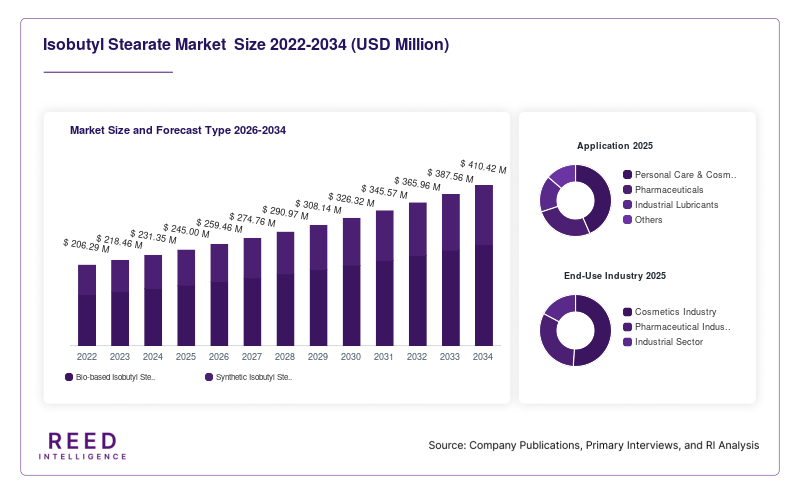
The global Isobutyl Stearate Market size was valued at USD 245 million in 2025 and is projected to reach approximately USD 412 million by 2034, expanding at a CAGR of 5.9% during the forecast period (2025–2034). The market growth is supported by the rising global demand for emollients and lubricants across cosmetics, personal care, and industrial applications. Isobutyl stearate, a fatty acid ester, is widely used due to its non-greasy texture, excellent spreading properties, and biodegradability, making it suitable for formulations aligned with evolving consumer preferences.
A key global factor driving the Isobutyl Stearate Market is the increasing shift toward bio-based and sustainable ingredients across industries. Regulatory frameworks and consumer awareness have encouraged manufacturers to adopt eco-friendly alternatives, thereby boosting the adoption of naturally derived esters like isobutyl stearate. Additionally, growth in personal care and cosmetics consumption across emerging economies continues to support long-term demand.
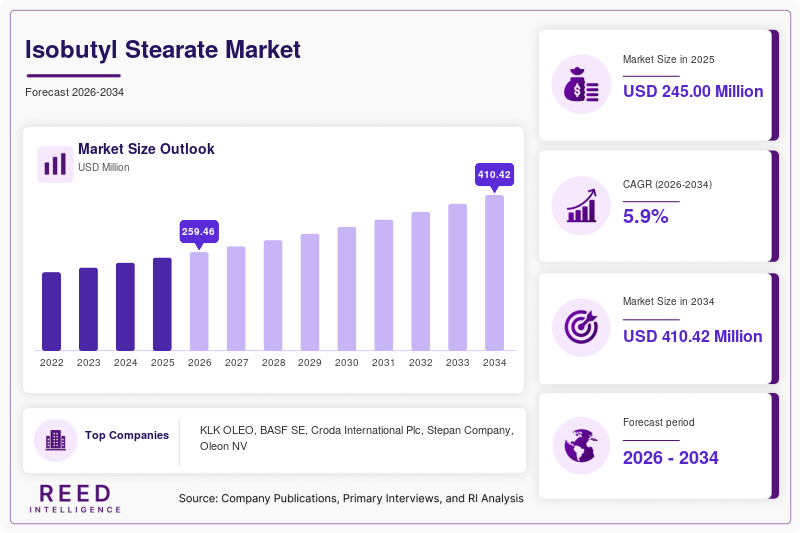
Key Highlights
- Asia Pacific dominated the market with a 38.6% share in 2025, while it is projected to be the fastest-growing region at a CAGR of 6.8%.
- By application, personal care & cosmetics accounted for the largest share (42.3%), while pharmaceutical applications are expected to grow fastest at a CAGR of 6.5%.
- By type, bio-based isobutyl stearate held the dominant share (61.2%), while synthetic variants are projected to grow at a CAGR of 5.1%.
- The United States led the market, valued at USD 52 million in 2025 and expected to reach USD 55.4 million in 2026.
Market Trends
Rising Demand for Bio-Based Ingredients
The Isobutyl Stearate Market is witnessing a growing preference for bio-based variants derived from natural fatty acids. Consumers are increasingly aware of product ingredients, especially in personal care and cosmetics. This has encouraged manufacturers to reformulate products using sustainable esters. Bio-based isobutyl stearate aligns with regulatory requirements and brand positioning focused on eco-conscious formulations. As sustainability becomes central to product development strategies, this trend is expected to continue shaping market dynamics.
Expansion of Multi-Functional Ingredient Usage
Manufacturers are increasingly adopting isobutyl stearate as a multifunctional ingredient across applications. Its ability to act as an emollient, lubricant, and dispersing agent makes it suitable for diverse end-use industries. In cosmetics, it enhances texture and spreadability, while in industrial applications, it improves lubrication efficiency. This trend reduces the need for multiple additives, simplifying formulations and reducing costs. As product innovation intensifies, the multifunctional benefits of isobutyl stearate are expected to drive its broader adoption.
Market Drivers
Growth in Personal Care and Cosmetics Industry
The expansion of the global personal care and cosmetics sector is a major driver for the Isobutyl Stearate Market. Increasing disposable income, urbanization, and changing lifestyles have led to higher consumption of skincare, haircare, and cosmetic products. Isobutyl stearate is widely used in creams, lotions, and makeup products due to its lightweight and non-oily characteristics. As consumers demand premium and effective formulations, manufacturers are incorporating high-performance ingredients, thereby boosting market growth.
Increasing Industrial Lubricant Applications
Isobutyl stearate is gaining traction as a lubricant in industrial applications due to its biodegradability and performance efficiency. Industries are shifting toward environmentally friendly lubricants to comply with environmental regulations. Its ability to reduce friction and enhance machinery efficiency has increased its adoption across manufacturing sectors. The demand for sustainable industrial solutions continues to support the steady growth of the Isobutyl Stearate Market.
Market Restraint
Volatility in Raw Material Prices
The Isobutyl Stearate Market faces challenges due to fluctuations in raw material prices, particularly fatty acids and alcohol derivatives. These raw materials are often derived from natural sources such as vegetable oils, which are subject to supply disruptions and price volatility influenced by climatic conditions and geopolitical factors. Such fluctuations impact production costs and profit margins for manufacturers.
Additionally, inconsistent pricing creates uncertainty in supply chains, making it difficult for manufacturers to maintain stable pricing strategies. Smaller manufacturers are particularly affected, as they may lack the resources to absorb cost variations. This restraint limits market expansion, especially in price-sensitive regions where cost efficiency is a key purchasing factor.
Market Opportunities
Expansion in Pharmaceutical Formulations
The use of isobutyl stearate in pharmaceutical applications is emerging as a promising opportunity. It is increasingly used as an excipient and carrier in topical formulations due to its skin-friendly properties. The growing demand for dermatological products and topical treatments is expected to create new growth avenues. As pharmaceutical companies focus on improving product efficacy and patient experience, the adoption of high-quality excipients like isobutyl stearate is expected to increase.
Growth in Emerging Economies
Emerging markets in Asia Pacific, Latin America, and Africa present significant growth opportunities for the Isobutyl Stearate Market. Rapid urbanization, rising middle-class population, and increasing consumer awareness are driving demand for personal care and industrial products. Local manufacturing expansion and favorable government policies are further supporting market growth. These regions offer untapped potential for manufacturers looking to expand their global footprint.
Segmental Analysis
By Type
Bio-based isobutyl stearate dominated the Isobutyl Stearate Market with a 61.2% share in 2025 due to its alignment with sustainability trends and regulatory compliance.
Synthetic isobutyl stearate is projected to grow at a CAGR of 5.1%, driven by its cost-effectiveness and consistent quality, making it suitable for industrial applications.
By Application
Personal care & cosmetics accounted for the largest share of 42.3% in 2025, supported by its widespread use in skincare and haircare formulations.
Pharmaceutical applications are expected to grow at a CAGR of 6.5% due to increasing demand for topical formulations and dermatological products.
By End-Use Industry
The cosmetics industry dominated with a 39.7% share in 2025, driven by increasing product innovation and consumer demand for premium formulations.
The pharmaceutical industry is projected to grow at a CAGR of 6.3%, supported by rising healthcare expenditure and demand for advanced formulations.
By Distribution Channel
Direct sales held the largest share of 58.4% in 2025 due to strong relationships between manufacturers and industrial buyers.
Online distribution channels are expected to grow at a CAGR of 6.7%, driven by increasing digitalization and ease of procurement.
Regional Analysis
North America
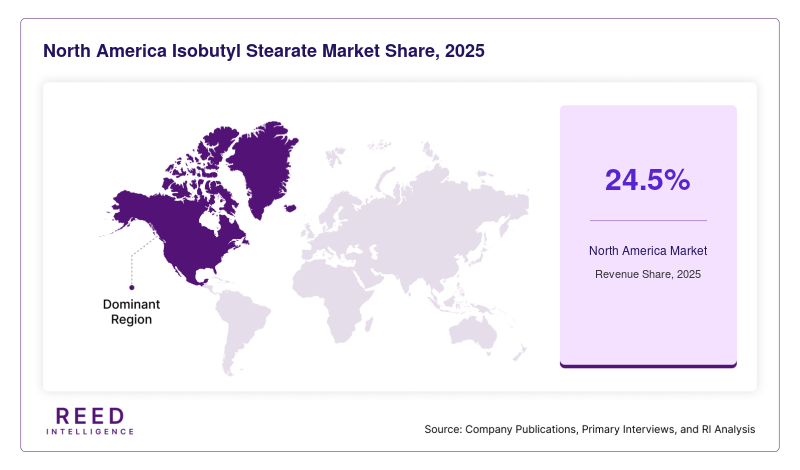
North America accounted for 24.5% of the Isobutyl Stearate Market share in 2025 and will grow at a CAGR of 5.2% during the forecast period. The region’s growth is driven by established personal care and pharmaceutical industries.
The United States dominated the regional market due to advanced manufacturing capabilities and high consumer demand for premium cosmetic products. The country’s strong focus on product innovation and regulatory compliance supported steady growth.
Europe
Europe held a 21.8% share of the Isobutyl Stearate Market in 2025 and is expected to grow at a CAGR of 5.4%. The region’s emphasis on sustainability and eco-friendly formulations has driven demand for bio-based esters.
Germany led the market, supported by its robust chemical manufacturing sector. The country’s focus on green chemistry and sustainable production processes contributed to increased adoption of isobutyl stearate.
Asia Pacific
Asia Pacific dominated the Isobutyl Stearate Market with a 38.6% share in 2025 and is projected to grow at a CAGR of 6.8%. Rapid industrialization and expanding personal care industries are key growth drivers.
China emerged as the leading country due to large-scale production and increasing domestic consumption. The country’s growing cosmetics industry and export capabilities supported market expansion.
Middle East & Africa
The Middle East & Africa accounted for 7.2% of the market in 2025 and will grow at a CAGR of 5.6%. Increasing demand for personal care products and industrial lubricants is driving growth.
Saudi Arabia dominated the region, supported by investments in industrial diversification. The country’s focus on expanding its chemical sector contributed to market growth.
Latin America
Latin America held a 7.9% share in 2025 and is expected to grow at a CAGR of 5.7%. Rising consumer awareness and increasing demand for cosmetics are key factors.
Brazil led the regional market due to its large population and growing beauty industry. The country’s expanding middle class supported increased consumption of personal care products.
Competitive Landscape
The Isobutyl Stearate Market is moderately fragmented, with several global and regional players competing based on product quality, pricing, and innovation. Leading companies focus on expanding their product portfolios and enhancing production capabilities.
The market leader, KLK OLEO, has strengthened its position through continuous investment in sustainable product development. The company recently introduced advanced bio-based ester solutions to meet growing demand for eco-friendly ingredients.
Other players are focusing on strategic partnerships, mergers, and geographic expansion to enhance their market presence. Innovation in formulation and supply chain optimization remains a key competitive strategy across the industry.
Key Players List
- KLK OLEO
- BASF SE
- Croda International Plc
- Stepan Company
- Oleon NV
- Vantage Specialty Chemicals
- IOI Oleochemical Industries
- Godrej Industries Ltd.
- Emery Oleochemicals
- Wilmar International Limited
- Kao Corporation
- Musim Mas Group
- Ecogreen Oleochemicals
- P&G Chemicals
- SABIC
Recent Developments
- 2024: KLK OLEO expanded its bio-based ester production capacity to meet rising demand.
- 2024: BASF SE introduced new sustainable emollient formulations for personal care.
- 2023: Croda International Plc invested in green chemistry research initiatives.
- 2023: Godrej Industries Ltd. expanded its oleochemical production facilities in Asia.
- 2023: Emery Oleochemicals launched new specialty ester products targeting pharmaceutical applications.
Isobutyl Stearate Market Segments
Type
- Bio-based Isobutyl Stearate
- Synthetic Isobutyl Stearate
Application
- Personal Care & Cosmetics
- Pharmaceuticals
- Industrial Lubricants
- Others
End-Use Industry
- Cosmetics Industry
- Pharmaceutical Industry
- Industrial Sector
Distribution Channel
- Direct Sales
- Distributors
- Online Sales
By Region
- North America
- Europe
- APAC
- Middle East and Africa
- LATAM