Isobutyraldehyde Market Size, Share, Demand Report By Application (Plasticizers, Agrochemical Intermediates, Resins & Coatings, Others), By Purity (Industrial Grade, High Purity Grade), By End-Use Industry (Chemicals, Agriculture, Pharmaceuticals, Construction, Automotive), Regional Outlook & Segment Forecasts, 2026–2034
USD 3950
Market Overview
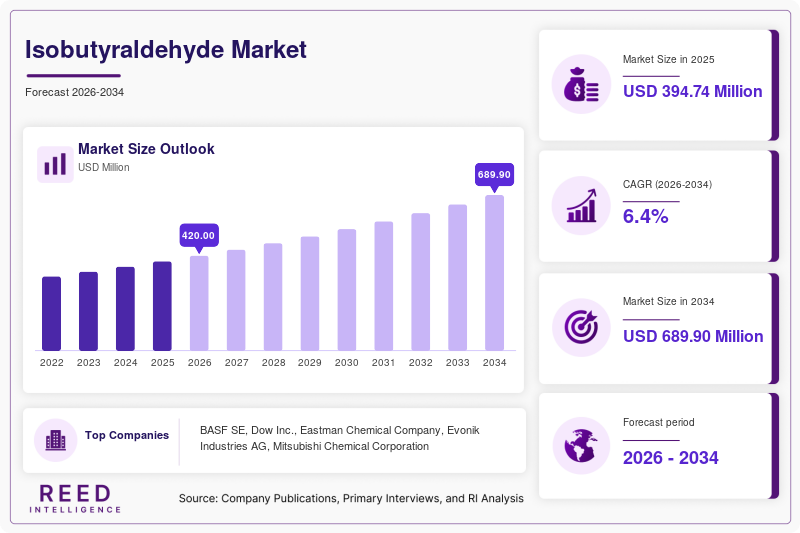
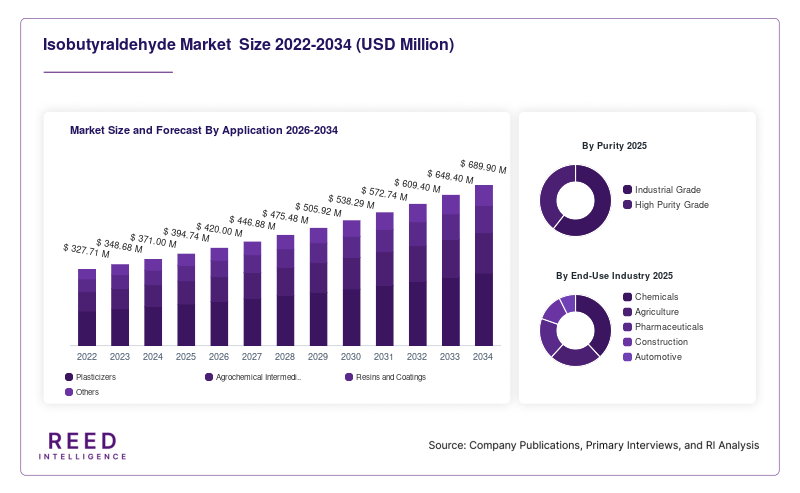
The global Isobutyraldehyde Market size is projected to reach a value of USD 420 million in 2026 and is expected to attain approximately USD 690 million by 2034, expanding at a CAGR of 6.4% during 2026–2034. The market growth is primarily supported by rising demand for intermediate chemicals used in the production of plasticizers, agrochemicals, and specialty solvents. Increasing industrialization and expansion of downstream chemical manufacturing, particularly in emerging economies, have strengthened consumption patterns of isobutyraldehyde across multiple end-use industries. Additionally, its growing utilization in synthesis processes for isobutanol and neopentyl glycol has further reinforced market expansion.
A major global factor influencing market growth is the accelerated shift toward high-performance chemical intermediates that improve efficiency in coatings, resins, and fuel additives. Manufacturers are increasingly adopting isobutyraldehyde-based derivatives due to their favorable reactivity and compatibility in advanced chemical formulations. Furthermore, technological improvements in catalytic hydrogenation processes have enhanced production efficiency, reducing overall manufacturing costs and supporting supply stability.
Key Highlights
- Asia Pacific dominated the market with a 36.8% share in 2025.
- Latin America is expected to grow at the fastest CAGR of 7.8% during 2026–2034.
- By application, plasticizers accounted for the largest share of 39.2%.
- while agrochemical intermediates are projected to grow at a CAGR of 7.5%.
- By purity level, industrial-grade isobutyraldehyde led with a 62.4% share, whereas high-purity grade is expected to expand at a CAGR of 8.1%.
- China remained the dominant country, with market values of USD 118 million in 2024 and USD 128 million in 2025.
Market Trends
Expansion of Bio-based Chemical Integration in Aldehyde Production
A significant trend shaping the Isobutyraldehyde Market is the increasing integration of bio-based and sustainable production pathways. Chemical manufacturers are exploring renewable feedstocks to reduce dependency on petrochemical raw materials and align with global sustainability objectives. Bio-based synthesis routes, including fermentation-derived intermediates, are being tested for commercial scalability. This shift is driven by stricter environmental regulations and corporate sustainability commitments across the chemical industry. Additionally, end-use industries such as packaging, coatings, and specialty chemicals are demanding greener alternatives, pushing producers to innovate cleaner production methods. This transition is also encouraging investments in R&D for catalyst optimization and process intensification to improve yield efficiency while reducing carbon emissions.
Rising Adoption in High-Performance Derivative Applications
Another key trend is the growing utilization of isobutyraldehyde in high-performance derivative applications such as neopentyl glycol, isobutanol, and specialty resins. These derivatives are increasingly used in automotive coatings, construction materials, and advanced polymer systems due to their enhanced thermal stability and durability. The demand for lightweight and high-strength materials in automotive and aerospace sectors has further accelerated consumption. Moreover, the shift toward high-solid and waterborne coatings has strengthened the need for reliable aldehyde intermediates that offer improved performance characteristics. This trend is also supported by continuous innovation in formulation chemistry, enabling manufacturers to develop advanced materials with superior mechanical and chemical resistance properties.
Market Drivers
Growing Demand from Plasticizers and Resin Manufacturing
The expansion of plasticizer and resin manufacturing industries is a key driver of the Isobutyraldehyde Market. Isobutyraldehyde serves as a crucial intermediate in producing compounds that enhance flexibility and durability in plastics. The rapid growth of the construction and automotive sectors has increased the demand for PVC-based materials and specialty resins, thereby boosting consumption of isobutyraldehyde derivatives. Additionally, infrastructure development in emerging economies has led to increased use of coatings, adhesives, and sealants, further supporting market expansion. The versatility of isobutyraldehyde in chemical synthesis makes it a preferred raw material in large-scale industrial applications, ensuring stable demand across global supply chains.
Expansion of Agrochemical and Specialty Chemical Industries
Another important driver is the increasing application of isobutyraldehyde in agrochemical formulations and specialty chemical production. The compound is used in synthesizing herbicides, pesticides, and plant growth regulators, which are essential for improving agricultural productivity. Rising global food demand and shrinking arable land have intensified the need for high-efficiency agrochemicals. Additionally, specialty chemical industries are leveraging isobutyraldehyde for producing fine chemicals and intermediates used in pharmaceuticals and performance materials. The growing emphasis on advanced crop protection solutions and sustainable agriculture practices continues to fuel demand, particularly in Asia Pacific and Latin America, where agricultural output is expanding rapidly.
Market Restraint
Volatility in Raw Material Supply and Price Fluctuations
One of the primary restraints affecting the Isobutyraldehyde Market is the volatility in raw material supply and associated price fluctuations. The production of isobutyraldehyde heavily depends on petrochemical feedstocks such as propylene, which are subject to crude oil price variations. Sudden changes in crude oil prices can significantly impact production costs and profit margins for manufacturers. Additionally, supply chain disruptions caused by geopolitical tensions, trade restrictions, or logistics bottlenecks further exacerbate market instability. Smaller producers often face challenges in maintaining cost competitiveness during periods of raw material price spikes, limiting their ability to expand production capacity or invest in technological advancements.
Market Opportunities
Expansion of High-Value Chemical Derivative Applications
A major opportunity in the Isobutyraldehyde Market lies in the expanding use of high-value chemical derivatives across multiple industries. Compounds derived from isobutyraldehyde, such as isobutanol and neopentyl glycol, are increasingly utilized in advanced coatings, lubricants, and polymer systems. These derivatives offer improved performance characteristics such as enhanced weather resistance, chemical stability, and mechanical strength. The growing demand for high-performance materials in automotive, aerospace, and construction industries is creating new opportunities for market players. Furthermore, ongoing research into novel chemical synthesis routes is expected to unlock additional applications, strengthening long-term growth potential.
Growth Potential in Emerging Industrial Economies
Another significant opportunity is the rising demand for isobutyraldehyde in emerging industrial economies across Asia Pacific, Latin America, and parts of Africa. Rapid industrialization, urbanization, and infrastructure development are driving increased consumption of chemical intermediates in these regions. Governments are also promoting domestic chemical manufacturing to reduce import dependency, creating favorable conditions for market expansion. Additionally, foreign direct investments in chemical production facilities are improving regional supply capabilities. The growing presence of global chemical manufacturers in these regions is expected to enhance production efficiency and distribution networks, thereby supporting sustained market growth.
Segmental Analysis
By Application
The plasticizers segment dominated the market with a 40.1% share in 2024, driven by strong demand in PVC production and flexible material manufacturing. Plasticizers derived from isobutyraldehyde are widely used in construction, automotive, and packaging industries due to their performance-enhancing properties.
The agrochemical intermediates segment is expected to grow at a CAGR of 7.6%, supported by rising agricultural productivity needs. Increasing demand for crop protection chemicals and fertilizers is boosting consumption of isobutyraldehyde-based intermediates in global agricultural markets.
By Purity
Industrial-grade isobutyraldehyde accounted for a 63.5% share in 2024, owing to its widespread use in large-scale chemical manufacturing. Its cost-effectiveness and suitability for bulk applications make it the preferred choice in industrial operations.
High-purity grade is expected to grow at a CAGR of 8.2%, driven by demand in specialty chemicals and pharmaceutical intermediates. Its enhanced chemical stability makes it suitable for high-performance applications requiring precision formulations.
By End-Use Industry
The chemicals industry dominated with a 44.7% share in 2024, supported by extensive use in intermediate synthesis and large-scale production processes. Strong integration into petrochemical value chains reinforces its dominance.
The pharmaceuticals and specialty materials segment is projected to grow at a CAGR of 7.9%, driven by increasing demand for fine chemicals and advanced formulations used in medical and high-performance applications.
Regional Analysis
North America
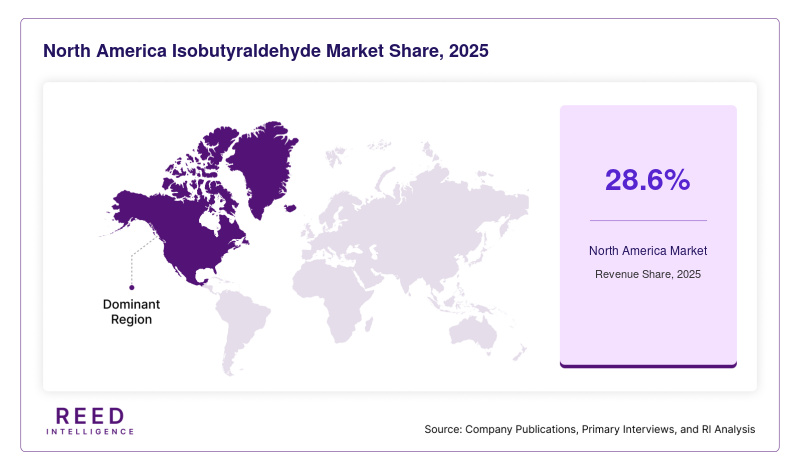
North America accounted for approximately 28.6% market share in 2025, with a projected CAGR of 5.9% during 2026–2034. The region benefits from a well-established chemical manufacturing base and strong demand from downstream industries such as coatings and automotive. Increasing investment in specialty chemicals and advanced material production continues to support regional growth.
The United States leads the North American market due to its robust petrochemical infrastructure and strong presence of key chemical manufacturers. A major growth factor is the rising demand for high-performance coatings in automotive and industrial applications, supported by technological advancements in chemical processing.
Europe
Europe held a 24.3% share in 2025, with expected growth at a CAGR of 5.6%. The region’s focus on sustainability and regulatory compliance has driven innovation in chemical production processes. Demand is largely driven by specialty chemicals and environmentally friendly industrial formulations.
Germany dominates the European market due to its advanced chemical industry and strong R&D ecosystem. A key growth factor is the increasing adoption of eco-friendly chemical intermediates in manufacturing processes, particularly in automotive coatings and construction materials.
Asia Pacific
Asia Pacific dominated with a 36.8% share in 2025, growing at a CAGR of 7.2%. Rapid industrialization and expansion of chemical manufacturing facilities across China, India, and South Korea have significantly boosted regional demand.
China leads the region due to large-scale chemical production capacity and strong downstream industries. A key growth driver is the expansion of agrochemical and plasticizer manufacturing supported by government-backed industrial development policies.
Middle East & Africa
The region accounted for 6.4% share in 2025, with a CAGR of 6.8%. Growth is supported by increasing petrochemical investments and diversification into value-added chemical production.
Saudi Arabia leads the market due to its strong petrochemical base. A major growth factor is the expansion of downstream chemical industries under national diversification programs.Saudi Arabia remains the dominant country in the region due to its strong petrochemical base and large-scale industrial investments. The country’s Vision 2030 initiative is a key growth enabler, promoting downstream chemical production and specialty chemical manufacturing expansion.
Latin America
Latin America held a 4.0% share in 2025, with the fastest CAGR of 7.8%. Growth is driven by rising agricultural chemical demand and expanding industrial base.
Brazil dominates the region due to strong agricultural output. A key growth factor is increasing demand for agrochemicals and crop protection solutions.Industrial development initiatives across Latin America are gradually improving chemical supply chains and boosting local production of value-added derivatives.
Competitive Landscape
The Isobutyraldehyde Market is moderately consolidated with the presence of key global chemical manufacturers focusing on capacity expansion and technological advancements. Major players include BASF SE, Eastman Chemical Company, Dow Inc., Evonik Industries, and Mitsubishi Chemical Corporation. BASF SE remains a leading company due to its strong production network and integrated chemical value chain. Recent developments include capacity expansion initiatives and investments in sustainable production technologies aimed at reducing environmental impact and improving operational efficiency.
Key Players
- BASF SE
- Dow Inc.
- Eastman Chemical Company
- Evonik Industries AG
- Mitsubishi Chemical Corporation
- LG Chem
- SABIC
- ExxonMobil Chemical
- INEOS Group
- LyondellBasell Industries
- Reliance Industries Limited
- Formosa Plastics Corporation
- Arkema Group
- Sumitomo Chemical Co., Ltd.
- Solvay S.A.
Recent Developments
- Several chemical manufacturers have expanded aldehyde production facilities in Asia Pacific to meet rising regional demand.
- Investments in catalyst optimization technologies have improved production efficiency and reduced emissions in aldehyde synthesis processes.
- Strategic partnerships between chemical companies and agrochemical producers have strengthened downstream application development and supply chain integration.
Isobutyraldehyde Market Segments
By Application
- Plasticizers
- Agrochemical Intermediates
- Resins and Coatings
- Others
By Purity
- Industrial Grade
- High Purity Grade
By End-Use Industry
- Chemicals
- Agriculture
- Pharmaceuticals
- Construction
- Automotive
By Region
- North America
- Europe
- APAC
- Middle East and Africa
- LATAM