Isoeicosane Market Size, Share & Demand Report By Type (Synthetic Isoeicosane, Bio-based Isoeicosane), By Application (Cosmetics & Personal Care, Pharmaceuticals, Industrial Applications), By End-Use Industry (Personal Care, Pharmaceuticals, Specialty Chemicals), By Region & Segment Forecasts, 2025–2034
USD 3950
Market Overview
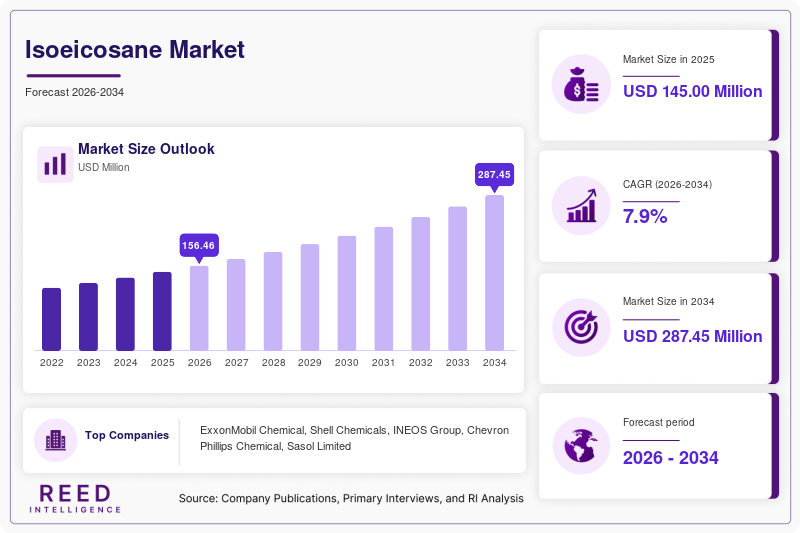
The global Isoeicosane Market size is witnessing steady expansion driven by increasing applications across personal care, pharmaceuticals, and specialty chemicals industries. The market size was estimated at approximately USD 145 million in 2025 and is projected to reach USD 158 million in 2026, reflecting consistent demand growth. By 2034, the market is forecasted to achieve a valuation of nearly USD 295 million, registering a compound annual growth rate (CAGR) of 7.9% from 2025 to 2034. This growth trajectory is supported by the rising consumption of high-performance emollients and solvents in premium cosmetic formulations.
Isoeicosane, a branched-chain hydrocarbon, is widely utilized for its lightweight texture, non-greasy feel, and excellent spreading properties. These characteristics make it a preferred ingredient in skincare products such as foundations, sunscreens, and serums. Additionally, its stability and compatibility with other cosmetic ingredients enhance formulation efficiency, further increasing its adoption among manufacturers.
Key Highlights
- Market size projected to grow from USD 145 million (2025) to USD 295 million (2034)
- CAGR of 7.9% during 2025–2034
- Strong demand from cosmetics and personal care industries
- Increasing focus on sustainable and bio-based formulations
- Expanding applications in pharmaceutical and specialty chemical sectors
Market Trends
Rising Demand for Lightweight Cosmetic Ingredients
The increasing preference for lightweight and non-comedogenic cosmetic ingredients is shaping the Isoeicosane Market trends. Consumers are prioritizing skincare and makeup products that provide a natural finish without clogging pores or leaving an oily residue. Isoeicosane’s ability to deliver a silky texture and fast absorption makes it a key ingredient in modern formulations. This trend is particularly evident in premium beauty brands that emphasize product performance and user experience. Additionally, the shift toward minimalistic and multifunctional products is encouraging manufacturers to incorporate ingredients like isoeicosane that enhance both texture and stability. As global beauty standards evolve, this trend is expected to sustain long-term growth.
Shift Toward Sustainable and Bio-Based Alternatives
Sustainability is becoming a central theme across the chemical and cosmetics industries, influencing the Isoeicosane Market growth. Companies are investing in research to develop bio-based isoeicosane derived from renewable feedstocks. This shift is driven by increasing regulatory pressure and consumer awareness regarding environmental impact. Brands are actively promoting eco-friendly formulations, which include responsibly sourced ingredients. Furthermore, advancements in green chemistry are enabling efficient production methods that reduce carbon emissions and waste generation. As sustainability becomes a competitive differentiator, the adoption of bio-based isoeicosane is expected to accelerate, contributing to market expansion over the forecast period.
Market Drivers
Expansion of the Global Cosmetics Industry
The rapid expansion of the cosmetics and personal care industry is a major driver of the Isoeicosane Market. With rising disposable incomes and increasing awareness of personal grooming, consumers are spending more on skincare and beauty products. Isoeicosane plays a crucial role in enhancing product texture and performance, making it a preferred ingredient in high-end formulations. Emerging markets in Asia Pacific and Latin America are experiencing strong growth in cosmetic consumption, further boosting demand. Additionally, the rise of e-commerce platforms has improved product accessibility, enabling brands to reach a wider audience. This continuous growth in the cosmetics sector directly supports the increasing use of isoeicosane.
Increasing Use in Pharmaceutical Formulations
The pharmaceutical industry is contributing significantly to the growth of the Isoeicosane Market. Its inert and non-reactive properties make it suitable for topical drug delivery systems. Isoeicosane is commonly used as a carrier in ointments and creams, ensuring uniform distribution of active ingredients. The growing prevalence of skin-related conditions and the demand for effective topical treatments are driving its adoption. Furthermore, advancements in dermatological research are encouraging the development of innovative formulations that require stable and skin-friendly excipients. As the pharmaceutical industry continues to evolve, the demand for high-quality ingredients like isoeicosane is expected to increase steadily.
Market Restraints
Volatility in Raw Material Prices
One of the key challenges affecting the Isoeicosane Market is the volatility in raw material prices. Isoeicosane is derived from petrochemical sources, making its production highly dependent on crude oil prices. Fluctuations in oil markets can lead to inconsistent production costs, impacting profit margins for manufacturers. This volatility also affects pricing strategies, making it difficult for companies to maintain stable supply agreements with end-users. Additionally, geopolitical tensions and supply chain disruptions can further exacerbate price instability. For instance, disruptions in global oil supply chains can lead to sudden spikes in production costs, forcing manufacturers to adjust their pricing. This uncertainty can hinder market growth, especially for small and medium-sized enterprises that lack the financial capacity to absorb cost fluctuations.
Market Opportunities
Growth in Emerging Markets
Emerging economies present significant opportunities for the Isoeicosane Market. Countries in Asia Pacific, Latin America, and the Middle East are witnessing rapid urbanization and increasing disposable incomes. This has led to a surge in demand for personal care products, creating a favorable environment for isoeicosane adoption. Local manufacturers are expanding their product portfolios to cater to evolving consumer preferences, further driving demand. Additionally, government initiatives supporting industrial growth and foreign investments are encouraging the establishment of new production facilities. As these markets continue to develop, they offer substantial growth potential for industry players.
Development of Bio-Based Isoeicosane
The development of bio-based isoeicosane represents a promising opportunity for market expansion. With growing environmental concerns, there is a strong demand for sustainable alternatives to petrochemical-based products. Companies are investing in research and development to produce isoeicosane from renewable sources such as plant-based feedstocks. This innovation not only reduces environmental impact but also aligns with regulatory requirements. Furthermore, consumers are increasingly willing to pay a premium for eco-friendly products, providing a competitive advantage to manufacturers offering sustainable solutions. As technological advancements continue, the commercialization of bio-based isoeicosane is expected to open new avenues for growth.
Segmental Analysis
By Type
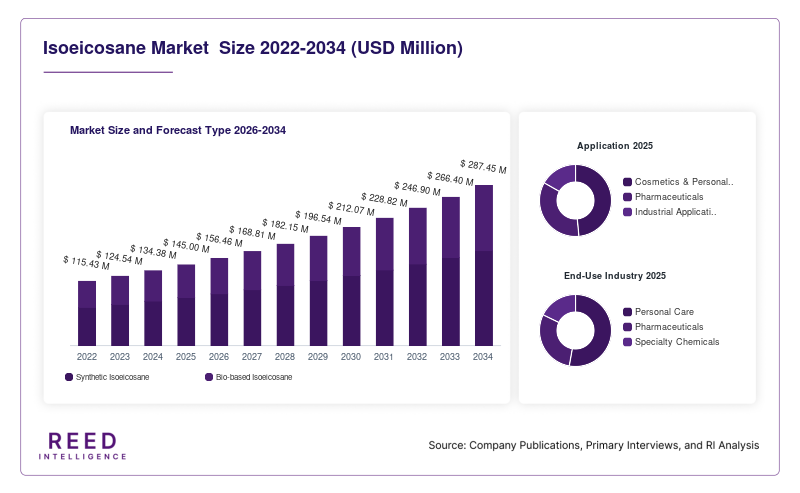
The synthetic isoeicosane segment dominated the Isoeicosane Market in 2024, accounting for approximately 78% of the total share. This dominance is attributed to its cost-effectiveness and widespread availability. Synthetic variants are widely used in cosmetic formulations due to their consistent quality and performance. Manufacturers prefer synthetic isoeicosane for large-scale production as it offers better control over purity and composition. Additionally, advancements in refining technologies have improved the efficiency of synthetic production processes, making it more accessible for various applications.
The bio-based isoeicosane segment is expected to witness the fastest growth, registering a CAGR of 9.5% during the forecast period. This growth is driven by increasing demand for sustainable and environmentally friendly products. Consumers are becoming more conscious of the environmental impact of their purchases, leading to a shift toward renewable alternatives. Manufacturers are investing in research to develop cost-effective bio-based production methods. As regulatory pressures increase, the adoption of bio-based isoeicosane is expected to accelerate.
By Application
The cosmetics and personal care segment held the largest share of the Isoeicosane Market in 2024, accounting for around 65% of the total revenue. Isoeicosane is widely used in products such as foundations, lipsticks, and sunscreens due to its lightweight texture and excellent spreading properties. The growing demand for high-performance cosmetic products is driving the adoption of this ingredient. Additionally, the trend toward premium and multifunctional products further supports market growth.
The pharmaceutical application segment is projected to grow at the fastest CAGR of 8.7% during the forecast period. This growth is driven by increasing demand for topical drug delivery systems. Isoeicosane’s inert nature makes it suitable for use in ointments and creams. The rising prevalence of skin-related conditions and advancements in dermatological research are key factors contributing to this growth.
By End-Use Industry
The personal care industry dominated the Isoeicosane Market in 2024, accounting for approximately 60% of the total share. The industry’s growth is driven by increasing consumer demand for skincare and beauty products. Isoeicosane is widely used to enhance product texture and performance, making it a key ingredient in modern formulations. The expansion of the global beauty industry further supports this segment’s dominance.
The specialty chemicals industry is expected to grow at the fastest CAGR of 8.3% during the forecast period. This growth is driven by increasing applications of isoeicosane in industrial formulations. The demand for high-performance solvents and additives is rising, particularly in advanced manufacturing processes. As industries continue to innovate, the adoption of isoeicosane in specialty chemicals is expected to increase.
Regional Analysis
North America
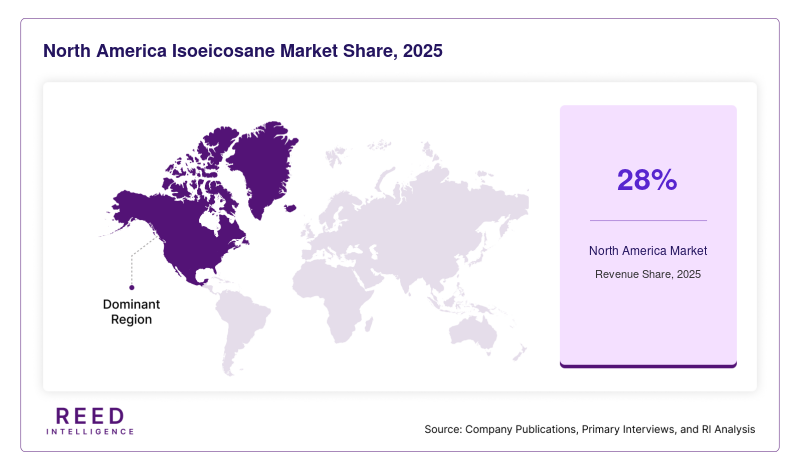
North America accounted for a significant share of the Isoeicosane Market in 2025, contributing approximately 28% of the global revenue. The region is expected to register a CAGR of 6.8% during the forecast period. The presence of well-established cosmetics and pharmaceutical industries supports market growth. Additionally, strong consumer demand for premium skincare products drives the adoption of advanced ingredients such as isoeicosane.
The United States dominates the regional market due to its large consumer base and high spending on personal care products. A unique growth factor in this region is the increasing demand for clean-label and dermatologically tested products. This trend encourages manufacturers to incorporate high-performance ingredients that enhance product safety and effectiveness.
Europe
Europe held around 24% of the global Isoeicosane Market share in 2025 and is projected to grow at a CAGR of 6.5% through 2034. The region benefits from stringent regulatory standards that promote the use of high-quality ingredients in cosmetic formulations. This has led to consistent demand for isoeicosane in various applications.
Germany leads the European market due to its strong chemical manufacturing base. A key growth factor is the rising focus on sustainable and eco-friendly formulations. European consumers are highly conscious of environmental impact, driving demand for responsibly sourced ingredients and encouraging innovation in production processes.
Asia Pacific
Asia Pacific emerged as the largest regional market in 2025, accounting for approximately 32% of the global share. The region is expected to grow at the fastest CAGR of 9.2% during the forecast period. Rapid urbanization, rising disposable incomes, and increasing awareness of personal grooming are key factors driving market growth.
China dominates the region due to its extensive manufacturing capabilities and large consumer base. A unique growth factor is the expansion of the local cosmetics industry, supported by strong domestic demand and export opportunities. This creates a robust market for isoeicosane in various applications.
Middle East & Africa
The Middle East & Africa region accounted for about 8% of the Isoeicosane Market in 2025 and is expected to grow at a CAGR of 7.1%. The region is witnessing increasing demand for personal care products, driven by rising urbanization and improving living standards.
Saudi Arabia leads the regional market due to its growing cosmetics sector. A notable growth factor is the increasing influence of global beauty trends, which encourages the adoption of advanced ingredients in local product formulations. This supports the steady growth of the market.
Latin America
Latin America held nearly 8% of the global market share in 2025 and is projected to grow at a CAGR of 7.4%. The region is experiencing steady growth due to increasing consumer spending on personal care products and expanding retail networks.
Brazil dominates the market in this region. A unique growth factor is the rising demand for affordable yet high-quality cosmetic products. Local manufacturers are focusing on improving product formulations, which drives the adoption of ingredients like isoeicosane.
Competitive Landscape
The Isoeicosane Market is moderately competitive, with several key players focusing on product innovation and strategic collaborations. Leading companies are investing in research and development to enhance product quality and expand their application scope. The market is characterized by the presence of both global and regional players competing on factors such as pricing, quality, and sustainability.
A major leader in the market is ExxonMobil Chemical, which holds a significant share due to its extensive product portfolio and strong distribution network. The company recently introduced advanced hydrocarbon formulations aimed at improving performance in cosmetic applications. Other players are also focusing on developing bio-based alternatives to meet evolving consumer preferences.
Key Players
- ExxonMobil Chemical
- Shell Chemicals
- INEOS Group
- Chevron Phillips Chemical
- Sasol Limited
- TotalEnergies
- BASF SE
- Dow Inc.
- LyondellBasell Industries
- Clariant AG
- Croda International
- Evonik Industries
- Arkema Group
- Solvay SA
- Mitsubishi Chemical Group
Recent Developments
- In 2024, a leading chemical manufacturer launched a new high-purity isoeicosane variant designed for premium cosmetic formulations.
- In 2023, a major player invested in bio-based hydrocarbon production facilities to expand its sustainable product portfolio.
- In 2025, a global cosmetics brand partnered with a chemical supplier to develop eco-friendly formulations using advanced isoeicosane derivatives.
Isoeicosane Market Segments
Type
- Synthetic Isoeicosane
- Bio-based Isoeicosane
Application
- Cosmetics & Personal Care
- Pharmaceuticals
- Industrial Applications
End-Use Industry
- Personal Care
- Pharmaceuticals
- Specialty Chemicals
By Region
- North America
- Europe
- APAC
- Middle East and Africa
- LATAM