Isomaltulose Market Size, Share & Demand Report By Form (Powder, Liquid), By Application (Food & Beverages, Sports Nutrition, Dietary Supplements, Pharmaceuticals & Clinical Nutrition), By End-Use Industry (Food Processing Industry, Healthcare & Clinical Nutrition, Nutraceutical Industry), By Distribution Channel (Online Retail, Supermarkets & Hypermarkets, Specialty Stores, Direct Sales/B2B), By Region & Segment Forecasts, 2025–2034
USD 3950
Market Overview
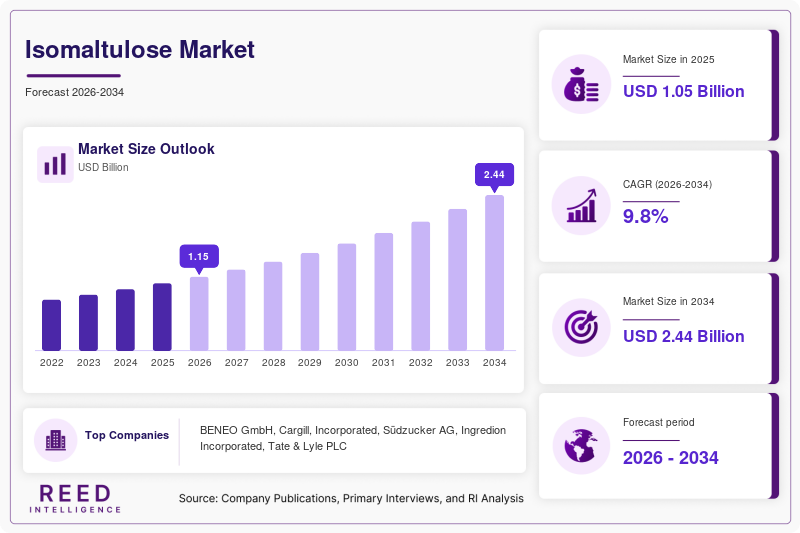
The global Isomaltulose Market was valued at approximately USD 1.05 billion in 2025 and is projected to reach USD 2.42 billion by 2034, expanding at a compound annual growth rate (CAGR) of 9.8% from 2025 to 2034. The market has gained steady traction due to its functional benefits as a low-glycemic carbohydrate widely used in food, beverages, and nutritional applications.
One of the primary global factors supporting the growth of the Isomaltulose Market is the increasing consumer shift toward healthier sugar alternatives. Rising awareness regarding blood sugar management and metabolic health has encouraged manufacturers to incorporate isomaltulose into sports drinks, energy bars, and dietary supplements. Its slow-release energy profile makes it particularly suitable for diabetic-friendly and performance-oriented formulations, thereby strengthening demand across developed and emerging economies.
Key Highlights
- Europe dominated the market in 2025 with a 38% share, while Asia Pacific is expected to be the fastest-growing region with a CAGR of 11.6%.
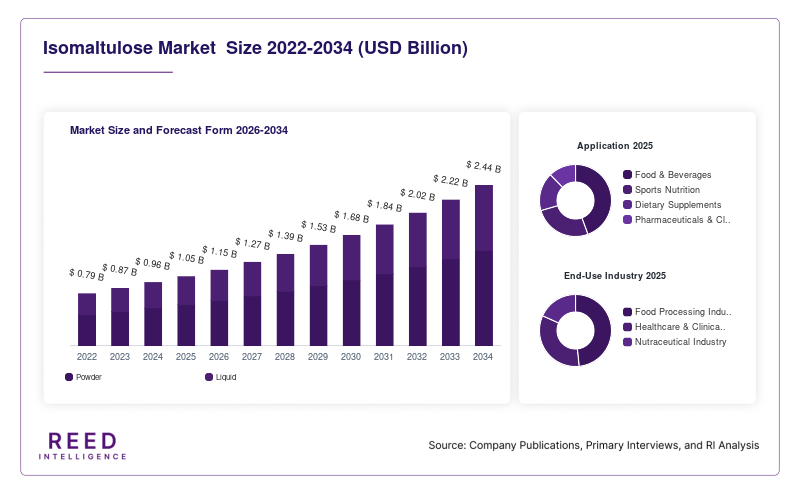
- In segmentation, Food & Beverage applications led with 52% share, while Sports Nutrition is projected to grow fastest at a CAGR of 12.4%.
- By form, Powdered isomaltulose dominated with 67% share, whereas Liquid form is expected to expand at a CAGR of 10.9%.
- Germany, the dominant country, recorded USD 210 million in 2025 and is estimated to reach USD 226 million in 2026.
Market Trends
Expansion of Functional Food Applications
The Isomaltulose Market is witnessing increased incorporation of isomaltulose into functional food products. Manufacturers are focusing on developing products that provide sustained energy release and improved metabolic benefits. This trend is particularly evident in breakfast cereals, dairy alternatives, and snack bars. The growing preference for low-glycemic index ingredients has encouraged food companies to reformulate products using isomaltulose, thereby enhancing its market penetration.
Rising Demand in Sports and Clinical Nutrition
Another notable trend shaping the Isomaltulose Market is its growing use in sports and clinical nutrition. Athletes and fitness enthusiasts prefer isomaltulose for its ability to provide prolonged energy without causing rapid spikes in blood glucose levels. Additionally, clinical nutrition products are increasingly incorporating isomaltulose for patients requiring controlled carbohydrate intake. This trend is supported by expanding health awareness and the rising adoption of personalized nutrition strategies.
Market Drivers
Increasing Demand for Low-Glycemic Sweeteners
The rising prevalence of lifestyle-related conditions such as diabetes and obesity has significantly increased demand for low-glycemic sweeteners. Isomaltulose, with its slow digestion and absorption properties, offers a stable energy release, making it an attractive alternative to traditional sugars. Food and beverage manufacturers are leveraging this advantage to cater to health-conscious consumers, thereby driving the growth of the Isomaltulose Market.
Growth in Nutritional and Dietary Supplement Industry
The expanding dietary supplement industry is another major driver of the Isomaltulose Market. The ingredient is widely used in energy drinks, protein powders, and meal replacement products. Its compatibility with various formulations and its functional benefits make it a preferred choice for supplement manufacturers. Increasing investments in health and wellness products globally are expected to further support market growth.
Market Restraint
High Production Costs and Limited Awareness in Developing Regions
Despite its growing adoption, the Isomaltulose Market faces challenges due to relatively high production costs compared to conventional sugars. The enzymatic conversion process required for isomaltulose production increases manufacturing expenses, which can limit its affordability and adoption in price-sensitive markets.
Additionally, limited consumer awareness in developing regions restricts market expansion. While developed economies have embraced functional sweeteners, many emerging markets still rely heavily on traditional sugar sources. This gap in awareness, combined with cost constraints, creates barriers for widespread adoption. Manufacturers need to invest in education and marketing initiatives to improve understanding of the benefits of isomaltulose. Addressing these challenges will be essential for achieving broader market penetration.
Market Opportunities
Growth in Diabetic-Friendly Food Products
The increasing global diabetic population presents a strong opportunity for the Isomaltulose Market. Food manufacturers are focusing on developing products tailored for diabetic consumers, where isomaltulose serves as a suitable carbohydrate alternative. Its low glycemic index supports stable blood sugar levels, making it ideal for specialized dietary products. This trend is expected to open new avenues for product innovation and market expansion.
Emerging Markets and Clean Label Trends
Emerging economies offer significant untapped potential for the Isomaltulose Market. As urbanization and disposable incomes rise, consumers are becoming more aware of healthier food options. Simultaneously, the clean label movement is gaining traction, encouraging the use of naturally derived ingredients like isomaltulose. Manufacturers can capitalize on this trend by expanding their presence in developing regions and promoting clean label formulations.
Segmental Analysis
By Form
Powdered isomaltulose dominated the Isomaltulose Market in 2025, accounting for approximately 67% of the total share. Its widespread use in dry food products, dietary supplements, and powdered beverage mixes has contributed to its dominance. The ease of storage, longer shelf life, and compatibility with various formulations have further supported its adoption.
Liquid isomaltulose is expected to be the fastest-growing subsegment, with a projected CAGR of 10.9%. Its increasing use in ready-to-drink beverages and liquid nutritional products will drive growth. The convenience and improved solubility of liquid formulations make them suitable for modern beverage applications.
By Application
Food and beverage applications led the market in 2025 with a 52% share. Isomaltulose is widely used in bakery products, confectionery, and beverages due to its functional properties and mild sweetness profile.
Sports nutrition is projected to be the fastest-growing application segment, expanding at a CAGR of 12.4%. The increasing demand for sustained energy products among athletes and fitness enthusiasts will drive this growth. The ingredient’s ability to provide prolonged energy release makes it ideal for performance-oriented products.
By End-Use Industry
The food processing industry dominated the Isomaltulose Market in 2025, holding a 48% share. The extensive use of isomaltulose in processed food products has contributed to its leading position.
The pharmaceutical and clinical nutrition segment is expected to grow at the fastest rate, with a CAGR of 11.2%. The increasing use of isomaltulose in specialized dietary products and medical nutrition formulations will support this growth.
By Distribution Channel
Offline distribution channels dominated the market in 2025, accounting for 61% of the share. Traditional retail stores and direct sales channels remain the primary means of product distribution.
Online distribution is anticipated to grow at a CAGR of 11.8%, driven by the rapid expansion of e-commerce platforms. Increasing consumer preference for online shopping and easy access to specialized products will boost this segment.
Regional Analysis
North America
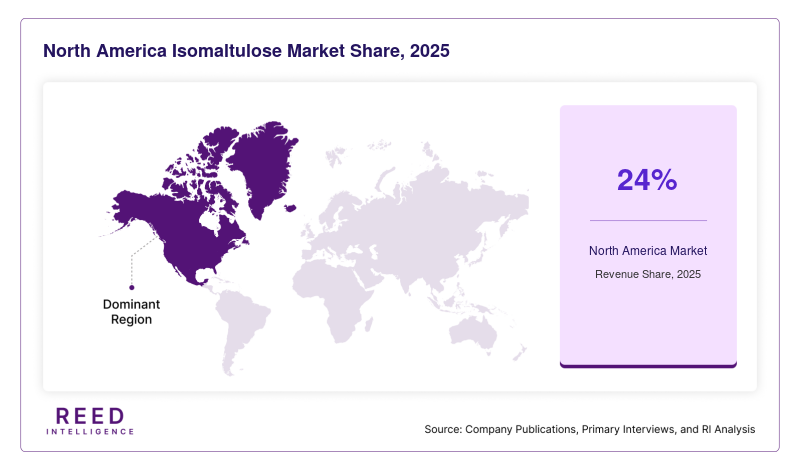
North America accounted for approximately 24% of the Isomaltulose Market share in 2025 and is expected to grow at a CAGR of 8.7% from 2025 to 2034. The region’s growth is supported by strong demand for functional foods and beverages. The presence of a well-established health and wellness industry has encouraged manufacturers to adopt innovative ingredients such as isomaltulose.
The United States dominated the regional market due to its advanced food processing sector and high consumer awareness. The country has seen increasing adoption of low-glycemic ingredients in sports nutrition and dietary supplements, which has contributed to steady market expansion.
Europe
Europe held the largest share of the Isomaltulose Market at 38% in 2025 and is projected to grow at a CAGR of 9.2%. The region benefits from strong regulatory support for functional ingredients and high consumer awareness regarding health and nutrition.
Germany emerged as the dominant country, driven by its robust food and beverage industry and emphasis on product innovation. The country’s focus on health-oriented formulations has significantly contributed to the widespread adoption of isomaltulose across various applications.
Asia Pacific
Asia Pacific represented 21% of the market share in 2025 and is anticipated to register the fastest growth with a CAGR of 11.6%. Rapid urbanization, increasing disposable incomes, and growing health awareness are key factors supporting regional growth.
China led the regional market due to its expanding food processing industry and increasing demand for functional ingredients. The country’s growing middle-class population and rising interest in health-focused products are expected to drive future demand.
Middle East & Africa
The Middle East & Africa accounted for around 9% of the Isomaltulose Market in 2025 and is expected to grow at a CAGR of 8.3%. The market is gradually expanding as awareness regarding healthy diets increases.
The United Arab Emirates dominated the region due to its growing health-conscious population and expanding retail sector. The increasing availability of functional food products has supported market growth in the country.
Latin America
Latin America held approximately 8% market share in 2025 and is projected to grow at a CAGR of 8.9%. The region is witnessing gradual adoption of functional ingredients driven by changing dietary patterns.
Brazil led the regional market due to its large consumer base and growing food and beverage industry. The country’s increasing focus on health and wellness products has contributed to rising demand for isomaltulose.
Competitive Landscape
The Isomaltulose Market is moderately consolidated, with key players focusing on product innovation, partnerships, and expansion strategies. Leading companies are investing in research and development to enhance product functionality and expand application areas.
A prominent market leader is BENEO GmbH, which has strengthened its position through continuous innovation and expansion of its functional ingredient portfolio. The company recently introduced new formulations targeting sports nutrition applications, reinforcing its market presence.
Other major players are focusing on strategic collaborations and regional expansion to capture emerging opportunities. The competitive environment is characterized by increasing emphasis on clean label ingredients and sustainable production practices.
Key Players List
- BENEO GmbH
- Cargill, Incorporated
- Südzucker AG
- Cosucra Groupe Warcoing SA
- Mitsubishi Corporation Life Sciences
- Ingredion Incorporated
- Tate & Lyle PLC
- Roquette Frères
- ADM (Archer Daniels Midland Company)
- Wilmar International Limited
- Baolingbao Biology Co., Ltd.
- Samyang Corporation
- Shandong Bailong Chuangyuan Bio-Tech Co., Ltd.
- Qingdao FTZ United International Inc.
- Futaste Co., Ltd.
Recent Developments
- In 2024, BENEO GmbH expanded its production capacity for isomaltulose to meet rising global demand.
- In 2023, Cargill introduced new functional sweetener blends incorporating isomaltulose for beverage applications.
- In 2024, Ingredion Incorporated launched a new product line targeting clean label and low-glycemic food formulations.
- In 2023, Roquette Frères strengthened its distribution network in Asia Pacific to enhance market reach.
- In 2024, Tate & Lyle PLC invested in research initiatives to develop advanced carbohydrate solutions for clinical nutrition.
Isomaltulose Market Segments
Form
- Powder
- Liquid
Application
- Food & Beverages
- Sports Nutrition
- Dietary Supplements
- Pharmaceuticals & Clinical Nutrition
End-Use Industry
- Food Processing Industry
- Healthcare & Clinical Nutrition
- Nutraceutical Industry
Distribution Channel
- Online Retail
- Supermarkets & Hypermarkets
- Specialty Stores
- Direct Sales/B2B
By Region
- North America
- Europe
- APAC
- Middle East and Africa
- LATAM