Isononyl Acrylate Market Size, Share & Demand Report By Application (Adhesives, Coatings, Sealants, Others), By End-Use Industry (Packaging, Automotive, Construction, Electronics, Others), By Formulation Type (Solvent-Based, Water-Based, Others), By Distribution Channel (Direct Sales, Distributors, Online) & Segment Forecasts, 2026–2034
USD 3950
Market Overview
The global Isononyl Acrylate Market was valued at approximately USD 2.1 billion in 2026 and is projected to reach USD 3.8 billion by 2034, expanding at a CAGR of 7.6% during the forecast period (2026–2034). Isononyl acrylate, a key monomer used in pressure-sensitive adhesives, coatings, and sealants, continues to gain traction due to its superior flexibility, weather resistance, and low glass transition temperature.
A major global factor supporting market growth is the increasing demand for high-performance adhesives across packaging, automotive, and construction industries. The rapid expansion of flexible packaging and rising investments in infrastructure development have significantly accelerated consumption. Additionally, the shift toward lightweight and durable materials in industrial applications has further reinforced demand.
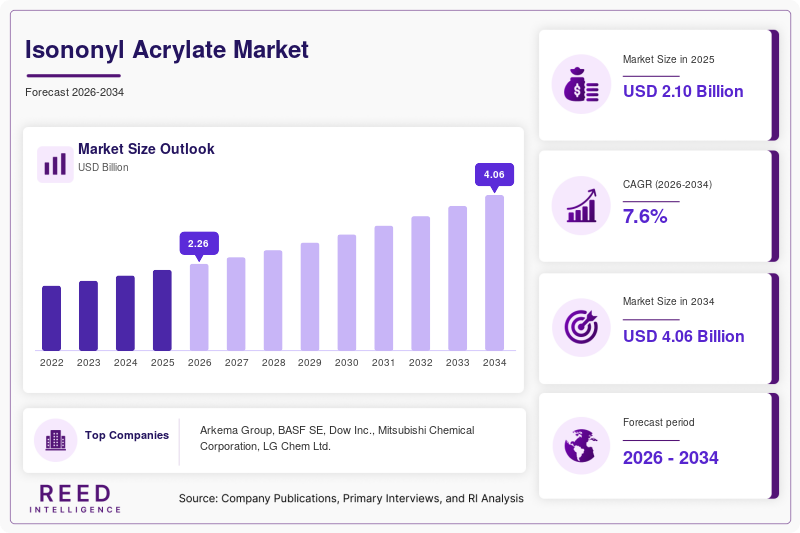
Key Highlights:
- Asia Pacific dominated the market with 41.3% share in 2025, while it is expected to grow at the fastest CAGR of 8.4% during the forecast period.
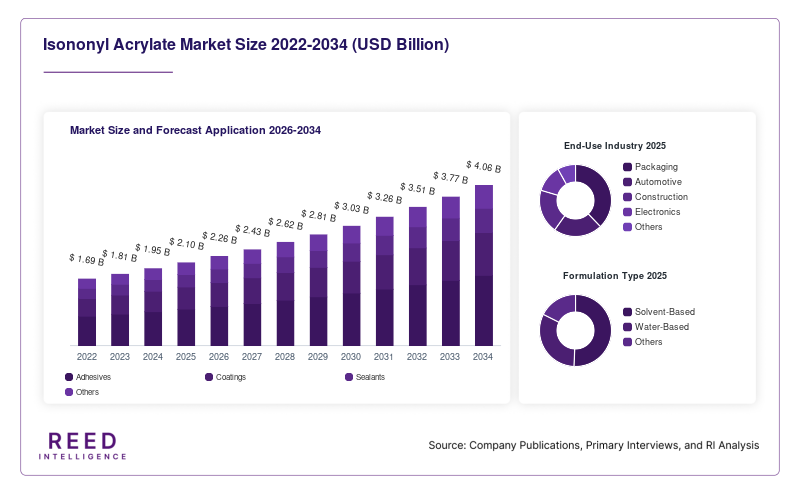
- Adhesives emerged as the leading application segment with a 46.7% share, whereas coatings are projected to be the fastest-growing segment at a CAGR of 8.1%.
- Packaging remained the dominant end-use segment with a 38.5% share, while automotive applications are anticipated to grow at 8.6% CAGR.
- China led globally, with market values reaching USD 620 million in 2024 and USD 665 million in 2025.
Market Trends
Rising Adoption of Pressure-Sensitive Adhesives (PSAs)
The increasing use of pressure-sensitive adhesives across packaging, hygiene products, and labels is reshaping the Isononyl Acrylate Market. These adhesives require monomers that offer flexibility and durability, making isononyl acrylate a preferred choice. Growth in e-commerce and logistics has accelerated demand for labeling and packaging solutions, which rely heavily on PSAs. This trend is expected to sustain long-term market growth as industries prioritize efficiency and performance.
Shift Toward Sustainable and Low-VOC Formulations
Environmental concerns and regulatory pressures are driving the adoption of low-VOC and eco-friendly materials. Isononyl acrylate is increasingly being incorporated into formulations that comply with environmental standards while maintaining high performance. Manufacturers are investing in research to develop bio-based alternatives and optimize production processes. This shift not only aligns with sustainability goals but also enhances market competitiveness by meeting evolving customer expectations.
Market Drivers
Expansion of Flexible Packaging Industry
The rapid growth of the flexible packaging sector is a key driver of the Isononyl Acrylate Market. Flexible packaging solutions require adhesives with excellent bonding strength and flexibility, which isononyl acrylate provides. Increasing consumption of packaged food, pharmaceuticals, and consumer goods has significantly boosted demand. Additionally, innovations in packaging materials and designs have further increased reliance on high-performance adhesive components.
Growth in Automotive Lightweight Materials
The automotive industry’s focus on lightweight materials to improve fuel efficiency and reduce emissions has driven the adoption of advanced adhesives and coatings. Isononyl acrylate-based formulations are widely used in bonding lightweight components and enhancing durability. The rising production of electric vehicles and the need for efficient assembly processes have further strengthened demand for such materials, contributing to steady market growth.
Market Restraint
Volatility in Raw Material Prices
Fluctuations in the prices of raw materials used in the production of isononyl acrylate present a significant challenge for market growth. These variations are often influenced by changes in crude oil prices, supply chain disruptions, and geopolitical factors. Manufacturers face difficulties in maintaining stable production costs, which can impact profit margins and pricing strategies. Additionally, the dependence on petrochemical feedstocks increases vulnerability to market uncertainties. This restraint may hinder the expansion of the Isononyl Acrylate Market, particularly for small and medium-scale producers with limited capacity to absorb cost fluctuations.
Market Opportunities
Growth in Emerging Economies
Emerging economies in Asia, Latin America, and Africa present significant growth opportunities for the Isononyl Acrylate Market. Rapid urbanization, industrialization, and increasing consumer spending are driving demand for adhesives, coatings, and sealants. Infrastructure development and expansion of manufacturing sectors further enhance market potential. Companies can leverage these opportunities by expanding production capacities and establishing strategic partnerships in these regions.
Advancements in Specialty Coatings
The development of specialty coatings with enhanced properties such as UV resistance, chemical stability, and durability offers new growth avenues. Isononyl acrylate is widely used in advanced coating formulations for industrial and consumer applications. Increasing demand for high-performance coatings in sectors such as electronics, construction, and marine industries is expected to drive market expansion. Continuous innovation and product development will play a crucial role in capturing these opportunities.
Segmental Analysis
By Application
Adhesives dominated the Isononyl Acrylate Market with a 46.7% share in 2025, driven by widespread use in packaging, labeling, and industrial bonding. The segment benefited from strong demand across multiple industries.
Coatings are expected to be the fastest-growing subsegment, with a projected CAGR of 8.1%. Increasing demand for protective and decorative coatings in construction and industrial applications will drive growth.
By End-Use Industry
Packaging accounted for the largest share at 38.5% in 2025, supported by rising demand for flexible packaging solutions. The segment’s growth was driven by increasing consumption of packaged goods.
Automotive is projected to grow at the fastest CAGR of 8.6%, driven by the adoption of lightweight materials and advanced bonding technologies.
By Formulation Type
Solvent-based formulations dominated with a 52.3% share in 2025, owing to their strong performance and widespread industrial use. These formulations are preferred for applications requiring high durability.
Water-based formulations are expected to grow at a CAGR of 8.3%, driven by increasing environmental regulations and demand for eco-friendly products.
By Distribution Channel
Direct sales accounted for the largest share at 61.2% in 2025, as manufacturers preferred direct engagement with industrial clients. This approach ensured better customization and cost efficiency.
Online and third-party distribution channels are projected to grow at a CAGR of 7.9%, supported by digitalization and expanding global trade networks.
Regional Analysis
North America
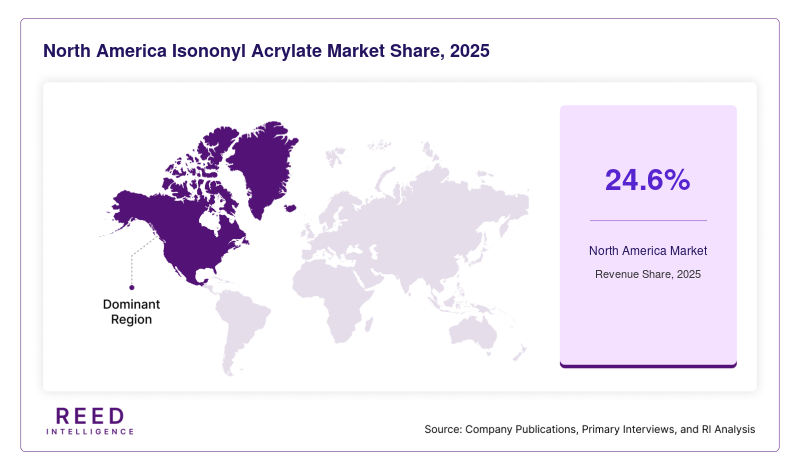
North America accounted for 24.6% of the Isononyl Acrylate Market in 2025, reflecting steady industrial demand. The region is projected to grow at a CAGR of 6.8% from 2026 to 2034. The presence of advanced manufacturing infrastructure and strong demand from packaging and automotive sectors supported market growth.
The United States dominated the regional market due to its well-established industrial base and continuous investments in advanced materials. The country’s focus on innovation in adhesives and coatings has contributed to sustained demand for isononyl acrylate.
Europe
Europe held a 21.8% market share in 2025 and is expected to grow at a CAGR of 6.5% during the forecast period. The region’s emphasis on sustainability and environmental regulations influenced product development and adoption.
Germany emerged as the leading country, driven by its strong automotive and industrial sectors. The country’s focus on high-quality manufacturing and advanced materials has supported the adoption of isononyl acrylate-based products.
Asia Pacific
Asia Pacific dominated the global market with a 41.3% share in 2025 and is anticipated to grow at a CAGR of 8.4% through 2034. Rapid industrialization and expanding manufacturing sectors contributed significantly to market growth.
China led the region due to its large-scale production capabilities and strong demand from packaging and construction industries. The country’s growing infrastructure projects and export-oriented manufacturing further strengthened its market position.
Middle East & Africa
The Middle East & Africa region accounted for 6.9% of the market in 2025 and is projected to grow at a CAGR of 7.2%. Increasing investments in construction and infrastructure development supported market expansion.
Saudi Arabia dominated the region, driven by large-scale infrastructure projects and industrial diversification initiatives. The country’s focus on economic development has created demand for advanced materials.
Latin America
Latin America held a 5.4% share in 2025 and is expected to grow at a CAGR of 6.9% during the forecast period. Growth in packaging and consumer goods industries contributed to market development.
Brazil emerged as the leading country, supported by its expanding industrial base and increasing demand for adhesives and coatings. The country’s economic growth and infrastructure investments have further enhanced market opportunities.
Competitive Landscape
The Isononyl Acrylate Market is moderately consolidated, with key players focusing on product innovation and capacity expansion. Leading companies are investing in research and development to enhance product performance and meet evolving industry requirements.
Arkema Group is a prominent market leader, known for its extensive product portfolio and strong global presence. The company recently expanded its production capacity to meet rising demand for specialty acrylates. Other major players are also strengthening their market positions through strategic collaborations and technological advancements.
Key Players List
- Arkema Group
- BASF SE
- Dow Inc.
- Mitsubishi Chemical Corporation
- LG Chem Ltd.
- Nippon Shokubai Co., Ltd.
- Sasol Limited
- Evonik Industries AG
- Toagosei Co., Ltd.
- Formosa Plastics Corporation
- Sumitomo Chemical Co., Ltd.
- Wanhua Chemical Group
- Shanghai Huayi Acrylic Acid Co., Ltd.
- Jiangsu Jurong Chemical Co., Ltd.
- Zhejiang Satellite Petrochemical Co., Ltd.
Recent Developments
- Arkema expanded its specialty acrylates production capacity in Asia to meet growing regional demand.
- BASF introduced new low-VOC acrylate formulations for sustainable applications.
- Dow invested in advanced adhesive technologies to enhance product performance.
- Mitsubishi Chemical strengthened its supply chain network to improve global distribution.
- LG Chem focused on developing eco-friendly materials for industrial applications.
Isononyl Acrylate Market Segments
Application
- Adhesives
- Coatings
- Sealants
- Others
End-Use Industry
- Packaging
- Automotive
- Construction
- Electronics
- Others
Formulation Type
- Solvent-Based
- Water-Based
- Others
Distribution Channel
- Direct Sales
- Distributors
- Online
By Region
- North America
- Europe
- APAC
- Middle East and Africa
- LATAM