Isoprene Monomer Market Size, Share & Demand Report By Product Type (Synthetic Isoprene, Bio-Based Isoprene), By Application (Synthetic Rubber, Polyisoprene, Styrene-Isoprene-Styrene Elastomers, Adhesives, Others), By End-Use Industry (Automotive, Healthcare, Industrial Manufacturing, Consumer Goods, Construction, Others), By Region & Segment Forecasts, 2026–2034
USD 3950
Market Overview
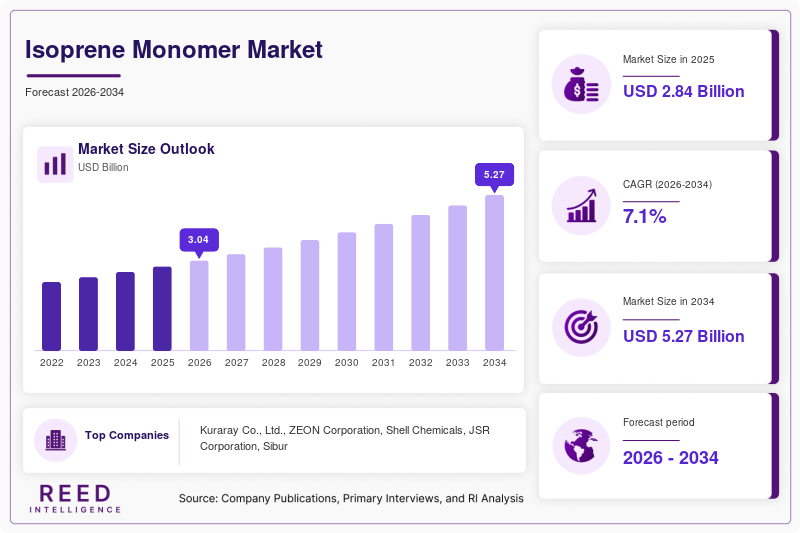
The Isoprene Monomer Market size was valued at approximately USD 2.84 billion in 2026 and is projected to reach USD 4.91 billion by 2034, expanding at a CAGR of 7.1% during the forecast period from 2026 to 2034. Isoprene monomer is a critical petrochemical intermediate widely utilized in the production of synthetic rubber, polyisoprene, styrene-isoprene-styrene elastomers, adhesives, and specialty polymers. The material plays a significant role in automotive manufacturing, medical products, industrial goods, footwear, and consumer applications due to its elasticity, durability, and processing advantages.
A major factor supporting market growth is the continued expansion of global automotive manufacturing and mobility infrastructure. Rising vehicle production across emerging economies has increased the consumption of synthetic rubber used in tires, seals, belts, hoses, and vibration control components. Additionally, industrial manufacturers are increasingly adopting advanced elastomer materials that offer improved performance under varying environmental conditions, creating sustained demand for isoprene-derived products.
Key Highlights
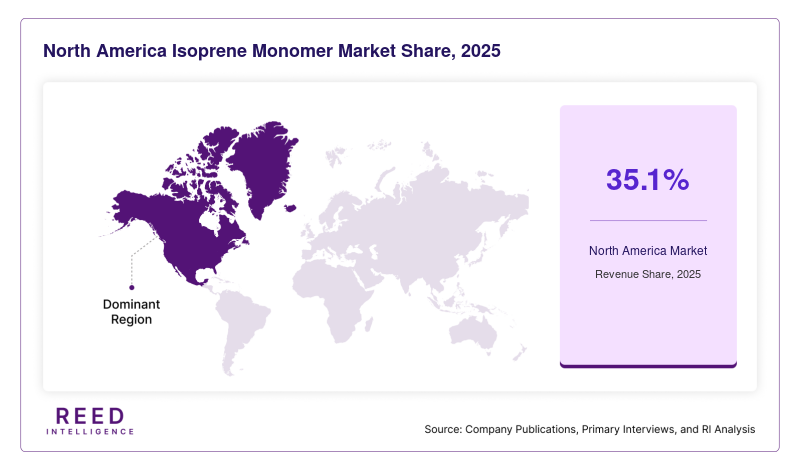
- North America dominated the market with a 35.1% share in 2025.
- Asia Pacific is expected to grow at the fastest CAGR of 8.6% during 2026–2034.
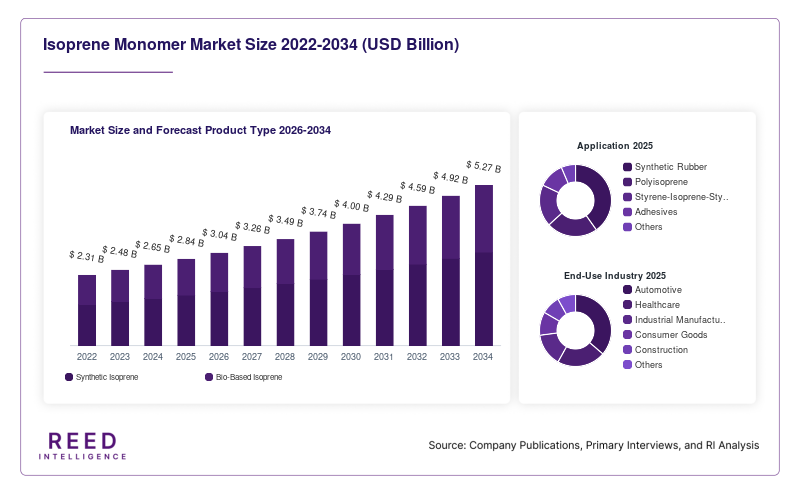
- By product type, synthetic isoprene accounted for the largest share of 74.8%.
- while bio-based isoprene is projected to grow at a CAGR of 9.8%.
- By application, synthetic rubber led with a 52.4% share.
- whereas SIS elastomers are expected to expand at a CAGR of 8.9%.
- By end-use industry, automotive accounted for the largest share of 46.7%.
- while healthcare is projected to grow at a CAGR of 9.3%.
- The United States remained the dominant country, with market values of USD 810 million in 2024 and USD 865 million in 2025.
Market Trends
Growing Commercialization of Bio-Based Isoprene Production
Sustainability objectives across chemical and manufacturing industries are accelerating interest in bio-based isoprene production technologies. Producers are investing in renewable feedstocks and biotechnology-based manufacturing routes to reduce dependence on petroleum-derived raw materials. Several pilot-scale projects have demonstrated the technical feasibility of producing isoprene through fermentation pathways, creating new possibilities for environmentally conscious rubber and polymer production. Market participants are increasingly collaborating with biotechnology companies to commercialize these solutions and strengthen long-term sustainability strategies.
Growing regulatory attention toward industrial emissions and carbon reduction targets is further encouraging investment in renewable alternatives. End users in automotive, consumer goods, and healthcare sectors are evaluating sustainable raw materials to support corporate environmental goals. As production economics continue to improve, bio-based isoprene is expected to gain greater acceptance across multiple industrial applications.
Rising Demand for High-Performance Elastomers
The demand for advanced elastomer materials continues to increase across automotive, industrial, and consumer product industries. Manufacturers are seeking materials that offer enhanced flexibility, wear resistance, durability, and temperature stability. Isoprene-based elastomers provide a favorable balance of mechanical performance and processing characteristics, making them suitable for demanding operating environments.
Infrastructure expansion and industrial modernization projects are also contributing to higher consumption of specialty elastomer products. Adhesives, sealants, and pressure-sensitive applications increasingly rely on isoprene-based formulations to improve product performance. Furthermore, manufacturers are developing customized elastomer grades designed for specific end-use requirements, supporting broader adoption across diverse industrial sectors and strengthening long-term market growth prospects.
Market Drivers
Expansion of Global Automotive Manufacturing
The automotive industry remains one of the most significant consumers of isoprene monomer derivatives. Growing vehicle production across Asia Pacific, North America, and selected European countries has increased demand for synthetic rubber materials used in tire manufacturing and automotive components. Modern vehicles require durable elastomers capable of withstanding mechanical stress, temperature fluctuations, and prolonged operational conditions, creating a strong consumption base for isoprene-derived products.
The increasing adoption of electric vehicles is also contributing to market growth. Electric vehicles require specialized tire designs and advanced sealing solutions that utilize high-performance elastomer materials. As automotive manufacturers continue expanding production capacities and introducing technologically advanced vehicles, demand for isoprene monomer is expected to remain strong throughout the forecast period.
Increasing Utilization in Medical and Healthcare Applications
Healthcare manufacturers are increasingly utilizing polyisoprene materials in medical gloves, catheters, tubing, and surgical products. Polyisoprene offers performance characteristics similar to natural rubber while reducing concerns associated with latex-related allergic reactions. This advantage has encouraged healthcare providers and medical device manufacturers to adopt synthetic alternatives across a broad range of applications.
Rising healthcare expenditures, expanding hospital infrastructure, and increasing demand for disposable medical products are supporting consumption growth. The growing emphasis on infection prevention and patient safety has also strengthened demand for high-quality medical materials. As healthcare systems continue modernizing worldwide, the requirement for reliable synthetic elastomers is expected to contribute significantly to overall market expansion.
Market Restraint
Volatility in Petrochemical Feedstock Prices
Fluctuations in crude oil and petrochemical feedstock prices remain a major challenge for the Isoprene Monomer Market. Since conventional isoprene production is closely linked to petroleum refining and petrochemical operations, changes in raw material pricing can significantly affect production costs and profit margins. Sudden increases in feedstock costs often reduce operational flexibility for manufacturers and create uncertainty across supply chains.
The impact is particularly significant for small and medium-sized producers that have limited ability to absorb cost fluctuations. Variable raw material pricing can also influence contract negotiations and long-term procurement strategies among downstream customers. For example, synthetic rubber manufacturers may face challenges in maintaining stable product pricing when feedstock costs rise sharply. Such volatility can delay investment decisions, reduce production planning efficiency, and create temporary imbalances between supply and demand. Although technological improvements and alternative feedstock development may help mitigate these challenges, price instability continues to represent a notable restraint affecting overall market growth.
Market Opportunities
Development of Sustainable Elastomer Supply Chains
The transition toward sustainable manufacturing presents substantial opportunities for market participants. Industrial buyers are increasingly seeking environmentally responsible materials that support carbon reduction objectives and circular economy initiatives. Isoprene producers can capitalize on this trend by expanding bio-based production capabilities and improving sustainability across supply chains.
Investments in renewable feedstocks, carbon-efficient production technologies, and recycling initiatives are creating new revenue opportunities. Companies that successfully develop sustainable product portfolios may gain stronger positioning among environmentally conscious customers. As regulatory frameworks continue encouraging cleaner industrial practices, sustainable isoprene solutions are expected to attract increasing commercial interest across multiple end-use sectors.
Growth of Specialty Adhesives and Polymer Applications
Specialty adhesives and advanced polymer applications represent another attractive growth avenue for the market. Isoprene-based materials are increasingly utilized in pressure-sensitive adhesives, packaging solutions, construction products, and consumer goods. Manufacturers continue developing specialized formulations that improve bonding strength, flexibility, and durability under demanding conditions.
The rapid expansion of e-commerce logistics and modern packaging systems is supporting demand for advanced adhesive technologies. Similarly, infrastructure development projects are increasing consumption of high-performance construction materials that incorporate specialty polymers. These trends are creating favorable conditions for isoprene monomer suppliers seeking to diversify beyond traditional synthetic rubber applications and establish stronger positions in value-added market segments.
Segmental Analysis
By Product Type
Synthetic isoprene represented the dominant product type segment and accounted for approximately 74.8% of market share in 2024. Its leadership position is supported by established commercial production processes, widespread industrial acceptance, and strong availability across major manufacturing regions. Synthetic isoprene serves as the primary feedstock for synthetic rubber, elastomers, adhesives, and specialty polymer production. Manufacturers prefer synthetic variants because they offer consistent quality, predictable performance characteristics, and reliable supply chain availability. The extensive integration of synthetic isoprene within global petrochemical operations has further strengthened its market position. Large-scale production capabilities and established distribution networks continue supporting widespread adoption across automotive, industrial, healthcare, and consumer product applications.
Bio-based isoprene is expected to be the fastest-growing product type, registering a CAGR of 9.8% during the forecast period. Growing sustainability concerns and increasing environmental regulations are encouraging producers to explore renewable alternatives. Technological advancements in biotechnology and fermentation-based production methods are improving commercial viability while reducing production costs. Major end-use industries are actively evaluating renewable materials to support corporate sustainability goals and reduce dependence on fossil-derived feedstocks. Continued investments in pilot facilities, research partnerships, and process optimization are expected to accelerate commercialization. As production efficiency improves and market acceptance increases, bio-based isoprene is likely to emerge as an increasingly important segment within the global market.
By Application
Synthetic rubber dominated the application segment and accounted for approximately 52.4% of total market share in 2024. The segment benefits from extensive utilization in tire manufacturing, industrial components, automotive systems, and consumer products. Synthetic rubber derived from isoprene offers favorable elasticity, durability, and wear resistance characteristics that support demanding operational requirements. Rising vehicle production and expanding transportation infrastructure continue generating substantial demand for tire-related applications. Industrial machinery manufacturers also utilize synthetic rubber materials in belts, hoses, gaskets, and sealing solutions. The segment's established position within multiple industries ensures stable demand and maintains its leadership role within the overall market structure.
Styrene-isoprene-styrene elastomers are projected to register the fastest CAGR of 8.9% through 2034. Growth is driven by increasing utilization in pressure-sensitive adhesives, packaging materials, personal care products, and specialty industrial applications. These elastomers provide flexibility, processability, and performance characteristics suitable for advanced product formulations. Rapid expansion of e-commerce and modern packaging industries is creating additional demand for adhesive solutions utilizing SIS technology. Manufacturers are also introducing innovative formulations designed to enhance product performance across diverse operating conditions. Continued development of specialty applications and value-added products is expected to strengthen growth prospects for this segment throughout the forecast period.
By End-Use Industry
The automotive industry remained the dominant end-use segment and accounted for approximately 46.7% of market share in 2024. Automotive manufacturers utilize isoprene-derived materials extensively in tires, sealing systems, hoses, belts, vibration control components, and various elastomer applications. Growing global vehicle production and increasing demand for durable materials continue supporting consumption. The transition toward advanced mobility solutions has also increased requirements for specialized elastomer products capable of meeting evolving performance standards. Established supply chains, large-scale production requirements, and ongoing investments in automotive manufacturing facilities reinforce the segment's leading position within the market.
Healthcare is anticipated to be the fastest-growing end-use industry, expanding at a CAGR of 9.3% during the forecast period. Rising healthcare expenditures, expanding medical infrastructure, and increasing demand for disposable medical products are key growth drivers. Polyisoprene materials are increasingly utilized in medical gloves, catheters, tubing, and surgical products because of their favorable performance characteristics and reduced allergenic risks. Growing emphasis on infection prevention and patient safety is encouraging wider adoption of synthetic elastomer solutions. Technological advancements in medical device manufacturing and expanding healthcare access across emerging economies are expected to further strengthen demand within this rapidly growing segment.
Regional Analysis
North America
North America accounted for approximately 35.1% of the global Isoprene Monomer Market in 2025, making it the leading regional market. The region is projected to expand at a CAGR of 6.5% through 2034. Strong petrochemical infrastructure, advanced manufacturing capabilities, and stable demand from automotive and healthcare industries continue to support market growth. Significant investments in elastomer production and specialty polymer development further strengthen regional competitiveness.
The United States remains the dominant country within North America. A key growth factor is the presence of an integrated petrochemical value chain that supports efficient production and distribution of isoprene derivatives. Continued investments in automotive manufacturing, medical device production, and industrial materials innovation contribute to sustained market expansion across the country.
North American producers are also increasingly investing in sustainable chemical technologies. Growing interest in renewable feedstocks and environmentally responsible manufacturing practices is encouraging innovation across the regional value chain. These developments are expected to support long-term market stability while improving competitiveness in global markets.
The region additionally benefits from strong research and development capabilities. Collaboration between chemical producers, universities, and industrial manufacturers supports the commercialization of advanced elastomer materials and innovative production technologies, creating favorable conditions for future market growth.
Europe
Europe represented approximately 27.4% of global market revenue in 2025 and is expected to grow at a CAGR of 6.7% during the forecast period. The region benefits from a well-established automotive sector, advanced industrial manufacturing, and increasing demand for specialty polymers. Regulatory support for sustainable production technologies is encouraging manufacturers to explore alternative feedstocks and environmentally friendly processes.
Industrial modernization initiatives across several European economies are contributing to increased demand for high-performance elastomers. Growth in renewable energy infrastructure, transportation systems, and industrial automation is creating additional opportunities for isoprene-based materials used in seals, adhesives, and specialty rubber products.
Germany remains the dominant country in the European market. A unique growth factor is its strong concentration of automotive engineering and advanced manufacturing activities. The country's extensive industrial base supports continuous demand for synthetic rubber and elastomer materials used in vehicle production and industrial equipment.
European manufacturers are also focusing on reducing environmental impact through cleaner production technologies. Investments in circular economy initiatives and sustainable materials research are strengthening regional competitiveness. These efforts are expected to support long-term growth while aligning with evolving environmental regulations.
Asia Pacific
Asia Pacific held approximately 24.6% of the global market in 2025 and is projected to record the fastest CAGR of 8.6% through 2034. Rapid industrialization, expanding automotive production, and increasing infrastructure investments are key factors driving regional growth. Rising manufacturing activity across developing economies continues to generate strong demand for synthetic rubber and related materials.
The region benefits from large-scale production facilities, cost-effective manufacturing capabilities, and growing domestic consumption. Increasing investments in petrochemical infrastructure and industrial development projects are further enhancing market potential across major economies.
China remains the dominant country within Asia Pacific. A unique growth factor is the country's extensive tire manufacturing industry, which consumes significant volumes of synthetic rubber materials. Continuous expansion of transportation infrastructure and industrial output further supports market demand.
Regional governments are also promoting advanced manufacturing and technological innovation. Investments in research, petrochemical modernization, and sustainable materials development are expected to strengthen the regional market position. As industrial output continues rising, Asia Pacific is likely to remain a major growth engine for the global market.
Middle East & Africa
The Middle East & Africa accounted for approximately 6.4% of global revenue in 2025 and is anticipated to grow at a CAGR of 6.9% during the forecast period. The region benefits from abundant hydrocarbon resources and ongoing investments in petrochemical value chain development. Several countries are expanding downstream chemical manufacturing activities to diversify economic growth and enhance industrial capabilities.
Infrastructure development, industrial expansion, and increasing manufacturing investments are contributing to greater consumption of elastomer materials. Regional producers are also seeking opportunities to increase value addition by expanding specialty chemical and polymer production capacities.
Saudi Arabia remains the dominant country in the region. A unique growth factor is the government's focus on industrial diversification and petrochemical expansion. Strategic investments in refining and chemical manufacturing facilities continue to strengthen domestic production capabilities and support market growth.
Growing partnerships between international chemical companies and regional producers are further enhancing technological capabilities. These collaborations are facilitating knowledge transfer, production efficiency improvements, and expansion of higher-value product portfolios across the regional market.
Latin America
Latin America captured approximately 6.5% of global market revenue in 2025 and is expected to expand at a CAGR of 6.8% through 2034. Growing automotive manufacturing, industrial development, and infrastructure investments are supporting demand for synthetic rubber and specialty polymer products. The region continues attracting investment in manufacturing sectors that utilize elastomer materials across various applications.
Rising consumer demand for transportation products, industrial equipment, and packaged goods is creating favorable conditions for market expansion. Increased focus on regional industrial competitiveness is also encouraging modernization of manufacturing operations.
Brazil remains the dominant country in Latin America. A unique growth factor is the country's large automotive and industrial manufacturing base, which generates consistent demand for synthetic rubber materials. Expansion of domestic production activities continues to support market development.
Government initiatives promoting industrial growth and foreign investment are contributing to stronger market prospects. Improvements in logistics infrastructure and manufacturing efficiency are expected to create additional opportunities for isoprene monomer suppliers operating across the region.
Competitive Landscape
The Isoprene Monomer Market remains moderately consolidated, with leading participants focusing on capacity expansion, process optimization, and product innovation to strengthen competitive positioning. Major manufacturers are investing in advanced production technologies, sustainability initiatives, and strategic partnerships to enhance operational efficiency and expand market reach.
Kuraray Co., Ltd. maintains a leading position due to its extensive elastomer portfolio, strong production capabilities, and global customer base. The company continues investing in specialty material development and advanced manufacturing processes to support long-term growth.Other prominent participants include ZEON Corporation, Shell Chemicals, JSR Corporation, and Sibur. These companies emphasize technological innovation, supply chain integration, and expansion of high-value product offerings. Market competition is increasingly influenced by sustainability strategies, particularly investments in renewable feedstocks and lower-carbon production methods.
Key Players
- ray Co., Ltd.
- ZEON Corporation
- Shell Chemicals
- JSR Corporation
- Sibur
- Goodyear Chemical
- Nizhnekamskneftekhim
- Braskem
- LyondellBasell Industries
- China Petroleum & Chemical Corporation
- ExxonMobil Chemical
- Sumitomo Chemical
- Reliance Industries Limited
- PJSC Tatneft
- Kraton Corporation
Recent Developments
- Kuraray expanded specialty elastomer production capabilities to support growing global demand from automotive and healthcare industries.
- ZEON Corporation increased investment in advanced synthetic rubber technologies aimed at improving material performance and production efficiency.
- Several leading producers initiated collaborative research projects focused on commercial-scale bio-based isoprene manufacturing technologies.
- Major petrochemical companies announced process optimization programs designed to enhance yield efficiency and reduce production costs.
- Industry participants expanded sustainability initiatives targeting lower carbon emissions and greater utilization of renewable feedstocks across production operations.
Isoprene Monomer Market Segments
Product Type
- Synthetic Isoprene
- Bio-Based Isoprene
Application
- Synthetic Rubber
- Polyisoprene
- Styrene-Isoprene-Styrene Elastomers
- Adhesives
- Others
End-Use Industry
- Automotive
- Healthcare
- Industrial Manufacturing
- Consumer Goods
- Construction
- Others
By Region
- North America
- Europe
- APAC
- Middle East and Africa
- LATAM