Isostearyl Alcohol Market Size, Share & Demand Report By Type (Synthetic Isostearyl Alcohol, Bio-Based Isostearyl Alcohol), By Application (Personal Care and Cosmetics, Industrial Lubricants, Surfactants, Coatings and Adhesives, Pharmaceutical Formulations, Others), By End-Use Industry (Cosmetics and Personal Care, Pharmaceutical, Industrial Manufacturing, Chemical Processing, Automotive, Others) By Region & Segment Forecasts, 2026–2034
USD 3950
Market Overview
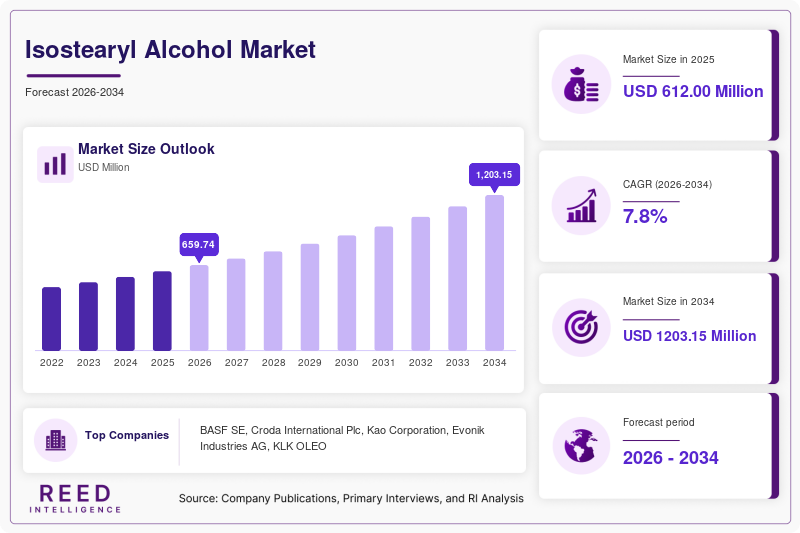
The global Isostearyl Alcohol Market size was valued at approximately USD 612 million in 2026 and is projected to reach nearly USD 1120 billion by 2034, expanding at a CAGR of 7.8% during the forecast period from 2026 to 2034. Isostearyl alcohol is widely used as an emollient, dispersing agent, surfactant intermediate, and texture enhancer across cosmetics, personal care, lubricants, coatings, and specialty chemical applications. The market continues to gain momentum due to rising demand for multifunctional ingredients in premium skincare and haircare formulations. Manufacturers are increasingly focusing on bio-based ingredients and performance-oriented formulations, which has improved the adoption of isostearyl alcohol in sustainable cosmetic production.
A major global factor supporting market growth is the expanding consumer preference for high-performance personal care products with enhanced texture, moisture retention, and skin-conditioning properties. The rapid rise of beauty and wellness industries in developing economies has further accelerated product demand. In addition, increasing disposable income, urbanization, and changing grooming habits among younger populations have contributed to higher consumption of cosmetic ingredients. Industrial applications are also broadening as formulators use isostearyl alcohol in metalworking fluids, industrial lubricants, and specialty coatings to improve product stability and spreadability.
Key Highlights
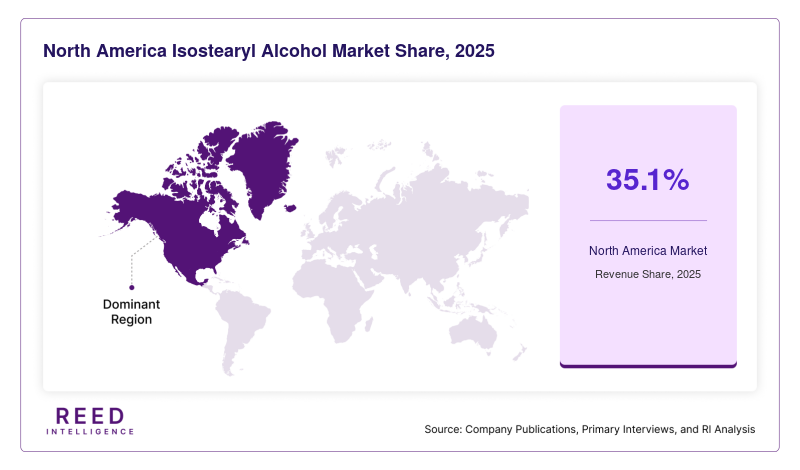
- North America dominated the market with a 35.1% share in 2025.
- Asia Pacific is expected to grow at the fastest CAGR of 9.6% during 2026–2034.
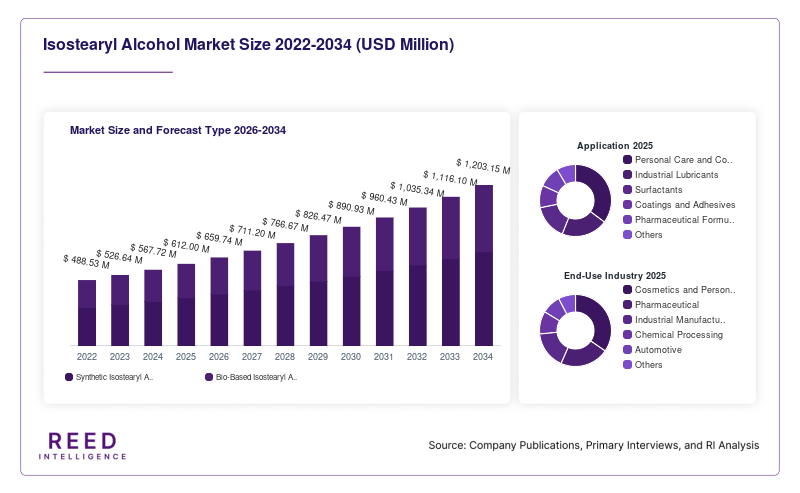
- By type, synthetic isostearyl alcohol accounted for the largest share of 58.4%.
- while bio-based isostearyl alcohol is projected to grow at a CAGR of 10.2%.
- By application, personal care and cosmetics led with a 46.8% share.
- whereas industrial lubricants are expected to expand at a CAGR of 8.9%.
- The United States remained the dominant country, with market values of USD 142 million in 2024 and USD 154 million in 2025.
Market Trends
Rising Demand for Sustainable and Bio-Based Cosmetic Ingredients
The increasing shift toward sustainable beauty and eco-conscious formulations has become a major trend in the Isostearyl Alcohol Market. Cosmetic manufacturers are actively replacing petroleum-derived ingredients with plant-based and biodegradable alternatives to align with changing consumer preferences and environmental regulations. Isostearyl alcohol derived from renewable feedstocks such as vegetable oils is gaining attention because it offers effective emollient and stabilizing properties while supporting clean-label product positioning. Global skincare and haircare brands are emphasizing ingredient transparency, which has encouraged suppliers to launch certified bio-based grades suitable for vegan and natural formulations.
This trend is particularly visible in premium skincare products, anti-aging creams, facial serums, and sulfate-free haircare solutions where texture and moisturization are important product attributes. Manufacturers are also improving production technologies to reduce carbon emissions and increase feedstock efficiency. The growing popularity of multifunctional cosmetic ingredients is expected to strengthen demand for bio-based isostearyl alcohol throughout the forecast period. Emerging economies in Asia Pacific and Latin America are witnessing increased launches of herbal and organic cosmetic products, further supporting long-term market growth.
Expansion of Specialty Chemical Applications Beyond Personal Care
Another important trend shaping the Isostearyl Alcohol Market is the growing use of the ingredient in specialty industrial applications beyond cosmetics and personal care. Industrial formulators are increasingly utilizing isostearyl alcohol in lubricants, coatings, metalworking fluids, and surfactant production because of its low volatility, enhanced stability, and effective dispersion properties. Manufacturers are focusing on high-performance specialty chemicals that improve operational efficiency while maintaining compatibility with stringent environmental standards.
The coatings industry has shown rising interest in isostearyl alcohol as an additive for improving surface smoothness and formulation consistency. Similarly, industrial lubricant manufacturers are integrating the ingredient into advanced formulations to enhance thermal stability and reduce wear under extreme conditions. Growth in automotive production, industrial automation, and infrastructure development is supporting broader adoption across multiple end-use sectors. Companies are also exploring customized blends and derivative products to improve functionality in industrial formulations. As research activities expand, the market is likely to witness the development of specialized grades tailored for niche industrial applications.
Market Drivers
Strong Growth of the Global Personal Care and Beauty Industry
The rapid expansion of the global beauty and personal care industry is a major driver supporting the growth of the Isostearyl Alcohol Market. Consumers are increasingly purchasing premium skincare, cosmetics, sun care, and haircare products that provide improved hydration, smooth texture, and long-lasting sensory performance. Isostearyl alcohol is widely used in these products because it functions effectively as an emollient, thickening agent, and dispersing component. Rising awareness regarding skincare routines and grooming habits among both men and women has accelerated demand for advanced cosmetic formulations.
E-commerce growth and social media marketing have also expanded the visibility of beauty brands, increasing the launch rate of innovative products containing multifunctional ingredients. Emerging economies are witnessing higher spending on cosmetics due to improving disposable income and urban lifestyle changes. In addition, aging populations in developed countries continue to support demand for anti-aging and moisturizing formulations. Cosmetic manufacturers are increasingly investing in research and product differentiation, which is expected to create sustained consumption of isostearyl alcohol across the forecast period.
Increasing Industrial Use in Lubricants and Specialty Formulations
The expanding utilization of isostearyl alcohol in industrial applications is another major factor driving market growth. The ingredient is increasingly used in industrial lubricants, surfactants, adhesives, and coatings because it improves stability, viscosity, and product performance under varying operating conditions. Industrial sectors are focusing on advanced specialty chemicals that support higher efficiency and lower environmental impact, which has encouraged the adoption of multifunctional oleochemical derivatives.
Growth in automotive manufacturing, machinery production, and infrastructure projects has strengthened demand for specialty lubricants and metalworking fluids. Isostearyl alcohol helps improve lubrication properties and enhances formulation consistency in high-temperature environments. In addition, manufacturers are developing specialty chemical blends tailored for industrial processing requirements. Rising investment in industrial modernization and automation in Asia Pacific and the Middle East is further contributing to increased consumption. Regulatory pressure for environmentally responsible industrial chemicals has also encouraged companies to shift toward biodegradable and bio-based ingredient alternatives, positively influencing market expansion.
Market Restraint
Volatility in Raw Material Prices and Supply Chain Constraints
Fluctuations in raw material prices remain a significant restraint affecting the growth of the Isostearyl Alcohol Market. The production of isostearyl alcohol depends heavily on oleochemical feedstocks and petrochemical derivatives, both of which are vulnerable to changes in crude oil prices, agricultural supply conditions, transportation costs, and trade policies. Variability in feedstock availability can directly influence production costs, reducing profit margins for manufacturers and creating pricing pressure across the supply chain. Smaller producers often face challenges in maintaining stable procurement strategies during periods of market instability.
Supply chain disruptions associated with geopolitical tensions, export restrictions, and logistics bottlenecks have also impacted the availability of raw materials and finished products in recent years. Cosmetic and industrial manufacturers may delay procurement decisions when ingredient pricing becomes unpredictable, affecting overall demand consistency. In addition, stringent environmental regulations regarding chemical processing and waste management can increase compliance costs for producers. Companies operating in highly competitive markets may struggle to transfer increased operational expenses to customers, especially in price-sensitive regions. These factors can limit production expansion and slow market penetration in emerging economies where affordability remains a major purchasing consideration.
Market Opportunities
Growth Potential in Emerging Economies and Local Cosmetic Manufacturing
Emerging economies present substantial opportunities for participants in the Isostearyl Alcohol Market due to rising urbanization, increasing disposable income, and expanding domestic cosmetic manufacturing capabilities. Countries across Asia Pacific, Latin America, and parts of the Middle East are witnessing strong growth in beauty and personal care consumption. Local cosmetic brands are introducing affordable skincare, haircare, and makeup products tailored to regional consumer preferences, creating additional demand for versatile ingredients such as isostearyl alcohol.
Governments in several developing countries are encouraging investment in specialty chemical manufacturing and downstream personal care production to reduce import dependence. This has created opportunities for ingredient suppliers to establish regional partnerships and production facilities. In addition, younger consumer populations are becoming more aware of skincare and grooming trends through digital platforms and influencer marketing. The growing popularity of herbal cosmetics and multifunctional formulations is expected to support higher adoption of bio-based isostearyl alcohol. Companies capable of offering cost-effective and customized ingredient solutions are likely to strengthen their position in these expanding regional markets.
Innovation in Pharmaceutical and Dermatological Applications
The increasing use of specialty ingredients in pharmaceutical and dermatological formulations offers another promising opportunity for the Isostearyl Alcohol Market. Pharmaceutical manufacturers are exploring multifunctional alcohol derivatives for topical creams, ointments, transdermal formulations, and medicated skincare products. Isostearyl alcohol provides desirable characteristics such as smooth spreadability, enhanced formulation stability, and improved moisture retention, making it suitable for dermatological applications.
Demand for advanced topical treatment products has increased due to rising skin sensitivity concerns, aging populations, and higher awareness regarding dermatological care. Manufacturers are investing in research to develop high-purity grades with improved compatibility for sensitive skin formulations. The expansion of cosmeceuticals and medicated beauty products is also creating opportunities for ingredient suppliers. In addition, pharmaceutical companies are increasingly seeking bio-compatible ingredients that comply with evolving safety and sustainability standards. Strategic collaboration between cosmetic ingredient suppliers and pharmaceutical formulators could accelerate product innovation and create new long-term revenue streams for market participants.
Segmental Analysis
By Type
Synthetic isostearyl alcohol accounted for the dominant share of the global Isostearyl Alcohol Market in 2024, representing approximately 58.4% of total revenue. The segment maintained strong market leadership due to its consistent quality, wide commercial availability, and cost-effective manufacturing process. Synthetic variants are extensively used in cosmetics, industrial lubricants, surfactants, and coatings because they provide reliable stability and formulation performance across multiple applications. Manufacturers prefer synthetic grades for large-scale industrial production as they offer better supply consistency and scalable processing capabilities. The segment also benefits from established petrochemical infrastructure and mature distribution networks across developed regions.
Demand for synthetic isostearyl alcohol has remained particularly strong in industrial applications where performance consistency and affordability are essential purchasing considerations. Cosmetic manufacturers also continue using synthetic variants in skincare creams, lotions, and makeup formulations because of their smooth texture and emulsifying properties. The availability of customized grades suitable for varying viscosity and purity requirements has further strengthened market penetration. Despite rising sustainability concerns, synthetic products continue to dominate due to lower production costs and high compatibility with conventional manufacturing systems.
By Application
Personal care and cosmetics represented the largest application segment in the Isostearyl Alcohol Market in 2024, accounting for approximately 46.8% of global revenue. The segment continues to dominate because isostearyl alcohol is widely used as an emollient, moisturizer, dispersing agent, and texture enhancer in skincare creams, sunscreens, makeup products, hair conditioners, and lotions. Increasing consumer focus on skincare quality and premium product formulations has strengthened ingredient demand across both developed and emerging economies. Cosmetic manufacturers value isostearyl alcohol for its ability to improve spreadability and provide a smooth sensory experience.
The growing popularity of multifunctional beauty products has also contributed to segment expansion. Consumers increasingly prefer formulations that combine hydration, anti-aging benefits, and lightweight texture within a single product. This trend has encouraged formulators to integrate advanced conditioning ingredients capable of improving overall product performance. Rising digital marketing activities and expanding online cosmetic retail channels have further accelerated product launches containing specialty emollients. Demand from men’s grooming and sensitive skin product categories is also creating additional growth opportunities within the personal care segment.
By End-Use Industry
The cosmetics and personal care industry held the dominant share of the Isostearyl Alcohol Market in 2024, contributing nearly 49.3% of total revenue. The segment continues to lead because of rising global demand for skincare, makeup, haircare, and premium beauty formulations. Consumers increasingly prefer products that deliver improved texture, hydration, and long-lasting performance, encouraging formulators to utilize multifunctional ingredients such as isostearyl alcohol. The ingredient’s compatibility with emulsions and active compounds makes it suitable for a broad range of cosmetic products.
Major cosmetic brands are investing heavily in product innovation and ingredient differentiation to strengthen brand identity in competitive markets. Demand for clean-label, sulfate-free, and vegan formulations has also increased the need for versatile emollients and conditioning agents. Growth in social media beauty trends and influencer-driven marketing campaigns has accelerated product adoption among younger consumers. The expansion of online retail platforms and direct-to-consumer beauty brands continues to support strong ingredient demand across both premium and mass-market product categories.
Regional Analysis
North America
North America accounted for the largest share of the global Isostearyl Alcohol Market in 2025, representing approximately 35.1% of total revenue. The region is projected to expand at a CAGR of 7.1% during the forecast period due to sustained demand from the cosmetics, skincare, and specialty chemical industries. Strong consumer preference for premium beauty products and multifunctional cosmetic ingredients continues to support market expansion. The presence of established personal care manufacturers and advanced formulation technologies has strengthened regional consumption patterns. Growing investment in sustainable and bio-based ingredients is also contributing to market development.
The United States remained the dominant country within the North American market due to its extensive cosmetics manufacturing base and high consumer spending on personal care products. Increasing demand for anti-aging skincare and dermatologist-recommended formulations has accelerated ingredient utilization across premium product categories. The country is also witnessing higher investment in clean-label and vegan cosmetic production, which supports demand for plant-derived isostearyl alcohol. In addition, research activities related to specialty lubricants and industrial formulations are creating broader commercial opportunities for manufacturers operating in the region.
Europe
Europe represented a significant portion of the Isostearyl Alcohol Market in 2025 and is expected to maintain stable growth at a CAGR of 6.8% through 2034. The region benefits from stringent cosmetic safety regulations and strong consumer awareness regarding sustainable ingredients. European manufacturers are increasingly focusing on biodegradable and naturally derived cosmetic additives to comply with environmental targets and changing consumer expectations. The demand for premium skincare products, anti-aging formulations, and organic beauty solutions continues to support steady market expansion across developed economies.
Germany emerged as the leading country in the European market due to its advanced chemical manufacturing infrastructure and strong personal care sector. The country has a well-established specialty chemicals industry that supports innovation in cosmetic ingredients and industrial applications. German manufacturers are investing in energy-efficient production technologies and sustainable feedstock sourcing to strengthen competitive positioning. Rising demand for high-performance industrial lubricants and eco-friendly coatings has also contributed to increased adoption of isostearyl alcohol across non-cosmetic applications.
Asia Pacific
Asia Pacific is anticipated to register the fastest growth in the global Isostearyl Alcohol Market, expanding at a CAGR of 9.6% during the forecast period. The region accounted for nearly 28.4% of market revenue in 2025 and continues to benefit from rapid urbanization, rising disposable income, and expanding cosmetic manufacturing activities. Consumer interest in skincare, haircare, and personal grooming products has increased substantially across major economies. International cosmetic brands are expanding regional production capacities, while domestic manufacturers are launching affordable and innovative formulations.
China remained the dominant country within the Asia Pacific market due to its large-scale cosmetics production and rapidly expanding specialty chemicals industry. Strong growth in e-commerce beauty sales and social media-driven skincare trends has accelerated ingredient demand. Chinese manufacturers are increasing investments in advanced oleochemical processing technologies to improve product quality and export competitiveness. In addition, government support for domestic chemical manufacturing and industrial modernization has strengthened the availability of raw materials and processing infrastructure required for market expansion.
Middle East & Africa
The Middle East & Africa region accounted for a smaller but steadily expanding share of the Isostearyl Alcohol Market in 2025 and is expected to grow at a CAGR of 6.5% during the forecast period. Increasing awareness regarding skincare and grooming products among younger populations is supporting regional demand for cosmetic ingredients. Beauty and wellness sectors are expanding gradually, particularly in urban centers where international cosmetic brands are strengthening retail presence. Demand for specialty industrial chemicals is also increasing alongside infrastructure and manufacturing development activities.
Saudi Arabia emerged as the dominant country within the regional market due to growing investments in personal care retail, industrial diversification, and chemical manufacturing capabilities. Rising disposable income and changing consumer lifestyles have increased demand for premium skincare and fragrance products. Government initiatives aimed at strengthening non-oil industrial sectors are encouraging local manufacturing and specialty chemical investments. The country is also experiencing higher demand for industrial lubricants and coatings used in construction and energy-related applications, supporting broader utilization of isostearyl alcohol.
Latin America
Latin America maintained a moderate share of the Isostearyl Alcohol Market in 2025 and is forecast to grow at a CAGR of 7.0% through 2034. Increasing urbanization, rising beauty consciousness, and expansion of regional cosmetic brands are supporting market growth. Consumers across the region are showing greater interest in skincare, haircare, and multifunctional beauty products formulated with conditioning and moisturizing ingredients. International manufacturers are also increasing product distribution networks to capture emerging demand opportunities in developing economies.
Brazil remained the leading country in the Latin American market due to its large cosmetics industry and strong consumer preference for beauty and personal care products. The country has a well-developed network of domestic cosmetic manufacturers that rely on specialty ingredients to improve formulation quality and product differentiation. Growing demand for haircare products and tropical skincare solutions has contributed to higher consumption of isostearyl alcohol. In addition, increasing investment in bio-based cosmetic ingredients and sustainable sourcing practices is creating favorable long-term opportunities for regional market participants.
Competitive Landscape
The Isostearyl Alcohol Market is characterized by the presence of global oleochemical manufacturers, specialty chemical producers, and cosmetic ingredient suppliers competing through product innovation, sustainability initiatives, and strategic expansion activities. Companies are focusing on developing high-purity and bio-based formulations to strengthen their position within premium cosmetic and pharmaceutical applications. Long-term supply agreements with personal care manufacturers and industrial clients remain an important competitive strategy across the market.
BASF SE continues to maintain a leading position due to its broad specialty chemical portfolio, advanced research capabilities, and extensive global distribution network. The company has strengthened its market presence through investments in sustainable ingredient development and environmentally responsible production technologies. Other major participants including Croda International Plc, Kao Corporation, Evonik Industries AG, and KLK OLEO are also emphasizing innovation and strategic partnerships to improve product differentiation.
Key Players
- BASF SE
- Croda International Plc
- Kao Corporation
- Evonik Industries AG
- KLK OLEO
- Ecogreen Oleochemicals
- Oleon NV
- Emery Oleochemicals
- Vantage Specialty Chemicals
- Jarchem Industries Inc.
- SABO S.p.A.
- Alzo International Inc.
- Musim Mas Holdings
- IOI Oleochemical Industries Berhad
- Sasol Limited
Recent Developments
- BASF SE announced the expansion of its sustainable cosmetic ingredient portfolio in 2025, including new bio-based emollient solutions designed for premium skincare applications.
- Croda International Plc invested in renewable feedstock sourcing initiatives in 2024 to strengthen sustainable oleochemical production and improve supply chain stability.
- Kao Corporation introduced advanced personal care ingredient formulations in 2025 focused on lightweight texture enhancement and improved moisturization performance.
- KLK OLEO expanded its specialty oleochemical production capacity in Asia Pacific to address increasing demand from regional cosmetic manufacturers.
Isostearyl Alcohol Market Segments
Type
- Synthetic Isostearyl Alcohol
- Bio-Based Isostearyl Alcohol
Application
- Personal Care and Cosmetics
- Industrial Lubricants
- Surfactants
- Coatings and Adhesives
- Pharmaceutical Formulations
- Others
End-Use Industry
- Cosmetics and Personal Care
- Pharmaceutical
- Industrial Manufacturing
- Chemical Processing
- Automotive
- Others
By Region
- North America
- Europe
- APAC
- Middle East and Africa
- LATAM