Isovaleraldehyde Market Size, Share & Demand Report By Application (Chemical Intermediates, Fragrance & Flavor, Pharmaceuticals, Others), By End-Use Industry (Pharmaceuticals, Agrochemicals, Personal Care, Chemical Manufacturing), By Production Process (Oxidation Process, Hydroformylation, Bio-Based Production), By Purity Level (Industrial Grade, High Purity Grade) By Region & Segment Forecasts, 2025–2034
USD 3950
Market Overview
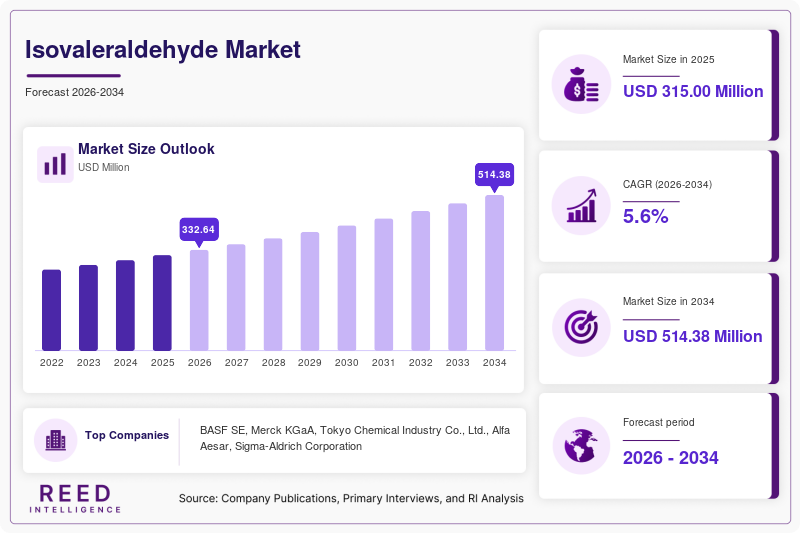
The global Isovaleraldehyde Market size was valued at approximately USD 315 million in 2025 and is projected to reach USD 515 million by 2034, expanding at a CAGR of 5.6% during 2025–2034. The market growth is primarily supported by increasing demand for specialty chemicals used in pharmaceuticals, agrochemicals, and fragrance applications. As an important intermediate in organic synthesis, isovaleraldehyde plays a key role in producing value-added compounds, which has strengthened its industrial relevance across diverse sectors.
A major global factor contributing to the expansion of the Isovaleraldehyde Market is the rising demand for fine chemicals in emerging economies. Rapid industrialization, combined with the expansion of chemical manufacturing infrastructure, has driven consistent consumption of aldehyde-based intermediates. Additionally, advancements in catalytic synthesis and process optimization have improved production efficiency, further supporting market growth.
Key Highlights
- Asia Pacific dominated the market with a 38.5% share in 2025, while the region is projected to grow at the fastest CAGR of 6.4%.
- By application, chemical intermediates accounted for the largest share (42.3%), while fragrance applications are expected to grow at a CAGR of 6.9%.
- By end-use, pharmaceuticals led the market (34.7%), whereas agrochemicals are forecast to grow at 6.7% CAGR.
- The United States remained the dominant country, with market values of USD 72 million in 2025 and USD 76 million in 2026.
Market Trends
Expansion of Specialty Chemical Applications
The increasing use of isovaleraldehyde in specialty chemical synthesis has been a defining trend in the Isovaleraldehyde Market. Manufacturers are leveraging its reactivity to develop advanced intermediates used in pharmaceuticals and fine chemicals. This trend is driven by the shift toward high-performance materials and customized chemical solutions. As industries demand more complex molecules with specific functional properties, isovaleraldehyde continues to gain traction as a versatile building block.
Rising Demand in Fragrance and Flavor Industry
Another key trend shaping the Isovaleraldehyde Market is the growing utilization of aldehydes in fragrance and flavor formulations. Isovaleraldehyde contributes to distinct aromatic profiles, making it valuable in perfumes and food additives. With increasing consumer demand for premium and natural-like scents, manufacturers are investing in innovative formulations. This trend is further supported by the expansion of the personal care and food processing industries, particularly in developing markets.
Market Drivers
Growth in Pharmaceutical Intermediate Production
The expanding pharmaceutical industry has significantly contributed to the growth of the Isovaleraldehyde Market. The compound serves as a critical intermediate in synthesizing active pharmaceutical ingredients (APIs) and other drug components. Rising healthcare demand, increased drug development activities, and growing investments in pharmaceutical manufacturing have collectively boosted the consumption of isovaleraldehyde.
Increasing Agrochemical Demand
The growing need for crop protection chemicals has also driven demand in the Isovaleraldehyde Market. The compound is widely used in the synthesis of pesticides and herbicides. With global food demand rising, agricultural productivity enhancement has become essential, leading to higher adoption of agrochemicals. This has directly increased the utilization of isovaleraldehyde in agricultural formulations.
Market Restraint
Stringent Environmental and Safety Regulations
The Isovaleraldehyde Market faces challenges due to strict environmental and safety regulations associated with aldehyde compounds. Regulatory bodies across major regions impose stringent guidelines regarding emissions, handling, and storage of volatile organic compounds. Compliance with these regulations increases operational costs for manufacturers and may limit production capacity expansions.
Additionally, concerns regarding worker safety and environmental impact have led to increased scrutiny of chemical manufacturing processes. Companies must invest in advanced safety systems and environmentally compliant technologies, which can affect profit margins. These regulatory pressures may slow down market growth, particularly for small and medium-scale producers.
Market Opportunities
Emerging Demand in Bio-Based Chemicals
The growing focus on sustainability presents a significant opportunity for the Isovaleraldehyde Market. Bio-based production methods are gaining attention as industries seek eco-friendly alternatives to traditional petrochemical processes. The development of renewable feedstocks and green chemistry techniques could enable sustainable isovaleraldehyde production, opening new growth avenues.
Expansion in Emerging Markets
Rapid industrial growth in developing regions offers substantial opportunities for the Isovaleraldehyde Market. Countries in Asia Pacific, Latin America, and the Middle East are witnessing increased investments in chemical manufacturing infrastructure. Rising demand for pharmaceuticals, agrochemicals, and consumer goods in these regions is expected to drive the adoption of isovaleraldehyde across multiple applications.
Segmental Analysis
By Application
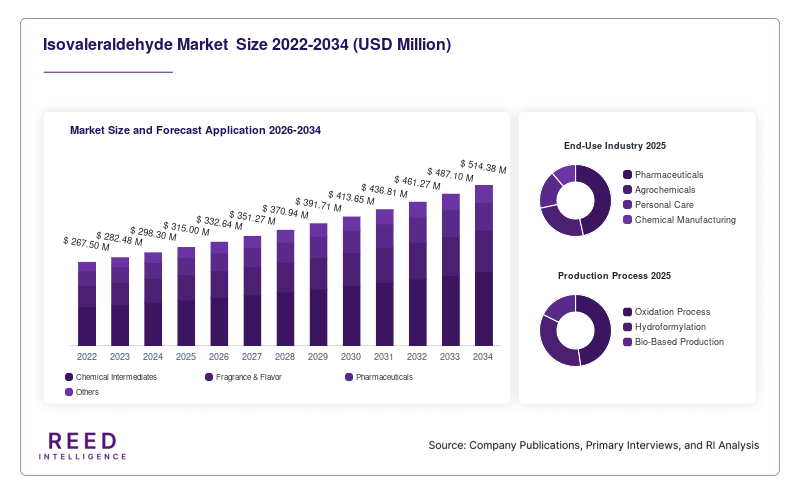
Chemical intermediates dominated the Isovaleraldehyde Market with a 42.3% share in 2025. This segment benefited from widespread use in organic synthesis processes across multiple industries.
Fragrance applications are expected to be the fastest-growing segment, with a projected CAGR of 6.9%. The rising demand for premium fragrances and personal care products will drive this growth.
By End-Use Industry
The pharmaceutical sector held the largest share of 34.7% in 2025, driven by its extensive use in drug synthesis. Increasing healthcare demand supported this segment’s dominance.
The agrochemical segment is anticipated to grow at a CAGR of 6.7%, driven by rising agricultural productivity requirements and increased use of crop protection products.
By Production Process
Oxidation-based production processes accounted for 55.8% of the market share in 2025, owing to their efficiency and cost-effectiveness.
Bio-based production methods are projected to grow at a CAGR of 6.5%, supported by sustainability initiatives and advancements in green chemistry technologies.
By Purity Level
Industrial-grade isovaleraldehyde dominated the market with a 61.2% share in 2025, primarily due to its widespread use in large-scale chemical synthesis.
High-purity grades are expected to grow at a CAGR of 6.3%, driven by increasing demand from pharmaceutical and specialty chemical applications requiring higher quality standards.
Regional Analysis
North America
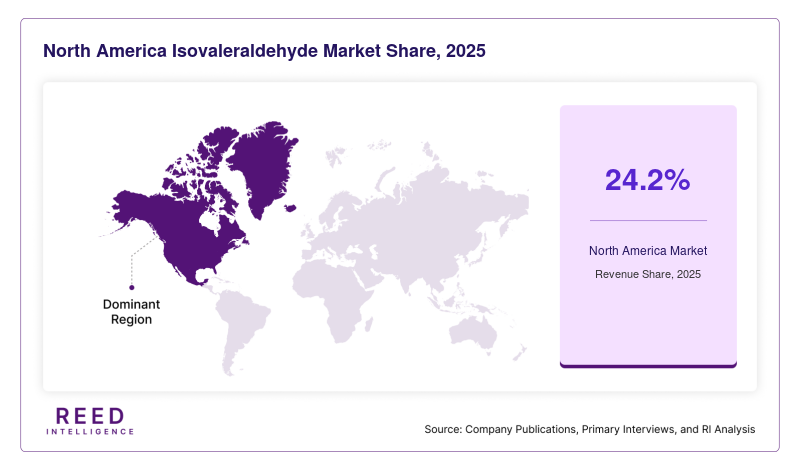
North America accounted for 24.2% of the Isovaleraldehyde Market in 2025 and is expected to grow at a CAGR of 4.8% during 2025–2034. The region’s established chemical manufacturing base supported steady demand for aldehyde intermediates.
The United States dominated the regional market due to its advanced pharmaceutical industry. High R&D investments and strong demand for specialty chemicals contributed to sustained consumption of isovaleraldehyde.
Europe
Europe held a 21.6% share in 2025 and is projected to expand at a CAGR of 4.6% over the forecast period. The region’s focus on sustainable chemical production influenced market dynamics.
Germany emerged as the leading country, supported by its robust chemical manufacturing sector. The presence of major specialty chemical producers and emphasis on innovation strengthened market growth.
Asia Pacific
Asia Pacific captured the largest share of 38.5% in 2025 and is expected to grow at the fastest CAGR of 6.4%. Rapid industrialization and expanding chemical production capacity drove market expansion.
China dominated the regional market due to its large-scale chemical manufacturing industry. The country’s growing demand for agrochemicals and pharmaceuticals supported increased consumption of isovaleraldehyde.
Middle East & Africa
The Middle East & Africa accounted for 8.1% of the market in 2025 and is forecast to grow at a CAGR of 5.2%. Increasing investments in petrochemical industries contributed to market growth.
Saudi Arabia led the region, driven by expanding chemical production facilities and government initiatives to diversify the economy beyond oil.
Latin America
Latin America held 7.6% of the market share in 2025 and is projected to grow at a CAGR of 5.0%. The region’s agricultural sector played a significant role in driving demand.
Brazil dominated the regional market due to its strong agrochemical industry. Increasing agricultural activities and demand for crop protection chemicals supported the growth of the Isovaleraldehyde Market.
Competitive Landscape
The Isovaleraldehyde Market is moderately consolidated, with several global and regional players competing based on product quality, pricing, and technological capabilities. Leading companies focus on expanding production capacity and improving process efficiency to maintain competitiveness.
A key market leader is BASF SE, which has a strong presence in specialty chemicals and continuously invests in research and development. The company recently expanded its aldehyde production capacity to meet growing global demand, reinforcing its market position.
Other major players emphasize strategic collaborations, mergers, and regional expansions to strengthen their market footprint. Continuous innovation and adoption of sustainable production methods remain critical strategies among competitors.
Key Players
- BASF SE
- Merck KGaA
- Tokyo Chemical Industry Co., Ltd.
- Alfa Aesar
- TCI Chemicals
- Sigma-Aldrich Corporation
- Lanxess AG
- Arkema Group
- Eastman Chemical Company
- Solvay S.A.
- Oxea GmbH
- Mitsubishi Chemical Corporation
- LG Chem Ltd.
- Jubilant Ingrevia Limited
- Gujarat Alkalies and Chemicals Limited
Recent Developments
- 2024: BASF SE expanded aldehyde production capacity in Asia to support regional demand.
- 2024: Eastman Chemical Company invested in process optimization technologies to improve efficiency.
- 2023: Lanxess AG introduced advanced chemical intermediates targeting pharmaceutical applications.
- 2023: Arkema Group strengthened its specialty chemicals portfolio through strategic acquisitions.
- 2023: Mitsubishi Chemical Corporation focused on sustainable production initiatives for aldehydes.
Isovaleraldehyde Market Segments
Application
- Chemical Intermediates
- Fragrance & Flavor
- Pharmaceuticals
- Others
End-Use Industry
- Pharmaceuticals
- Agrochemicals
- Personal Care
- Chemical Manufacturing
Production Process
- Oxidation Process
- Hydroformylation
- Bio-Based Production
Purity Level
- Industrial Grade
- High Purity Grade
By Region
- North America
- Europe
- APAC
- Middle East and Africa
- LATAM