Isoxaflutole Market Size, Share & Demand Report By Formulation Type (Herbicide Grade, Bio-Enhanced Formulations), By Crop Type (Corn, Sugarcane, Cereals, Others), By Application Method (Pre-Emergence, Post-Emergence), By Distribution Channel (Agrochemical Retailers, Direct Sales, Online Platforms), By Region & Segment Forecasts, 2026–2034
USD 3950
Market Overview
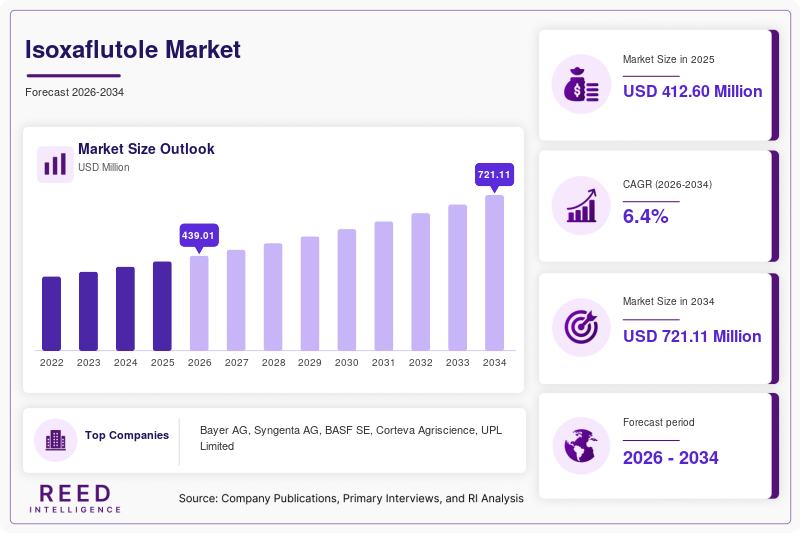
The global Isoxaflutole Market size was valued at USD 412.6 million in 2026 and is projected to reach USD 678.4 million by 2034, expanding at a CAGR of 6.4% during the forecast period (2026–2034). Isoxaflutole, a selective herbicide widely used in pre- and post-emergence weed control, has gained traction across modern agriculture due to its effectiveness in controlling broadleaf and grass weeds in crops such as corn, sugarcane, and cereals.
A key global factor supporting the growth of the Isoxaflutole Market is the rising demand for higher agricultural productivity amid shrinking arable land. Farmers and agribusinesses are increasingly adopting advanced crop protection chemicals to maximize yields, reduce manual labor, and ensure consistent crop quality. Isoxaflutole’s efficiency in integrated weed management systems has made it a preferred herbicide in both developed and developing agricultural economies.
Key Highlights
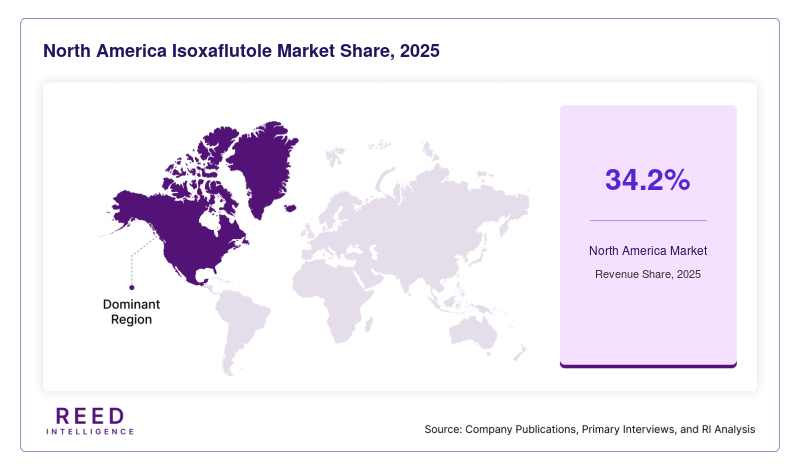
- North America dominated the market with a 34.2% share in 2025, while Asia Pacific is projected to grow at the fastest CAGR of 7.6% (2026–2034).
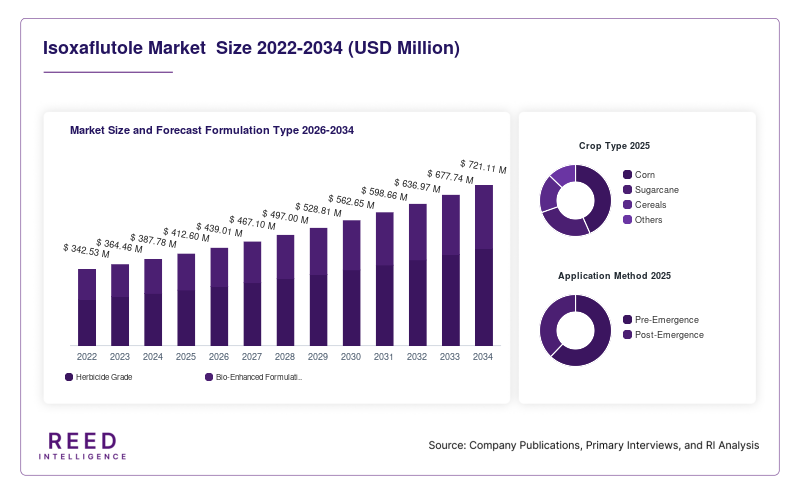
- Herbicide grade Isoxaflutole accounted for the largest share (61.5%), while bio-enhanced formulations are expected to grow fastest at a CAGR of 8.2%.
- Corn application segment led with 47.3% share, whereas sugarcane applications are anticipated to expand at a CAGR of 7.9%.
- The United States market was valued at USD 128.4 million in 2024 and USD 134.9 million in 2025, driven by large-scale mechanized farming and herbicide adoption.
Market Trends
Shift Toward Sustainable Herbicide Formulations
One of the notable trends shaping the Isoxaflutole Market is the increasing shift toward environmentally safer and sustainable herbicide formulations. Regulatory bodies and agricultural stakeholders are focusing on minimizing chemical residues in soil and water. Manufacturers are investing in improved formulations with reduced toxicity and enhanced biodegradability. This trend is encouraging innovation in controlled-release technologies and eco-compatible carriers that optimize herbicide efficiency while reducing environmental impact.
Integration with Precision Agriculture Technologies
Another emerging trend is the integration of Isoxaflutole usage with precision agriculture technologies. The adoption of GPS-guided spraying systems, drones, and AI-based farm analytics is enabling farmers to apply herbicides with higher accuracy and reduced wastage. This integration improves cost efficiency and minimizes environmental exposure, thereby increasing the overall effectiveness of Isoxaflutole applications. As digital farming solutions gain traction, demand for compatible herbicide products is expected to rise steadily.
Market Drivers
Rising Demand for Crop Yield Optimization
The need to increase crop productivity to meet global food demand is a major driver of the Isoxaflutole Market. Farmers are adopting advanced herbicides to combat weed resistance and improve crop yields. Isoxaflutole offers long-lasting weed control, reducing the need for repeated applications and ensuring better crop establishment. This efficiency makes it an attractive solution for large-scale farming operations.
Expansion of Commercial Farming Practices
The expansion of commercial and contract farming practices is significantly contributing to market growth. Large agricultural enterprises require effective weed management solutions to maintain uniform crop quality across vast farmland. Isoxaflutole’s compatibility with mechanized farming systems and its effectiveness across multiple crops make it a preferred choice in commercial agriculture, particularly in North America and emerging economies in Asia Pacific.
Market Restraints
Stringent Environmental Regulations
A major restraint in the Isoxaflutole Market is the increasing stringency of environmental and regulatory frameworks governing agrochemical usage. Regulatory authorities in several regions impose strict guidelines on herbicide application, residue limits, and environmental impact. Compliance with these regulations often requires additional testing and reformulation, which can increase production costs and limit market expansion.
Market Opportunities
Growth in Emerging Agricultural Economies
Emerging economies in Asia Pacific, Latin America, and Africa present significant opportunities for the Isoxaflutole Market. Rapid agricultural modernization, government support for crop protection solutions, and increasing awareness among farmers about advanced herbicides are driving adoption in these regions. Expanding agricultural exports further supports the demand for efficient weed control products.
Development of Bio-Based and Hybrid Formulations
The development of bio-based and hybrid herbicide formulations represents another promising opportunity. Combining Isoxaflutole with biological agents or safer chemical compounds can enhance performance while addressing environmental concerns. These innovations are expected to attract regulatory approval more easily and open new avenues for market growth.
Segmental Analysis
By Formulation Type
The herbicide grade Isoxaflutole segment dominated the market with a 61.5% share in 2025, driven by its widespread use in conventional farming systems. Its proven effectiveness in controlling a broad spectrum of weeds has made it a preferred choice among farmers.
The bio-enhanced formulations segment is expected to grow at a CAGR of 8.2%, supported by increasing demand for environmentally safer herbicide solutions. These formulations combine chemical and biological components, offering improved performance and reduced environmental impact.
By Crop Type
The corn segment accounted for the largest share of 47.3% in 2025, as Isoxaflutole is extensively used in corn cultivation for effective weed management. High corn production in North America and Latin America has contributed significantly to this segment’s dominance.
The sugarcane segment is projected to grow at a CAGR of 7.9%, driven by expanding sugar production and increasing adoption of herbicides in tropical regions. Isoxaflutole’s ability to control persistent weeds in sugarcane fields supports its growing demand.
By Application Method
The pre-emergence application segment held a dominant share of 58.7% in 2025, as early-stage weed control is critical for crop establishment. Isoxaflutole’s effectiveness when applied before weed germination has made it widely used in this application method.
The post-emergence segment is expected to grow at a CAGR of 7.1%, driven by the need for corrective weed control and flexibility in application timing. Advances in formulation technology are enhancing the effectiveness of post-emergence treatments.
By Distribution Channel
The agrochemical retailers segment dominated with a 52.4% share in 2025, as farmers rely on local distributors for product availability and technical guidance.
The online distribution segment is anticipated to grow at a CAGR of 8.5%, fueled by increasing digitalization in agriculture and the convenience of e-commerce platforms. Online channels provide farmers with access to a wider range of products and competitive pricing.
Regional Analysis
North America
North America accounted for 34.2% of the Isoxaflutole Market share in 2025 and is expected to grow at a CAGR of 5.9% during the forecast period. The region’s dominance was driven by advanced agricultural practices, high adoption of herbicides, and strong distribution networks. The United States remained the leading country due to its large-scale corn production and widespread use of pre-emergent herbicides to enhance yield efficiency.
Europe
Europe held a 24.6% market share in 2025 and is projected to grow at a CAGR of 5.4% from 2026 to 2034. Growth in the region is supported by precision farming adoption and sustainable agriculture initiatives. France emerged as the dominant country, driven by its extensive cereal cultivation and emphasis on integrated pest management practices.
Asia Pacific
Asia Pacific represented 21.8% of the market share in 2025 and is anticipated to grow at the fastest CAGR of 7.6%. Rapid agricultural expansion, increasing food demand, and government initiatives supporting agrochemical usage are key growth factors. China led the regional market due to its large agricultural base and rising adoption of advanced herbicides to improve crop yields.
Middle East & Africa
The Middle East & Africa region accounted for 10.1% of the market share in 2025 and is expected to grow at a CAGR of 6.2%. Growth is driven by the gradual adoption of modern farming techniques and increasing investments in agricultural infrastructure. South Africa dominated the region, supported by commercial farming practices and export-oriented agriculture.
Latin America
Latin America held a 9.3% share in 2025 and is forecast to expand at a CAGR of 6.8%. The region’s growth is fueled by expanding soybean and corn cultivation and increasing demand for efficient weed control solutions. Brazil emerged as the leading country due to its large-scale agricultural operations and strong agrochemical market presence.
Competitive Landscape
The Isoxaflutole Market is characterized by the presence of established agrochemical companies focusing on product innovation and strategic collaborations. The market leader, Bayer AG, maintains a strong position through its extensive product portfolio and continuous investment in research and development. The company recently introduced an advanced Isoxaflutole formulation aimed at improving weed control efficiency while reducing environmental impact.
Other key players such as Syngenta AG, BASF SE, Corteva Agriscience, and UPL Limited are actively expanding their market presence through partnerships, acquisitions, and regional expansion strategies. These companies emphasize developing sustainable herbicide solutions and enhancing distribution networks. Competitive dynamics are shaped by innovation in formulation technologies, regulatory compliance, and the ability to address evolving agricultural needs. As demand for efficient crop protection solutions grows, market participants are expected to focus on differentiation through performance and sustainability.
Key Players List
- Bayer AG
- Syngenta AG
- BASF SE
- Corteva Agriscience
- UPL Limited
- FMC Corporation
- Nufarm Limited
- Adama Agricultural Solutions Ltd.
- Sumitomo Chemical Co., Ltd.
- Nissan Chemical Corporation
- American Vanguard Corporation
- Albaugh LLC
- Arysta LifeScience Corporation
- Rallis India Limited
- PI Industries Ltd.
Recent Developments
- In 2025, leading agrochemical companies introduced improved Isoxaflutole formulations with enhanced environmental safety profiles.
- Strategic collaborations between manufacturers and agricultural technology firms increased integration with precision farming systems.
- Expansion of distribution networks in Asia Pacific and Latin America improved product accessibility for farmers.
- Investment in research and development focused on hybrid herbicide solutions combining chemical and biological components.
- Regulatory approvals for new formulations supported market expansion in key agricultural regions.
Isoxaflutole Market Segments
Formulation Type
- Herbicide Grade
- Bio-Enhanced Formulations
Crop Type
- Corn
- Sugarcane
- Cereals
- Others
Application Method
- Pre-Emergence
- Post-Emergence
Distribution Channel
- Agrochemical Retailers
- Direct Sales
- Online Platforms
By Region
- North America
- Europe
- APAC
- Middle East and Africa
- LATAM