IT As A Service (ITaaS) Market Size, Share & Trends Analysis Report By Service Type (Infrastructure as a Service, Platform as a Service), By Deployment (Public Cloud, Private Cloud), By Organization Size (Large Enterprises, Small & Medium Enterprises), By Application (IT Infrastructure Management, Application Management), By End Use (BFSI, IT & Telecommunications, Healthcare, Retail & E-Commerce, Manufacturing) Forecasts, 2026–2034
USD 3950
IT As A Service (ITaaS) Market Size
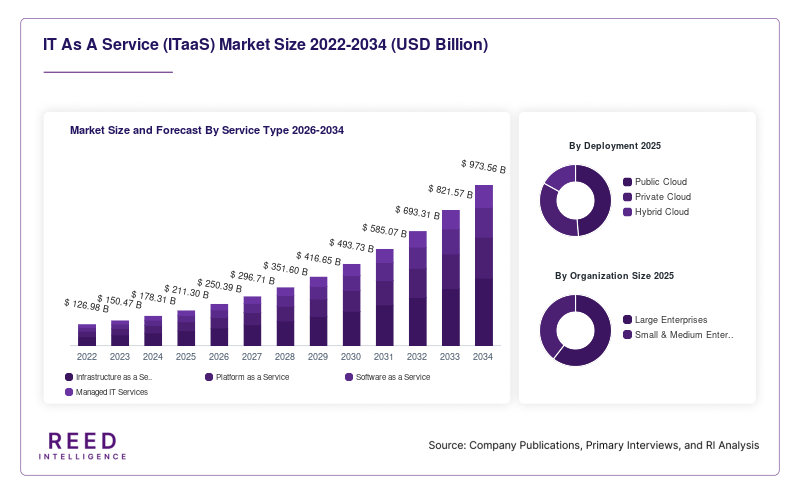
The global IT As A Service (ITaaS) Market size was valued at USD 211.30 billion in 2025 and is projected to grow from USD 250.39 billion in 2026 to USD 973.56 billion by 2034, registering a CAGR of 18.50% during the forecast period from 2026 to 2034.
IT As A Service (ITaaS) is shifting enterprise technology procurement from ownership of infrastructure and software toward consumption-based access to computing, applications, platforms, managed infrastructure, security and workplace capabilities. NIST defines cloud computing around on-demand access, resource pooling, rapid elasticity and measured service, with SaaS, PaaS, and IaaS forming the three core service models.
The current market signal is particularly strong around cloud infrastructure and AI. Gartner forecasts worldwide IT spending of USD 6.37 trillion in 2026, up 14.2%, with IaaS spending reaching USD 287 billion, up 29.3%. Gartner identifies data-center systems and IaaS as major spending-growth areas as enterprises and hyperscalers expand infrastructure for AI workloads.
AI is changing the economics of ITaaS because organizations need elastic compute, storage, networking, AI platforms and managed operational support without building every capability internally. Gartner estimates AI spending at USD 2.59 trillion in 2026, while AI-optimized IaaS spending is projected to reach USD 42 billion in 2026.
At the same time, enterprises are retaining hybrid environments rather than moving everything to public cloud. Managed-service providers are increasingly positioned between internal IT teams and cloud providers, handling migration, infrastructure operations, security, optimization and application management. Accenture identifies hybrid infrastructure, cloud optimization, managed applications and security as core parts of this operating model.
-market-8259.png)
IT As A Service (ITaaS) Market Drivers
AI Workloads Are Increasing Demand for Consumption-Based IT Infrastructure
AI is creating a major new demand layer for ITaaS because organizations need computing capacity faster than traditional capital-planning cycles can provide. Gartner expects worldwide AI spending to reach USD 2.59 trillion in 2026, with AI infrastructure representing more than 45% of spending through the coming years. AI-optimized IaaS spending alone is projected to reach USD 42 billion in 2026.
The mechanism is straightforward: training, inference, vector databases, data pipelines and AI-agent workloads require scalable compute and storage. Instead of purchasing sufficient infrastructure for peak demand, enterprises can obtain capacity through cloud and managed-service models.
Microsoft's FY2026 results show this demand directly. Azure and other cloud services revenue grew 39% in FY2026 Q2 and 40% in Q3, with Microsoft citing demand across workloads and continued investment in AI infrastructure.
This benefits IaaS providers, managed cloud operators, data-management companies and cybersecurity providers. The counterbalance is rising cloud expenditure: organizations need FinOps, workload optimization and governance to prevent AI-related consumption from eroding the economic benefit of outsourcing infrastructure.
Enterprises Are Replacing Fixed IT Ownership With Managed and Subscription Models
The ITaaS model allows organizations to convert portions of technology spending from internally operated infrastructure into recurring service expenditure. NIST's cloud model explicitly incorporates measured service and rapid provisioning, while modern managed-service models extend the same concept to infrastructure, applications, cybersecurity and digital workplaces.
Gartner forecasts worldwide IT services spending at USD 1.57 trillion in 2026, while its April 2026 forecast placed IT services, including application implementation and managed services and IaaS, above USD 1.87 trillion.
The commercial mechanism is particularly relevant for companies with legacy infrastructure. Accenture reports that 34% of C-suite executives consider legacy infrastructure among the top three barriers to fully realizing cloud value, while 82% of companies achieving their cloud outcomes use managed services to a moderate or great degree.
This creates recurring demand for cloud migration, infrastructure monitoring, application management, security operations and optimization. It also allows smaller IT departments to access specialist skills without building equivalent teams internally.
Hybrid and Multi-Cloud Complexity Is Expanding the Role of ITaaS Providers
Cloud adoption has not eliminated traditional infrastructure. Enterprises continue to operate combinations of public cloud, private cloud, on-premise systems and edge infrastructure. NIST recognizes public, private, community and hybrid cloud deployment models, while current managed-service providers increasingly operate across multiple environments.
Accenture's infrastructure-management offering explicitly covers on-premise, public-cloud, private-cloud and hybrid environments, while its cloud practice emphasizes migration, optimization, FinOps and ongoing management.
The mechanism creates a larger service layer between technology vendors and enterprise users. Companies may purchase infrastructure from one provider, applications from another and security services from a third, while requiring one managed operating model across the environment.
This favors ITaaS companies that can integrate heterogeneous technologies. The counterbalance is vendor complexity: poorly governed multi-cloud environments can create duplicated tools, inconsistent security controls and unexpected consumption costs.
IT As A Service (ITaaS) Market Restraints
Cloud Cost Control and Vendor Lock-In Remain Significant Concerns
Consumption-based IT does not automatically reduce technology expenditure. Cloud costs can rise quickly when workloads are poorly optimized, data is transferred frequently between environments or AI workloads operate continuously.
Accenture specifically highlights FinOps as a mechanism for making cloud and AI expenditure visible and predictable. Its current cloud offering emphasizes cost governance alongside migration and optimization.
Vendor lock-in is another concern. Moving applications, data and operational processes between cloud platforms can require significant engineering work. Organizations may therefore retain hybrid architectures even when public-cloud services are available.
The commercial implication is that ITaaS providers increasingly need to sell optimization and portability, not only infrastructure capacity. Providers able to demonstrate measurable workload efficiency can protect customer relationships, whereas undifferentiated capacity becomes more exposed to price competition.
Security, Data Sovereignty and Compliance Increase Implementation Complexity
ITaaS moves infrastructure and operational responsibilities across organizational boundaries, increasing the importance of identity management, data governance, cybersecurity and regulatory controls.
Gartner forecasts worldwide sovereign-cloud IaaS spending at USD 80 billion in 2026, up 35.6% from 2025. Governments and regulated industries are major buyers because they require greater control over data location, technology independence and compliance.
This creates additional requirements for regional cloud infrastructure, encryption, access controls, auditability and specialized managed services. Providers must therefore maintain compliance capabilities alongside technical capacity.
The opportunity is that complexity can increase demand for managed security and compliance services. The restraint is that regionalization can reduce the scalability advantage of a single global cloud architecture.
IT As A Service (ITaaS) Market Opportunities
AI-Optimized Infrastructure as a Service
AI is creating a specialized infrastructure layer within ITaaS. Gartner projects AI-optimized IaaS spending to reach USD 42 billion in 2026, with demand driven by LLM training and operationalization of AI across enterprise workflows.
Providers can differentiate through GPU availability, high-speed networking, optimized storage, inference infrastructure, orchestration and managed AI environments. The opportunity also extends to companies that provide FinOps and workload optimization because AI workloads can generate substantially higher infrastructure consumption than conventional applications.
Managed AI, Application and Infrastructure Operations
Enterprises increasingly need help operating cloud-native applications, data platforms and AI systems after migration. Accenture's application-managed-services model combines cloud, generative AI, automation and traditional managed services, while IBM is introducing managed cloud services for Red Hat AI inference and OpenShift virtualization.
This creates a recurring-services opportunity because customers require monitoring, updates, security, performance management and compliance throughout the life of the application.
The market is consequently expanding beyond "cloud hosting" toward an operating model in which external providers manage portions of the enterprise technology stack.
Sovereign and Industry-Specific Cloud Services
Sovereign cloud demand is creating room for regional providers and global vendors with localized infrastructure. Gartner expects sovereign IaaS spending to reach USD 80 billion in 2026 and notes that Europe is expected to surpass North America in sovereign-cloud IaaS spending in 2027.
The opportunity is particularly relevant to government, financial services, healthcare, telecommunications and critical infrastructure. Providers can differentiate through local data residency, regulatory compliance, encryption, identity controls and industry-specific managed services.
Segmental Analysis
By Service Type
Infrastructure as a Service represents approximately 31% of the global ITaaS Market in 2025. IaaS provides scalable computing, storage and networking without requiring customers to own the underlying infrastructure. Gartner forecasts worldwide IaaS spending of USD 287 billion in 2026, up 29.3%, making it one of the fastest-expanding parts of enterprise technology spending.
Platform as a Service accounts for approximately 19%, while Software as a Service represents approximately 32%.
Managed IT Services account for approximately 18% and are the fastest-growing service type, with a CAGR of approximately 20.1%. Demand is linked to enterprise requirements for cloud operations, application management, cybersecurity, infrastructure optimization and specialist skills. Accenture's current managed-services portfolio spans infrastructure, applications, data, AI and cybersecurity.
By Deployment
Public Cloud represents approximately 52% of the market in 2025. Its share is supported by elastic infrastructure, broad geographic coverage and consumption-based pricing.
Hybrid Cloud accounts for approximately 33%, reflecting enterprises that retain legacy applications, regulated workloads or specialized infrastructure while adopting public-cloud services.
Private Cloud represents approximately 15%.
Hybrid Cloud is the fastest-growing deployment segment, with an estimated 20.2% CAGR. Hybrid environments allow organizations to combine public-cloud scalability with control over sensitive workloads and existing infrastructure. Accenture specifically positions managed infrastructure services around hybrid environments spanning on-premise, private and public cloud.
By Organization Size
Large Enterprises represent approximately 68% of the market in 2025. Large organizations have more complex infrastructure estates, larger cloud budgets and greater requirements for application modernization, cybersecurity and managed operations.
Small & Medium Enterprises account for approximately 32%.
Small & Medium Enterprises are the fastest-growing organization segment, with approximately 21.4% CAGR. ITaaS allows smaller organizations to access infrastructure, software, security and specialist technical skills without maintaining large internal technology teams.
Accenture's launch of Accenture Edge in June 2026 specifically targets companies with USD 300 million to USD 3 billion in annual revenue and identifies the mid-market as an estimated USD 240 billion technology-services opportunity.
By Application
IT Infrastructure Management accounts for approximately 27% of the market in 2025, reflecting demand for compute, storage, networks and infrastructure operations.
Application Management represents approximately 22%, while Data Management & Analytics accounts for 18%.
Cybersecurity represents approximately 19%, supported by growing complexity across cloud and hybrid environments.
Digital Workplace represents approximately 14%.
Cybersecurity is the fastest-growing application segment, with an estimated 22.4% CAGR. The mechanism is the growing number of cloud workloads, identities, applications and data environments that must be monitored and protected. Accenture now incorporates cybersecurity managed services directly into its broader managed-services model.
By End Use
IT & Telecommunications represents approximately 23% of the market in 2025 because technology companies themselves operate extensive cloud, data, application and network infrastructure.
BFSI accounts for approximately 18%, followed by Manufacturing at 15%, Retail & E-Commerce at 13%, Healthcare at 11%, Government & Defense at 10% and other industries at 10%.
Healthcare is the fastest-growing end-use segment, with approximately 21.6% CAGR. Healthcare organizations are increasing investment in digital applications, data infrastructure, cybersecurity and cloud platforms while operating under demanding privacy and regulatory requirements.
Regional Analysis
North America IT As A Service (ITaaS) Market
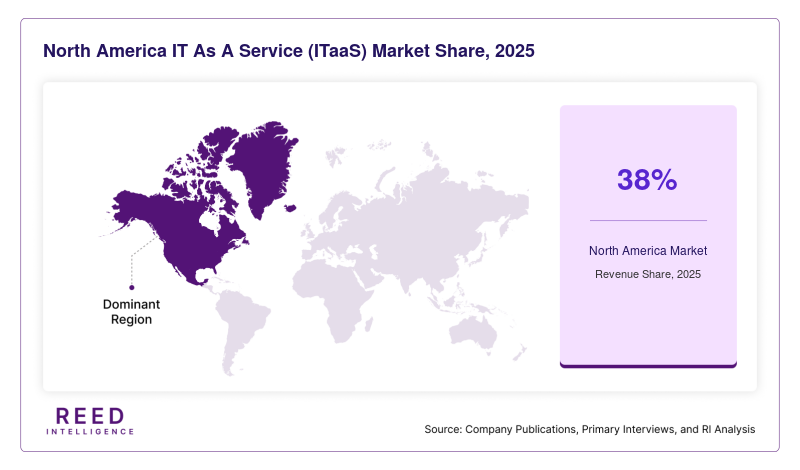
North America represents approximately 38% of the global ITaaS Market in 2025. The region has a mature cloud ecosystem, extensive enterprise software adoption and the world's largest concentration of hyperscale cloud providers and technology-service companies.
U.S. enterprises are also major consumers of AI infrastructure. Gartner forecasts worldwide IT spending to reach USD 6.37 trillion in 2026, with IaaS and data-center systems among the fastest-growing areas.
Microsoft's FY2026 results illustrate the scale of cloud demand. Azure and other cloud services revenue grew 40% in FY2026 Q3, while the company continued increasing infrastructure investment to support AI workloads.
The regional market is projected to grow at approximately 17.2% CAGR through 2034. Large enterprises remain major buyers of cloud migration, managed infrastructure, cybersecurity and application services.
The main constraint is market maturity. Many large companies already have significant cloud adoption, shifting incremental demand toward optimization, modernization, AI infrastructure and managed operations rather than initial cloud migration.
Europe IT As A Service (ITaaS) Market
Europe accounts for approximately 27% of the global market in 2025. The region has extensive cloud adoption across large enterprises and SMEs but places greater emphasis on data sovereignty, regulatory compliance and regional technology infrastructure.
Gartner forecasts sovereign-cloud IaaS spending worldwide at USD 80 billion in 2026 and expects Europe to surpass North America in sovereign IaaS spending in 2027.
This creates demand for European cloud infrastructure, localized managed services and compliance-focused technology operations. Financial services, government and critical infrastructure are particularly relevant because data residency and regulatory requirements influence provider selection.
Europe is expected to grow at approximately 18.0% CAGR. Hybrid cloud is important because many enterprises are balancing cloud modernization with established on-premise infrastructure.
The principal constraint is fragmented regulation and market structure across individual countries, which can increase implementation complexity and reduce economies of scale.
APAC IT As A Service (ITaaS) Market
APAC represents approximately 24% of the global market in 2025 and is the fastest-growing region, with a CAGR of approximately 22.4%.
The region combines rapid cloud adoption, digitalization, expanding AI workloads and a large base of enterprises moving from traditional IT infrastructure toward consumption-based models.
India provides a clear example. Gartner forecasts public-cloud spending in India at USD 17.5 billion in 2026, up 28.1% from USD 13.7 billion in 2025. Gartner attributes the increase to AI-ready infrastructure, application modernization, digital sovereignty and consumption-based IT models.
China, Japan, South Korea, Singapore and Australia also contribute to regional demand through cloud migration, AI infrastructure, data platforms and managed services.
The competitive structure includes hyperscalers, telecommunications companies, regional cloud providers and global system integrators. Local data requirements can favor regional infrastructure and sovereign-cloud offerings.
The principal constraints include different data regulations across countries, varying enterprise IT maturity and uneven cloud infrastructure availability.
Middle East and Africa IT As A Service (ITaaS) Market
Middle East and Africa represents approximately 6% of the global market in 2025 and is projected to grow at approximately 20.0% CAGR.
Government digital-transformation programs, cloud migration, financial-services modernization and telecommunications investment are creating demand for ITaaS. The Middle East is particularly relevant to sovereign-cloud and regulated workloads because governments and critical infrastructure organizations increasingly require control over data and technology infrastructure.
Gartner identifies governments as the primary buyers of sovereign IaaS, followed by regulated industries and critical infrastructure organizations such as energy and utilities and telecommunications.
The region's growth mechanism therefore combines cloud adoption with digital sovereignty and managed services.
Infrastructure availability, cybersecurity skills and local regulatory requirements remain constraints, particularly across African markets. Providers that combine regional data centers with managed services can address these gaps.
LATAM IT As A Service (ITaaS) Market
LATAM accounts for approximately 5% of the global ITaaS Market in 2025 and is projected to grow at approximately 19.4% CAGR.
Brazil and Mexico are the region's major technology markets, supported by financial services, telecommunications, retail, manufacturing and public-sector digitalization.
Cloud adoption is increasingly connected with application modernization and data analytics rather than simple infrastructure migration. Enterprises are also using managed-service providers to overcome shortages of specialized cloud, cybersecurity and data skills.
The region's growth mechanism is therefore a combination of cloud adoption, modernization and outsourcing of complex IT operations.
Currency volatility, cybersecurity requirements and differences in data regulations can affect investment timing. Local providers and global integrators with regional delivery centers can mitigate these barriers through localized pricing, support and compliance capabilities.
Competitive Landscape
The ITaaS market has a highly diversified competitive structure because no single provider controls the complete stack. Hyperscalers compete in IaaS and PaaS, software vendors dominate SaaS categories, telecommunications companies provide connectivity and cloud services, while system integrators and managed-service providers operate across multiple layers.
Microsoft is expanding Azure across enterprise infrastructure, AI and hybrid cloud. Azure and other cloud services grew 40% in FY2026 Q3, with Microsoft continuing to invest in AI infrastructure and cloud capacity.
Accenture competes primarily through consulting, application management, infrastructure management, cloud migration, security and AI-enabled managed services. Its fiscal 2025 revenue reached USD 69.7 billion and new bookings reached USD 80.6 billion, while its 2026 strategy increasingly integrates AI into technology delivery.
IBM is positioning hybrid cloud and AI as central parts of its technology strategy. In 2025, IBM generated USD 67.5 billion in revenue, with software representing approximately 45% of revenue; its consulting business continued to see demand for AI-enabled workflow transformation and cloud modernization.
Key Market Players
- Microsoft
- Amazon Web Services
- Google Cloud
- IBM
- Accenture
- Oracle
- Salesforce
- SAP
- ServiceNow
- Cisco
- HPE
- Dell Technologies
- DXC Technology
- Kyndryl
- Capgemini
- Tata Consultancy Services
- Infosys
- Wipro
- Cognizant
- NTT DATA
Recent Market Developments
- September 2026 – Accenture and AWS expanded their mid-market collaboration. Six offerings became available through AWS Marketplace, combining AWS cloud infrastructure, security, and AI services with Accenture's managed technology capabilities. The development expands ITaaS distribution beyond very large enterprises.
- August 2026 - Gartner projected AI-optimized IaaS spending to reach USD 42 billion in 2026. The company attributed the increase to LLM training and the operationalization of AI across enterprise applications and workflows.
IT As A Service (ITaaS) Market Segments
By Service Type
- Infrastructure as a Service
- Platform as a Service
- Software as a Service
- Managed IT Services
By Deployment
- Public Cloud
- Private Cloud
- Hybrid Cloud
By Organization Size
- Large Enterprises
- Small & Medium Enterprises
By Application
- IT Infrastructure Management
- Application Management
- Data Management & Analytics
- Cybersecurity
- Digital Workplace
By End Use
- BFSI
- IT & Telecommunications
- Healthcare
- Retail & E-Commerce
- Manufacturing
- Government & Defense
- Other Industries
By Region
- North America
- Europe
- APAC
- Middle East and Africa
- LATAM