IT Recruitment Market Size, Share & Demand Report By Recruitment Type (Contract Staffing, Temporary Staffing, Recruitment Process Outsourcing (RPO), Executive Search), By Enterprise Size (Large Enterprises, Small & Medium Enterprises), By End-Use Industry (Banking, Financial Services & Insurance, Healthcare IT, Manufacturing, Retail & E-commerce, Government & Public Sector, Others), By Region & Segment Forecasts, 2026–2034
USD 3950
Market Overview
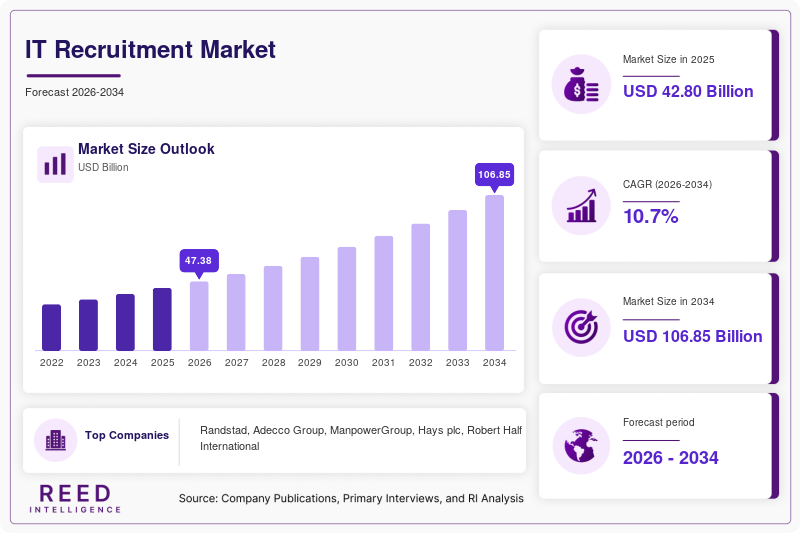
The global IT Recruitment Market size was valued at USD 42.8 billion in 2026 and is projected to reach USD 96.7 billion by 2034, expanding at a CAGR of 10.7% during 2026–2034. The market continues to evolve as organizations accelerate digital transformation initiatives, increase investments in cloud infrastructure, and expand technology-focused business models. Demand for qualified technology professionals has increased across software development, cybersecurity, artificial intelligence, data analytics, cloud computing, and enterprise application management, creating sustained demand for specialized recruitment services.
The growing complexity of workforce requirements has encouraged enterprises to adopt advanced recruitment platforms, recruitment process outsourcing services, and AI-powered candidate sourcing tools. Organizations are increasingly partnering with specialized IT staffing firms to reduce hiring cycles and improve talent acquisition outcomes. The emergence of hybrid work models has further expanded talent pools beyond geographic boundaries, allowing employers to recruit technology professionals from multiple regions.
Key Highlights
- North America dominated the market with a 34.8% share in 2025.
- while Asia Pacific is expected to grow at the fastest CAGR of 12.3% during 2026–2034.
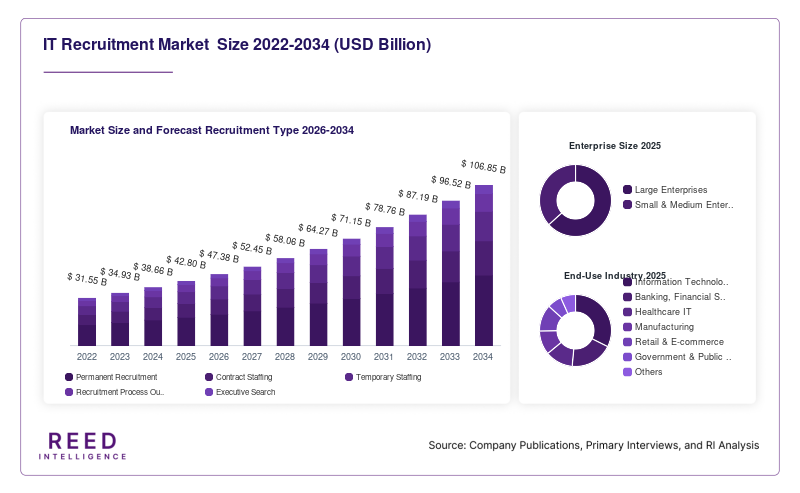
- By recruitment type, Permanent Recruitment accounted for the largest share of 44.1%.
- while Recruitment Process Outsourcing (RPO) is projected to grow at a CAGR of 12.9%.
- By enterprise size, Large Enterprises led with a 61.4% share.
- whereas Small & Medium Enterprises are expected to expand at a CAGR of 11.8%.
- By end-use industry, Information Technology & Telecommunications held a 37.6% share.
- while Healthcare IT is projected to grow at a CAGR of 13.2%.
- The United States remained the dominant country, with market values of USD 10.9 billion in 2024 and USD 11.8 billion in 2025.
Market Trends
Rising Adoption of AI-Powered Recruitment Platforms
Artificial intelligence is transforming the IT Recruitment Market by improving candidate sourcing, screening, and matching processes. Recruitment firms and enterprise hiring teams increasingly utilize machine learning algorithms to identify qualified candidates from large talent databases. AI-driven solutions reduce manual workloads, improve hiring efficiency, and shorten recruitment timelines. Predictive analytics tools help recruiters assess candidate suitability based on skills, experience, and career trajectories. Organizations are also implementing conversational chatbots for candidate engagement and interview scheduling. As competition for technology talent intensifies, employers are investing in intelligent recruitment technologies to improve hiring outcomes, enhance candidate experiences, and reduce operational costs associated with traditional recruitment practices.
Growth of Remote and Borderless Technology Hiring
The expansion of remote work has significantly influenced recruitment strategies across the technology sector. Employers are no longer limited to local talent pools and can access highly skilled professionals from multiple countries. This trend has increased demand for recruitment agencies capable of managing international sourcing, compliance requirements, and remote onboarding processes. Technology companies are actively recruiting software developers, cybersecurity specialists, cloud engineers, and data scientists from emerging talent hubs. The ability to hire remotely has improved workforce flexibility while enabling organizations to address persistent skill shortages. Consequently, recruitment providers are expanding global talent networks and investing in digital hiring platforms that support distributed workforce models.
Market Drivers
Expanding Demand for Digital Transformation Talent
The ongoing digital transformation of businesses across industries remains a major growth driver for the IT Recruitment Market. Enterprises continue investing in cloud migration, automation, cybersecurity frameworks, and advanced analytics platforms. These initiatives require specialized technology professionals with expertise in emerging digital technologies. Demand for software engineers, data analysts, AI specialists, cloud architects, and cybersecurity experts continues to exceed available supply in many markets. Recruitment firms play a critical role in connecting organizations with qualified candidates capable of supporting digital modernization efforts. As technology becomes central to business operations, companies increasingly rely on professional recruitment services to secure talent efficiently and maintain competitive advantages.
Increasing Skill Gaps Across Technology Domains
The rapid pace of technological innovation has created substantial skill shortages across multiple IT disciplines. New technologies often emerge faster than educational institutions and workforce development programs can produce qualified professionals. As a result, organizations face difficulties filling specialized roles related to artificial intelligence, machine learning, cloud computing, DevOps, and cybersecurity. Recruitment agencies with sector-specific expertise help bridge these gaps by identifying candidates from broader talent networks. The growing need for specialized hiring solutions encourages companies to outsource recruitment activities and engage staffing providers capable of delivering highly skilled professionals. This trend continues to support long-term market expansion across developed and emerging economies.
Market Restraint
High Competition for Skilled Technology Professionals
One of the primary challenges affecting the IT Recruitment Market is the intense competition for qualified technology talent. Organizations across industries are competing for the same pool of experienced professionals, particularly in fields such as cybersecurity, artificial intelligence, cloud infrastructure, and software engineering. This competitive environment often results in prolonged hiring cycles, increased recruitment costs, and higher employee compensation expectations. Recruitment agencies must invest heavily in candidate sourcing technologies, employer branding initiatives, and talent engagement programs to maintain access to skilled professionals. For example, large multinational technology companies frequently attract top candidates through attractive compensation packages and career development opportunities, making it difficult for smaller organizations to secure comparable talent. These conditions can limit hiring efficiency and create operational challenges for recruitment service providers.
Market Opportunities
Expansion of Recruitment Process Outsourcing Services
Recruitment Process Outsourcing services are creating substantial opportunities within the IT Recruitment Market. Many organizations seek to streamline talent acquisition processes while reducing recruitment costs and administrative burdens. RPO providers offer end-to-end hiring solutions that include candidate sourcing, screening, onboarding, workforce planning, and employer branding support. Businesses increasingly prefer outsourced recruitment models to gain access to specialized expertise and advanced hiring technologies. As workforce requirements become more complex, demand for strategic recruitment partnerships is expected to increase. This trend is particularly strong among multinational corporations managing large-scale hiring programs across multiple regions and technology functions.
Emerging Demand from Healthcare and Financial Technology Sectors
Healthcare and financial services organizations are rapidly increasing technology investments, generating new opportunities for recruitment providers. Healthcare institutions are adopting digital health platforms, telemedicine systems, electronic health records, and AI-driven diagnostic solutions. Similarly, financial organizations are investing in fintech platforms, digital payments, blockchain technologies, and cybersecurity infrastructure. These developments require specialized technology talent with industry-specific knowledge. Recruitment agencies capable of identifying professionals with both technical expertise and domain experience are positioned to benefit from rising demand. The convergence of technology and traditional industries is expected to create a broader client base and support sustained market growth throughout the forecast period.
Segmental Analysis
By Recruitment Type
Permanent Recruitment represented the dominant subsegment and accounted for approximately 44.1% of the market share in 2024. Organizations continue prioritizing long-term workforce development strategies, resulting in sustained demand for permanent hiring services. Technology companies seek employees capable of supporting critical business functions, maintaining institutional knowledge, and contributing to long-term innovation objectives. Permanent recruitment providers offer specialized candidate sourcing, assessment, and onboarding services that help employers secure qualified professionals. Demand remains particularly strong for software engineers, cloud specialists, cybersecurity analysts, and project managers. Large enterprises continue investing in permanent workforce expansion to support digital transformation initiatives and maintain operational stability.
Recruitment Process Outsourcing emerged as the fastest-growing subsegment and is projected to expand at a CAGR of 12.9% during the forecast period. Organizations increasingly adopt outsourced recruitment models to improve hiring efficiency and reduce administrative burdens. RPO providers deliver scalable solutions that encompass workforce planning, candidate sourcing, screening, interviewing, and onboarding activities. Growing competition for technology talent encourages employers to leverage specialized recruitment expertise and advanced hiring technologies. Multinational corporations managing high-volume recruitment programs are particularly attracted to outsourced solutions that enhance hiring consistency while improving workforce acquisition outcomes across diverse geographic markets.
By Enterprise Size
Large Enterprises held the dominant position within the market and accounted for approximately 61.4% of total revenue share in 2024. These organizations typically maintain extensive technology infrastructures and require continuous recruitment support to fill specialized roles. Large corporations frequently undertake digital transformation projects involving cloud migration, cybersecurity enhancement, artificial intelligence deployment, and enterprise software implementation. Such initiatives generate substantial demand for technology professionals across multiple functional areas. Recruitment agencies serving large enterprises often provide customized talent acquisition strategies, executive search capabilities, and workforce planning services designed to address complex hiring requirements and support long-term business objectives.
Small and Medium Enterprises are expected to record the fastest growth rate, registering a CAGR of 11.8% through 2034. SMEs increasingly recognize the importance of technology adoption in improving operational efficiency and customer engagement. However, many smaller organizations lack internal recruitment resources and specialized hiring expertise. As a result, they increasingly partner with recruitment providers to access broader talent pools and streamline hiring processes. Cloud-based recruitment platforms, flexible staffing models, and subscription-based recruitment services are making professional hiring solutions more accessible to smaller businesses. Growing digitalization among SMEs is expected to sustain demand for recruitment services throughout the forecast period.
By End-Use Industry
Information Technology & Telecommunications accounted for the largest market share of approximately 37.6% in 2024. The sector remains the primary consumer of recruitment services due to ongoing demand for software developers, network engineers, cloud architects, and cybersecurity professionals. Rapid technological advancements require organizations to continuously update workforce capabilities and recruit professionals with specialized expertise. Technology companies also face intense competition for talent, encouraging greater reliance on recruitment agencies capable of identifying qualified candidates efficiently. The expansion of digital platforms, telecommunications infrastructure, and enterprise software solutions continues supporting recruitment demand across the sector.
Healthcare IT is anticipated to be the fastest-growing subsegment, expanding at a CAGR of 13.2% during the forecast period. Healthcare providers are increasingly adopting digital health technologies, telemedicine platforms, data analytics systems, and electronic medical record solutions. These initiatives require skilled professionals capable of managing complex technology environments while ensuring regulatory compliance and data security. Recruitment providers specializing in healthcare technology talent are benefiting from growing demand for software engineers, cybersecurity specialists, data analysts, and health informatics professionals. Continued investment in healthcare digitalization is expected to create significant recruitment opportunities over the coming years.
Regional Analysis
North America
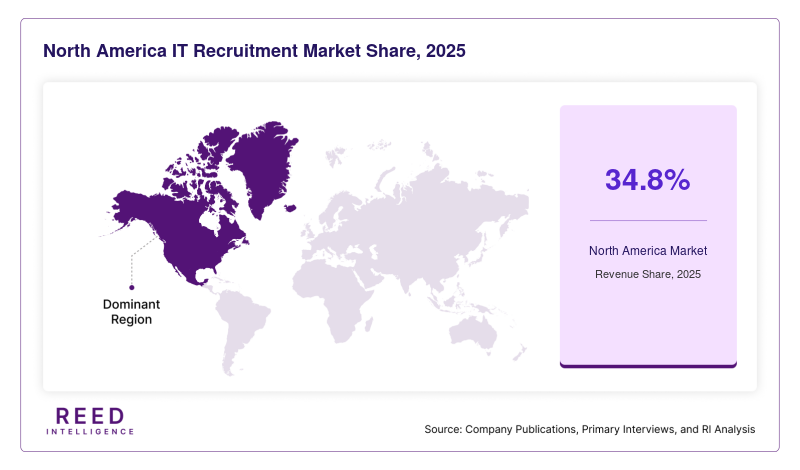
North America accounted for approximately 34.8% of the global IT Recruitment Market in 2025, maintaining its position as the largest regional market. The region benefits from a mature technology ecosystem, high digital adoption rates, and substantial investments in software development and cloud infrastructure. Market growth is expected to continue at a CAGR of 9.8% through 2034 as organizations seek specialized talent across cybersecurity, artificial intelligence, and data analytics domains. Recruitment service providers continue expanding technology-enabled hiring solutions to meet evolving workforce demands.
The United States remains the dominant country within the region due to its concentration of technology companies, innovation centers, and startup ecosystems. A key growth factor is the sustained expansion of enterprise digital transformation programs across industries including finance, healthcare, retail, and manufacturing. Organizations continue investing heavily in technology modernization initiatives, generating consistent demand for highly skilled IT professionals and specialized recruitment services.
Europe
Europe represented approximately 27.6% of the global IT Recruitment Market in 2025 and is projected to expand at a CAGR of 9.9% during the forecast period. Growing investments in digital infrastructure, cybersecurity frameworks, and enterprise software platforms are supporting recruitment demand across the region. Employers increasingly rely on specialized staffing providers to address technology skill shortages and comply with evolving workforce regulations. Cross-border recruitment activities are also becoming more common within the European labor market.
Germany remains the leading country in the European market due to its strong industrial base and growing adoption of Industry 4.0 technologies. A unique growth factor is the integration of advanced automation and smart manufacturing systems across industrial sectors. These developments require skilled software engineers, cloud specialists, and data professionals, encouraging organizations to engage specialized recruitment partners capable of sourcing technology talent efficiently.
Asia Pacific
Asia Pacific held approximately 23.4% of the global IT Recruitment Market in 2025 and is expected to register the fastest CAGR of 12.3% through 2034. Rapid digitalization, expanding startup ecosystems, and increasing technology investments are contributing to strong regional growth. Governments across the region continue supporting digital economy initiatives, creating substantial demand for technology professionals. Recruitment agencies are expanding operations to address growing workforce requirements across software development, cloud computing, and cybersecurity functions.
India remains the dominant country in Asia Pacific due to its large technology workforce, extensive outsourcing industry, and growing startup environment. A major growth factor is the increasing establishment of global capability centers by multinational corporations. These facilities require significant volumes of technology talent, encouraging companies to utilize specialized recruitment services to support large-scale hiring programs and workforce expansion strategies.
Middle East & Africa
The Middle East & Africa accounted for approximately 7.2% of the global IT Recruitment Market in 2025 and is forecast to grow at a CAGR of 10.4% during the study period. Regional governments continue investing in digital transformation initiatives, smart city projects, and technology infrastructure development. These investments are increasing demand for software developers, cybersecurity specialists, and cloud professionals. Recruitment firms are expanding regional talent networks to support evolving workforce requirements across public and private sectors.
Saudi Arabia represents the largest market within the region due to extensive economic diversification programs and technology modernization efforts. A unique growth factor is the implementation of national digital development strategies aimed at reducing dependence on traditional industries. Large-scale investments in technology projects continue generating employment opportunities, supporting demand for specialized recruitment and staffing services across multiple sectors.
Latin America
Latin America captured approximately 7.0% of the global IT Recruitment Market in 2025 and is expected to expand at a CAGR of 10.1% through 2034. The region is benefiting from increased technology adoption, digital banking expansion, and growing investments in software development services. Organizations are actively recruiting technology professionals to support cloud migration, cybersecurity implementation, and digital customer engagement initiatives. Recruitment providers are increasingly leveraging digital platforms to connect employers with qualified candidates across regional markets.
Brazil remains the dominant country within Latin America due to its large economy and expanding technology sector. A significant growth factor is the rise of technology startups and innovation hubs focused on fintech, e-commerce, and digital services. These businesses require specialized technical talent and frequently partner with recruitment agencies to identify skilled professionals capable of supporting rapid organizational growth.
Competitive Landscape
The IT Recruitment Market is characterized by the presence of global staffing firms, specialized technology recruitment providers, and emerging digital talent platforms. Competition is largely based on industry expertise, talent network strength, technology capabilities, geographic reach, and service quality. Market participants are increasingly investing in artificial intelligence, analytics, and automation tools to improve candidate sourcing and recruitment efficiency.
Randstad remains one of the leading companies in the market due to its extensive global presence and diversified recruitment service portfolio. The company recently expanded its digital recruitment capabilities through investments in AI-driven talent acquisition technologies. Other major participants continue pursuing strategic partnerships, acquisitions, and platform enhancements to strengthen market positions and improve service offerings.
Key Players
- Randstad
- Adecco Group
- ManpowerGroup
- Hays plc
- Robert Half International
- Korn Ferry
- PageGroup
- Allegis Group
- TEKsystems
- Insight Global
- Harvey Nash Group
- Michael Page
- Kelly Services
- NTT DATA Staffing
- Robert Walters
Recent Developments
- Randstad expanded its AI-based candidate matching platform to improve hiring speed and recruitment accuracy for technology-focused clients.
- Adecco Group introduced enhanced digital talent acquisition solutions targeting cloud computing, cybersecurity, and software engineering recruitment.
- ManpowerGroup strengthened its technology staffing division through new workforce analytics capabilities designed to improve talent forecasting.
- Hays plc expanded its specialized recruitment services for artificial intelligence and data science professionals across key international markets.
- Robert Half International launched advanced virtual hiring tools to support remote recruitment and global technology talent acquisition.
IT Recruitment Market Segments
Recruitment Type
- Permanent Recruitment
- Contract Staffing
- Temporary Staffing
- Recruitment Process Outsourcing (RPO)
- Executive Search
Enterprise Size
- Large Enterprises
- Small & Medium Enterprises (SMEs)
End-Use Industry
- Information Technology & Telecommunications
- Banking, Financial Services & Insurance (BFSI)
- Healthcare IT
- Manufacturing
- Retail & E-commerce
- Government & Public Sector
- Others
By Region
- North America
- Europe
- APAC
- Middle East and Africa
- LATAM