Ivermectin Market Size, Share & Demand Report By Type (Tablets, Topical Formulations, Injectables), By Application (Human Use, Veterinary Use), By Distribution Channel (Hospital Pharmacies, Retail Pharmacies, Online Pharmacies), By Region & Segment Forecasts, 2026–2034
USD 3950
Market Overview
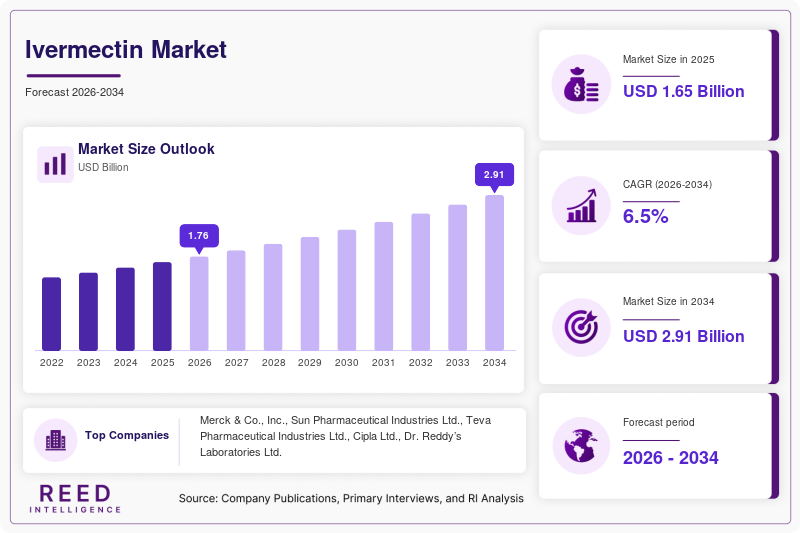
The global Ivermectin Market size was valued at approximately USD 1.65 billion in 2026 and is projected to reach USD 2.74 billion by 2034, expanding at a compound annual growth rate (CAGR) of 6.5% during 2026–2034. The market growth is largely supported by the increasing global burden of parasitic infections in both humans and animals, particularly in developing regions where access to preventive healthcare remains limited. Ivermectin continues to play a vital role in the treatment of conditions such as onchocerciasis, strongyloidiasis, and scabies, as well as in veterinary applications for livestock and companion animals.
A key global factor driving market expansion is the rising investment in public health programs focused on neglected tropical diseases (NTDs). Governments and international organizations are scaling up mass drug administration (MDA) initiatives, especially in Africa and Asia Pacific, where parasitic diseases remain endemic. This sustained demand is reinforcing the production and distribution of ivermectin-based formulations across multiple healthcare channels.
Key Highlights
- North America dominated the market with a 32.8% share in 2025.
- Asia Pacific is expected to grow at the fastest CAGR of 7.8% during 2026–2034.
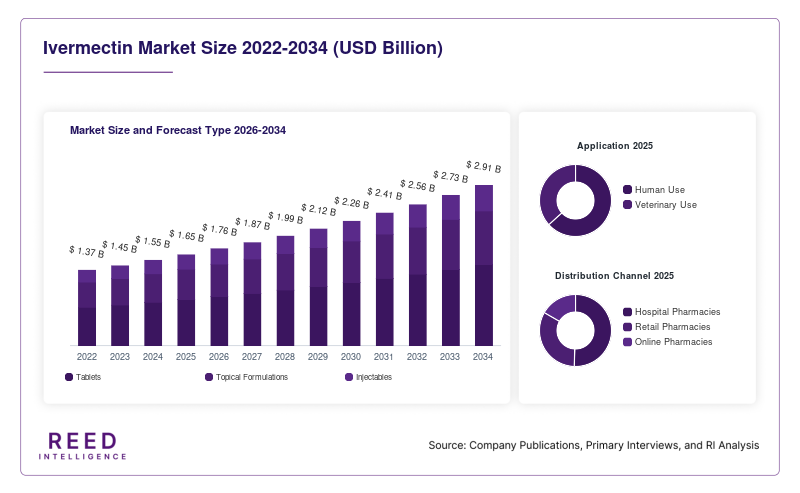
- By type, tablets accounted for the largest share of 44.6%.
- while topical formulations are projected to grow at a CAGR of 7.2%.
- By application, human use led with a 58.3% share, whereas veterinary use is expected to expand at a CAGR of 6.9%.
- The United States remained the dominant country, with market values of USD 420 million in 2024 and USD 455 million in 2025.
Market Trends
Expansion of Veterinary Applications and Livestock Health Management
The growing emphasis on livestock productivity and animal health management is contributing significantly to the expansion of ivermectin usage in veterinary medicine. Farmers and agricultural enterprises are increasingly adopting preventive healthcare measures to minimize economic losses caused by parasitic infections in cattle, sheep, and poultry. Ivermectin-based formulations are widely used for deworming and parasite control, improving overall herd health and productivity. The rising global demand for meat and dairy products has intensified the need for efficient livestock management practices. Additionally, regulatory frameworks in several countries are encouraging the use of approved antiparasitic treatments, which further supports the adoption of ivermectin in veterinary applications.
Development of Novel Formulations and Delivery Systems
Pharmaceutical companies are focusing on enhancing drug efficacy and patient compliance through the development of innovative ivermectin formulations. Topical creams, sustained-release injectables, and combination therapies are gaining traction, particularly for dermatological conditions such as rosacea and scabies. These advanced delivery systems improve drug absorption and reduce dosing frequency, making treatment more convenient for patients. Furthermore, research efforts are exploring the potential repurposing of ivermectin for broader therapeutic applications, which is influencing market dynamics. The shift toward user-friendly and targeted drug delivery methods is expected to shape the future trajectory of the ivermectin market.
Market Drivers
Rising Prevalence of Parasitic and Infectious Diseases
The increasing incidence of parasitic infections across both developed and developing regions is a primary driver of the ivermectin market. Diseases such as onchocerciasis, lymphatic filariasis, and scabies continue to affect millions of people globally, particularly in tropical and subtropical areas. Limited access to sanitation, clean water, and healthcare infrastructure exacerbates the spread of these infections. Ivermectin remains a widely recommended treatment due to its proven efficacy and cost-effectiveness. Public health agencies are prioritizing early diagnosis and treatment, which is boosting the demand for antiparasitic medications. The consistent need for effective treatment options ensures steady market growth.
Government and NGO-Led Mass Drug Administration Programs
Large-scale health initiatives led by governments and non-governmental organizations are significantly contributing to market expansion. Mass drug administration programs aim to eliminate neglected tropical diseases by distributing ivermectin to at-risk populations. These initiatives are particularly prominent in regions such as sub-Saharan Africa and Southeast Asia. Funding support from global health organizations has enabled the widespread availability of ivermectin at low or no cost. The success of these programs in reducing disease prevalence has reinforced their continuation, thereby sustaining long-term demand for the drug. The structured implementation of such campaigns continues to drive market growth.
Market Restraint
Regulatory Scrutiny and Misuse Concerns
The ivermectin market faces challenges due to increasing regulatory scrutiny and concerns regarding misuse. In recent years, the drug has been subject to controversy related to off-label use, which has prompted health authorities to impose stricter guidelines on its prescription and distribution. Regulatory bodies are emphasizing evidence-based usage, limiting the expansion of ivermectin into unapproved therapeutic areas. This cautious approach can slow market growth, particularly in developed regions where compliance standards are stringent.
Additionally, the misuse of ivermectin in self-medication practices has raised safety concerns, leading to tighter control measures. Pharmaceutical companies must invest in clinical research and regulatory approvals to expand indications, which increases operational costs and delays product launches. These factors collectively create barriers to market expansion and may limit the pace of innovation within the industry.
Market Opportunities
Expansion in Emerging Markets
Emerging economies present significant growth opportunities for the ivermectin market due to their high disease burden and improving healthcare infrastructure. Countries in Asia Pacific, Latin America, and Africa are witnessing increased healthcare investments, which are enhancing access to essential medicines. Government initiatives aimed at controlling parasitic diseases are creating a favorable environment for market expansion. Pharmaceutical companies are entering these regions through partnerships and local manufacturing strategies, reducing costs and improving distribution efficiency. The growing awareness of preventive healthcare is also contributing to increased adoption of ivermectin-based treatments.
Research into New Therapeutic Applications
Ongoing research into the potential use of ivermectin for additional medical conditions offers promising growth opportunities. Scientists are exploring its anti-inflammatory and antiviral properties, which could expand its application beyond traditional antiparasitic uses. Although these studies are still in early stages, positive findings could open new revenue streams for manufacturers. The development of combination therapies and targeted treatments may further enhance the drug’s clinical utility. Continued investment in research and development is expected to unlock new possibilities, supporting long-term market growth.
Segmental Analysis
By Type
Tablets emerged as the dominant subsegment in 2024, accounting for approximately 44.6% of the market share. Their widespread use in treating parasitic infections in humans is a major factor contributing to their dominance. Tablets offer ease of administration, accurate dosing, and cost-effectiveness, making them a preferred choice among healthcare providers. They are commonly used in mass drug administration programs, further boosting their demand. The availability of generic versions also enhances affordability, particularly in developing regions.
Topical formulations are expected to be the fastest-growing subsegment, with a CAGR of 7.2% during the forecast period. These formulations are increasingly used for dermatological conditions such as rosacea and scabies. The growing demand for targeted treatments with minimal systemic side effects is driving their adoption. Advances in formulation technology are improving drug absorption and efficacy, making topical ivermectin a viable alternative to oral treatments.
By Application
Human use dominated the market in 2024, holding a share of 58.3%. The high prevalence of parasitic infections and the effectiveness of ivermectin in treating these conditions contribute to its dominance. Public health initiatives and increased awareness about disease prevention further support the growth of this segment. The drug’s inclusion in essential medicine lists ensures its widespread availability and usage.
Veterinary use is projected to be the fastest-growing segment, with a CAGR of 6.9%. The increasing focus on animal health and productivity is driving demand for ivermectin in livestock and companion animals. Farmers are adopting preventive healthcare measures to reduce economic losses caused by parasitic infections. The growing global demand for animal-based products further supports this segment’s expansion.
By Distribution Channel
Hospital pharmacies accounted for the largest share in 2024, driven by the high volume of prescriptions for ivermectin in clinical settings. Hospitals play a crucial role in the treatment of severe parasitic infections, ensuring consistent demand for the drug. The presence of skilled healthcare professionals and access to advanced diagnostic tools further supports the dominance of this segment.
Online pharmacies are expected to be the fastest-growing distribution channel, with a CAGR of 7.5%. The increasing adoption of digital healthcare platforms and the convenience of online purchasing are driving this growth. Patients are increasingly turning to online channels for medication procurement, particularly in urban areas. The expansion of e-commerce and improved logistics networks are enhancing accessibility, contributing to the segment’s rapid growth.
Regional Analysis
North America
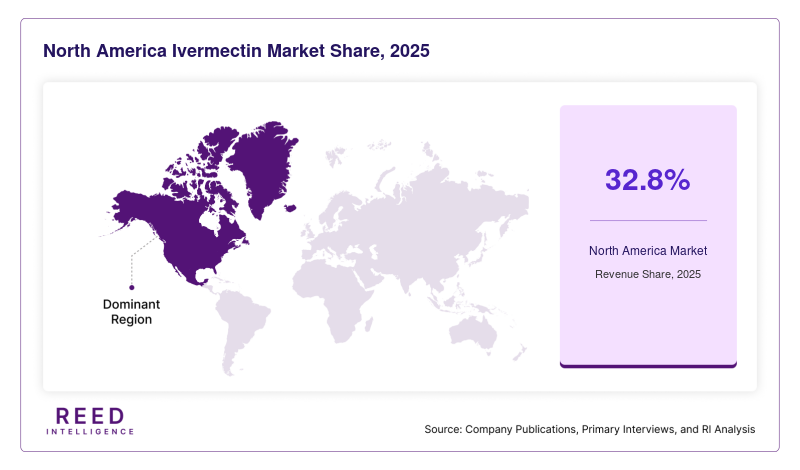
North America held a significant share of the ivermectin market in 2025, accounting for approximately 32.8%, and is projected to grow at a CAGR of 5.9% during the forecast period. The region benefits from advanced healthcare infrastructure, high awareness levels, and strong regulatory oversight. The presence of established pharmaceutical companies and ongoing research activities contributes to steady market growth. Demand is driven by both human and veterinary applications, particularly in dermatology and livestock management sectors.
The United States dominates the regional market, supported by high healthcare spending and widespread availability of prescription medications. A unique growth factor is the increasing adoption of advanced topical formulations for dermatological conditions such as rosacea. The country’s focus on innovation and clinical research is fostering the development of improved ivermectin products, enhancing treatment outcomes and patient adherence.
Europe
Europe accounted for a market share of around 27.4% in 2025 and is expected to grow at a CAGR of 5.7% through 2034. The region’s growth is supported by strong regulatory frameworks and well-established healthcare systems. Increasing awareness about parasitic infections and the importance of preventive care is driving demand for ivermectin-based treatments. The veterinary sector also plays a crucial role in sustaining market growth.
Germany leads the European market due to its robust pharmaceutical industry and emphasis on research and development. A unique growth factor in the country is the integration of advanced diagnostic tools that enable early detection of parasitic infections. This facilitates timely treatment and increases the demand for effective medications such as ivermectin.
Asia Pacific
Asia Pacific is expected to witness the fastest growth, with a CAGR of 7.8% during the forecast period, and held a share of 21.6% in 2025. The region’s large population base and high prevalence of parasitic diseases are key factors driving market expansion. Government initiatives aimed at improving healthcare access and controlling infectious diseases are further supporting growth.
India dominates the regional market due to its extensive public health programs and large patient population. A unique growth factor is the widespread implementation of mass drug administration campaigns targeting neglected tropical diseases. These initiatives significantly boost the demand for ivermectin and ensure consistent market expansion.
Middle East & Africa
The Middle East & Africa region accounted for approximately 10.5% of the market share in 2025 and is projected to grow at a CAGR of 6.6%. The high prevalence of parasitic infections and limited access to healthcare services in certain areas drive the demand for ivermectin. International health organizations are actively involved in improving disease control measures in this region.
South Africa is the dominant country, benefiting from improving healthcare infrastructure and increased government spending. A unique growth factor is the collaboration between public and private sectors to enhance drug distribution networks, ensuring better access to essential medications in remote areas.
Latin America
Latin America held a market share of around 7.7% in 2025 and is expected to grow at a CAGR of 6.2% during the forecast period. The region’s growth is driven by rising awareness of parasitic diseases and increasing healthcare investments. Government programs aimed at disease prevention and treatment are supporting market expansion.
Brazil leads the regional market due to its large population and active public health initiatives. A unique growth factor is the integration of ivermectin into national healthcare programs targeting parasitic infections. This approach ensures consistent demand and supports the growth of the market in the region.
Competitive Landscape
The ivermectin market is moderately fragmented, with several global and regional players competing based on product quality, pricing, and distribution networks. Leading companies are focusing on expanding their product portfolios and strengthening their market presence through strategic collaborations and acquisitions. The market leader is recognized for its extensive product range and strong global distribution network.
Companies are investing in research and development to introduce innovative formulations and improve drug efficacy. Recent developments include the launch of advanced topical products and partnerships aimed at expanding market reach in emerging regions. Competitive strategies also involve cost optimization and the expansion of manufacturing capabilities to meet growing demand.
Key Players List
- Merck & Co., Inc.
- Sun Pharmaceutical Industries Ltd.
- Teva Pharmaceutical Industries Ltd.
- Mylan N.V.
- Cipla Ltd.
- Dr. Reddy’s Laboratories Ltd.
- Zydus Lifesciences Ltd.
- Glenmark Pharmaceuticals Ltd.
- Hikma Pharmaceuticals PLC
- Perrigo Company plc
- Amneal Pharmaceuticals Inc.
- Intas Pharmaceuticals Ltd.
- Alkem Laboratories Ltd.
- Lupin Limited
- Aurobindo Pharma Limited
Recent Developments
- A leading pharmaceutical company introduced a new topical ivermectin formulation aimed at improving treatment outcomes for dermatological conditions.
- Several manufacturers expanded their production capacities to meet increasing global demand, particularly in emerging markets.
- Strategic collaborations between pharmaceutical firms and government agencies were established to support mass drug administration programs in high-burden regions.
Ivermectin Market Segments
Type
- Tablets
- Topical Formulations
- Injectables
Application
- Human Use
- Veterinary Use
Distribution Channel
- Hospital Pharmacies
- Retail Pharmacies
- Online Pharmacies
By Region
- North America
- Europe
- APAC
- Middle East and Africa
- LATAM