IVF Time Lapse Imaging System Market Size, Share & Trends Analysis Report By Product Type (Integrated Time-Lapse Incubators, Standalone Time-Lapse Imaging Systems), By Application (Embryo Monitoring & Culture, Embryo Selection), By End User (Fertility Clinics, Hospitals & Reproductive Medicine Centers), By Capacity (Low-Capacity Systems, Medium-Capacity Systems) and By Region (North America, Europe, APAC, Middle East and Africa, LATAM) Forecasts, 2026–2034
USD 3950
IVF Time Lapse Imaging System Market Size
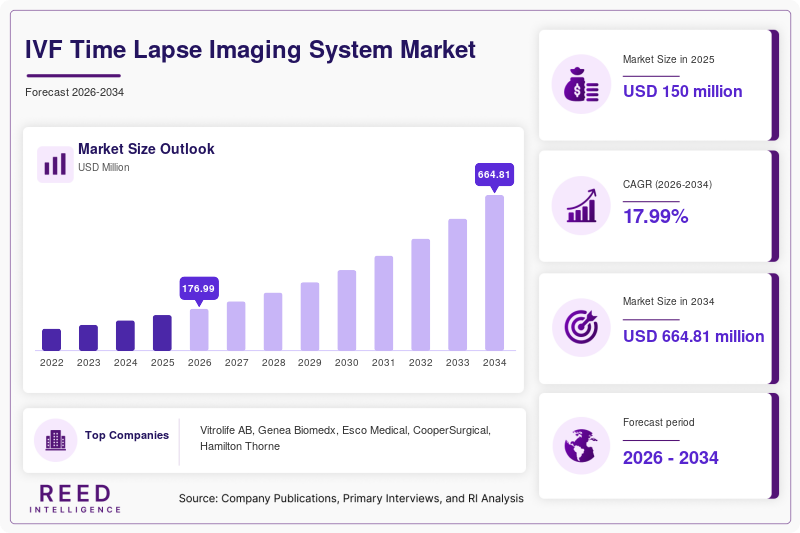
The global IVF Time Lapse Imaging System Market size was valued at USD 150 million in 2025 and is projected to grow from USD 180 million in 2026 to USD 664.81 million by 2034, registering a CAGR of 17.99% during the forecast period from 2026 to 2034.
The IVF Time Lapse Imaging System Market covers specialized embryo incubators and imaging platforms that continuously capture embryo-development images during IVF or ICSI culture. Unlike conventional microscopy, these systems allow embryologists to review embryo development without repeatedly removing embryos from controlled incubation conditions. ESHRE maintains dedicated good-practice recommendations for time-lapse technology, while its 2026 IVF-laboratory guidance addresses embryo culture, traceability, quality management and laboratory procedures.
The underlying clinical market is substantial. WHO estimates that approximately one in six people of reproductive age experience infertility during their lifetime, while the U.S. CDC reported 435,426 ART cycles at 457 reporting clinics in 2022.
However, the commercial case for time-lapse systems is evolving. The technology provides continuous morphokinetic information and can improve laboratory workflow, but evidence that it independently improves live-birth outcomes remains mixed. A 2024 multicenter randomized trial involving 1,575 participants found no significant improvement in live birth from time-lapse imaging with embryo selection compared with standard care. The UK HFEA therefore currently rates automated time-lapse imaging as having insufficient evidence of improving the chance of having a baby.
The growth mechanism is consequently shifting toward laboratory automation, undisturbed culture, digital traceability, AI-assisted assessment and workflow standardization, rather than relying solely on claims of higher IVF success rates.
IVF Time Lapse Imaging System Market Drivers
Increasing IVF Activity Expands the Addressable Laboratory Base
The number of IVF and other assisted-reproductive-technology procedures creates the underlying installed base for time-lapse imaging systems. WHO estimates that infertility affects approximately one in six people globally, while the CDC recorded more than 435,000 ART cycles at U.S. reporting clinics in 2022.
Time-lapse equipment is particularly relevant to laboratories performing large numbers of embryo-culture cycles because a single system can continuously monitor multiple patient dishes. Vitrolife's EmbryoScope+ supports up to 15 patient dishes and up to 240 embryos, while EmbryoScope 8 supports eight patient dishes with up to 16 embryos per dish.
The commercial mechanism is therefore linked to laboratory throughput. As fertility centers expand cycle capacity, they can justify equipment that combines incubation and imaging instead of using separate conventional incubators and periodic microscopy. This supports replacement demand as well as first-time adoption.
The counterbalance is affordability. IVF equipment purchases are capital-intensive, and clinics with low cycle volumes may not generate enough utilization to justify a dedicated time-lapse platform.
Continuous Imaging Creates Workflow and Data Advantages
Time-lapse systems provide continuous images of embryos without requiring repeated manual removal from the incubator. Vitrolife describes its EmbryoScope systems as providing continuous image acquisition while maintaining controlled culture conditions, while Esco Medical's MIRI TL uses independent chambers and integrated imaging to monitor embryo development continuously.
The commercial value extends beyond embryo selection. Continuous images create a digital record of embryo development that can be reviewed retrospectively, annotated and incorporated into laboratory decision-making. This can help standardize observations between embryologists and reduce dependence on a small number of manual observation points.
Traceability is another important mechanism. Vitrolife's EmbryoScope 8 integrates barcode-based patient registration and eWitness workflow, linking patient information with embryo-culture records.
This makes time-lapse systems increasingly relevant to laboratories seeking greater automation and auditability, even where clinical evidence does not demonstrate a direct improvement in live-birth rates.
AI Is Expanding the Value of Time-Lapse Data
Artificial intelligence is changing the economic proposition of time-lapse imaging because continuous embryo videos create large datasets that can be analyzed algorithmically. Vitrolife's iDAScore uses AI to analyze time-lapse sequences and generate embryo rankings based on developmental information.
Research is also moving toward more sophisticated image-based models. A 2024 randomized, double-blind trial involving 1,066 patients compared iDAScore-based selection with conventional morphology and found a clinical pregnancy rate of 46.5% versus 48.2%; the study did not demonstrate noninferiority of the AI approach.
This creates an important market distinction: AI can improve consistency, automation and analytical efficiency without necessarily being proven to improve clinical outcomes. Esco Medical's 2026 partnership with Cercle, focused on AI-enabled IVF workflows and embryo scoring, shows that suppliers continue investing in this direction.
IVF Time Lapse Imaging System Market Restraints
Clinical Evidence Does Not Yet Establish a Clear Live-Birth Benefit
The main restraint is the gap between technological capability and demonstrated clinical benefit. The TILT randomized trial, published in The Lancet in 2024, randomized 1,575 IVF/ICSI participants across seven centers. Live-birth rates were 33.7% with time-lapse imaging and embryo selection, 36.6% with undisturbed culture alone and 33.0% with standard care; neither time-lapse approach significantly increased the odds of live birth versus standard care.
The HFEA subsequently rated time-lapse imaging with automated embryo analysis black for improving the chance of having a baby, based on the available evidence.
This affects purchasing decisions because clinics must justify an additional capital expenditure and potentially higher patient costs. The strongest commercial arguments therefore increasingly concern workflow, traceability, continuous observation and data analysis rather than guaranteed clinical improvement.
High Capital Cost and Laboratory Integration Requirements
Time-lapse systems combine incubator technology, microscopy, cameras, software, image storage and laboratory workflow requirements. Implementation also requires staff training, validation, maintenance and quality-control procedures.
Vitrolife's product portfolio illustrates the range of configurations required by different laboratories: EmbryoScope 8 for smaller clinics, EmbryoScope+ for higher capacity and EmbryoScope Flex for different stimulation and patient-volume requirements.
Regulatory status can further complicate deployment. The FDA cleared the EmbryoScope+ as a Class II assisted-reproduction accessory in 2018, but Vitrolife currently states that its EmbryoScope 8, EmbryoScope+ and EmbryoScope Flex systems are not FDA 510(k)-cleared for sale in the United States, while its iDAScore software also carries a no-510(k)-clearance disclaimer.
Clinics therefore need to evaluate not only performance but also regulatory suitability in their jurisdiction.
IVF Time Lapse Imaging System Market Opportunities
AI-Assisted Embryo Assessment and Laboratory Automation
The largest technology opportunity is the conversion of time-lapse video into structured embryo-development data. Manual embryo assessment is influenced by embryologist experience, time constraints and laboratory staffing. Vitrolife's iDAScore illustrates the movement toward automated analysis and ranking of embryos using full developmental sequences.
The commercial opportunity does not depend entirely on proving a higher live-birth rate. Automated systems can reduce manual video-review time, standardize scoring and make large embryo cohorts easier to compare.
The market is consequently moving toward integrated systems combining incubation, imaging, software, AI scoring and electronic witnessing rather than treating the camera as a standalone laboratory instrument.
Expansion in Emerging IVF Markets
The global burden of infertility creates room for additional IVF infrastructure. WHO estimates lifetime infertility prevalence at approximately 17.5% globally and notes that fertility treatment remains inaccessible or unaffordable for many patients, particularly in lower-income settings.
As fertility centers expand in Asia, Latin America and the Middle East, equipment suppliers can address laboratories that are building modern infrastructure rather than replacing legacy systems.
Lower-capacity platforms can be particularly relevant in this expansion. Vitrolife's EmbryoScope 8 is designed for smaller clinics and can monitor eight patient dishes simultaneously, providing a lower-capacity entry point into time-lapse imaging.
Connected IVF Laboratories and Traceability
Digital connectivity creates another opportunity. Embryo imaging can be connected to patient identification, electronic witnessing, laboratory information and embryo-selection workflows.
Vitrolife's EmbryoScope-eWitness integration automatically exchanges patient information and supports barcode generation and traceable dish labeling. Genea Biomedx also promotes connected IVF laboratory solutions combining Geri time-lapse incubation with witnessing and laboratory-management products.
As IVF laboratories face stronger requirements around quality management, sample identification and traceability, connected time-lapse systems can become part of a wider laboratory digitalization investment.
Segmental Analysis
By Product Type
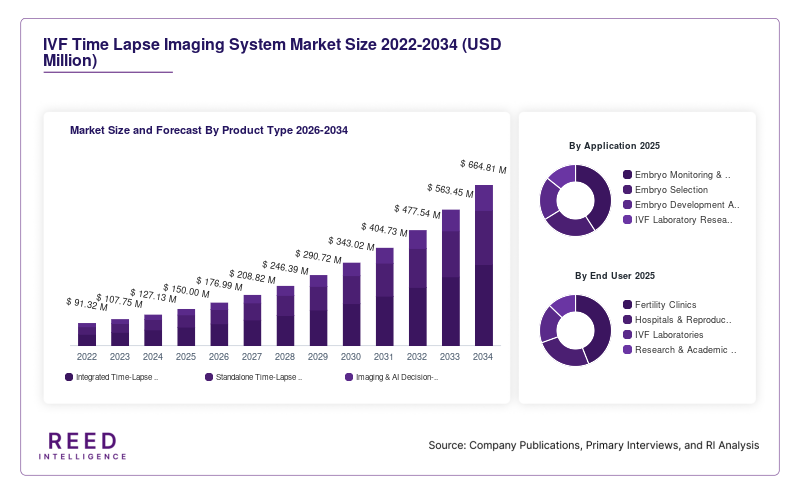
Integrated Time-Lapse Incubators represent approximately 63% of the global market in 2025, making them the dominant product segment. These systems combine controlled embryo culture with continuous imaging, eliminating the need to transfer embryos to a separate microscope for routine observations. Vitrolife's EmbryoScope family and Esco Medical's MIRI TL are examples of integrated platforms.
Standalone Time-Lapse Imaging Systems account for approximately 21% and are used where laboratories want to add imaging capabilities to existing culture infrastructure.
Imaging & AI Decision-Support Software represents approximately 16% but is the fastest-growing product segment, with a CAGR of approximately 24.8%. Software development is supported by the growing availability of time-lapse datasets and the movement toward automated embryo assessment. Vitrolife's iDAScore provides an example of this transition.
By Application
Embryo Monitoring & Culture accounts for approximately 40% of the market in 2025. Continuous monitoring enables embryologists to observe embryo development without repeated removal from the controlled incubation environment.
Embryo Selection represents approximately 34%, reflecting the use of developmental and morphokinetic information to support transfer decisions.
Embryo Development Assessment represents approximately 18%, while IVF Laboratory Research accounts for approximately 8%.
Embryo Selection is the fastest-growing application, with a CAGR of approximately 20.6%, driven by AI-assisted scoring and increasingly sophisticated analysis of developmental sequences. However, current clinical evidence means the technology is best understood as a decision-support tool rather than a proven replacement for conventional embryologist assessment.
By End User
Fertility Clinics represent approximately 58% of the global market in 2025. These facilities conduct the majority of IVF cycles and require equipment capable of integrating with routine embryo-culture workflows.
Hospitals & Reproductive Medicine Centers account for approximately 22%, while IVF Laboratories represent 13% and Research & Academic Institutions account for approximately 7%.
Research & Academic Institutions are the fastest-growing end-user segment, with a CAGR of approximately 19.5%, supported by research into embryo morphokinetics, AI, developmental prediction and laboratory automation.
The research market is important because new algorithms require large, well-annotated embryo datasets before they can be evaluated in prospective clinical settings.
By Capacity
Medium-Capacity Systems represent approximately 43% of the market in 2025, reflecting demand from established fertility centers that require more than a small-clinic configuration without operating the largest centralized laboratory.
High-Capacity Systems account for approximately 34%, particularly in high-volume fertility groups and large IVF laboratories.
Low-Capacity Systems represent approximately 23% but are the fastest-growing category, with a CAGR of approximately 21.2%. Smaller systems lower the initial capacity requirement for clinics beginning time-lapse adoption. Vitrolife's EmbryoScope 8, which supports eight patient dishes, illustrates this approach.
Regional Analysis
North America IVF Time Lapse Imaging System Market
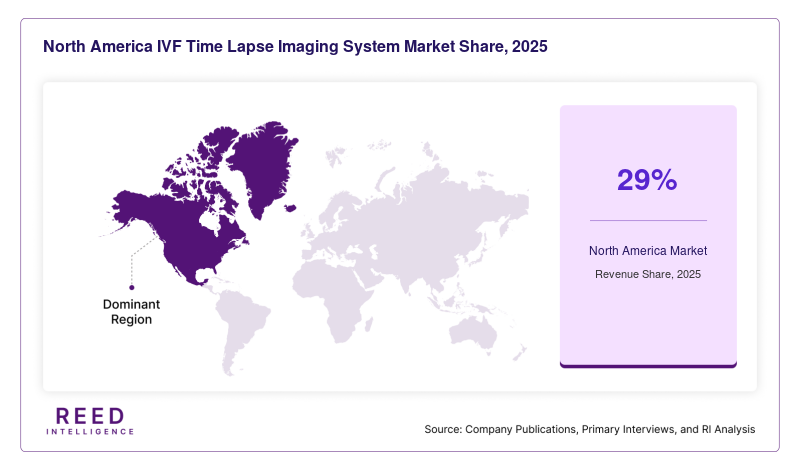
North America represents approximately 29% of the global IVF Time Lapse Imaging System Market in 2025. The region benefits from a large IVF treatment base, established fertility networks, high laboratory investment capacity and strong interest in AI-enabled reproductive medicine.
The U.S. alone recorded 435,426 ART cycles across 457 reporting clinics in 2022, demonstrating a substantial addressable clinical infrastructure.
The region also has strong technology adoption and research activity. AI-based embryo selection has been evaluated through large multicenter trials involving clinics in Australia and Europe, while U.S. and Canadian fertility networks are active in clinical validation of laboratory technologies.
However, regulatory status remains a commercial constraint. Vitrolife states that its current EmbryoScope family products and iDAScore are not cleared for sale in the U.S., illustrating how regulatory requirements can restrict otherwise established technologies.
North America is projected to grow at approximately 16.5% CAGR through 2034. Demand is increasingly linked to laboratory automation and AI rather than simple first-generation imaging adoption.
Europe IVF Time Lapse Imaging System Market
Europe accounts for approximately 34% of the market in 2025, making it the largest regional market. The region has a mature fertility-clinic network, extensive embryology expertise and a long history of time-lapse technology adoption.
ESHRE maintains dedicated recommendations for time-lapse technology and has also updated its guidance on embryo morphology assessment and IVF-laboratory good practice. The 2025 ESHRE/ALPHA morphology consensus provides recommendations for dynamic and static embryo assessment and embryo ranking, creating a relevant clinical framework for interpreting time-lapse information.
Europe is also an important manufacturing and development base. Vitrolife's EmbryoScope portfolio and Esco Medical's MIRI TL are established European-developed platforms. Esco Medical describes MIRI TL as an EU-designed and manufactured multiroom incubator with integrated imaging.
Europe is projected to grow at approximately 17.1% CAGR through 2034. Adoption is supported by laboratory digitalization and established regulatory pathways, although evidence requirements for add-on technologies can moderate claims about clinical benefit.
APAC IVF Time Lapse Imaging System Market
APAC represents approximately 23% of the global market in 2025 and is the fastest-growing region, with a CAGR of approximately 21.5%.
The region benefits from expanding fertility services, growing IVF laboratory infrastructure and increasing interest in AI-enabled reproductive medicine. Japan, China, Australia, South Korea, India and Southeast Asia provide multiple technology-adoption markets with different regulatory and reimbursement structures.
Australia is particularly relevant to time-lapse research. The 2024 iDAScore randomized trial involved IVF clinics in Australia and Europe, while Genea Biomedx continues to develop Geri time-lapse incubation and connected IVF laboratory technologies.
China is also becoming an important technology-development and manufacturing market. A 2025 Hong Kong-listed company filing described a strategic cooperation arrangement involving Genea Biomedx and Rhea Labs, including collaboration on AI-related products.
APAC's growth mechanism is therefore both demand-side and supply-side: fertility treatment infrastructure is expanding while regional companies and international suppliers develop lower-capacity, connected and AI-enabled systems.
The main constraints include regulatory differences, unequal access to advanced IVF services and differences in healthcare funding.
Middle East and Africa IVF Time Lapse Imaging System Market
Middle East and Africa represents approximately 7% of the global market in 2025 and is projected to expand at approximately 18.8% CAGR.
Demand is concentrated in major fertility centers in the Gulf states, Israel and selected African markets where private reproductive-health infrastructure is expanding. Premium fertility clinics can adopt advanced embryology equipment as part of broader IVF laboratory modernization.
The market mechanism is closely linked to private fertility investment. Time-lapse systems can be positioned alongside advanced incubators, electronic witnessing, cryopreservation and genetic-testing workflows as part of an integrated laboratory platform.
The principal constraint is uneven access to IVF treatment. WHO notes that fertility treatment remains unaffordable or unavailable for many patients globally, with out-of-pocket payment representing a major barrier in many countries.
Consequently, adoption will remain concentrated in higher-volume and higher-investment reproductive medicine centers.
LATAM IVF Time Lapse Imaging System Market
LATAM accounts for approximately 7% of the global market in 2025 and is expected to grow at approximately 19.2% CAGR.
Brazil, Mexico, Argentina, Colombia and Chile provide important fertility-treatment markets, with private clinics representing an important purchasing base for advanced embryology equipment.
The regional opportunity is driven by increasing IVF access, private fertility-clinic investment and the gradual adoption of laboratory automation. Time-lapse systems can differentiate clinics through continuous embryo monitoring and digital documentation, particularly in markets where patients increasingly compare clinic technology and laboratory capabilities.
LATAM also presents opportunities for suppliers offering lower-capacity systems because smaller fertility centers may not require the throughput of large European or North American IVF groups.
The principal constraints are treatment affordability, uneven reimbursement, imported-equipment costs, currency volatility and differences in regulatory requirements.
Competitive Landscape
The IVF Time Lapse Imaging System Market is concentrated around specialized reproductive-technology companies with capabilities spanning incubators, imaging, software and laboratory workflow.
Vitrolife has one of the broadest portfolios through the EmbryoScope family, EmbryoViewer and iDAScore. The company offers systems for different clinic capacities and combines time-lapse imaging with embryo decision-support software. EmbryoScope 8 is designed for smaller clinics, while EmbryoScope+ supports higher patient capacity.
Genea Biomedx competes with Geri, a modular time-lapse incubator featuring six independent patient chambers. The company also promotes connected laboratory systems and AI-enabled embryo assessment.
Esco Medical offers MIRI TL systems with six- and 12-chamber configurations, integrated cameras and independent culture chambers. In December 2025, Esco highlighted the platform's continuous imaging and AI-ready morphokinetic data, while in February 2026 it announced a partnership with Cercle covering AI solutions for IVF workflows and embryo scoring.
Key Market Players
- Vitrolife AB
- Genea Biomedx
- Esco Medical
- CooperSurgical
- Hamilton Thorne
- ASTEC Co., Ltd.
- FUJIFILM Irvine Scientific
- Cook Medical
- IVFtech ApS
- Research Instruments
- Nikon Corporation
- Merck KGaA
- FertiPro
- TMRW Life Sciences
Recent Market Developments
- September 2026 – Genea Biomedx highlighted AI-enabled embryo assessment. Its September 2 webinar focused on label-free metabolic imaging and artificial intelligence for objective viability insights and embryo ranking, demonstrating the industry's movement beyond conventional time-lapse morphology toward multimodal embryo assessment.
- May 2026 – Esco Medical continued education around time-lapse systems. The company published material on how IVF time-lapse incubators support embryo culture, selection and transfer workflows, reinforcing the integration of imaging with the broader IVF laboratory process.
IVF Time Lapse Imaging System Market Segments
By Product Type
- Integrated Time-Lapse Incubators
- Standalone Time-Lapse Imaging Systems
- Imaging & AI Decision-Support Software
By Application
- Embryo Monitoring & Culture
- Embryo Selection
- Embryo Development Assessment
- IVF Laboratory Research
By End User
- Fertility Clinics
- Hospitals & Reproductive Medicine Centers
- IVF Laboratories
- Research & Academic Institutions
By Capacity
- Low-Capacity Systems
- Medium-Capacity Systems
- High-Capacity Systems
By Region
- North America
- Europe
- APAC
- Middle East and Africa
- LATAM