Jackhammer Market Size, Share & Demand Report By Product Type (Hydraulic Jackhammers, Electric Jackhammers, Cordless Jackhammers), By Application (Mining, Road Maintenance, Railway Maintenance, Industrial Applications), By End Use (Commercial Infrastructure, Industrial Facilities, Municipal Projects, Mining Operations) By Region & Segment Forecasts, 2026–2034
USD 3950
Market Overview
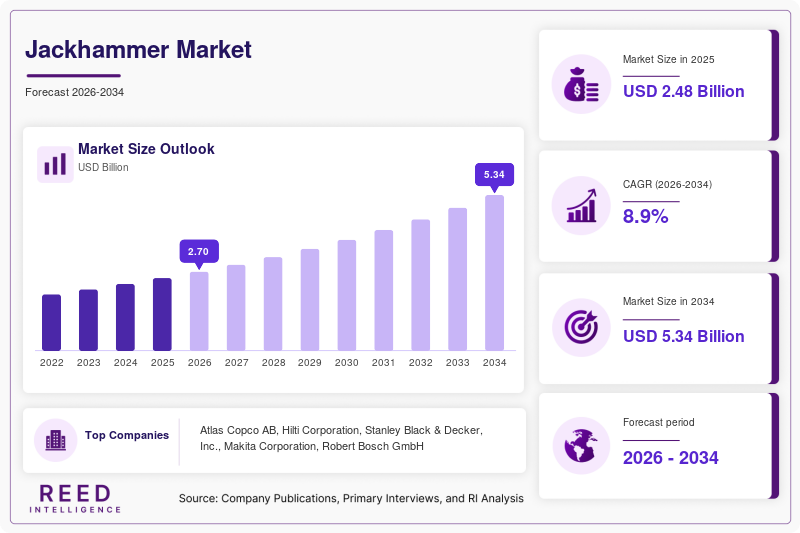
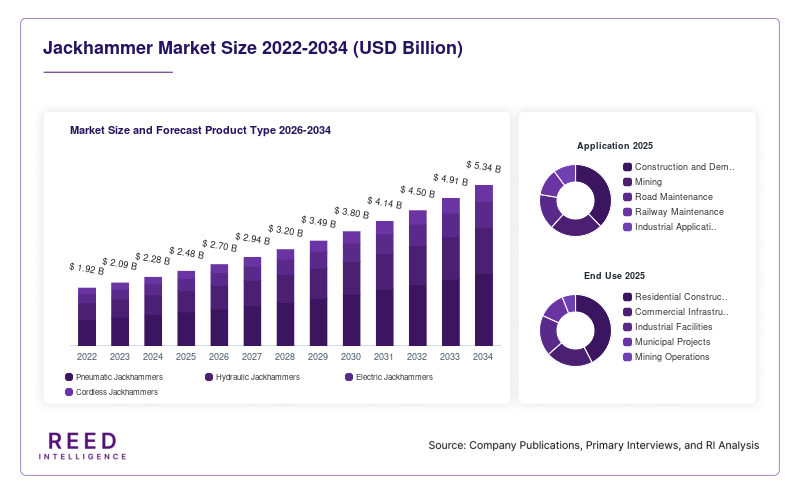
The global Jackhammer Market size was valued at USD 2.48 billion in 2026 and is projected to reach USD 4.91 billion by 2034, expanding at a CAGR of 8.9% during the forecast period. The market continues to gain momentum due to increasing investments in infrastructure modernization, mining operations, urban redevelopment projects, and transportation construction activities across both developed and developing economies. Jackhammers are widely used in demolition, road construction, mining excavation, tunneling, railway maintenance, and municipal engineering projects because they improve work efficiency and reduce manual labor intensity. The growing adoption of pneumatic, hydraulic, and electric jackhammers across industrial and commercial sectors is also supporting long-term market expansion.
Rising government spending on public infrastructure remains one of the major global factors supporting market growth. Several countries are allocating larger budgets for highways, metro rail projects, airports, bridges, and smart city developments. These projects require heavy-duty demolition and drilling equipment, increasing the demand for advanced jackhammers with lower vibration, better energy efficiency, and higher durability. Manufacturers are also focusing on ergonomic designs and battery-powered systems to improve operator safety and meet stricter workplace regulations.
Key Highlights
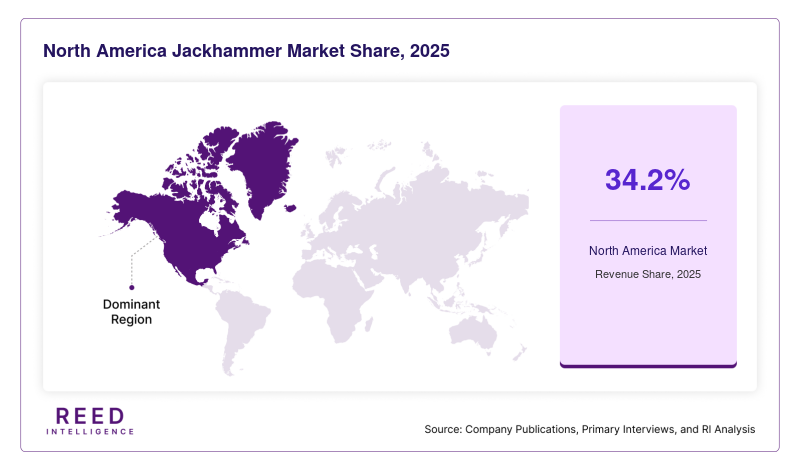
- North America dominated the market with a 34.2% share in 2025.
- Asia Pacific is expected to grow at the fastest CAGR of 10.8% during 2026–2034.
- By product type, pneumatic jackhammers accounted for the largest share of 43.7%.
- while electric jackhammers are projected to grow at a CAGR of 11.4%.
- By application, construction and demolition led with a 46.5% share.
- whereas mining activities are expected to expand at a CAGR of 10.9%.
- By end use, commercial infrastructure accounted for the highest share of 39.4%.
- while residential construction is expected to grow at a CAGR of 10.3%.
- The United States remained the dominant country, with market values of USD 640 million in 2024 and USD 702 million in 2025.
Market Trends
Rising Adoption of Cordless and Electric Equipment
The Jackhammer Market is witnessing growing demand for cordless and electric equipment as contractors and construction firms focus on operational flexibility and lower maintenance costs. Traditional pneumatic systems require compressors and additional setup, which increases transportation and operational complexity at project sites. Electric jackhammers offer improved portability, lower emissions, and reduced noise levels, making them suitable for indoor construction and urban redevelopment projects. Battery advancements have further improved runtime and performance, enabling contractors to use cordless equipment for extended operations without sacrificing productivity. Manufacturers are introducing lightweight models with brushless motors and anti-vibration systems to improve worker comfort and reduce fatigue during long shifts.
The increasing focus on sustainable construction practices is also contributing to the transition toward electric equipment. Several urban regions are implementing stricter environmental and workplace noise regulations, encouraging contractors to replace diesel-driven and pneumatic alternatives. In addition, rental equipment providers are expanding their portfolios with battery-powered jackhammers to address evolving customer preferences. These trends are expected to accelerate market penetration among small and medium-sized contractors seeking cost-efficient and user-friendly demolition solutions.
Integration of Ergonomic and Smart Features
Manufacturers in the Jackhammer Market are increasingly integrating ergonomic and smart monitoring features to improve operational safety and equipment efficiency. Construction and mining companies are emphasizing worker protection because vibration-related injuries and operator fatigue remain significant industry concerns. To address this issue, manufacturers are designing advanced anti-vibration handles, lightweight housings, and noise-reduction systems that improve handling and reduce long-term health risks. These features are becoming important purchasing criteria among contractors involved in large-scale infrastructure and industrial projects.
Smart technologies are also reshaping the competitive landscape. Modern jackhammers are being equipped with sensors that monitor operating temperature, impact frequency, runtime, and maintenance intervals. These systems help reduce downtime by enabling predictive maintenance and equipment tracking. Fleet operators are increasingly adopting connected equipment to improve productivity and optimize asset utilization across multiple project sites. As digitalization expands across the construction equipment industry, demand for technologically enhanced jackhammers is expected to increase steadily during the forecast period.
Market Drivers
Expanding Global Infrastructure Development Activities
Rapid growth in global infrastructure development is one of the primary factors driving the Jackhammer Market. Governments across developed and emerging economies are investing heavily in roads, railways, airports, tunnels, industrial facilities, and smart city projects. These projects require efficient demolition and concrete-breaking equipment capable of handling large-scale operations within shorter timelines. Jackhammers remain essential tools for removing old structures, breaking asphalt, and preparing surfaces for reconstruction activities. The increasing pace of urbanization is also supporting demand for modern construction equipment across residential and commercial sectors.
Several countries in Asia Pacific and the Middle East are implementing long-term infrastructure expansion programs to improve transportation networks and industrial connectivity. This trend is increasing the procurement of high-performance demolition tools among contractors and public agencies. In addition, aging infrastructure in North America and Europe is generating consistent demand for repair and rehabilitation projects, further supporting equipment sales. As public and private investment in infrastructure continues to increase, the demand for advanced jackhammer systems is expected to remain strong.
Growth in Mining and Resource Extraction Operations
The expansion of mining and resource extraction activities is another major driver supporting the Jackhammer Market. Mining companies require durable and high-impact equipment for rock breaking, excavation, and drilling operations in both surface and underground mining environments. Rising demand for minerals, metals, and energy resources is encouraging mining operators to expand production capacities and invest in efficient equipment solutions. Jackhammers play a critical role in smaller-scale excavation and maintenance tasks where mobility and precision are required.
Developing economies in Africa and Latin America are experiencing increased mining exploration due to growing foreign investment in natural resource projects. These regions are adopting modern equipment to improve productivity and worker safety standards. In addition, advancements in hydraulic and pneumatic technologies have improved the operational efficiency and durability of jackhammers used in demanding mining conditions. Equipment manufacturers are also developing heavy-duty models capable of withstanding harsh environments, which is increasing adoption across mining operations worldwide.
Market Restraint
High Maintenance Costs and Workplace Safety Concerns
High maintenance expenses and workplace safety concerns continue to restrain growth in the Jackhammer Market. Pneumatic and hydraulic jackhammers require regular servicing, lubrication, and component replacement to maintain operational efficiency. Frequent exposure to dust, vibration, and harsh environmental conditions can reduce equipment lifespan and increase repair costs for contractors and industrial operators. Small construction companies often face budget limitations, making it difficult to invest in advanced equipment or maintain large fleets efficiently.
Workplace safety regulations also present challenges for manufacturers and end users. Continuous exposure to vibration and noise can lead to operator fatigue, hearing damage, and musculoskeletal injuries. Governments and labor organizations are implementing stricter safety standards regarding equipment vibration levels and worker exposure durations. Compliance with these regulations requires manufacturers to invest in ergonomic technologies and advanced safety features, which can increase production costs and equipment prices. For example, contractors operating in urban redevelopment projects often need additional noise-control systems and protective equipment to comply with local regulations. These added expenses can limit adoption among cost-sensitive buyers and reduce profit margins for rental equipment providers.
Market Opportunities
Increasing Demand for Rental Construction Equipment
The growing popularity of equipment rental services is creating significant opportunities for the Jackhammer Market. Many construction contractors prefer renting demolition equipment instead of purchasing new systems because rental models reduce upfront capital expenditure and maintenance responsibilities. Small and medium-sized enterprises, in particular, are increasingly relying on rental providers for short-term infrastructure and renovation projects. This trend is encouraging rental companies to expand their fleets with technologically advanced jackhammers that offer improved efficiency and durability.
The expansion of infrastructure activities in emerging economies is also supporting the rental equipment business model. Contractors working on temporary or project-based operations benefit from flexible rental agreements and lower equipment ownership risks. Rental providers are investing in electric and cordless jackhammers to attract environmentally conscious customers and comply with urban noise regulations. Digital fleet management systems are further improving asset utilization and equipment tracking, enabling rental companies to maximize operational efficiency and customer satisfaction.
Technological Advancements in Low-Vibration Equipment
Technological innovation in low-vibration and energy-efficient equipment presents another major opportunity for the Jackhammer Market. Manufacturers are increasingly developing advanced systems that improve user comfort, reduce operational fatigue, and enhance productivity. Anti-vibration technology is becoming a critical differentiator in the market because contractors are prioritizing worker safety and regulatory compliance. These innovations are particularly important in developed regions where occupational safety standards are becoming stricter.
The integration of lightweight materials and smart control systems is further improving product performance. Advanced electric jackhammers now offer better impact energy efficiency while generating lower noise and emissions compared to traditional pneumatic systems. Companies investing in research and development are expected to gain competitive advantages by introducing equipment with extended battery life, predictive maintenance features, and ergonomic designs. As construction and mining companies modernize equipment fleets, demand for technologically advanced jackhammers is expected to create new revenue opportunities for manufacturers.
Segmental Analysis
By Product Type
Pneumatic jackhammers accounted for the largest share of the Jackhammer Market in 2024, representing 43.7% of total revenue. These systems remain widely adopted across construction, mining, and road maintenance applications because of their high impact force and operational reliability. Pneumatic equipment is especially preferred for heavy-duty demolition projects where continuous power output is necessary for breaking concrete, asphalt, and rock surfaces. Contractors operating in large-scale infrastructure projects continue to favor pneumatic systems due to their durability and suitability for demanding environments. The availability of compressed air systems across industrial and construction sites further supports the widespread adoption of this segment.
Electric jackhammers are projected to witness the fastest growth, expanding at a CAGR of 11.4% during the forecast period. Rising demand for environmentally friendly and low-noise construction equipment is driving adoption across urban construction projects and indoor demolition applications. Electric models offer lower maintenance requirements and improved portability compared to pneumatic alternatives, making them attractive for contractors seeking operational flexibility. Advancements in lithium-ion battery technology are further improving runtime and performance capabilities. Manufacturers are introducing lightweight cordless models with ergonomic designs and anti-vibration features, increasing their popularity among commercial contractors and rental equipment providers.
By Application
Construction and demolition applications held the dominant share of the Jackhammer Market in 2024, accounting for 46.5% of global revenue. The segment benefits from continuous investments in commercial buildings, transportation infrastructure, and urban redevelopment projects. Jackhammers are extensively used for breaking concrete surfaces, removing damaged pavement, and preparing sites for reconstruction activities. Rapid urban expansion in emerging economies and renovation activities in developed countries are supporting strong demand for demolition equipment. Construction contractors prefer advanced jackhammers with improved impact performance and lower vibration levels to enhance productivity and worker safety.
Mining applications are expected to register the fastest CAGR of 10.9% during the forecast period. Rising global demand for minerals, metals, and energy resources is encouraging mining companies to expand production and invest in efficient excavation tools. Jackhammers play an important role in secondary rock breaking, maintenance tasks, and underground mining operations where maneuverability is critical. Increasing exploration activities in Africa, Latin America, and Asia Pacific are also creating growth opportunities for equipment manufacturers. Technological advancements in hydraulic systems and heavy-duty components are improving durability and operational performance, making modern jackhammers more suitable for harsh mining environments.
By End Use
Commercial infrastructure emerged as the dominant end-use segment in the Jackhammer Market, accounting for 39.4% of global revenue in 2024. This segment includes transportation projects, industrial facilities, airports, railways, and public utility developments that require extensive demolition and excavation activities. Governments and private investors are allocating significant budgets toward modernization and expansion of infrastructure networks, increasing demand for efficient construction equipment. Jackhammers are widely utilized in road repair, bridge maintenance, and tunnel construction projects due to their high operational efficiency and versatility. The growing focus on urban redevelopment and smart city construction is further supporting segment growth.
Residential construction is expected to record the fastest CAGR of 10.3% during the forecast period. Rapid population growth and urban migration are increasing demand for housing developments across emerging economies. Residential renovation and remodeling activities in developed markets are also supporting the adoption of compact and lightweight jackhammers. Contractors involved in residential projects increasingly prefer electric and cordless models because they produce lower noise levels and are easier to operate in confined spaces. Rising consumer spending on home improvement projects and government support for affordable housing programs are expected to drive long-term demand within this segment.
Regional Analysis
North America
North America accounted for 34.2% of the global Jackhammer Market in 2025 and is expected to maintain steady growth at a CAGR of 7.8% during the forecast period. The region benefits from strong infrastructure rehabilitation activities, particularly in the United States and Canada, where governments are allocating large budgets for highway repairs, bridge modernization, and urban transit expansion. The increasing adoption of electric construction equipment and advanced demolition technologies is also contributing to regional market growth. Rental equipment providers across North America are expanding inventories with low-vibration and cordless jackhammers to meet changing contractor requirements.
The United States remains the dominant country in the region due to high construction spending and extensive industrial development projects. A major growth factor is the ongoing modernization of aging transportation infrastructure, including tunnels, rail networks, and public utilities. Federal funding initiatives supporting road and bridge reconstruction are increasing demand for efficient demolition equipment. Additionally, the strong presence of construction equipment manufacturers and technology providers is accelerating product innovation and market competitiveness across the country.
Europe
Europe represented 25.1% of the global Jackhammer Market in 2025 and is projected to expand at a CAGR of 7.4% through 2034. Market growth in the region is supported by infrastructure renovation projects, railway modernization, and sustainable urban redevelopment initiatives. European construction companies are increasingly investing in electric and low-noise equipment to comply with strict environmental and workplace safety regulations. Demand for compact and ergonomic jackhammers is particularly strong in densely populated urban areas where noise reduction and worker protection are major priorities.
Germany remains the leading country within the European market due to its strong industrial base and advanced construction sector. A unique growth factor driving the market is the expansion of energy-efficient infrastructure and underground utility upgrades. The country is investing heavily in transportation corridors, smart manufacturing facilities, and renewable energy infrastructure projects, all of which require advanced demolition and drilling equipment. The presence of established engineering companies and high adoption of automation technologies further support market growth in Germany.
Asia Pacific
Asia Pacific held 22.8% of the global Jackhammer Market in 2025 and is expected to register the fastest CAGR of 10.8% during the forecast period. Rapid urbanization, industrialization, and population growth are driving large-scale infrastructure and housing projects across the region. Governments in countries such as China, India, Indonesia, and Vietnam are increasing investments in transportation networks, industrial corridors, and smart city developments. These projects are creating strong demand for demolition and excavation equipment capable of supporting high-volume construction activities.
China dominates the regional market due to extensive infrastructure development and large-scale industrial construction projects. One major growth factor is the expansion of metro rail and high-speed railway systems across urban centers. Continuous investment in transportation connectivity and public infrastructure is increasing procurement of construction equipment among contractors and state-owned enterprises. In addition, local manufacturers are offering competitively priced jackhammer products, which is improving equipment accessibility and accelerating adoption across domestic and regional markets.
Middle East & Africa
The Middle East & Africa accounted for 10.4% of the global Jackhammer Market in 2025 and is projected to grow at a CAGR of 8.6% during the forecast period. Market expansion is supported by increasing investments in commercial construction, mining operations, and oil and gas infrastructure. Countries across the Gulf region are undertaking large-scale urban development projects, including airports, tourism facilities, industrial zones, and smart cities. These initiatives are driving demand for durable demolition and drilling equipment suited for high-temperature and demanding operational environments.
Saudi Arabia remains the dominant country in the regional market due to extensive investments in infrastructure diversification and industrial development programs. A unique growth factor is the implementation of large tourism and megacity projects that require extensive excavation and demolition activities. Mining expansion in African countries is also supporting regional demand for heavy-duty jackhammers. International construction firms operating in the region are increasingly adopting technologically advanced equipment to improve project efficiency and reduce operational downtime.
Latin America
Latin America captured 7.5% of the global Jackhammer Market in 2025 and is expected to grow at a CAGR of 8.1% through 2034. Infrastructure modernization, mining investments, and urban housing projects are supporting demand for construction and demolition equipment across the region. Governments are focusing on improving transportation infrastructure and public utilities, creating opportunities for contractors and equipment suppliers. The increasing popularity of equipment rental services is also helping small and medium-sized construction firms access modern jackhammer technologies without high upfront investment.
Brazil remains the leading country in the Latin American market due to its large construction industry and expanding mining sector. A major growth factor is the continued investment in mineral extraction and industrial infrastructure development. Mining companies require durable rock-breaking equipment for operational efficiency and maintenance activities, which is supporting consistent demand for hydraulic and pneumatic jackhammers. Additionally, infrastructure upgrades related to ports, logistics facilities, and urban transit systems are contributing to equipment sales across the country.
Competitive Landscape
The Jackhammer Market is moderately competitive, with global and regional manufacturers focusing on product innovation, ergonomic improvements, and geographic expansion strategies. Companies are investing in lightweight equipment, battery-powered technologies, and smart monitoring systems to strengthen market positioning and meet changing customer preferences. Strategic partnerships with rental equipment providers and construction firms are also becoming common as manufacturers seek to expand distribution networks and improve customer reach.
Atlas Copco remains one of the leading companies in the market due to its strong product portfolio, global distribution capabilities, and emphasis on technological innovation. The company continues to introduce energy-efficient and low-vibration jackhammer solutions designed for construction and mining applications. Other major participants are focusing on mergers, acquisitions, and regional manufacturing expansion to improve competitiveness and reduce supply chain costs.
A recent industry development includes the launch of advanced cordless demolition hammers with extended battery performance and digital monitoring features. Manufacturers are also integrating predictive maintenance technologies to reduce equipment downtime and improve operational efficiency. Increasing competition among established brands and emerging regional suppliers is expected to accelerate innovation and support long-term market growth.
Key Players
- Atlas Copco AB
- Hilti Corporation
- Stanley Black & Decker, Inc.
- Makita Corporation
- Robert Bosch GmbH
- Caterpillar Inc.
- Ingersoll Rand Inc.
- Hitachi Construction Machinery Co., Ltd.
- Komatsu Ltd.
- Doosan Corporation
- Chicago Pneumatic
- DEWALT
- Milwaukee Tool
- JCB Ltd.
- Metabo Corporation
Recent Developments
- Atlas Copco introduced a new range of low-vibration electric jackhammers designed for urban construction and indoor demolition applications.
- Hilti Corporation expanded its cordless demolition equipment portfolio with enhanced battery technology aimed at improving runtime and operational flexibility.
- Stanley Black & Decker announced investments in smart construction equipment technologies, including predictive maintenance capabilities for heavy-duty demolition tools.
- Makita Corporation launched compact brushless jackhammer models targeted at residential renovation contractors and rental equipment providers.
- Caterpillar Inc. strengthened its distribution partnerships in Asia Pacific to expand the availability of hydraulic demolition equipment across emerging infrastructure markets.
Jackhammer Market Segments
Product Type
- Pneumatic Jackhammers
- Hydraulic Jackhammers
- Electric Jackhammers
- Cordless Jackhammers
Application
- Construction and Demolition
- Mining
- Road Maintenance
- Railway Maintenance
- Industrial Applications
End Use
- Residential Construction
- Commercial Infrastructure
- Industrial Facilities
- Municipal Projects
- Mining Operations
By Region
- North America
- Europe
- APAC
- Middle East and Africa
- LATAM