Jib Crane Market Size, Share & Demand Report By Crane Type (Wall-Mounted Jib Cranes, Freestanding Jib Cranes, Articulating Jib Cranes, Mast-Type Jib Cranes), By Operation Mode (Electric-Operated, Manual-Operated, Pneumatic-Operated), By End-Use Industry (Manufacturing, Warehousing and Logistics, Construction, Automotive, Energy and Utilities, Others) By Region & Segment Forecasts, 2026–2034
USD 3950
Market Overview
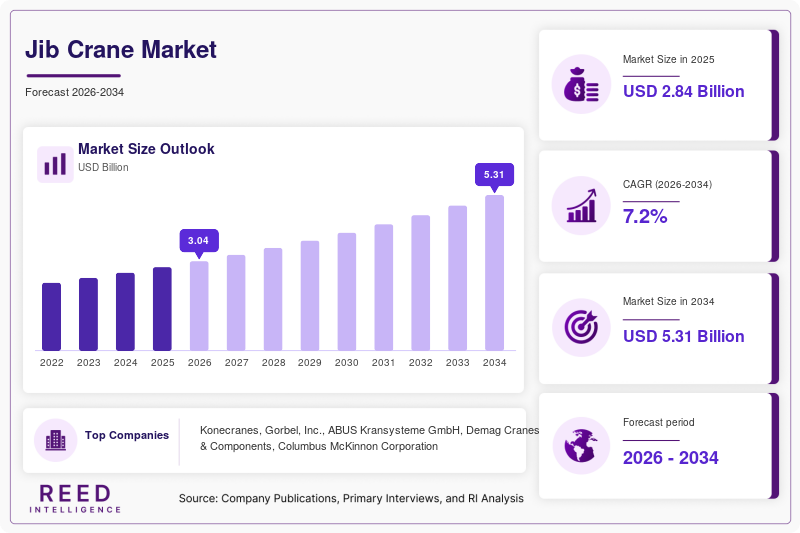
The global Jib Crane Market size was valued at USD 2.84 billion in 2026 and is projected to reach USD 4.97 billion by 2034, expanding at a CAGR of 7.2% during the forecast period from 2026 to 2034. The market is witnessing stable expansion due to the increasing adoption of material handling equipment across manufacturing, logistics, construction, automotive, and warehousing industries. Jib cranes are widely used for lifting and moving heavy loads within confined workspaces, making them suitable for facilities that require efficient and flexible handling solutions. Growing investments in industrial automation and smart factory infrastructure are further supporting demand for modern jib crane systems equipped with electric hoists, wireless controls, and energy-efficient components.
One of the major global factors supporting market growth is the rapid expansion of warehouse automation and e-commerce logistics infrastructure. Rising order volumes and shorter delivery timelines have encouraged companies to improve operational productivity through advanced lifting and handling systems. Jib cranes help reduce manual labor requirements while improving worker safety and production efficiency. In addition, infrastructure development projects in emerging economies continue to create strong demand for lifting equipment used in fabrication plants, ports, and industrial facilities.
Key Highlights
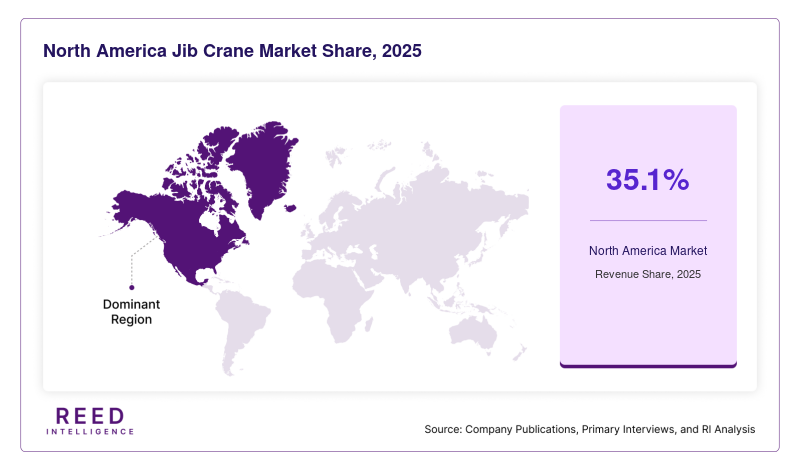
- North America dominated the market with a 35.1% share in 2025, while Asia Pacific is expected to grow at the fastest CAGR of 8.9% during 2026–2034.
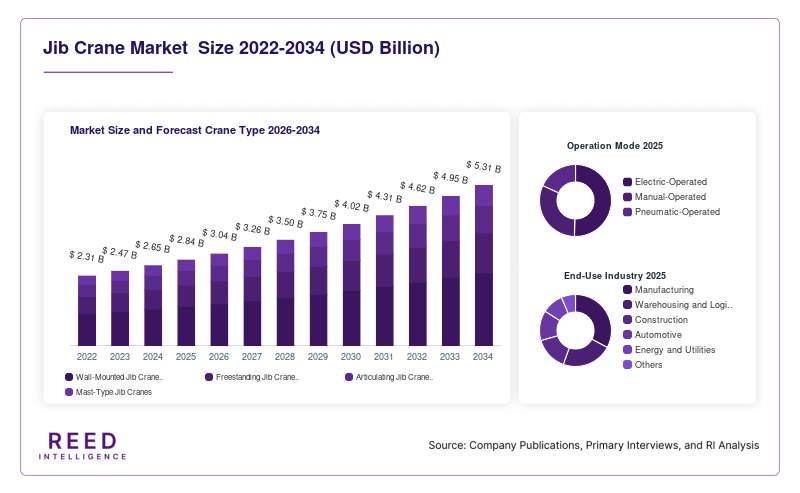
- By crane type, wall-mounted jib cranes accounted for the largest share of 39.4%, while articulating jib cranes are projected to grow at a CAGR of 9.6%.
- By operation mode, electric-operated systems led with a 58.2% share, whereas pneumatic-operated systems are expected to expand at a CAGR of 8.7%.
- By end-use industry, manufacturing accounted for the highest share of 42.8%, while warehousing and logistics are projected to grow at a CAGR of 9.3%.
- The United States remained the dominant country, with market values of USD 690 million in 2024 and USD 748 million in 2025.
Market Trends
Integration of Smart Monitoring and Automation Technologies
The Jib Crane Market is increasingly witnessing the integration of smart technologies that improve operational efficiency and maintenance planning. Manufacturers are introducing cranes equipped with sensors, remote-control systems, load monitoring devices, and predictive maintenance software. These technologies help operators monitor crane performance in real time while reducing unexpected downtime and repair costs. Industrial facilities are focusing on improving productivity and workplace safety, which has accelerated the adoption of intelligent jib crane systems across automotive plants, steel manufacturing units, and logistics centers.
The rise of Industry 4.0 practices is also encouraging companies to integrate jib cranes with automated production systems and warehouse management platforms. Smart jib cranes can collect operational data, identify load patterns, and optimize lifting performance based on workflow requirements. In addition, the use of wireless communication systems enables operators to manage crane movement from safer distances, reducing workplace injuries. Growing demand for digitally connected industrial equipment is expected to continue influencing product development and investment strategies across the global market.
Rising Preference for Compact and Customized Lifting Solutions
Industrial facilities are increasingly demanding compact and customized lifting systems that can operate efficiently in limited spaces. This trend has significantly increased the popularity of wall-mounted and articulating jib cranes in sectors such as electronics, pharmaceuticals, food processing, and small-scale manufacturing. Businesses are prioritizing flexible lifting solutions that can be tailored according to facility layout, load capacity, and workflow requirements. Customized jib cranes provide improved movement control and help maximize floor space utilization, which is particularly important in high-density industrial environments.
Manufacturers are responding by offering modular crane designs with adjustable boom lengths, rotating capabilities, and corrosion-resistant materials suitable for harsh operating conditions. The growing emphasis on ergonomic workstations and labor efficiency is also encouraging the deployment of workstation jib cranes in assembly lines and maintenance facilities. Furthermore, increasing investments in infrastructure modernization and factory upgrades are contributing to the adoption of advanced compact crane systems. This trend is expected to remain significant as industries continue focusing on operational flexibility and efficient material handling processes.
Market Drivers
Expansion of Industrial Manufacturing Activities
The continued expansion of global manufacturing activities is a major factor driving the Jib Crane Market. Industries such as automotive, aerospace, heavy machinery, shipbuilding, and metal fabrication require efficient lifting systems for handling raw materials, components, and finished products. Jib cranes provide localized lifting support that improves production efficiency and reduces manual handling efforts. Rapid industrialization in emerging economies has increased the establishment of manufacturing facilities, further strengthening demand for versatile crane solutions across production environments.
The growing adoption of automated manufacturing systems has also contributed to increased use of jib cranes integrated with hoists and intelligent lifting controls. Companies are investing in advanced handling equipment to minimize operational delays and improve workplace safety standards. In addition, government initiatives supporting industrial infrastructure development in countries such as India, China, Vietnam, and Indonesia are encouraging investments in factory modernization. As manufacturing output continues to increase worldwide, demand for reliable and cost-effective material handling equipment is expected to support long-term market growth.
Growth of Warehousing and Logistics Infrastructure
The rapid expansion of e-commerce operations and third-party logistics services is significantly driving the demand for jib cranes in warehouse environments. Logistics facilities require efficient handling systems to improve cargo movement, inventory management, and order fulfillment operations. Jib cranes are widely used for loading, unloading, and positioning heavy materials within distribution centers and storage facilities. Their ability to operate in confined spaces while improving handling efficiency makes them suitable for modern warehouse applications.
Growing investments in smart warehouses and automated logistics hubs are also increasing the adoption of electric-operated jib cranes with remote monitoring capabilities. Companies are focusing on improving operational throughput while reducing labor-intensive processes and workplace injuries. In addition, the construction of new ports, freight terminals, and industrial storage facilities in developing economies is supporting market expansion. The increasing need for faster supply chain operations and efficient goods handling systems is expected to continue creating growth opportunities for jib crane manufacturers and suppliers during the forecast period.
Market Restraint
High Installation and Maintenance Costs Affect Adoption Among Small Enterprises
One of the primary restraints affecting the Jib Crane Market is the high installation and maintenance cost associated with advanced crane systems. Although jib cranes improve operational productivity and worker safety, many small and medium-sized enterprises face financial limitations when investing in automated lifting equipment. The total ownership cost often includes structural modifications, electrical integration, periodic inspections, operator training, and replacement of worn components. These expenses can discourage adoption, especially among businesses operating with limited capital budgets.
The complexity of maintaining technologically advanced jib cranes also presents operational challenges. Facilities using smart monitoring systems and automated controls require skilled technicians for diagnostics and repair activities. In regions with limited access to technical expertise, maintenance delays can reduce equipment efficiency and increase downtime. Furthermore, fluctuations in steel prices and supply chain disruptions may increase manufacturing costs, leading to higher product prices for end users. For example, smaller fabrication workshops in developing countries often continue using manual lifting systems because advanced jib crane installations require higher initial investments. This cost-sensitive environment may limit market penetration in certain industrial segments despite growing demand for material handling automation.
Market Opportunities
Increasing Infrastructure Development in Emerging Economies
Rapid infrastructure development across emerging economies is creating substantial opportunities for the Jib Crane Market. Governments in Asia Pacific, the Middle East, Latin America, and parts of Africa are investing heavily in transportation networks, industrial parks, ports, airports, and energy projects. These developments require efficient lifting and material handling systems for construction and maintenance activities. Jib cranes are increasingly used in fabrication facilities, maintenance workshops, and infrastructure support operations because of their flexibility and compact design.
Countries such as India, Saudi Arabia, Brazil, and Indonesia are witnessing rising industrial construction activities supported by foreign direct investment and public infrastructure spending. The expansion of manufacturing clusters and export-oriented industrial zones is further increasing demand for workstation cranes and wall-mounted lifting systems. In addition, growing urbanization and renewable energy projects are creating new application areas for jib cranes in wind turbine assembly, power generation facilities, and heavy equipment servicing. These infrastructure-related investments are expected to provide long-term revenue opportunities for global and regional market participants.
Growing Adoption of Energy-Efficient and Ergonomic Equipment
The increasing focus on energy efficiency and workplace ergonomics is creating favorable growth opportunities within the Jib Crane Market. Industrial companies are prioritizing lifting systems that consume less power while improving worker comfort and operational safety. Manufacturers are introducing lightweight crane structures, variable frequency drive systems, and energy-efficient hoists that reduce electricity consumption and maintenance requirements. These innovations are becoming increasingly attractive for industries seeking to lower operational costs and comply with sustainability targets.
Ergonomic workstation solutions are also gaining popularity as industries focus on reducing worker fatigue and minimizing occupational injuries. Jib cranes help streamline repetitive lifting tasks and improve operator efficiency in assembly lines and maintenance operations. The adoption of environmentally friendly manufacturing practices is further encouraging the replacement of older lifting equipment with advanced crane systems designed for lower emissions and reduced energy usage. As sustainability initiatives continue influencing industrial purchasing decisions, manufacturers offering efficient and ergonomic jib crane solutions are expected to gain a competitive advantage in the evolving market landscape.
Segmental Analysis
By Crane Type
Wall-mounted jib cranes held the dominant share of 39.4% in 2024 due to their compact design, flexible operation, and suitability for facilities with limited floor space. These cranes are widely used in manufacturing plants, assembly lines, and maintenance workshops where efficient material handling within confined work areas is essential. Their ability to rotate across a wide operational range while minimizing structural modifications has increased their popularity across industrial sectors. Wall-mounted systems are also preferred because they can be integrated easily with existing facility layouts without requiring extensive floor support structures. The automotive and metal fabrication industries remain major users of these crane systems due to their consistent requirement for repetitive lifting tasks. In addition, the lower installation footprint and improved workspace utilization offered by wall-mounted jib cranes continue to support their market dominance across developed and emerging industrial economies.
Articulating jib cranes are projected to register the fastest CAGR of 9.6% during the forecast period owing to their superior flexibility and maneuverability in complex work environments. These cranes are designed with dual-arm structures that allow operators to position loads around obstacles and within narrow workstations more efficiently than traditional fixed-arm systems. Industries such as aerospace, electronics, pharmaceuticals, and precision engineering are increasingly adopting articulating cranes to improve handling accuracy and workflow efficiency. The growing trend toward customized workstation solutions and ergonomic lifting equipment is also accelerating demand for these systems. Manufacturers are introducing lightweight articulating models equipped with electric hoists, advanced rotation mechanisms, and corrosion-resistant components to address industry-specific requirements. Rising adoption in automated production facilities and maintenance applications is expected to support strong long-term growth for this subsegment.
By Operation Mode
Electric-operated jib cranes accounted for the largest market share of 58.2% in 2024 due to their high operational efficiency, lower manual effort, and suitability for continuous industrial applications. These systems are widely used in manufacturing, warehousing, and logistics environments where frequent lifting operations are required. Electric cranes provide smoother load handling, improved precision, and enhanced productivity compared to manual alternatives. Their compatibility with automated production systems and remote-control technologies has further increased their adoption across advanced industrial facilities. Growing emphasis on worker safety and operational reliability is encouraging businesses to replace traditional lifting systems with electrically powered equipment. In addition, electric-operated cranes offer lower maintenance requirements and better load capacity management, making them suitable for high-volume industrial environments. The increasing use of energy-efficient motors and smart monitoring technologies is further strengthening demand for this subsegment globally.
Pneumatic-operated jib cranes are expected to witness the fastest CAGR of 8.7% during the forecast period due to rising adoption in hazardous and explosion-sensitive environments. These cranes are particularly suitable for industries such as chemicals, oil and gas, pharmaceuticals, and food processing where electrical spark risks must be minimized. Pneumatic systems offer reliable operation in harsh industrial conditions while reducing the risk of ignition in flammable environments. Growing workplace safety regulations and stringent industrial compliance standards are encouraging the deployment of non-electric lifting solutions across sensitive operational facilities. Manufacturers are increasingly developing advanced pneumatic crane models with enhanced load balancing capabilities and improved energy efficiency. In addition, the rising demand for corrosion-resistant and low-maintenance lifting equipment in offshore and process industries is supporting growth in this subsegment. Expanding industrial safety awareness is expected to sustain future demand for pneumatic-operated jib cranes.
By End-Use Industry
The manufacturing sector dominated the Jib Crane Market with a 42.8% share in 2024 due to increasing automation and production efficiency requirements across industrial facilities. Jib cranes are extensively used in assembly lines, machining units, welding stations, and fabrication workshops to support repetitive lifting and positioning tasks. Their ability to improve workflow efficiency and reduce manual labor dependency makes them essential equipment within modern manufacturing operations. Industries such as automotive, aerospace, heavy machinery, and electronics continue to generate significant demand for crane systems capable of handling varied load capacities. Manufacturers are increasingly integrating jib cranes with smart production systems and automated handling technologies to optimize operational performance. In addition, growing investments in factory expansion and industrial modernization projects across emerging economies are supporting continued adoption of advanced material handling solutions within the manufacturing sector.
Warehousing and logistics is projected to emerge as the fastest-growing end-use segment with a CAGR of 9.3% during the forecast period. The rapid growth of e-commerce operations and third-party logistics services has significantly increased demand for efficient handling systems within distribution centers and storage facilities. Jib cranes help improve loading, unloading, packaging, and inventory management processes while reducing operational delays. Their compact structure and flexible movement capabilities make them highly suitable for modern warehouse environments with limited operational space. Companies are increasingly investing in automated logistics infrastructure equipped with electric-operated crane systems integrated with warehouse management software. The expansion of cold storage facilities, freight terminals, and smart logistics hubs is further supporting segment growth. Rising focus on supply chain optimization and faster order fulfillment operations is expected to continue driving strong demand within this end-use category.
Regional Analysis
North America
North America accounted for 35.1% of the global Jib Crane Market share in 2025 and continues to maintain a leading position due to strong industrial automation investments and advanced manufacturing infrastructure. The regional market is projected to expand at a CAGR of 6.8% during the forecast period. Increasing demand for automated lifting systems across automotive, aerospace, warehousing, and metal fabrication industries is supporting market expansion. Companies in the region are prioritizing workplace safety and operational efficiency, encouraging the adoption of technologically advanced jib crane systems equipped with remote monitoring and intelligent control features.
The United States remains the dominant contributor to the North American market due to large-scale investments in logistics infrastructure and factory modernization projects. The growth of e-commerce fulfillment centers and smart warehouses is creating strong demand for compact and flexible material handling equipment. In addition, the presence of major crane manufacturers and strong regulatory standards related to workplace safety are supporting continuous product innovation. Rising adoption of electric-operated cranes in industrial maintenance facilities is also contributing to market growth across the country.
Europe
Europe represented 27.4% of the global Jib Crane Market in 2025 and is expected to grow at a CAGR of 6.5% from 2026 to 2034. The region benefits from a strong manufacturing base and increasing investments in automated production technologies. Industries such as automotive, heavy engineering, and renewable energy are major users of jib crane systems throughout Europe. Companies are increasingly adopting compact lifting equipment that improves production flexibility and supports efficient handling operations in space-constrained facilities.
Germany remains the leading country within the European market due to its advanced industrial manufacturing sector and high focus on engineering efficiency. The country is witnessing strong demand for smart lifting systems integrated with digital monitoring solutions. In addition, the transition toward sustainable manufacturing practices is encouraging industries to replace conventional lifting equipment with energy-efficient jib cranes. The expansion of renewable energy infrastructure and electric vehicle manufacturing facilities is also contributing to regional market growth.
Asia Pacific
Asia Pacific is projected to register the fastest CAGR of 8.9% during the forecast period due to rapid industrialization and infrastructure development activities. The region accounted for 24.6% of the global Jib Crane Market share in 2025. Increasing investments in manufacturing plants, logistics centers, and industrial automation technologies are driving market demand across developing economies. The rising number of construction and infrastructure projects is also increasing the use of lifting equipment in fabrication workshops and maintenance operations.
China dominates the regional market because of its extensive manufacturing sector and large-scale industrial production activities. The country continues to invest heavily in smart factories, transportation infrastructure, and warehouse automation systems. Growing export-oriented industries and increasing adoption of automated handling equipment are supporting strong market growth. In addition, government initiatives encouraging industrial modernization and advanced manufacturing capabilities are further accelerating demand for jib crane systems across multiple sectors.
Middle East & Africa
The Middle East & Africa region held 7.1% of the global Jib Crane Market in 2025 and is expected to grow at a CAGR of 7.4% during the forecast period. The market is benefiting from increasing investments in industrial diversification, infrastructure development, and energy sector expansion. Countries across the Gulf region are focusing on developing manufacturing facilities, logistics hubs, and construction projects that require efficient material handling solutions. Jib cranes are increasingly used in maintenance workshops, ports, and industrial assembly operations throughout the region.
Saudi Arabia represents the leading market within the Middle East & Africa due to ongoing industrial transformation initiatives and large-scale infrastructure investments. The country’s industrial development programs are encouraging the expansion of manufacturing and warehousing facilities. Rising investments in oil and gas infrastructure maintenance activities are also supporting the demand for heavy-duty jib crane systems. Furthermore, the development of smart industrial cities and logistics corridors is creating additional growth opportunities for crane manufacturers operating in the region.
Latin America
Latin America accounted for 5.8% of the global Jib Crane Market share in 2025 and is anticipated to expand at a CAGR of 6.9% over the forecast period. The market is experiencing gradual growth due to increasing industrial activities and infrastructure modernization projects across the region. Manufacturing companies are investing in material handling equipment to improve productivity and reduce workplace injuries. The growth of mining, construction, and logistics sectors is also contributing to the increasing demand for jib crane systems in industrial applications.
Brazil remains the dominant country in the Latin American market due to its large industrial base and expanding warehousing infrastructure. The country is witnessing growing investments in automotive manufacturing, mining operations, and logistics facilities. Rising focus on operational efficiency and worker safety standards is encouraging businesses to adopt modern lifting equipment. In addition, infrastructure projects related to transportation and energy development are supporting continued demand for jib cranes across industrial and commercial sectors.
Competitive Landscape
The Jib Crane Market is moderately fragmented, with global and regional manufacturers competing based on product customization, lifting capacity, automation capabilities, and after-sales service support. Companies are focusing on expanding their product portfolios with smart lifting systems integrated with digital monitoring technologies and energy-efficient components. Strategic partnerships, acquisitions, and regional expansion initiatives are commonly adopted to strengthen market presence and improve customer reach across industrial sectors.
Konecranes remains one of the leading companies in the global market due to its extensive product portfolio, strong international distribution network, and focus on industrial automation solutions. The company continues investing in intelligent lifting technologies and predictive maintenance systems designed to improve operational efficiency. Gorbel, Inc., ABUS Kransysteme GmbH, Columbus McKinnon Corporation, and Demag Cranes & Components are also major participants offering customized jib crane solutions for manufacturing and logistics applications.
Key Players
- Konecranes
- Gorbel, Inc.
- ABUS Kransysteme GmbH
- Demag Cranes & Components
- Columbus McKinnon Corporation
- Terex Corporation
- Liebherr Group
- Spanco Inc.
- Street Crane Company
- JASO Industrial Cranes
- Donati Sollevamenti
- Henan Mine Crane Co., Ltd.
- OZ Lifting Products LLC
- Workstation Crane Group
- Mazzella Companies
Recent Developments
- In 2025, Konecranes launched a new smart jib crane series featuring predictive maintenance software and remote operational diagnostics for industrial facilities.
- In 2024, Gorbel, Inc. expanded its manufacturing operations in North America to increase production capacity for workstation jib crane systems.
- In 2025, Columbus McKinnon Corporation introduced energy-efficient electric hoist integration technology designed for automated warehouse applications.
- In 2024, Demag Cranes & Components developed lightweight articulating jib cranes targeting aerospace and precision engineering industries.
- In 2025, ABUS Kransysteme GmbH announced the expansion of its distributor network across Asia Pacific to support rising industrial automation demand.
Jib Crane Market Segments
Crane Type
- Wall-Mounted Jib Cranes
- Freestanding Jib Cranes
- Articulating Jib Cranes
- Mast-Type Jib Cranes
Operation Mode
- Electric-Operated
- Manual-Operated
- Pneumatic-Operated
End-Use Industry
- Manufacturing
- Warehousing and Logistics
- Construction
- Automotive
- Energy and Utilities
- Others
By Region
- North America
- Europe
- APAC
- Middle East and Africa
- LATAM