Jigsaw Puzzle Market Size, Share & Demand Report By Product Type (Traditional Cardboard Puzzles, Wooden Puzzles), By Piece Count (Less Than 500 Pieces, 500–1000 Pieces, More Than 1000 Pieces), By Theme (Landscape & Nature, Cities & Architecture, Licensed Entertainment, Art & Paintings), By Distribution Channel (Online Retail, Specialty Toy Stores, Hypermarkets & Supermarkets, Department Stores), By Region & Segment Forecasts, 2026–2034
USD 3950
Market Overview
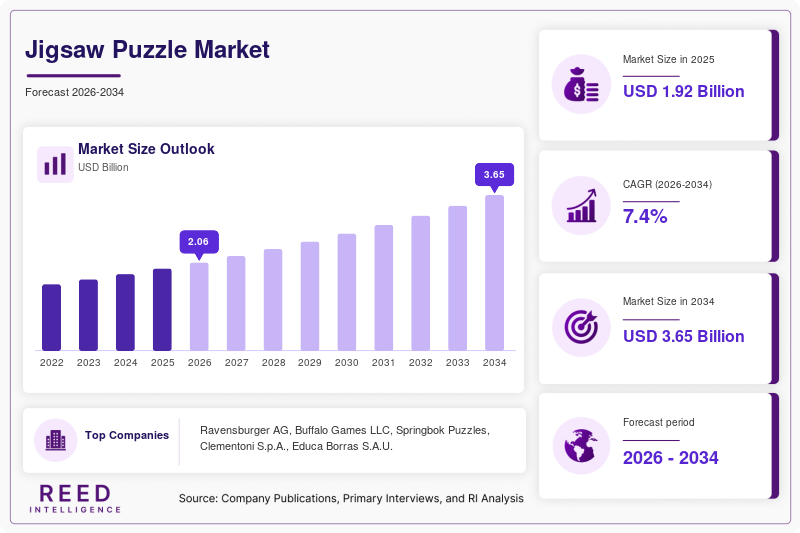
The Jigsaw Puzzle Market Size was valued at USD 1.92 billion in 2026 and is projected to reach USD 3.41 billion by 2034, expanding at a CAGR of 7.4% during the forecast period (2026–2034). The market continues to grow steadily due to increasing consumer interest in screen-free entertainment, cognitive development activities, and family-oriented recreational products. Jigsaw puzzles have evolved beyond traditional tabletop games and are increasingly positioned as educational tools, mindfulness products, and premium collectibles for diverse age groups.
A significant global factor supporting the growth of the Jigsaw Puzzle Market is the increasing emphasis on mental wellness and cognitive engagement. Consumers across age groups are adopting puzzles as a leisure activity that promotes concentration, memory retention, stress reduction, and problem-solving skills. Educational institutions, healthcare providers, and recreational centers are also encouraging puzzle-based activities as part of cognitive development and therapeutic programs, contributing to sustained market demand worldwide.
Key Highlights
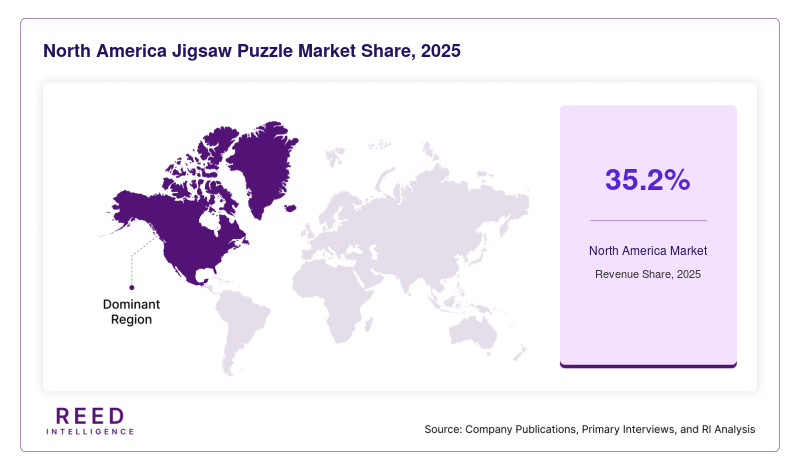
- North America accounted for the largest market share of 35.2% in 2025, while Asia Pacific is projected to register the fastest CAGR of 8.6% during 2026–2034.
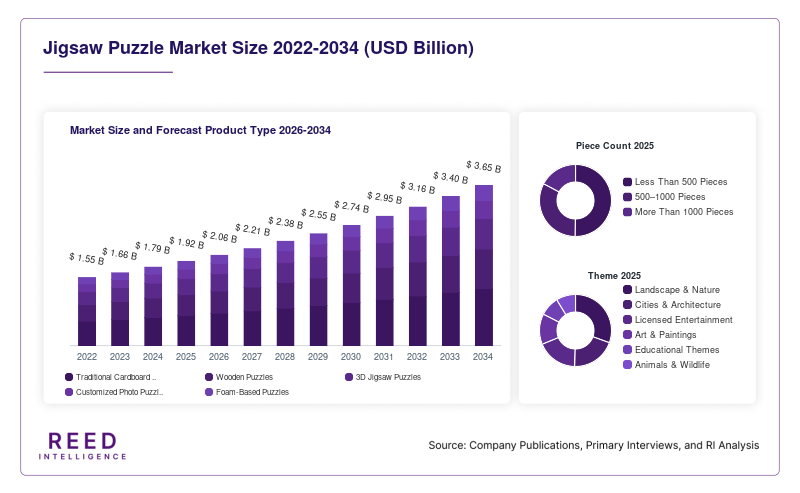
- By Product Type, Traditional Cardboard Puzzles held the dominant share of 58.4% in 2025, while 3D Jigsaw Puzzles are expected to grow at a CAGR of 9.4%.
- By Piece Count, 500–1000 Piece Puzzles represented 42.6% share in 2025, whereas More Than 1000 Piece Puzzles are forecast to expand at 8.8% CAGR.
- By Theme, Landscape & Nature Puzzles accounted for 29.7% share in 2025, while Licensed Entertainment Themes are anticipated to grow at 9.1% CAGR.
- By Distribution Channel, Online Retail captured 46.3% market share in 2025, while Direct-to-Consumer Sales are expected to register a CAGR of 9.3%.
- The United States remained the leading national market, with market values of USD 428 million in 2024 and USD 456 million in 2025.
Market Trends
Growing Popularity of Premium and Collector Edition Puzzles
Consumers are increasingly seeking high-quality puzzle products featuring artistic illustrations, luxury packaging, exclusive themes, and limited-edition releases. Manufacturers are responding by introducing premium puzzle collections that appeal to enthusiasts and collectors. These products often incorporate enhanced materials, unique artwork, and specialty designs, creating additional revenue opportunities across the Jigsaw Puzzle Market.
Expansion of Personalized and Custom Puzzle Offerings
The demand for personalized puzzle products is increasing among consumers seeking customized gifts and unique recreational experiences. Digital printing technologies enable manufacturers to create puzzles using personal photographs, artwork, and customized themes. This trend is expanding product differentiation and encouraging greater consumer engagement across online retail channels.
Market Drivers
Increasing Demand for Educational and Cognitive Development Products
Parents and educational institutions are placing greater emphasis on activities that support cognitive development and learning outcomes. Jigsaw puzzles promote critical thinking, pattern recognition, concentration, and spatial reasoning skills. As educational play continues to gain importance globally, puzzle products are increasingly incorporated into home learning and classroom environments.
Rising Consumer Interest in Screen-Free Entertainment
Consumers are actively seeking alternatives to digital entertainment and excessive screen exposure. Jigsaw puzzles provide an engaging offline activity suitable for individuals, families, and social groups. Growing awareness regarding digital wellness and balanced recreational habits continues to support demand for puzzle-based entertainment products.
Market Restraint
Competition from Digital Gaming and Interactive Entertainment
The growing popularity of video games, mobile applications, streaming services, and virtual entertainment platforms remains a key challenge for the Jigsaw Puzzle Market. Younger consumers often allocate leisure time toward digital experiences, creating competitive pressure for traditional puzzle manufacturers seeking to attract new customer segments.
Market Opportunities
Expansion of Sustainable and Eco-Friendly Puzzle Products
Consumers are increasingly prioritizing environmentally responsible products. Manufacturers can capitalize on this opportunity by introducing puzzles made from recycled cardboard, biodegradable materials, and sustainable packaging solutions. Growing environmental awareness is expected to support demand for eco-conscious puzzle offerings.
Growth of Puzzle Subscription and Membership Services
Subscription-based business models are creating new opportunities within the Jigsaw Puzzle Market. Monthly puzzle delivery services offering exclusive designs, themed collections, and limited-edition products can improve customer retention and recurring revenue generation. Such models also enable manufacturers to strengthen direct consumer relationships.
Segmental Analysis
By Product Type
The Jigsaw Puzzle Market is segmented into:
- Traditional Cardboard Puzzles
- Wooden Puzzles
- 3D Jigsaw Puzzles
- Customized Photo Puzzles
- Foam-Based Puzzles
Traditional Cardboard Puzzles held the largest share of 58.4% in 2025. Their affordability, extensive theme availability, and broad consumer appeal contributed to widespread adoption across all age groups.
3D Jigsaw Puzzles are projected to witness the fastest growth at a CAGR of 9.4% during the forecast period. Increasing demand for interactive puzzle experiences and architectural model-based designs will drive segment expansion.
By Piece Count
The market is categorized into:
- Less Than 500 Pieces
- 500–1000 Pieces
- More Than 1000 Pieces
500–1000 Piece Puzzles accounted for 42.6% market share in 2025 due to their balance between challenge level and completion time. These puzzles appeal to both casual consumers and hobby enthusiasts.
More Than 1000 Piece Puzzles are expected to grow at a CAGR of 8.8% through 2034. Enthusiast consumers seeking complex and immersive puzzle experiences will increasingly support segment growth.
By Theme
The market includes:
- Landscape & Nature
- Cities & Architecture
- Licensed Entertainment
- Art & Paintings
- Educational Themes
- Animals & Wildlife
Landscape & Nature Puzzles represented 29.7% of market revenue in 2025. Scenic imagery and universal consumer appeal contributed to strong segment demand.
Licensed Entertainment Themes are projected to expand at a CAGR of 9.1% during the forecast period. Popular film franchises, television properties, and gaming-related content will continue attracting younger consumers and collectors.
By Distribution Channel
The market is segmented into:
- Online Retail
- Specialty Toy Stores
- Hypermarkets & Supermarkets
- Department Stores
- Direct-to-Consumer Channels
Online Retail accounted for 46.3% share in 2025 due to broad product selection, convenient purchasing options, and increasing adoption of digital commerce platforms.
Direct-to-Consumer Channels are anticipated to register the fastest CAGR of 9.3% through 2034. Manufacturers will increasingly leverage proprietary online platforms to offer personalized products, exclusive collections, and subscription services.
Regional Analysis
North America
North America accounted for 35.2% of the Jigsaw Puzzle Market share in 2025 and is projected to grow at a CAGR of 6.8% during 2026–2034. The region benefits from strong consumer spending on recreational products and a well-established hobby market. Growing participation in family-oriented indoor activities continues to support market demand.
The United States dominated the regional market due to widespread adoption of educational toys, strong hobby culture, and extensive availability of premium puzzle brands. Increasing demand for collector editions has further contributed to market expansion.
Europe
Europe held 29.4% market share in 2025 and is anticipated to expand at a CAGR of 7.0% through 2034. The region maintains a strong tradition of puzzle-based recreation and educational gaming products. Demand remains supported by consumers seeking intellectually stimulating leisure activities.
Germany remained the dominant country due to its established board game and puzzle manufacturing industry. Consumer preference for educational and family entertainment products continues to support regional growth.
Asia Pacific
Asia Pacific represented 22.5% of the global market in 2025 and is expected to register the fastest CAGR of 8.6% during 2026–2034. Rising disposable income, expanding middle-class populations, and increasing awareness of educational toys are contributing to market development.
China emerged as the leading national market owing to growing demand for educational products and increasing popularity of hobby-based indoor activities. Expanding e-commerce penetration has improved product accessibility across urban and semi-urban markets.
Middle East & Africa
The Middle East & Africa accounted for 6.3% market share in 2025 and is projected to grow at a CAGR of 7.2% during the forecast period. Rising investments in educational products and increasing consumer spending on family entertainment are supporting market growth across the region.
United Arab Emirates led the regional market due to growing demand for premium recreational products and educational toys. Expanding retail infrastructure continues to improve market accessibility.
Latin America
Latin America held 6.6% market share in 2025 and is expected to expand at a CAGR of 7.5% through 2034. The region is witnessing increasing adoption of educational and family-oriented recreational products. Growth in organized retail and online commerce channels is supporting market expansion.
Brazil remained the dominant country due to increasing consumer interest in affordable home-based entertainment activities and growing penetration of specialty toy retailers.
Competitive Landscape
The Jigsaw Puzzle Market remains moderately fragmented, with manufacturers focusing on product innovation, licensed content partnerships, premium materials, and direct consumer engagement. Companies continue expanding product portfolios to address evolving consumer preferences across educational, recreational, and collector-oriented segments.
Ravensburger AG remains a leading market participant due to its extensive puzzle portfolio, strong global distribution network, and emphasis on product quality. The company recently expanded its premium puzzle collection featuring exclusive artwork and environmentally responsible manufacturing materials, strengthening its position in the global market.
Other major companies are investing in customized puzzle technologies, digital marketing initiatives, and licensing agreements with entertainment brands to enhance market competitiveness and customer engagement.
Key Players List
- Ravensburger AG
- Buffalo Games LLC
- Springbok Puzzles
- Clementoni S.p.A.
- Educa Borras S.A.U.
- Schmidt Spiele GmbH
- Eurographics Inc.
- Cobble Hill Puzzle Company
- White Mountain Puzzles
- MasterPieces Puzzle Company
- Wentworth Wooden Puzzles
- Heye Puzzle GmbH
- Trefl S.A.
- Gibsons Games Ltd.
- Melissa & Doug LLC
Recent Developments
- In 2025, several manufacturers introduced sustainable puzzle collections utilizing recycled cardboard and eco-friendly inks.
- Leading companies expanded licensing agreements with entertainment brands to launch new themed puzzle products.
- Personalized puzzle platforms enhanced customization capabilities through improved digital printing technologies.
- Manufacturers increased investment in direct-to-consumer e-commerce platforms and subscription-based puzzle programs.
- Premium puzzle collections featuring limited-edition artwork and collector-focused packaging gained wider commercial availability.
Jigsaw Puzzle Market Segments
Product Type
- Traditional Cardboard Puzzles
- Wooden Puzzles
- 3D Jigsaw Puzzles
- Customized Photo Puzzles
- Foam-Based Puzzles
Piece Count
- Less Than 500 Pieces
- 500–1000 Pieces
- More Than 1000 Pieces
Theme
- Landscape & Nature
- Cities & Architecture
- Licensed Entertainment
- Art & Paintings
- Educational Themes
- Animals & Wildlife
Distribution Channel
- Online Retail
- Specialty Toy Stores
- Hypermarkets & Supermarkets
- Department Stores
- Direct-to-Consumer Channels
By Region
- North America
- Europe
- APAC
- Middle East and Africa
- LATAM