Juice Extractor Market Size, Share & Trends Analysis Report By Product Type (Centrifugal Juicers, Masticating or Slow Juicers, Triturating Juicers), By Category (Electric and Manual), By Application (Household and Commercial), By Distribution Channel (Online, Specialty Stores) and By Region (North America, Europe, APAC, Middle East and Africa, LATAM) Forecasts, 2026–2034
USD 3950
Juice Extractor Market Size
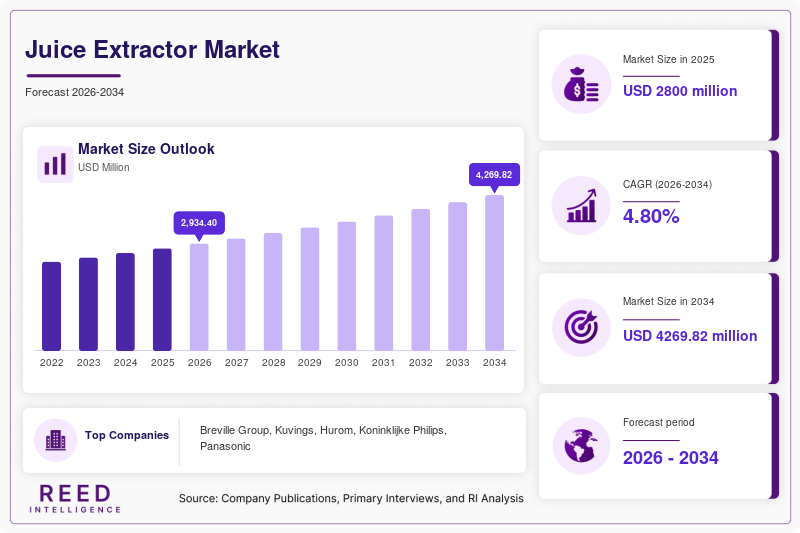
The global Juice Extractor Market was valued at USD 2,800 million in 2025 and is estimated to reach USD 2,930 million in 2026. Based on the supplied forecast, the market is projected to reach USD 4,269.82 million by 2034, registering a stated CAGR of 4.80% during 2026–2034.
The supplied figures are broadly consistent with the stated growth rate. The increase from USD 2,930 million in 2026 to USD 4,269.82 million in 2034 implies a CAGR of approximately 4.91%. The difference is small enough to be attributable to rounding or the use of slightly different underlying estimates; this report preserves all user-provided values.
All market values and modeled segment and regional values in this report are expressed in USD million. Segment shares and regional allocations are internal analytical estimates rather than externally reported market statistics.
Juice extractors are kitchen appliances that separate liquid from the pulp and fibrous material of fruits and vegetables. The market covers centrifugal juicers, masticating or slow juicers, triturating models, citrus extractors and other manual or electric devices used in homes and commercial food-service settings. Product selection depends on extraction speed, juice yield, ingredient compatibility, noise, cleaning effort, durability and purchase price.
The market is shaped by two distinct purchasing priorities. Mass-market buyers generally evaluate affordability, preparation speed, storage footprint and ease of cleaning, while premium buyers may prioritize slow extraction, higher-capacity feeding systems and specialized functions. Manufacturers are responding with product designs that reduce preparation and handling effort. Kuvings, for example, has promoted hands-free slow juicers with large ingredient hoppers, allowing users to load more produce at once and reducing the need for repeated feeding. This illustrates how convenience-oriented engineering can support premium product positioning.
Juice extractors also compete with blenders, mixer-grinders, ready-to-drink juices and other beverage-preparation methods. A blender typically retains more of the ingredients in the final mixture, whereas an extractor separates juice from much of the pulp. This functional difference means that consumer preference for a particular appliance depends on intended recipes, dietary habits and convenience rather than health awareness alone.
Juice Extractor Market Drivers
Convenience-focused product engineering improves everyday usability
Preparation time and cleanup effort can determine whether consumers continue using a juicer after purchase. Large feed chutes, automatic feeding mechanisms, simplified assembly and easier-to-clean components reduce the effort involved in making juice. Kuvings’ AUTO10S, for example, features a 3,000 mL hopper and an automatic cutting function designed to simplify ingredient loading. Such features provide a tangible product benefit that manufacturers can communicate beyond general wellness messaging.
However, feature upgrades do not automatically translate into higher unit sales. Manufacturers must demonstrate that the added convenience justifies the price premium and that larger or more complex components do not make storage, cleaning or maintenance more difficult.
Health-oriented food preparation supports interest in fresh juice
Consumers interested in preparing fruit and vegetable beverages at home can use juice extractors to control ingredients, portion sizes and flavor combinations. This provides an alternative to packaged beverages and allows users to prepare recipes based on personal preferences. The opportunity is strongest when the appliance fits into a repeatable household routine rather than being purchased for occasional use.
The commercial implication is that product makers can position juicers around practical use cases—such as morning preparation, family-sized batches or vegetable-based recipes—while avoiding unsupported claims that extracted juice is inherently healthier than whole produce. Juice extractors remain one option within broader food-preparation habits, and demand depends on consumer preference, price and the perceived value of the finished beverage.
Premium slow juicers create a differentiated product tier
Masticating and slow juicers generally operate differently from centrifugal models, using slower crushing or pressing mechanisms rather than rapid spinning to separate juice. Manufacturers market these products around features such as extraction performance, noise levels, ingredient handling and ease of use. Premium offerings can therefore command higher prices when consumers perceive a meaningful benefit.
Kuvings’ AUTO-series products illustrate this positioning through large-capacity hoppers and hands-free operation. The commercial opportunity is to move beyond basic appliance specifications and communicate the benefits that matter in everyday use. The limitation is that premium products face a smaller potential buyer pool when price sensitivity is high or consumers are uncertain about how frequently they will use the appliance.
Juice Extractor Market Restraints
Cleaning effort and inconsistent usage can limit replacement demand
Juicers require produce preparation, assembly, cleaning and management of separated pulp. If these tasks take longer than consumers expect, use may decline after the initial purchase. This can reduce word-of-mouth recommendations and make some buyers reluctant to replace an older machine when it fails.
Product design can mitigate the problem, but it cannot remove the need for routine cleaning. Manufacturers need to balance extraction performance with a manageable number of parts, easy access to strainers and filters, and clear cleaning instructions. Models that appear convenient at the point of sale but prove difficult to maintain may struggle to sustain consumer satisfaction.
Price sensitivity constrains premium product adoption
Slow juicers and multifunctional models may carry a higher purchase price than basic centrifugal or manual alternatives. The premium can be difficult to justify for consumers who prepare juice infrequently or who can meet their needs through a blender, citrus press or ready-to-drink beverage.
Manufacturers therefore face a segmentation challenge: entry-level models need to remain accessible without compromising essential performance, while premium models must offer visible benefits that justify the higher cost. A broad portfolio can address different price points, but it also increases inventory, marketing and product-support complexity.
Appliance durability, repairability and parts availability affect ownership economics
A consumer’s decision to replace a juicer depends partly on whether the existing product can be repaired economically. Research by the European Commission’s Joint Research Centre on small household appliances, including food-preparation appliances, has examined repairability, product lifetimes, spare parts and consumer replacement behavior. The research highlights the relevance of repair costs and product design to the broader appliance market.
For manufacturers, longer product life and available spare parts can improve customer trust, but may also lengthen replacement intervals. Limited parts availability or expensive repairs can lead consumers to choose a new, low-priced machine rather than service an existing one. The commercial balance depends on product reliability, warranty terms, parts pricing and the manufacturer’s after-sales network.
Juice Extractor Market Opportunities
Hands-free and large-capacity models can address batch preparation
Large hoppers and automated feeding functions can reduce the need to cut produce into small pieces and repeatedly add ingredients. This is useful for households preparing several servings and for some small commercial operations where preparation time matters. Kuvings’ AUTO10S and AUTO10 Plus products demonstrate this design direction, with hopper capacities of 3,000 mL and 4,000 mL, respectively.
The opportunity is to develop products around measurable convenience benefits rather than adding features without a clear user need. Manufacturers should also assess the trade-offs: larger units can require more counter space, weigh more and cost more to ship or store.
Commercial-grade extraction systems can serve food-service operators
Juice bars, cafés, restaurants, hotels and other food-service businesses may require machines with higher throughput, durable components and service support. Their purchasing criteria differ from household buyers because equipment downtime can interrupt sales and labor productivity affects operating costs.
Commercial demand is therefore influenced by daily usage, cleaning procedures, service response times, parts availability and the ability to produce consistent beverages. Suppliers with dedicated commercial models and reliable maintenance networks can compete on lifecycle cost rather than purchase price alone. However, commercial equipment must be evaluated separately from household appliances because the machines, price points and utilization patterns can differ substantially.
Repairability and durable design can differentiate brands
As repairability receives greater attention in European product-policy discussions, appliance manufacturers have an opportunity to distinguish products through accessible spare parts, repair information, replaceable wear components and longer-term service support. The European Commission’s Joint Research Centre has published research and stakeholder materials on repairability requirements for household appliances, including food-preparation products.
Repairability can support brand reputation and reduce ownership costs, particularly for premium products. The trade-off is that designing for repair and maintaining a spare-parts network can increase costs. Commercial success will depend on whether buyers value these benefits enough to influence purchasing decisions.
Segmental Analysis
By Product Type
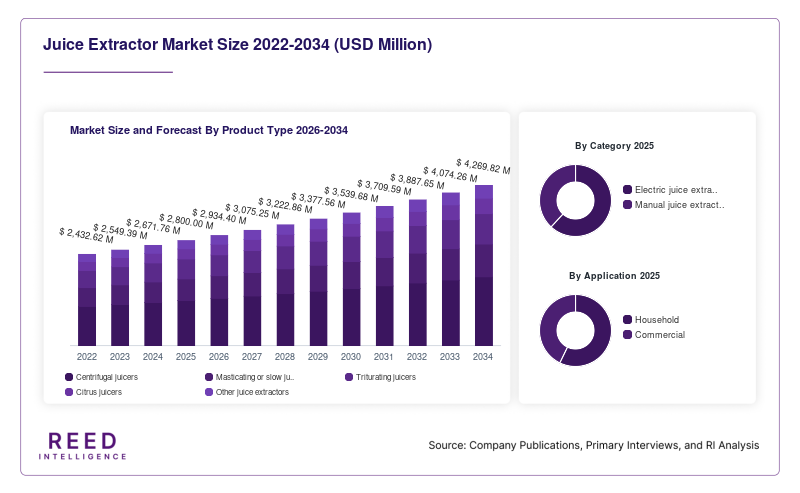
Centrifugal juicers are modeled at 42% of the 2025 market, equivalent to approximately USD 1,176 million. Their speed and generally accessible price points support their position as a mainstream product type. The category appeals to consumers who prioritize quick juice preparation and straightforward operation. Its commercial challenge is differentiation: manufacturers must balance price, extraction performance, noise, cleaning and product durability to avoid competing primarily on cost.
Masticating or slow juicers represent a modeled 35% of the 2025 market, equivalent to approximately USD 980 million. These products are commonly positioned around slow crushing or pressing, premium construction and features intended to improve the juicing experience. Their opportunity lies in consumers willing to pay for specialized performance and convenience, while the higher price and sometimes more involved cleaning process can constrain broader adoption.
Triturating juicers account for an internally allocated 8% of the 2025 market, or approximately USD 224 million. These machines typically use twin-gear mechanisms and occupy a more specialized part of the category. Their market depends on buyers who value specific extraction capabilities and are willing to accept higher prices or more involved maintenance. Because product definitions and classifications differ between sources, this share should be interpreted as a modeled category rather than a verified industry statistic.
Citrus juicers represent a modeled 10% of the 2025 market, equivalent to approximately USD 280 million. These products are used primarily for citrus fruits and can appeal to consumers seeking a simple, focused appliance. Manual presses and compact electric models serve different price points, while the narrow application limits their ability to replace a full-function juicer for consumers who want to process a broad range of fruits and vegetables.
Other juice extractors account for the remaining modeled 5% of the 2025 market, or approximately USD 140 million. This group includes specialized extraction designs that do not fit cleanly into the main categories. Demand depends on specific use cases, product availability and regional preferences. Its relatively small allocation reflects the specialized nature of these products within the overall category.
By Category
Electric juice extractors are modeled at 88% of the 2025 market, equivalent to approximately USD 2,464 million. Motorized extraction reduces manual effort and can improve convenience for consumers who prepare juice regularly or process larger quantities. The category includes centrifugal, slow and other electric models, with a wide range of prices and capabilities. Motor reliability, noise, power consumption and cleaning requirements remain important purchase considerations.
Manual juice extractors account for an internally allocated 12% of the 2025 market, or approximately USD 336 million. Manual models can offer a lower purchase price, compact storage and simple operation, particularly for citrus fruit and occasional use. Their limitations include the physical effort required and lower suitability for large-volume or repeated extraction. Demand is therefore linked to convenience needs, price sensitivity and the type of produce consumers intend to process.
By Application
Household applications represent a modeled 82% of the 2025 market, equivalent to approximately USD 2,296 million. Home users typically evaluate juicers on purchase price, ease of use, cleaning, storage footprint, noise and suitability for everyday recipes. Manufacturers can reach this segment through a tiered portfolio, from compact entry-level units to premium slow juicers. Actual use frequency remains an important constraint because consumers who rarely make juice may delay replacing an appliance or choose a lower-priced alternative.
Commercial applications account for an internal allocation of 18% of the 2025 market, or approximately USD 504 million. This segment includes juice bars, cafés, restaurants, hotels and other food-service operators. Demand depends on throughput, consistency, cleaning time, reliability and service availability. Commercial buyers may be willing to pay more for equipment that reduces downtime and labor requirements, but the economics vary by venue size and daily beverage volume.
By Distribution Channel
Online channels are modeled at 30% of the 2025 market, equivalent to approximately USD 840 million. Online marketplaces and brand-owned stores support product discovery, comparison of specifications and access to niche or premium models. Manufacturers can use demonstration videos, detailed product pages and reviews to explain differences between extraction methods. However, online sales also intensify price competition and make clear warranty and service information important.
Specialty stores represent a modeled 25% of the 2025 market, or approximately USD 700 million. These retailers can provide product demonstrations, explain extraction methods and help consumers compare models in person. Such assistance is particularly relevant for premium products with different mechanisms and cleaning requirements. The channel’s performance depends on store reach, knowledgeable staff, product availability and the ability to justify a higher price through product education.
Supermarkets and hypermarkets account for an internal allocation of 25% of the 2025 market, equivalent to approximately USD 700 million. These outlets can support purchases of mainstream appliances through broad consumer reach and competitive pricing. Their strength is accessibility; their limitation is that specialist product education may be more limited than in dedicated appliance stores.
Other channels represent the remaining modeled 20% of the 2025 market, or approximately USD 560 million. This group includes direct sales, department stores, smaller retailers and other distribution arrangements not captured in the main categories. The share is an analytical allocation and will vary with local retail structures, brand distribution agreements and the treatment of online sales by individual sources.
Regional Analysis
North America Juice Extractor Market
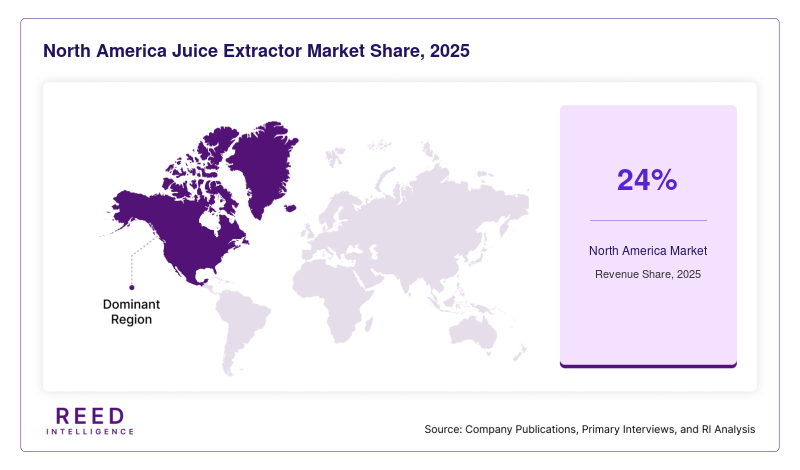
North America is modeled at 24% of the global market in 2025, equivalent to approximately USD 672 million. Its modeled share is 23% in 2034, representing approximately USD 989 million. The region offers an established consumer-appliance retail environment and demand for both entry-level and premium kitchen equipment. Buyers may compare extraction speed, cleanup effort, product durability and the convenience of preparing larger batches when selecting a juicer.
The market’s outlook depends on replacement purchases, premium appliance adoption and retailers’ ability to communicate product differences. E-commerce can support the discovery of specialized slow juicers, while physical retail remains useful for consumers who want to compare products before purchasing. However, juicers compete with blenders and ready-made beverages, and recurring demand depends on whether owners use their appliances frequently enough to justify replacement or upgrading.
Europe Juice Extractor Market
Europe is allocated a modeled 27% of the global market in 2025, or approximately USD 756 million. By 2034, its modeled share is 26%, equivalent to approximately USD 1,118 million. The region has a broad market for food-preparation appliances and a mix of premium and mainstream product offerings. In 2025, a European Commission Joint Research Centre preparatory study on repairability included food-preparation appliances such as juicers and examined factors affecting product repair and replacement. This work is relevant to the market because repair costs, spare-parts access and product lifetime can influence household purchasing decisions.
Regional demand depends on household purchasing power, appliance replacement cycles, retail access and consumer preferences for compact or premium products. Manufacturers may find opportunities in durable designs and accessible maintenance, but the commercial impact of repairability initiatives will depend on final policy requirements and how they are implemented across the relevant product categories.
Asia-Pacific Juice Extractor Market
Asia-Pacific is modeled at 30% of the global market in 2025, equivalent to approximately USD 840 million. Its modeled share increases to 32% by 2034, or approximately USD 1,376 million. The region includes diverse household appliance markets, from price-sensitive buyers seeking basic equipment to consumers interested in premium slow juicers and more convenient food-preparation products.
Demand depends on household appliance penetration, income levels, urban living patterns, retail infrastructure and the availability of products suited to local kitchens. In India, Euromonitor’s food-preparation appliance coverage identifies juice extractors as a category showing comparatively dynamic growth within the broader sector, while also noting the importance of multifunctionality and health-oriented product preferences. This provides directional evidence of category interest, but it does not establish a directly comparable regional market share.
Manufacturers seeking regional growth need appropriate price points, local distribution and service support. Product designs that are easy to clean and store may be commercially relevant in smaller kitchens, while premium products need to demonstrate benefits that justify their higher cost.
Middle East and Africa Juice Extractor Market
The Middle East and Africa region is modeled at 8% of the global market in 2025, representing approximately USD 224 million. Its modeled share is 9% by 2034, equivalent to approximately USD 387 million. Demand can arise from household appliance purchases as well as commercial users such as cafés, restaurants and hospitality operators. Market conditions vary widely across countries, and purchasing power, retail access and service coverage influence the mix of products sold.
Kuvings announced a Dubai Mall retail presence in June 2025 and described expansion efforts across several Middle Eastern markets. The company also highlighted the role of localized product offerings and in-person retail experiences in reaching consumers. This is an example of a brand’s distribution strategy, not proof of the region’s total market growth.
Regional opportunities depend on product affordability, reliable distribution and the availability of warranties and spare parts. Commercial prospects should be evaluated separately from household demand because hospitality and food-service operators have different requirements for throughput and equipment maintenance.
Latin America Juice Extractor Market
Latin America is allocated a modeled 11% of the global market in 2025, equivalent to approximately USD 308 million. By 2034, its modeled share is 10%, representing approximately USD 430 million. Demand depends on household appliance affordability, local retail networks and consumer interest in preparing fresh beverages at home. Entry-level products may be important in price-sensitive markets, while premium juicers can serve a narrower group of consumers willing to pay for specialized performance.
Manufacturers must account for exchange-rate movements, import costs, distribution margins and local service capabilities. These factors affect final retail prices and can change the competitive position of imported brands versus locally distributed or manufactured alternatives. A country-by-country assessment is necessary because retail structures, household purchasing power and commercial food-service demand vary considerably across the region.
Competitive Landscape
The Juice Extractor Market includes diversified household-appliance manufacturers and specialists focused on juicers and fresh-beverage equipment. Competition spans product price, extraction method, convenience, durability, distribution reach and after-sales support. Broad appliance brands can benefit from established retail relationships and brand recognition, while specialist manufacturers may differentiate through slow-juicing technology, large-capacity feeding systems or commercial-grade products.
Product development is increasingly focused on reducing the effort associated with everyday juicing. Hands-free loading, larger hoppers, easier cleaning and more compact designs can help manufacturers distinguish their products. These features are most commercially valuable when they address a recurring user problem. Premium positioning alone is not sufficient if consumers perceive the appliance as difficult to clean or unlikely to be used regularly.
Key Market Players
The following companies participate in juicers, juice extractors or related household and commercial food-preparation appliances. This is a representative list, not a ranking by market share.
Recent Market Developments
- September 2026, Kuvings reported showcasing its hands-free slow juicers at IFA 2026 in Berlin, including the AUTO10S, and highlighted continued efforts to reach international buyers and partners. The company’s product presentation emphasized convenience, larger-capacity ingredient handling and ease of use. Trade fairs can help specialist manufacturers demonstrate technical features to distributors and consumers, although exhibition activity alone does not establish sales growth.
- February 2026, Kuvings reported displaying its AUTO10S hands-free slow juicer at Ambiente 2026 in Frankfurt, with demonstrations focused on preparation convenience and product performance. The company also used the event to promote its broader kitchen-appliance portfolio. International trade events remain a route for premium appliance makers to engage distributors and showcase product design, but commercial impact depends on subsequent orders and distribution agreements.
Juice Extractor Market Segments
By Product Type
- Centrifugal juicers
- Masticating or slow juicers
- Triturating juicers
- Citrus juicers
- Other juice extractors
By Category
- Electric juice extractors
- Manual juice extractors
By Application
- Household
- Commercial
By Distribution Channel
- Online
- Specialty stores
- Supermarkets and hypermarkets
- Other channels
By Region
- North America
- Europe
- APAC
- Middle East and Africa
- LATAM