Kawasaki Disease Treatment Market Size, Share & Demand Report By Treatment Type (Intravenous Immunoglobulin (IVIG), Aspirin Therapy, Corticosteroids, Biologic Therapies), By Drug Class (Immunoglobulins, Anti-inflammatory Drugs, Biologics), By Route of Administration (Intravenous, Oral), By End-Use (Hospitals, Specialty Clinics, Ambulatory Surgical Centers), By Region & Segment Forecasts, 2026–2034
USD 3950
Market Overview
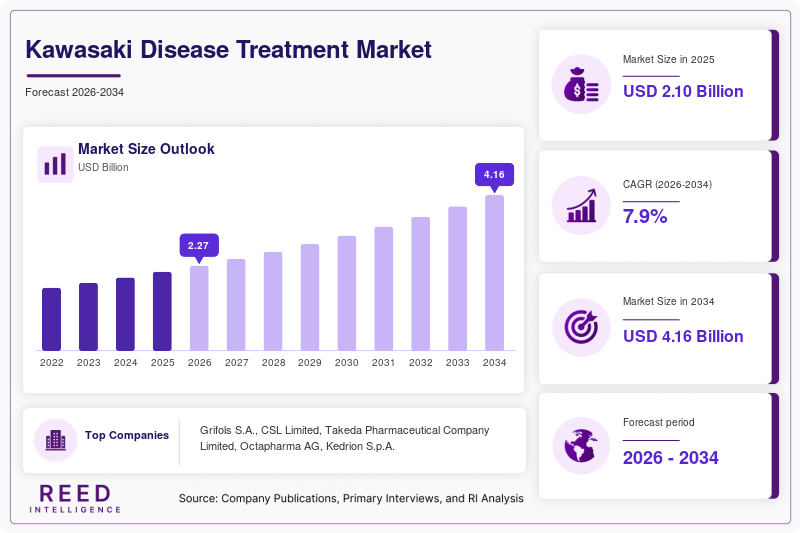
The global Kawasaki Disease Treatment Market size was valued at approximately USD 2.1 billion in 2026 and is projected to reach USD 3.9 billion by 2034, expanding at a compound annual growth rate (CAGR) of 7.9% during the forecast period (2026–2034). Kawasaki disease, a pediatric inflammatory condition affecting blood vessels, continues to require timely therapeutic intervention to prevent complications such as coronary artery aneurysms. The market growth is being supported by the increasing awareness of early diagnosis and treatment protocols across healthcare systems worldwide.
One of the primary global factors driving the Kawasaki Disease Treatment Market is the rising incidence of pediatric inflammatory diseases, particularly in emerging economies. Improvements in diagnostic capabilities, combined with better access to immunoglobulin therapies and supportive treatments, have significantly enhanced treatment outcomes. Governments and healthcare organizations are also promoting early screening programs, which further contribute to market expansion.
Key Highlights:
- North America dominated the market with a share of 38.5% in 2025, while Asia Pacific is expected to register the fastest CAGR of 9.2% during the forecast period.
- Intravenous immunoglobulin (IVIG) was the leading treatment type segment with a share of 54.3%, while biologics are projected to grow fastest at a CAGR of 10.1%.
- Hospitals accounted for the largest end-use segment with 62.7% share, whereas specialty clinics are expected to expand at a CAGR of 8.8%.
- The United States market was valued at USD 620 million in 2024 and reached USD 660 million in 2025.
Market Trends
Increasing Adoption of Biologic Therapies
The Kawasaki Disease Treatment Market is witnessing a gradual shift toward biologic therapies, particularly for patients who are resistant to first-line treatments such as intravenous immunoglobulin (IVIG). Biologics, including monoclonal antibodies targeting inflammatory pathways, are gaining traction due to their ability to modulate immune responses more precisely. Healthcare providers are increasingly incorporating these therapies into treatment protocols for refractory cases. This trend is supported by ongoing clinical research and growing physician confidence in targeted therapies, which is expected to reshape treatment paradigms over the forecast period.
Expansion of Pediatric Specialty Care Infrastructure
Another notable trend in the Kawasaki Disease Treatment Market is the expansion of pediatric specialty care centers and improved hospital infrastructure. Many countries are investing in dedicated pediatric cardiology units and advanced diagnostic tools to enhance early detection and management of Kawasaki disease. This infrastructure growth is enabling faster diagnosis and treatment initiation, which is critical in preventing long-term complications. Additionally, telemedicine and digital health platforms are facilitating better follow-up care and monitoring, especially in remote regions. These advancements are expected to contribute to consistent market growth and improved patient outcomes globally.
Market Drivers
Rising Incidence of Pediatric Inflammatory Disorders
The increasing prevalence of Kawasaki disease and related inflammatory conditions among children is a key driver of the Kawasaki Disease Treatment Market. Factors such as environmental triggers, genetic predisposition, and improved disease recognition are contributing to higher reported cases. Healthcare providers are prioritizing early intervention to reduce the risk of cardiovascular complications, thereby increasing the demand for effective treatment options such as IVIG and adjunct therapies.
Advancements in Diagnostic Techniques
Technological advancements in diagnostic tools are significantly influencing the growth of the Kawasaki Disease Treatment Market. Improved imaging techniques, laboratory biomarkers, and clinical guidelines have enhanced the accuracy and speed of diagnosis. Early detection allows timely administration of therapies, which improves treatment outcomes and reduces hospitalization duration. These advancements are particularly impactful in developed regions, where healthcare systems are equipped with advanced diagnostic infrastructure.
Market Restraint
High Cost of Treatment Therapies
One of the major restraints in the Kawasaki Disease Treatment Market is the high cost associated with treatment, particularly intravenous immunoglobulin (IVIG) therapy. IVIG remains the standard first-line treatment, but its high price can pose a financial burden on healthcare systems and patients, especially in low- and middle-income countries. The cost factor limits accessibility and may lead to delayed treatment in certain regions.
Additionally, biologic therapies, which are increasingly being used for resistant cases, are even more expensive, further exacerbating affordability challenges. Limited reimbursement policies in some countries also contribute to restricted access to advanced treatments. As a result, the overall growth potential of the market may be constrained in regions with limited healthcare funding. Addressing cost-related challenges through policy reforms and generic alternatives will be essential for sustained market expansion.
Market Opportunities
Development of Targeted Immunotherapies
The development of targeted immunotherapies presents a significant opportunity in the Kawasaki Disease Treatment Market. Research efforts are increasingly focused on identifying specific inflammatory pathways involved in the disease, enabling the development of precision therapies. These treatments have the potential to improve efficacy while reducing side effects, making them attractive options for both patients and healthcare providers. Pharmaceutical companies investing in R&D for biologics and novel immunomodulators are likely to gain a competitive edge in the market.
Growth in Emerging Healthcare Markets
Emerging economies offer substantial growth opportunities for the Kawasaki Disease Treatment Market. Countries in Asia Pacific, Latin America, and parts of Africa are witnessing improvements in healthcare infrastructure and increased government spending on pediatric care. Rising awareness about Kawasaki disease and better access to diagnostic facilities are expected to drive demand for treatment solutions in these regions. Market players can capitalize on these opportunities by expanding their presence and offering cost-effective treatment options tailored to local needs.
Segmental Analysis
By Treatment Type
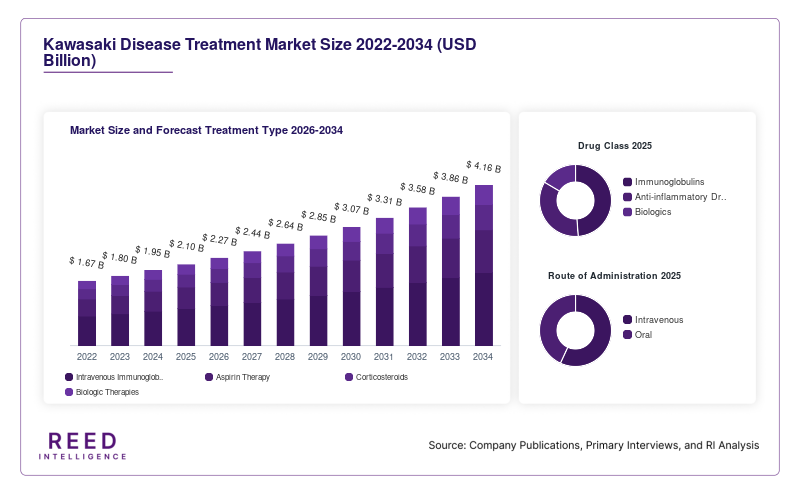
Intravenous immunoglobulin (IVIG) dominated the Kawasaki Disease Treatment Market in 2025, accounting for 54.3% of the total share. Its widespread use as the first-line treatment for Kawasaki disease has made it the standard of care.
Biologics are expected to be the fastest-growing segment, with a projected CAGR of 10.1%. Their ability to target specific inflammatory pathways will drive adoption, particularly in treatment-resistant cases.
By Drug Class
Immunoglobulins held the largest share of 51.7% in 2025 due to their effectiveness in reducing inflammation and preventing complications.
Corticosteroids are anticipated to grow at a CAGR of 8.6%, supported by their increasing use as adjunct therapy in severe cases.
By Route of Administration
The intravenous route dominated the market with a share of 68.9% in 2025, primarily due to the administration of IVIG therapy.
Oral administration is expected to grow at a CAGR of 7.4%, driven by the convenience of use and development of oral adjunct therapies.
By End-Use
Hospitals accounted for the largest share of 62.7% in 2025, as most Kawasaki disease treatments are administered in hospital settings.
Specialty clinics are projected to grow at a CAGR of 8.8%, owing to the increasing availability of specialized pediatric care centers.
Regional Analysis
North America
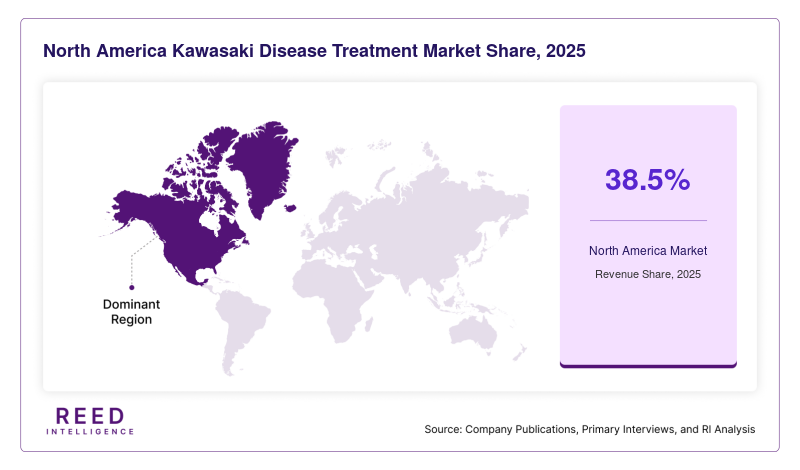
North America accounted for 38.5% of the Kawasaki Disease Treatment Market share in 2025 and is expected to grow at a CAGR of 6.8% during the forecast period. The region’s established healthcare infrastructure and high awareness levels contributed to its dominant position.
The United States emerged as the leading country due to its advanced pediatric healthcare system and widespread adoption of IVIG therapy. Strong insurance coverage and early diagnosis initiatives have played a crucial role in supporting market growth.
Europe
Europe held a market share of 27.2% in 2025 and is projected to grow at a CAGR of 7.1% from 2026 to 2034. The region has been characterized by well-developed healthcare systems and consistent research activities in pediatric diseases.
Germany dominated the European market due to its robust healthcare funding and emphasis on clinical research. Increased adoption of advanced treatment protocols has contributed to steady market expansion.
Asia Pacific
Asia Pacific captured 21.8% of the Kawasaki Disease Treatment Market share in 2025 and is expected to register the fastest CAGR of 9.2% during the forecast period. The region has experienced rapid growth due to increasing disease incidence and improving healthcare infrastructure.
Japan led the market in this region, driven by a higher prevalence of Kawasaki disease and strong government support for pediatric healthcare. Early diagnosis and treatment programs have significantly improved patient outcomes.
Middle East & Africa
The Middle East & Africa region held a market share of 6.5% in 2025 and is projected to grow at a CAGR of 7.5% during the forecast period. The region has been gradually improving its healthcare capabilities.
Saudi Arabia dominated the regional market due to increased healthcare investments and rising awareness about pediatric diseases. Government initiatives aimed at improving healthcare access have supported market growth.
Latin America
Latin America accounted for 6.0% of the Kawasaki Disease Treatment Market share in 2025 and is expected to grow at a CAGR of 7.8% from 2026 to 2034. The region has shown steady progress in healthcare development.
Brazil led the market due to its expanding healthcare infrastructure and increasing focus on pediatric care. Public health programs and awareness campaigns have contributed to improved diagnosis and treatment rates.
Competitive Landscape
The Kawasaki Disease Treatment Market is moderately competitive, with several established pharmaceutical companies and emerging players contributing to market growth. Key companies are focusing on expanding their product portfolios and investing in research and development to introduce advanced treatment options.
A leading player in the market is Grifols S.A., known for its strong presence in the immunoglobulin segment. The company has recently expanded its production capacity to meet the growing demand for IVIG therapies. Other major players are also focusing on strategic collaborations and product innovations to strengthen their market position. The competitive landscape is expected to evolve with the introduction of novel biologic therapies and increased investment in pediatric healthcare research.
Key Players List
- Grifols S.A.
- CSL Limited
- Takeda Pharmaceutical Company Limited
- Octapharma AG
- Kedrion S.p.A.
- Sanofi S.A.
- Pfizer Inc.
- F. Hoffmann-La Roche Ltd.
- Novartis AG
- Bayer AG
- Johnson & Johnson
- Amgen Inc.
- Biogen Inc.
- AbbVie Inc.
- AstraZeneca plc
Recent Developments
- 2025: Grifols S.A. expanded its IVIG manufacturing capacity to meet global demand.
- 2024: CSL Limited introduced an enhanced immunoglobulin formulation for pediatric use.
- 2025: Takeda Pharmaceutical Company strengthened its plasma-derived therapies portfolio.
- 2024: Octapharma AG invested in new research facilities focused on rare pediatric diseases.
- 2025: Kedrion S.p.A. entered strategic partnerships to expand distribution in emerging markets.
Kawasaki Disease Treatment Market Segments
Treatment Type
- Intravenous Immunoglobulin (IVIG)
- Aspirin Therapy
- Corticosteroids
- Biologic Therapies
Drug Class
- Immunoglobulins
- Anti-inflammatory Drugs
- Biologics
Route of Administration
- Intravenous
- Oral
End-Use
- Hospitals
- Specialty Clinics
- Ambulatory Surgical Centers
By Region
- North America
- Europe
- APAC
- Middle East and Africa
- LATAM