Keratoprosthesis Market Size, Share & Demand Report By Type (Boston Keratoprosthesis, Osteo-Odonto Keratoprosthesis, AlphaCor Keratoprosthesis), By Material (Polymers, Biological Materials, Hybrid Materials), By Application (Corneal Blindness, Graft Failure, Trauma Cases), By End-Use (Hospitals, Specialty Clinics, Ambulatory Surgical Centers), By Region & Segment Forecasts, 2025–2034
USD 3950
Market Overview
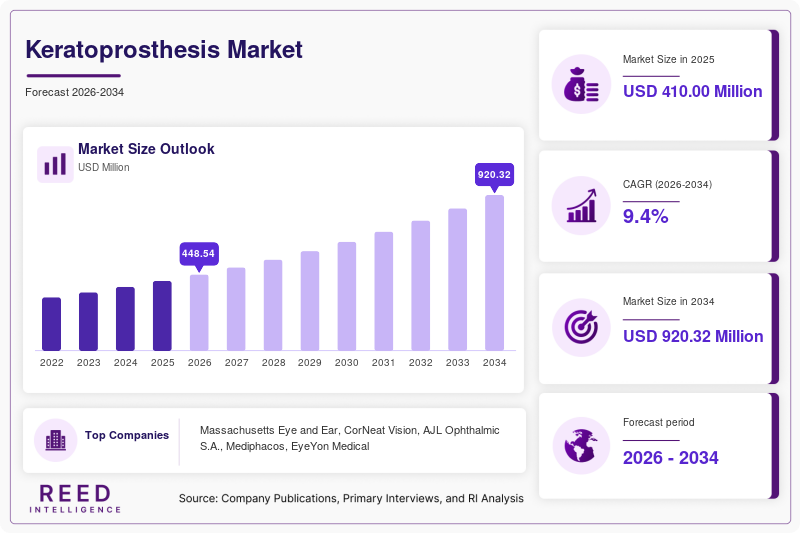
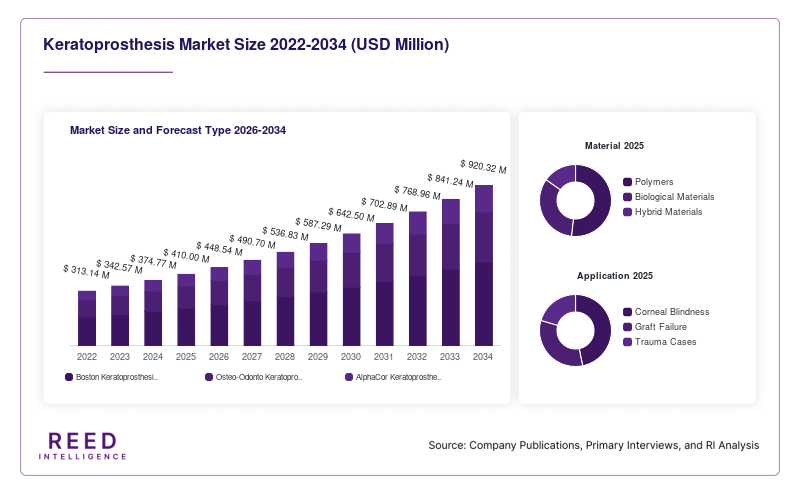
The global Keratoprosthesis Market size was estimated at USD 410 million in 2025 and is projected to reach approximately USD 920 million by 2034, expanding at a CAGR of 9.4% during the forecast period (2025–2034). The market reflects steady growth driven by increasing cases of corneal blindness, particularly among patients unsuitable for traditional corneal transplantation procedures. Keratoprosthesis devices, also known as artificial corneas, are gaining traction as a viable solution in cases of graft failure, severe ocular surface disease, and chemical injuries.
One major global factor supporting market growth is the rising burden of visual impairment due to aging populations and chronic ocular diseases. As the prevalence of corneal disorders continues to increase globally, healthcare systems are investing in advanced ophthalmic interventions, including keratoprosthesis implants, thereby supporting market expansion.
Key Highlights
- North America dominated the market with a 38.5% share in 2025, while Asia Pacific is projected to register the fastest CAGR of 11.2% through 2034.
- By type, Boston Keratoprosthesis held the largest share (52.3%), whereas osteo-odonto keratoprosthesis is expected to grow at the fastest CAGR of 10.8%.
- By application, corneal blindness treatment led with 61.4% share, while graft failure cases are projected to grow at 10.5% CAGR.
- The U.S. market was valued at USD 132 million in 2025 and is expected to reach USD 142 million in 2026.
Market Trends
Advancements in Biomaterial Engineering
The Keratoprosthesis Market is witnessing significant advancements in biomaterials used for artificial corneas. Innovations such as biocompatible polymers and hybrid materials are improving device integration with ocular tissues. These developments reduce complications like inflammation and extrusion, thereby enhancing clinical outcomes. Manufacturers are increasingly focusing on long-term implant stability, which is encouraging surgeons to adopt keratoprosthesis procedures more frequently.
Increasing Adoption of Minimally Invasive Ophthalmic Procedures
A shift toward minimally invasive surgical approaches is shaping the Keratoprosthesis Market. Surgeons are adopting refined implantation techniques that reduce recovery time and improve visual outcomes. These advancements are particularly beneficial for high-risk patients who are not suitable candidates for traditional corneal transplants. The growing emphasis on outpatient surgical procedures is also supporting demand, as it reduces hospitalization costs and increases accessibility to advanced eye care treatments.
Market Drivers
Rising Prevalence of Corneal Blindness
The increasing incidence of corneal blindness worldwide is a primary driver of the Keratoprosthesis Market. Conditions such as keratitis, trauma, and genetic disorders contribute significantly to vision loss. In many cases where donor corneas are unavailable or transplantation fails, keratoprosthesis serves as an effective alternative, driving its demand.
Limited Availability of Donor Corneas
The shortage of donor corneas globally is another key factor accelerating market growth. Eye banks in several regions face supply constraints, leading to long waiting periods for corneal transplantation. This gap has encouraged healthcare providers to adopt artificial cornea solutions, positioning keratoprosthesis as a critical option in advanced ophthalmic care.
Market Restraint
Post-Surgical Complications and High Costs
One of the major challenges in the Keratoprosthesis Market is the risk of post-surgical complications, including infection, glaucoma, and device extrusion. These complications necessitate continuous follow-up care and monitoring, which can burden both patients and healthcare providers. Additionally, the high cost of keratoprosthesis devices and associated surgical procedures limits accessibility, particularly in low- and middle-income countries. The requirement for specialized surgical expertise further restricts widespread adoption. These factors collectively hinder the market’s growth potential despite increasing demand.
Market Opportunities
Expansion in Emerging Markets
Emerging economies present a significant opportunity for the Keratoprosthesis Market. Increasing healthcare expenditure, improving medical infrastructure, and growing awareness about advanced ophthalmic treatments are driving demand in these regions. Governments and non-profit organizations are also investing in eye care programs, creating favorable conditions for market expansion.
Integration of Digital Monitoring Technologies
The integration of digital health technologies with keratoprosthesis devices offers new growth avenues. Smart implants and remote monitoring systems can help track post-operative outcomes and detect complications early. This advancement enhances patient safety and improves long-term success rates, making keratoprosthesis a more reliable treatment option.
Segmental Analysis
By Type
The Boston Keratoprosthesis segment dominated the Keratoprosthesis Market in 2025, accounting for 52.3% of the total share. Its widespread adoption was attributed to its proven clinical outcomes, ease of implantation, and strong acceptance among ophthalmologists. The device has been extensively used for treating severe corneal blindness cases, making it the preferred choice in many healthcare settings.
The osteo-odonto keratoprosthesis segment is expected to grow at the fastest CAGR of 10.8% during the forecast period. This growth will be driven by its suitability for patients with severe ocular surface diseases where conventional options are ineffective. Its unique approach, using a patient’s own tooth and bone structure, offers improved biocompatibility and long-term stability.
By Material
Polymers dominated the material segment with a 48.6% share in 2025 due to their flexibility, durability, and biocompatibility. These materials have been widely used in manufacturing keratoprosthesis devices, contributing to better surgical outcomes and reduced complications.
Biological materials are projected to grow at a CAGR of 10.2% during the forecast period. Their ability to integrate naturally with human tissue and reduce immune response is expected to drive adoption. Ongoing research in bioengineered corneas will further support segment growth.
By Application
Corneal blindness treatment held the largest share of 61.4% in 2025, driven by the high prevalence of vision impairment caused by corneal diseases. The increasing demand for effective treatment options in cases where transplantation fails contributed to the segment’s dominance.
Graft failure cases are expected to grow at a CAGR of 10.5% during the forecast period. The rising number of unsuccessful corneal transplants is creating demand for alternative solutions, positioning keratoprosthesis as a preferred option.
By End-Use
Hospitals dominated the end-use segment with a 55.2% share in 2025. The availability of advanced surgical facilities and skilled professionals contributed to their leading position. Hospitals also handle a large volume of complex cases, supporting higher adoption of keratoprosthesis procedures.
Specialty ophthalmic clinics are expected to grow at a CAGR of 10.7% during the forecast period. These clinics offer specialized care and personalized treatment plans, attracting patients seeking advanced vision restoration solutions.
Regional Analysis
North America
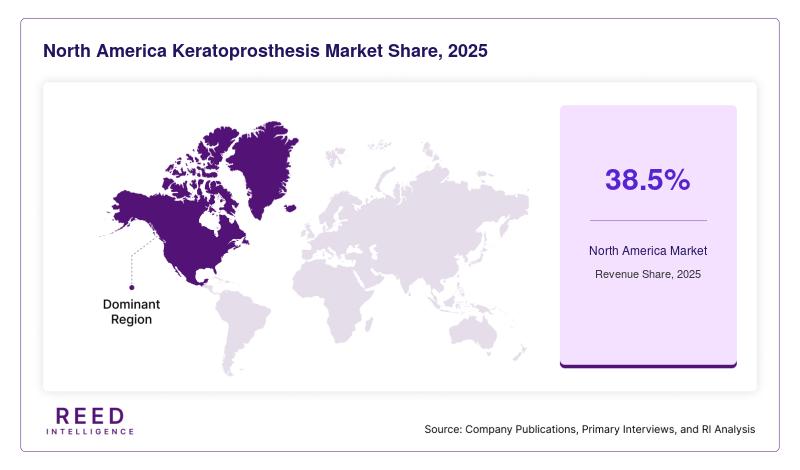
North America accounted for 38.5% of the Keratoprosthesis Market share in 2025 and is expected to grow at a CAGR of 8.7% during the forecast period. The region’s dominance was supported by advanced healthcare infrastructure, high adoption of innovative medical technologies, and strong presence of leading ophthalmic device manufacturers. Favorable reimbursement policies and increasing investment in research also contributed to market growth.
The United States remained the dominant country in this region due to its well-established ophthalmology sector and high prevalence of corneal disorders. The availability of skilled surgeons and early adoption of advanced keratoprosthesis systems further strengthened the market. Continuous innovation and clinical research activities are expected to sustain growth in the coming years.
Europe
Europe held a significant share of 27.2% in 2025 and is projected to expand at a CAGR of 8.9% through 2034. The region benefited from a strong healthcare system and increasing focus on advanced surgical treatments. Government initiatives aimed at reducing blindness rates supported the adoption of keratoprosthesis procedures.
Germany emerged as the leading country in Europe due to its robust medical device industry and emphasis on clinical research. The presence of specialized ophthalmology centers and growing awareness among patients contributed to market expansion. Increased funding for healthcare innovation is expected to further drive growth.
Asia Pacific
Asia Pacific accounted for 19.8% of the market in 2025 and is anticipated to register the fastest CAGR of 11.2% during the forecast period. Rapid urbanization, improving healthcare infrastructure, and rising awareness about advanced treatments are key factors driving growth in this region.
China dominated the Asia Pacific market due to its large patient pool and increasing investments in healthcare facilities. The growing burden of eye diseases and expanding access to specialized care are expected to boost demand for keratoprosthesis devices. Government initiatives to improve eye health are also contributing to market growth.
Middle East & Africa
The Middle East & Africa region held a 7.1% share in 2025 and is projected to grow at a CAGR of 9.1% over the forecast period. The market is gradually expanding due to increasing healthcare investments and improving access to ophthalmic care.
Saudi Arabia emerged as the dominant country in this region due to its expanding healthcare infrastructure and rising focus on advanced medical treatments. The growing prevalence of vision disorders and government support for healthcare modernization are expected to drive market growth.
Latin America
Latin America accounted for 7.4% of the Keratoprosthesis Market in 2025 and is expected to grow at a CAGR of 9.3% through 2034. The region is experiencing steady growth due to improving healthcare access and increasing awareness about vision restoration treatments.
Brazil dominated the regional market due to its large population and expanding healthcare services. Increasing adoption of advanced surgical procedures and growing investments in medical technology are expected to support market growth in the coming years.
Competitive Landscape
The Keratoprosthesis Market is moderately consolidated, with key players focusing on product innovation, clinical research, and strategic collaborations. The market leader, Massachusetts Eye and Ear, has maintained a strong position through its Boston Keratoprosthesis product line and continuous advancements in device design. The company recently introduced improvements aimed at enhancing long-term implant stability and reducing complications.
Other prominent players are investing in research and development to improve device performance and expand their product portfolios. Partnerships with healthcare institutions and academic organizations are also common strategies to strengthen market presence. The competitive environment is characterized by technological innovation and a focus on improving patient outcomes.
Key Players List
- Massachusetts Eye and Ear
- CorNeat Vision
- AJL Ophthalmic S.A.
- Mediphacos
- Optics Medical
- EyeYon Medical
- DIOPTEX GmbH
- Aurolab
- LinkoCare Life Sciences
- VisionCare Inc.
- HumanOptics AG
- Keramed Inc.
- Reper NN
- FCI Ophthalmics
- Polytech Domilens
Recent Developments
- 2024: CorNeat Vision introduced a synthetic cornea implant with enhanced integration capabilities.
- 2024: Aurolab expanded its ophthalmic device portfolio to include advanced keratoprosthesis solutions.
- 2023: EyeYon Medical launched a new artificial cornea system targeting minimally invasive procedures.
- 2023: AJL Ophthalmic S.A. strengthened its distribution network across Europe and Latin America.
- 2023: Mediphacos announced clinical trials for next-generation keratoprosthesis materials.
Keratoprosthesis Market Segments
Type
- Boston Keratoprosthesis
- Osteo-Odonto Keratoprosthesis
- AlphaCor Keratoprosthesis
Material
- Polymers
- Biological Materials
- Hybrid Materials
Application
- Corneal Blindness
- Graft Failure
- Trauma Cases
End-Use
- Hospitals
- Specialty Clinics
- Ambulatory Surgical Centers
By Region
- North America
- Europe
- APAC
- Middle East and Africa
- LATAM