Kitchen Towel Market Size, Share & Trends Analysis Report by Product Type, Material, Distribution Channel, End User, and Region, Forecasts, 2026–2034
USD 3950
Kitchen Towel Market Size
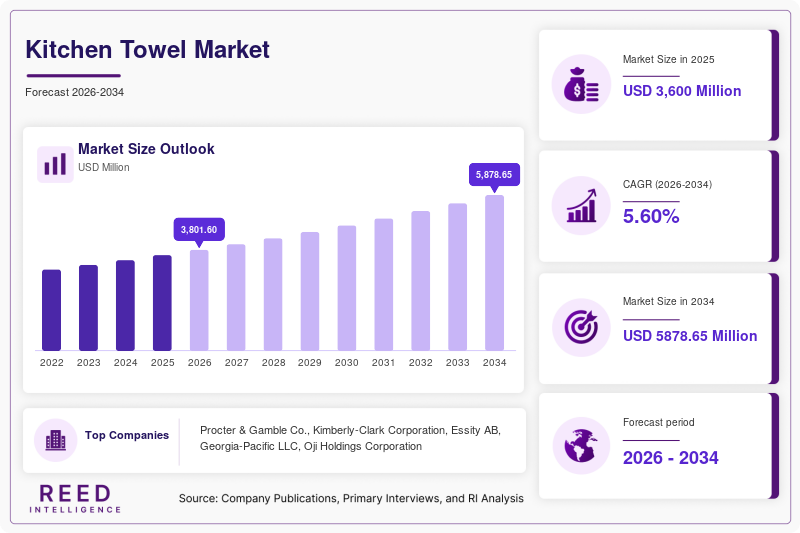
The global kitchen towel market size was valued at USD 3,600 million in 2025 and is projected to grow from USD 3,801.60 million in 2026 to USD 5,878.65 million by 2034, registering a CAGR of 5.60% during the forecast period from 2026 to 2034.
The kitchen towel market comprises reusable and disposable towels used for drying dishes, wiping kitchen surfaces, handling cookware, absorbing spills, and maintaining hygiene in residential and commercial kitchens. Products include cotton towels, microfiber towels, linen towels, paper kitchen towels, and other absorbent textile or paper-based alternatives. Demand is influenced by household consumption, food preparation practices, hospitality operations, cleaning routines, product durability, absorbency, and convenience.
The market serves a broad customer base, including households, restaurants, hotels, catering businesses, institutional kitchens, and food-service establishments. Reusable fabric towels appeal to consumers seeking durability, washability, and reduced reliance on single-use products, while disposable paper towels are used where quick cleanup and convenient disposal are priorities. Manufacturers compete through material quality, absorbency, softness, lint control, durability, design, pack size, pricing, and product availability.
Kitchen Towel Market Drivers
Rising focus on kitchen hygiene: Greater attention to cleaning surfaces, drying utensils, and managing spills supports regular demand for absorbent kitchen towels across residential and commercial environments.
Expansion of food-service operations: Restaurants, cafés, hotels, catering providers, and institutional kitchens require cleaning and drying supplies for daily operations. Their recurring procurement needs support demand for reusable textiles and disposable paper towels.
Growth in household spending on home products: Kitchen textiles serve practical and decorative purposes, allowing manufacturers to reach consumers through everyday utility products, coordinated kitchen accessories, and premium home-linen collections.
Wider retail availability: Supermarkets, household-goods retailers, convenience stores, and e-commerce platforms increase product accessibility and allow consumers to choose among materials, designs, pack sizes, and price points.
Kitchen Towel Market Restraints
Competition from substitute cleaning products: Cleaning cloths, sponges, wipes, dish-drying racks, and other household products can substitute for kitchen towels in selected applications, limiting demand in some use cases.
Raw-material and manufacturing cost fluctuations: Cotton, pulp, energy, water, processing, packaging, and transportation costs can affect manufacturing expenses and retail pricing. Cost volatility may pressure margins or reduce demand for premium products.
Environmental concerns: Disposable paper towels generate recurring waste, while reusable textiles require water, detergents, and energy for laundering. These considerations can influence purchasing preferences and increase expectations for responsible material sourcing.
Quality and durability concerns: Low absorbency, linting, odor retention, color fading, and fabric deterioration can reduce consumer satisfaction and repeat purchases. Manufacturers must balance price, performance, and durability.
Kitchen Towel MarketOpportunities
Development of eco-conscious product ranges: Recycled fibers, responsibly sourced cotton, alternative plant-based materials, and reduced-packaging formats offer opportunities for brands responding to sustainability concerns.
Expansion of online and direct-to-consumer sales: Digital channels enable targeted product discovery, multipack sales, customer feedback collection, and access to specialized consumer groups.
Commercial and institutional supply contracts: Restaurants, hospitality operators, caterers, and institutional kitchens create opportunities for bulk packs, standardized product specifications, and recurring procurement arrangements.
Premium and differentiated product designs: Quick-drying fabrics, high-absorbency construction, attractive prints, coordinated sets, and durable reusable formats can help manufacturers distinguish products in competitive retail markets.
Kitchen Towel Market Segmental Analysis
By Product Type
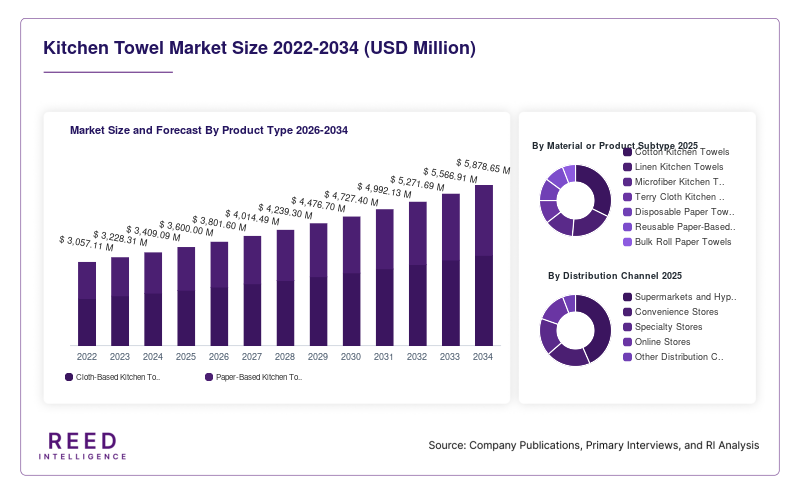
Cloth-based and paper-based kitchen towels serve different consumer priorities. Cloth-based towels are reusable, washable, and available in multiple fabrics and designs. They are suitable for drying dishes, wiping surfaces, and general kitchen tasks. Paper-based towels provide convenient disposal and are commonly used for spills, quick cleaning, and applications where users prefer not to reuse a towel.
Cloth-based kitchen towels are identified as a leading product category in some published market assessments, while other market studies identify paper-based products as the leading segment. The dominant category therefore depends on market definition, product coverage, and geographic scope. A precise global market-share percentage and a comparable segment-specific CAGR could not be independently established from the available evidence.
By Material or Product Subtype
Cotton towels are widely used because of their absorbency, washability, and versatility. Terry cloth offers a textured construction suitable for absorbing moisture, while linen is valued for its texture and kitchen-linen appearance. Microfiber products appeal to buyers seeking lightweight cleaning materials and surface-wiping performance. Paper-based products compete through convenience, absorbency, packaging formats, and availability in single-use or bulk-roll configurations.
Demand opportunities differ by application. Households may prioritize comfort, design, durability, and cost per use, whereas commercial buyers often consider procurement cost, supply consistency, and cleaning requirements. Eco-conscious products and high-performance materials offer differentiation opportunities, but a reliable numerical ranking of individual material subsegments by share or CAGR is not available.
By Distribution Channel
Supermarkets and hypermarkets provide broad product assortment, physical inspection, multipack options, and access to established household brands. Convenience stores support immediate and smaller-volume purchases, while specialty stores can offer premium textiles, kitchen accessories, and coordinated home-linen products.
Online stores enable consumers to compare specifications, reviews, pack sizes, and prices. They also help emerging brands reach customers without relying exclusively on physical retail networks. Supermarkets and hypermarkets are identified as a leading channel in some published market assessments; however, exact channel shares and channel-specific CAGRs are not consistently available across sources.
By End-User
The residential segment includes households purchasing towels for dish drying, spill cleanup, food preparation, and routine surface cleaning. Buying decisions are shaped by absorbency, washability, appearance, price, and the preference for reusable or disposable formats. Pack sizes and coordinated designs can influence purchase frequency and brand selection.
The commercial segment includes restaurants, cafés, hotels, caterers, institutional kitchens, and other food-service operations. These buyers may require larger quantities, dependable replenishment, consistent product specifications, and solutions suited to their cleaning procedures. Commercial demand is supported by recurring operational use, although purchasing volumes vary with business activity and the cleaning practices adopted by individual establishments.
Kitchen Towel Market Regional Analysis
North America Kitchen Towel Market
North America represents an established kitchen towel market, supported by household cleaning routines, organized retail networks, and demand from restaurants, hotels, and institutional food-service operators. Consumers can choose among disposable paper towels, reusable fabric towels, multipacks, and premium kitchen textiles. Supermarkets, warehouse retailers, specialty stores, and e-commerce platforms support product availability across different price categories.
Market opportunities include reusable kitchen towels, recycled-fiber paper products, premium designs, and bulk formats for commercial customers. Private-label competition and alternative cleaning products influence pricing and brand differentiation. A reliable regional market-share percentage and forecast CAGR for North America could not be confirmed from comparable sources.
Europe Kitchen Towel Market
Europe accounted for approximately 22.4% of global kitchen towel market revenue in 2025, according to Dataintelo. Demand is supported by household cleaning practices, hospitality operations, and established retail networks. Consumers purchase reusable cotton, linen, and other fabric towels alongside disposable paper towels, with product selection influenced by absorbency, durability, design, and environmental considerations.
Opportunities include reusable towel collections, responsibly sourced materials, premium designs, and products for commercial kitchens. Retailers and manufacturers must also address price competition and differing consumer preferences across countries. A comparable regional CAGR for Europe was not available in the cited source, so a numerical forecast rate cannot be stated reliably.
Asia Pacific Kitchen Towel Market
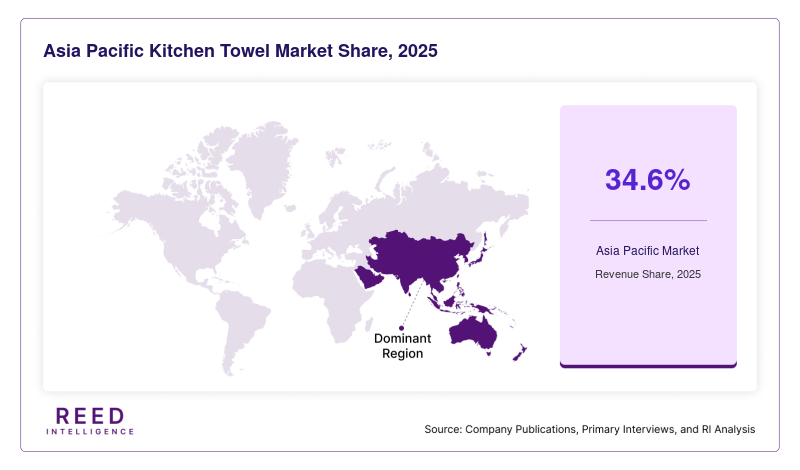
Asia Pacific was the dominant region, accounting for 34.6% of global kitchen towel market revenue in 2025. Dataintelo estimates the region's market at approximately USD 7.75 billion that year. Its position is associated with a large consumer base, urbanization, rising disposable incomes, expanding retail access, and demand from hospitality and food-service businesses. China, India, Japan, South Korea, and Southeast Asian economies contribute to regional demand.
Latin America Kitchen Towel Market
Latin America accounted for approximately 8.7% of global kitchen towel market revenue in 2025, according to Dataintelo. Brazil and Mexico are identified as major demand centers. Household cleaning needs, retail availability, and demand from restaurants, hotels, and catering businesses support consumption of both reusable fabric towels and disposable paper products.
Middle East & Africa Kitchen Towel Market
The Middle East & Africa region represented approximately 6.5% of global kitchen towel market revenue in 2025, based on Dataintelo's regional estimates. Demand varies across countries and is influenced by household consumption, hospitality activity, food-service operations, purchasing power, and the availability of imported and locally distributed products. Gulf Cooperation Council markets contribute to demand for premium products, while other markets offer opportunities as retail access develops.
North America Kitchen Towel Market
North America accounted for approximately 27.8% of global kitchen towel market revenue in 2025, making it the second-largest region in Dataintelo's estimates. Demand is supported by established household cleaning practices, broad retail availability, and purchases by restaurants, hotels, and institutional food-service operators. Consumers can choose from disposable paper towels, reusable fabric towels, multipacks, and premium kitchen textiles.
Competitive Landscape Kitchen Towel Market
The kitchen towel market is fragmented across paper-tissue manufacturers, household paper-product brands, textile producers, private-label suppliers, and specialist kitchen-linen businesses. Competition varies between disposable paper towels and reusable cloth-based products. Paper-towel suppliers compete through absorbency, sheet strength, roll size, dispensing compatibility, packaging, and price, while reusable-towel manufacturers emphasize material quality, durability, design, ease of laundering, and product versatility.
Companies seek to differentiate their products through material innovation, brand recognition, retail relationships, online availability, and commercial supply capabilities. Private-label products can intensify price competition, particularly in everyday-use categories. In reusable textiles, coordinated designs and premium materials can help establish distinct product positioning. In paper-based products, production efficiency, fiber sourcing, product performance, and distribution scale remain relevant competitive factors.
Key Market Players
- Procter & Gamble Co.
- Kimberly-Clark Corporation
- Essity AB
- Georgia-Pacific LLC
- Oji Holdings Corporation
- Sofidel Group
- Metsä Tissue
- WEPA Group
- Cascades Inc.
- Kruger Products Inc.
Kitchen Towel Market Recent Developments
May, 2026 - Sellars introduces Bravo paper towels made with 75% recycled materials: Sellars announced that its Bravo paper towels, available through Target stores and Target.com in the United States, are made from 75% curbside-recycled paper and cardboard. The company highlighted absorbency and scrubbing strength alongside recycled-fiber content. This development demonstrates product differentiation through recycled materials and functional performance in the disposable paper-towel category.
October, 2026 - Daio Paper launches reusable, heat-resistant kitchen towel: Daio Paper announced the nationwide launch of its Elleair Cho Kyushu Kitchen Towel Tough Towel 2WAY Type, designed for repeated washing and use, with approximately 10 times the strength of its conventional kitchen towel and heat resistance for selected cooking applications. The product uses pulp and lyocell nonwoven material and features a package that supports countertop placement or hanging. This launch reflects product innovation focused on durability, versatility, and convenience.
Kitchen Towel Market Segments
By Product Type
- Cloth-Based Kitchen Towels
- Paper-Based Kitchen Towels
By Material or Product Subtype
- Cotton Kitchen Towels
- Linen Kitchen Towels
- Microfiber Kitchen Towels
- Terry Cloth Kitchen Towels
- Disposable Paper Towels
- Reusable Paper-Based Towels
- Bulk Roll Paper Towels
By Distribution Channel
- Supermarkets and Hypermarkets
- Convenience Stores
- Specialty Stores
- Online Stores
- Other Distribution Channels
By End-User
- Residential
- Commercial
By Region
- North America
- Europe
- APAC
- Middle East and Africa
- LATAM