Knee Cartilage Repair Market Size, Share & Demand Report By Treatment Type (Cell-Based Cartilage Repair, Non-Cell-Based Cartilage Repair, Tissue Scaffolds), By Application (Hyaline Cartilage Repair, Fibrocartilage Repair), By End-Use (Hospitals, Ambulatory Surgical Centers, Specialty Clinics), By Material Type (Natural Biomaterials, Synthetic Biomaterials), By Region & Segment Forecasts, 2026–2034
USD 3950
Market Overview
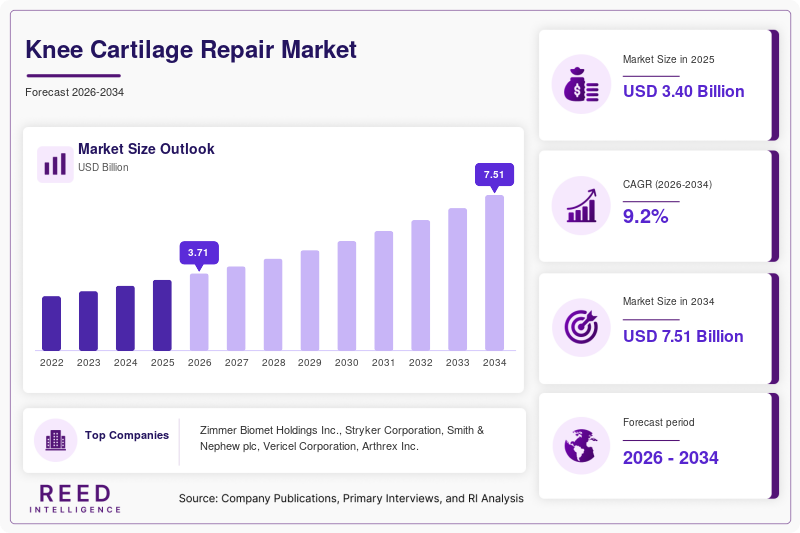
The global Knee Cartilage Repair Market size was valued at approximately USD 3.4 billion in 2026 and is projected to reach USD 6.9 billion by 2034, expanding at a CAGR of 9.2% during the forecast period (2026–2034). The market growth is being supported by the increasing global incidence of knee-related disorders, particularly osteoarthritis and sports injuries, which continue to drive demand for advanced cartilage restoration solutions.
One of the primary global factors contributing to the expansion of the Knee Cartilage Repair Market is the growing aging population, which is more susceptible to cartilage degeneration. In addition, improved access to orthopedic procedures and rising healthcare expenditure across developed and emerging economies have further strengthened the market outlook.
Key Highlights
- North America dominated the market with a share of 38.6% in 2025, while Asia Pacific is expected to register the fastest CAGR of 11.3% during the forecast period.
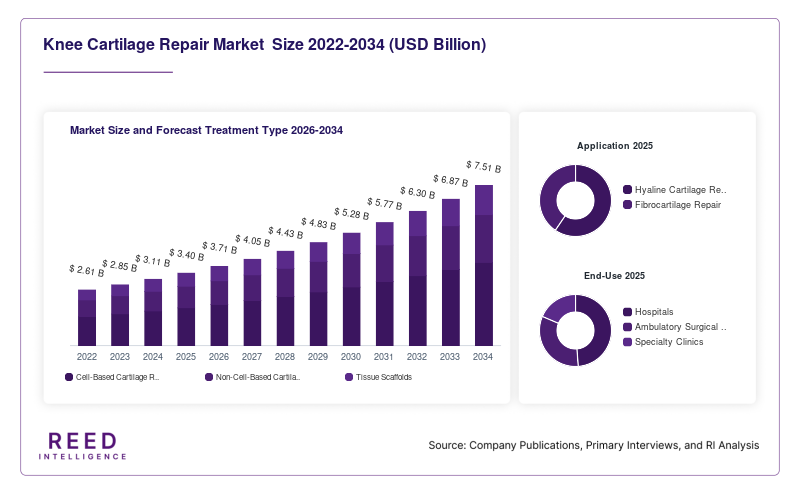
- By treatment type, cell-based cartilage repair held the largest share of 41.2% in 2025, while tissue scaffolds are projected to grow at a CAGR of 10.5%.
- By application, hyaline cartilage repair dominated with 47.8% share, whereas fibrocartilage repair is anticipated to grow at a CAGR of 9.8%.
- The U.S. Knee Cartilage Repair Market was valued at USD 1.1 billion in 2024 and reached USD 1.2 billion in 2025, reflecting steady demand growth.
Market Trends
Adoption of Minimally Invasive Procedures
A notable trend in the Knee Cartilage Repair Market is the increasing preference for minimally invasive surgical procedures such as arthroscopy. These procedures reduce hospital stay, lower complication risks, and accelerate recovery time. Healthcare providers are shifting toward these techniques to improve patient outcomes and reduce operational costs, thereby boosting adoption across both developed and emerging regions.
Integration of Regenerative Medicine Technologies
Another significant trend shaping the market is the integration of regenerative medicine approaches, including stem cell therapy and biomaterial-based scaffolds. These technologies focus on restoring natural cartilage function rather than replacing it. Continuous advancements in biologics and tissue engineering are expected to redefine treatment protocols and expand the application scope of cartilage repair solutions.
Market Drivers
Rising Prevalence of Osteoarthritis and Sports Injuries
The increasing burden of osteoarthritis and sports-related knee injuries is a key driver of the Knee Cartilage Repair Market. Sedentary lifestyles, obesity, and higher participation in sports activities have led to a surge in cartilage damage cases. This has created sustained demand for effective repair procedures, especially among younger and active populations.
Technological Advancements in Orthopedic Treatments
Technological innovation in orthopedic devices and procedures is significantly contributing to market growth. The development of advanced biomaterials, 3D-printed scaffolds, and cell-based therapies has enhanced the efficiency and durability of cartilage repair treatments. These advancements are improving clinical success rates, thereby encouraging wider adoption.
Market Restraint
High Cost of Treatment Procedures
One of the major restraints in the Knee Cartilage Repair Market is the high cost associated with advanced procedures such as autologous chondrocyte implantation and stem cell therapies. Limited reimbursement coverage in certain regions further restricts patient access, particularly in low- and middle-income countries.
Market Opportunities
Expansion in Emerging Healthcare Markets
Emerging economies present significant growth opportunities for the Knee Cartilage Repair Market due to improving healthcare infrastructure and increasing awareness about advanced treatment options. Governments in these regions are investing in healthcare modernization, which is expected to facilitate market penetration.
Growing Demand for Personalized Medicine
The rising focus on personalized medicine is opening new avenues in cartilage repair. Customized implants and patient-specific treatment approaches are gaining traction. This trend is expected to enhance treatment outcomes and create new revenue streams for market players.
Segmental Analysis
By Treatment Type
The Knee Cartilage Repair Market is segmented into cell-based cartilage repair, non-cell-based cartilage repair, and tissue scaffolds.
- Cell-based cartilage repair dominated the market with a 41.2% share in 2025, due to its effectiveness in restoring cartilage function and long-term clinical benefits.
- Tissue scaffolds are expected to be the fastest-growing segment, registering a CAGR of 10.5%, driven by their ability to support natural tissue regeneration and compatibility with advanced biomaterials.
By Application
The market is segmented into hyaline cartilage repair and fibrocartilage repair.
- Hyaline cartilage repair accounted for the largest share of 47.8% in 2025, owing to its critical role in maintaining joint function and mobility.
- Fibrocartilage repair is projected to grow at a CAGR of 9.8%, supported by increasing use in less severe cartilage damage cases and cost-effective treatment options.
By End-Use
The Knee Cartilage Repair Market includes hospitals, ambulatory surgical centers, and specialty clinics.
- Hospitals dominated with a 52.6% share in 2025, due to the availability of advanced surgical infrastructure and skilled professionals.
- Ambulatory surgical centers are expected to grow at a CAGR of 10.1%, driven by shorter procedure times and lower treatment costs.
By Material Type
The market is categorized into natural biomaterials and synthetic biomaterials.
- Natural biomaterials held the largest share of 55.3% in 2025, due to better biocompatibility and reduced risk of adverse reactions.
- Synthetic biomaterials are projected to grow at a CAGR of 9.7%, supported by innovations in polymer technology and durability.
Regional Analysis
North America
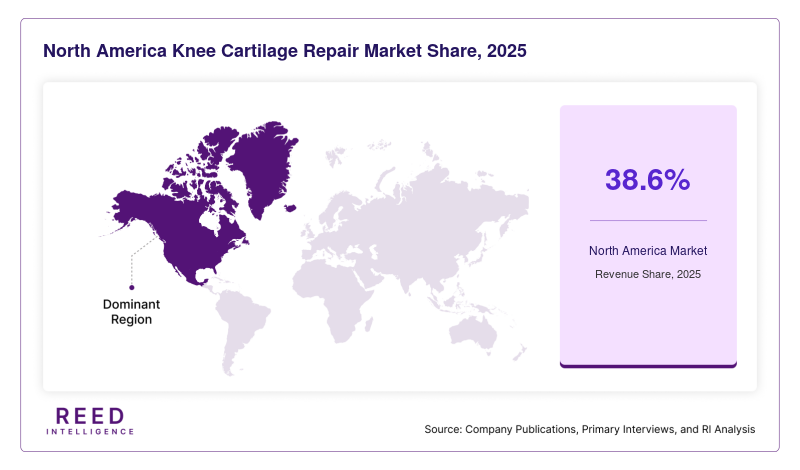
North America accounted for 38.6% of the Knee Cartilage Repair Market share in 2025 and is expected to grow at a CAGR of 8.7% during the forecast period. The United States dominated the region due to advanced healthcare infrastructure and high adoption of innovative orthopedic procedures. The presence of skilled surgeons and strong reimbursement systems contributed to sustained market demand.
Europe
Europe held a 27.4% share in 2025 and will grow at a CAGR of 8.9%. Germany emerged as the leading country, supported by a strong focus on research and development in regenerative medicine. Increasing awareness about early diagnosis and treatment of cartilage damage has further supported market expansion in the region.
Asia Pacific
Asia Pacific captured 19.8% market share in 2025 and is projected to grow at the fastest CAGR of 11.3%. China dominated the region due to rising healthcare investments and expanding patient base. The growing adoption of advanced surgical procedures and increasing medical tourism are contributing to rapid market growth.
Middle East & Africa
The Middle East & Africa accounted for 7.1% share in 2025 and is expected to grow at a CAGR of 9.0%. The UAE led the region, driven by improving healthcare facilities and rising demand for specialized orthopedic treatments. Government initiatives to enhance healthcare access are supporting market growth.
Latin America
Latin America held 7.1% of the market share in 2025 and is forecast to grow at a CAGR of 9.2%. Brazil dominated the region due to increasing awareness about knee disorders and expanding access to orthopedic care. Growing investments in healthcare infrastructure are expected to drive future growth.
Competitive Landscape
The Knee Cartilage Repair Market is moderately competitive, with key players focusing on product innovation, strategic collaborations, and geographic expansion. Leading companies include Zimmer Biomet, Stryker Corporation, Smith & Nephew, Vericel Corporation, and Arthrex Inc.
Zimmer Biomet is recognized as a market leader due to its extensive product portfolio and strong global presence. The company has recently focused on expanding its regenerative medicine offerings, including advanced cartilage repair solutions. Stryker Corporation continues to invest in research and development to enhance minimally invasive surgical technologies. Smith & Nephew emphasizes biologics and tissue regeneration products, while Vericel Corporation specializes in cell-based therapies. Arthrex Inc. is known for its innovative orthopedic devices and strong distribution network.
These companies are actively engaged in partnerships and product launches to strengthen their market position and address evolving clinical needs.
Key Players List
- Zimmer Biomet Holdings Inc.
- Stryker Corporation
- Smith & Nephew plc
- Vericel Corporation
- Arthrex Inc.
- CONMED Corporation
- DePuy Synthes (Johnson & Johnson)
- Osiris Therapeutics Inc.
- Medtronic plc
- RTI Surgical Holdings Inc.
- B. Braun Melsungen AG
- Anika Therapeutics Inc.
- Collagen Solutions plc
- Geistlich Pharma AG
- Tissue Regenix Group plc
Recent Developments
- In 2025, leading companies introduced advanced scaffold-based implants to enhance cartilage regeneration outcomes.
- Several market participants expanded their presence in Asia Pacific through distribution partnerships and local manufacturing facilities.
- New clinical trials were initiated focusing on stem cell-based cartilage repair therapies to improve long-term patient outcomes.
- Technological advancements in 3D bioprinting enabled the development of customized cartilage implants tailored to individual patients.
- Strategic collaborations between biotechnology firms and orthopedic device manufacturers increased, aiming to accelerate product innovation.
Knee Cartilage Repair Market Segments
Treatment Type
- Cell-Based Cartilage Repair
- Non-Cell-Based Cartilage Repair
- Tissue Scaffolds
Application
- Hyaline Cartilage Repair
- Fibrocartilage Repair
End-Use
- Hospitals
- Ambulatory Surgical Centers
- Specialty Clinics
Material Type
- Natural Biomaterials
- Synthetic Biomaterials
By Region
- North America
- Europe
- APAC
- Middle East and Africa
- LATAM