Knowledge Graph Market Size, Share & Demand Report By Component (Solutions, Services), By Deployment Mode (On-Premises, Cloud, Hybrid), By Application (Search & Recommendation, Data Integration, Fraud Detection & Risk Management, Knowledge Management), By End-Use Industry (IT & Telecommunications, Healthcare, BFSI, Retail & E-commerce, Government) & Segment Forecasts, 2026–2034
USD 3950
Market Overview
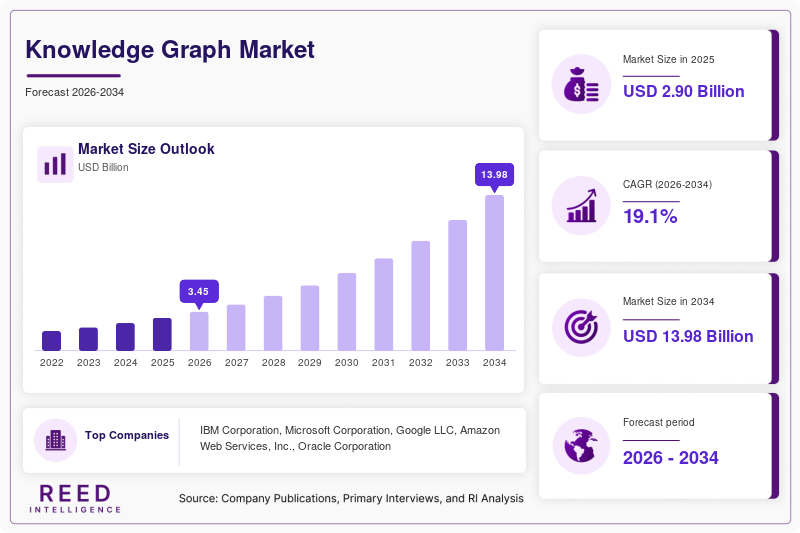
The global Knowledge Graph Market size was valued at USD 2.9 billion in 2026 and is projected to reach USD 11.8 billion by 2034, expanding at a CAGR of 19.1% during the forecast period (2026–2034). The market growth has been supported by the increasing demand for structured and connected data across enterprises, enabling improved search, recommendation engines, and intelligent decision-making systems.
A key global factor driving market expansion has been the widespread adoption of artificial intelligence and semantic technologies across industries. Organizations are increasingly investing in data integration tools that allow them to transform fragmented datasets into interconnected knowledge frameworks, improving operational efficiency and enhancing customer experience.
Key Highlights
- North America dominated the Knowledge Graph Market with a 38.6% share in 2025, while Asia Pacific is expected to grow at the fastest CAGR of 22.4% during the forecast period.
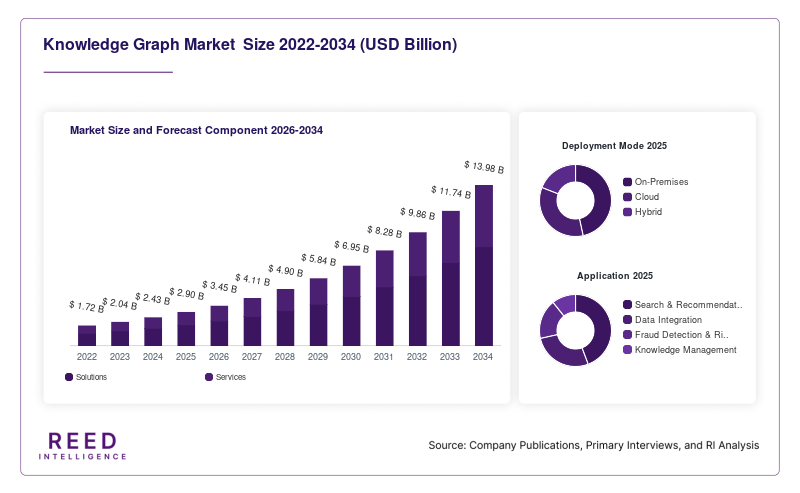
- By component, solutions led the market with a 64.2% share in 2025, while services are projected to grow at a CAGR of 20.8%.
- By deployment, cloud-based knowledge graphs held the dominant share of 58.7% in 2025, whereas hybrid deployment is expected to expand at a CAGR of 21.6%.
- By application, search and recommendation systems accounted for the largest share of 29.5% in 2025, while fraud detection and risk management is anticipated to grow at a CAGR of 23.1%.
- The United States remained the dominant country, with market values of USD 0.92 billion in 2024 and USD 1.08 billion in 2025.
Market Trends
Rising Integration of Knowledge Graphs with Generative AI
The integration of knowledge graphs with generative AI models has emerged as a notable trend in the Knowledge Graph Market. Enterprises are leveraging knowledge graphs to provide contextual grounding for large language models, improving accuracy and reducing hallucination risks. This combination enables more reliable conversational AI systems, especially in industries such as healthcare, finance, and legal services. As organizations seek explainable AI systems, knowledge graphs are becoming a foundational layer for semantic reasoning and contextual data enrichment.
Increasing Adoption in Enterprise Data Fabric Architectures
Another important trend is the integration of knowledge graphs into enterprise data fabric and data mesh architectures. Companies are shifting from siloed data environments to interconnected frameworks where knowledge graphs act as a unifying layer. This trend is particularly visible in large organizations that manage complex datasets across departments. Knowledge graphs help improve metadata management, streamline analytics workflows, and support real-time insights, making them critical in modern data ecosystems.
Market Drivers
Growing Demand for Contextual Data and Semantic Search
Organizations are increasingly focusing on delivering more relevant and personalized user experiences, which has accelerated the demand for contextual data processing. Knowledge graphs enable semantic search capabilities by understanding relationships between entities rather than relying on keyword-based approaches. This capability is driving adoption in sectors such as e-commerce, media, and enterprise search platforms, where accurate information retrieval is critical.
Expansion of Data-Driven Decision-Making Across Industries
The rapid growth of data volumes has made it essential for businesses to derive actionable insights efficiently. Knowledge graphs provide a structured way to integrate and analyze diverse data sources, enabling better decision-making. Industries such as banking, healthcare, and telecommunications are adopting knowledge graph technologies to enhance analytics capabilities, improve operational efficiency, and gain competitive advantages.
Market Restraint
Complexity in Implementation and Data Integration
One of the primary challenges in the Knowledge Graph Market is the complexity involved in designing and implementing knowledge graph solutions. Integrating data from multiple sources, ensuring data quality, and maintaining scalability require significant technical expertise and investment. These factors can limit adoption among small and medium-sized enterprises.
Market Opportunities
Expansion in Healthcare Data Management
The healthcare sector presents significant opportunities for the Knowledge Graph Market. Knowledge graphs can integrate clinical, genomic, and patient data to enable advanced analytics and personalized treatment plans. As healthcare systems increasingly adopt digital solutions, the demand for structured and interconnected data frameworks is expected to rise.
Growing Adoption in Financial Fraud Detection
Another emerging opportunity lies in financial fraud detection and risk management. Knowledge graphs can map complex relationships between transactions, entities, and behaviors, helping organizations identify anomalies and prevent fraud. Financial institutions are expected to increase investments in knowledge graph technologies to enhance security and compliance frameworks.
Segmental Analysis
By Component
The solutions segment dominated the Knowledge Graph Market with a 64.2% share in 2025, as organizations increasingly adopted platforms that enable data integration, semantic modeling, and analytics. These solutions provide end-to-end capabilities for building and managing knowledge graphs.
The services segment is expected to grow at a CAGR of 20.8% during the forecast period. The growth is driven by the increasing need for consulting, integration, and maintenance services, particularly among enterprises lacking in-house expertise.
By Deployment Mode
Cloud deployment held the largest share of 58.7% in 2025, as organizations preferred scalable and cost-effective solutions. Cloud-based knowledge graphs offer flexibility, ease of deployment, and integration with other cloud services.
Hybrid deployment is projected to grow at a CAGR of 21.6%, driven by the need for data security and compliance. Organizations are increasingly adopting hybrid models to balance flexibility with control over sensitive data.
By Application
Search and recommendation systems accounted for the largest share of 29.5% in 2025, as knowledge graphs enhance search accuracy and personalization by understanding user intent and relationships between data entities.
Fraud detection and risk management is expected to grow at the fastest CAGR of 23.1%. The ability of knowledge graphs to identify complex patterns and relationships makes them highly effective in detecting fraudulent activities.
By End-Use Industry
The IT and telecommunications sector dominated the market with a 27.8% share in 2025, driven by the need to manage large volumes of structured and unstructured data.
The healthcare sector is anticipated to grow at a CAGR of 22.7%, supported by the increasing adoption of data-driven healthcare solutions and the need for integrated patient data systems.
Regional Analysis
North America
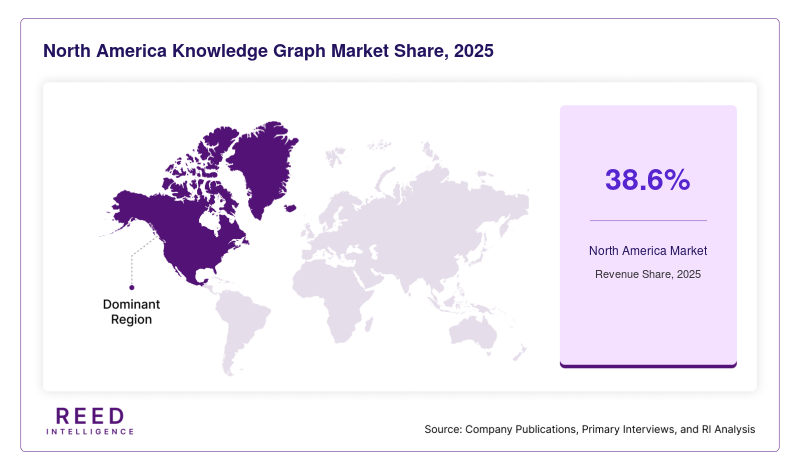
North America accounted for 38.6% of the Knowledge Graph Market share in 2025. The region is expected to grow at a CAGR of 17.8% during 2026–2034. The United States dominated the regional market due to the presence of advanced technology infrastructure and high adoption of AI-driven solutions. The strong ecosystem of technology providers and early adoption of semantic technologies supported market expansion.
Europe
Europe held 26.4% of the market share in 2025 and is projected to grow at a CAGR of 18.2%. Germany emerged as the dominant country, driven by its focus on industrial digitalization and data governance frameworks. The region’s emphasis on data privacy and compliance has encouraged the adoption of structured data management solutions such as knowledge graphs.
Asia Pacific
Asia Pacific captured 21.7% of the market share in 2025 and is anticipated to grow at the fastest CAGR of 22.4%. China led the region, supported by rapid digital transformation and increasing investments in AI technologies. The expansion of e-commerce platforms and large-scale data generation has created strong demand for knowledge graph solutions.
Middle East & Africa
The Middle East & Africa region accounted for 7.1% of the market share in 2025 and is expected to grow at a CAGR of 19.0%. The United Arab Emirates dominated the region, driven by smart city initiatives and government-led digital transformation programs. The increasing focus on data-driven governance has contributed to market growth.
Latin America
Latin America held 6.2% of the market share in 2025 and is projected to expand at a CAGR of 18.6%. Brazil emerged as the leading country, supported by growing investments in digital infrastructure and enterprise analytics solutions. The rising adoption of cloud technologies has further accelerated market development.
Competitive Landscape
The Knowledge Graph Market is characterized by the presence of several global technology providers focusing on innovation and strategic partnerships. Leading players are investing in AI integration, cloud-based solutions, and advanced analytics capabilities to strengthen their market position. The market leader, IBM Corporation, has expanded its knowledge graph offerings by integrating them with AI-driven analytics platforms, enabling enhanced data insights and automation. Microsoft Corporation and Google LLC continue to leverage their cloud ecosystems to deliver scalable knowledge graph solutions.
Amazon Web Services, Inc. is focusing on managed graph database services to attract enterprise clients. Oracle Corporation is enhancing its semantic data capabilities through continuous product development. Companies are also engaging in mergers, acquisitions, and collaborations to expand their technological capabilities and geographic presence, intensifying competition across the market.
Key Players List
- IBM Corporation
- Microsoft Corporation
- Google LLC
- Amazon Web Services, Inc.
- Oracle Corporation
- SAP SE
- Neo4j, Inc.
- Stardog Union, Inc.
- Ontotext (Sirma Group)
- Franz Inc.
- Cambridge Semantics Inc.
- TigerGraph, Inc.
- DataStax, Inc.
- MarkLogic Corporation
- RelationalAI, Inc.
Recent Developments
- In 2025, IBM Corporation launched an enhanced knowledge graph solution integrated with advanced AI capabilities to improve enterprise data analytics.
- Microsoft Corporation expanded its Azure-based knowledge graph services, focusing on scalability and real-time data processing.
- Google LLC introduced updates to its knowledge graph APIs to support improved semantic search capabilities.
- Amazon Web Services, Inc. enhanced its graph database services to support complex data relationships and analytics.
- Neo4j, Inc. announced new tools for graph data science, enabling organizations to derive deeper insights from connected data.
Knowledge Graph Market Segments
Component
- Solutions
- Services
Deployment Mode
- On-Premises
- Cloud
- Hybrid
Application
- Search & Recommendation
- Data Integration
- Fraud Detection & Risk Management
- Knowledge Management
End-Use Industry
- IT & Telecommunications
- Healthcare
- BFSI
- Retail & E-commerce
- Government
By Region
- North America
- Europe
- APAC
- Middle East and Africa
- LATAM