Knuckleboom Loaders Market Size, Share Demand Report By Type (Truck-Mounted Knuckleboom Loaders, Trailer-Mounted Knuckleboom Loaders), By Capacity (Below 10 Ton, 10–20 Ton, Above 20 Ton), By Application (Forestry & Timber Handling, Construction Material Handling, Recycling & Scrap Handling), By End Use (Construction Contractors, Municipal Services), By Region & Segment Forecasts, 2026–2034
USD 3950
Market Overview
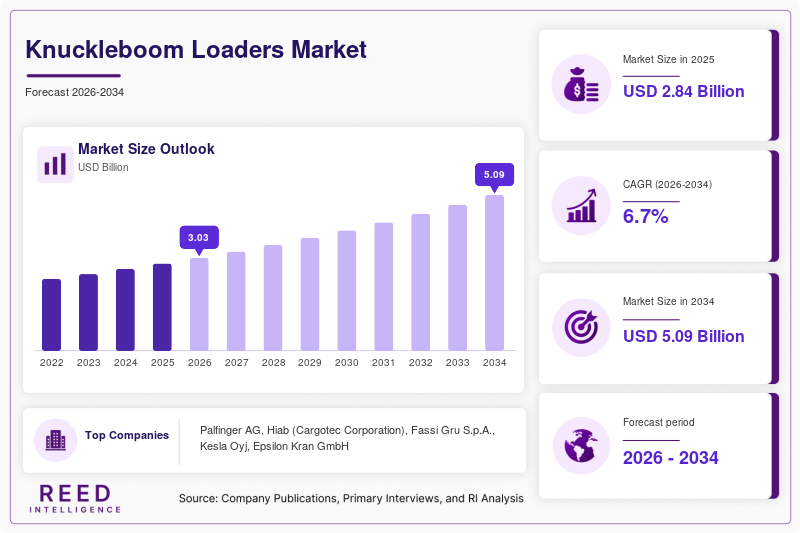
The global Knuckleboom Loaders Market size was valued at USD 2.84 billion in 2026 and is projected to reach USD 4.79 billion by 2034, expanding at a CAGR of 6.7% from 2026 to 2034. Knuckleboom loaders, widely used for timber handling, scrap movement, construction material lifting, and agricultural logistics, have gained importance as industries seek compact, versatile, and high-reach loading equipment. Their articulated boom design allows precise movement in confined job sites, making them suitable for urban construction zones, forest operations, and industrial yards.
A major global factor supporting market expansion has been the continued rise in infrastructure renewal and industrial material handling modernization. Governments and private operators have increased spending on roads, ports, utilities, and warehousing facilities, which has created steady demand for efficient loading machinery capable of reducing manual handling time and improving operational safety.
Key Highlights
- Europe held the dominant regional share of 34.8% in 2025, while Asia Pacific is expected to register the fastest CAGR of 8.1% through 2034.
- By Type, Truck-Mounted Knuckleboom Loaders led with 46.2% share in 2025, while Trailer-Mounted Models will grow fastest at 7.5% CAGR.
- By Capacity, 10–20 Ton Units accounted for 39.6% share in 2025, while Above 20 Ton Units will expand fastest at 7.8% CAGR.
- By Application, Forestry & Timber Handling led with 31.4% share in 2025, while Recycling & Scrap Handling will grow fastest at 8.3% CAGR.
- By End Use, Construction Contractors dominated with 36.7% share in 2025, while Municipal Services will rise fastest at 7.6% CAGR.
- Germany, the dominant country, was valued at USD 286 million in 2024 and USD 301 million in 2025.
Market Trends
Digital Fleet Monitoring and Smart Hydraulics
The Knuckleboom Loaders Market is witnessing rapid adoption of telematics systems that track fuel use, lifting cycles, maintenance intervals, and operator behavior. Fleet owners are using connected platforms to reduce downtime and optimize machine utilization. Smart hydraulic controls are also improving boom precision, lowering energy loss, and reducing component wear.
Shift Toward Multi-Purpose Compact Equipment
Contractors and logistics firms increasingly prefer compact machines that can perform multiple loading tasks across different locations. Knuckleboom loaders are benefiting from this trend because they can switch attachments, operate in tight spaces, and load varied materials such as logs, steel pipes, pallets, and waste containers.
Market Drivers
Expansion of Construction and Infrastructure Projects
Growing investment in roads, bridges, rail corridors, housing, and utility networks has raised the need for efficient material lifting systems. Knuckleboom loaders are used for loading steel, concrete products, pipes, and construction supplies where maneuverability is important.
Growth in Mechanized Forestry and Waste Handling
Forest harvesting companies and waste management operators are replacing manual and conventional loading systems with articulated boom equipment. Knuckleboom loaders improve safety, loading speed, and reach, making them suitable for timber yards and recycling stations.
Market Restraint
High Initial Ownership and Maintenance Costs
Advanced hydraulic systems, telescopic booms, and control electronics increase upfront equipment prices. For smaller contractors and local operators, financing and maintenance costs may limit purchases and extend replacement cycles.
Market Opportunities
Rental Fleet Penetration in Emerging Markets
Rental equipment businesses in Asia, Latin America, and the Middle East are expanding fleets with versatile loaders. This model lowers ownership barriers and opens new customer segments for manufacturers.
Electrified and Hybrid Loader Development
Low-emission job sites and stricter urban environmental rules are creating opportunities for battery-assisted or hybrid knuckleboom loaders. These models can support indoor yards, ports, and municipal applications.
Segmental Analysis
By Type
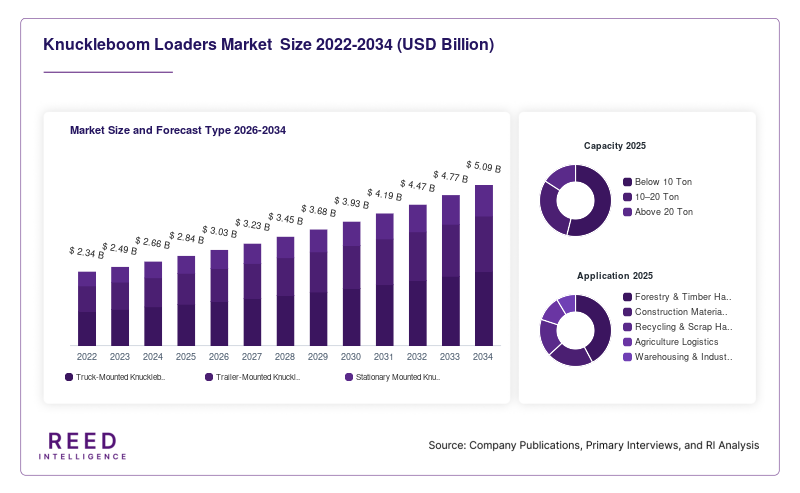
Truck-Mounted Knuckleboom Loaders held the largest share of 46.2% in 2025 due to strong mobility and suitability for on-road transport plus loading functions.
Trailer-Mounted Models are projected to grow at 7.5% CAGR through 2034 as contractors will seek flexible fleet options that can be paired with different towing vehicles for seasonal operations.
By Capacity
10–20 Ton Units accounted for 39.6% share in 2025 because they balanced lifting power with operating efficiency across construction and industrial tasks.
Above 20 Ton Units will register the fastest CAGR of 7.8% as ports, scrap yards, and heavy material terminals will require higher payload equipment with extended reach.
By Application
Forestry & Timber Handling dominated with 31.4% share in 2025 owing to widespread use in log loading, yard stacking, and transport preparation.
Recycling & Scrap Handling will grow fastest at 8.3% CAGR as circular economy investments and metal recovery capacity expansions will increase equipment demand.
By End Use
Construction Contractors held 36.7% share in 2025 as loaders were widely used for pipes, beams, pallets, and site materials.
Municipal Services will expand fastest at 7.6% CAGR because city authorities will invest in waste collection, storm cleanup, and maintenance fleets.
By Power Source
Diesel-Powered Loaders led with 72.5% share in 2025 due to high torque output and established refueling infrastructure.
Hybrid/Electric Loaders will grow fastest at 9.2% CAGR as fleet operators will target lower emissions and quieter urban operation.
Regional Analysis
North America
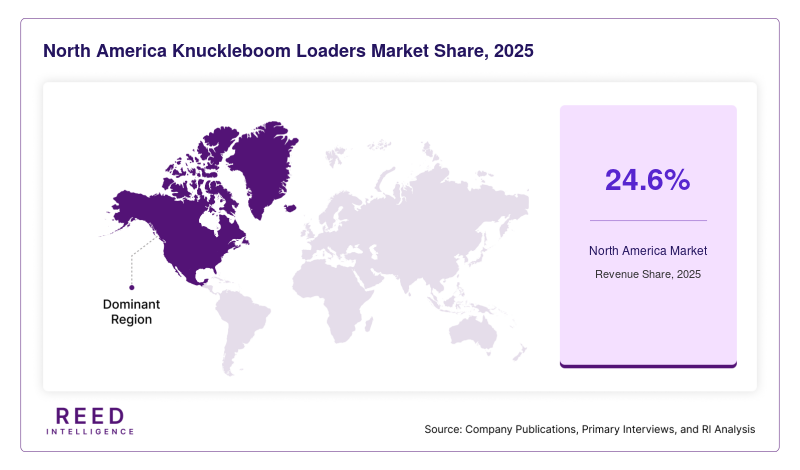
North America accounted for 24.6% of the Knuckleboom Loaders Market in 2025 and is projected to grow at a CAGR of 6.1% through 2034. Demand will be supported by replacement of aging utility fleets and higher investment in waste transfer stations. The U.S. will remain the leading country due to broad use in utility maintenance and freight logistics operations.
Europe
Europe held 34.8% share in 2025 and will grow at a CAGR of 5.9% during the forecast period. Strong demand will come from forestry operations, municipal fleets, and strict workplace safety regulations. Germany will lead the region because of its advanced engineering base and high adoption of mechanized industrial handling systems.
Asia Pacific
Asia Pacific represented 22.9% of the market in 2025 and will expand at the fastest CAGR of 8.1% to 2034. Industrialization, port expansion, and urban development will create strong demand for mobile loaders. China will dominate due to extensive infrastructure activity and growth in domestic equipment manufacturing.
Middle East & Africa
Middle East & Africa captured 9.1% share in 2025 and will grow at a CAGR of 6.8%. Construction of logistics zones, mining support yards, and utility infrastructure will support sales. Saudi Arabia will lead due to large industrial and urban development programs.
Latin America
Latin America held 8.6% share in 2025 and is expected to grow at a CAGR of 6.4%. Demand will stem from agriculture logistics, timber exports, and mining-related handling needs. Brazil will remain the dominant country due to its forestry and agribusiness sectors.
Competitive Landscape
The Knuckleboom Loaders Market remains moderately consolidated, with established crane and loader manufacturers competing through product innovation, dealer networks, and aftermarket service. Leading participants focus on hydraulic efficiency, telematics integration, attachment compatibility, and regional assembly expansion.
Palfinger AG remains a market leader with a broad loader portfolio and strong presence across Europe and North America. The company recently introduced upgraded digital monitoring solutions for loader fleets to improve uptime and predictive maintenance planning. Hiab (Cargotec Corporation) maintains strong demand through truck-mounted loader systems for logistics and utility customers. Fassi Gru S.p.A. continues to expand heavy-duty articulated lifting solutions. Kesla Oyj has a notable position in forestry loading equipment. Epsilon Kran GmbH, part of Palfinger, remains active in timber and recycling applications.
Competition is increasingly shifting toward lifecycle value, service contracts, operator training, and connected equipment solutions rather than price-only strategies.
Key Players List
- Palfinger AG
- Hiab (Cargotec Corporation)
- Fassi Gru S.p.A.
- Kesla Oyj
- Epsilon Kran GmbH
- Jonsered AB
- Tajfun Liv d.o.o.
- HMF Group A/S
- PM Group S.p.A.
- Copma S.r.l.
- Atlas GmbH
- Ferrari International S.p.A.
- Maxilift S.p.A.
- Loglift Forestry Cranes
- Penny Hydraulics Ltd.
Recent Developments
- Palfinger launched next-generation connected knuckleboom loaders with predictive service alerts.
- Hiab expanded service network coverage for utility and transport fleet customers in North America.
- Fassi introduced updated high-capacity articulated loader models with improved stability systems.
- Kesla expanded forestry loader offerings designed for sustainable timber harvesting fleets.
- Several regional manufacturers introduced hybrid-ready platforms for urban municipal operations.
Knuckleboom Loaders Market Segments
Type
- Truck-Mounted Knuckleboom Loaders
- Trailer-Mounted Knuckleboom Loaders
- Stationary Mounted Knuckleboom Loaders
Capacity
- Below 10 Ton
- 10–20 Ton
- Above 20 Ton
Application
- Forestry & Timber Handling
- Construction Material Handling
- Recycling & Scrap Handling
- Agriculture Logistics
- Warehousing & Industrial Handling
End Use
- Construction Contractors
- Municipal Services
- Industrial Operators
- Fleet Rental Companies
Power Source
- Diesel
- Hybrid
- Electric
By Region
- North America
- Europe
- APAC
- Middle East and Africa
- LATAM