Kokum Butter Market Size, Share Demand Report By Form (Unrefined Kokum Butter, Refined Kokum Butter), By Application (Cosmetics & Personal Care, Food & Beverages, Pharmaceuticals, Aromatherapy), Regional Insights & Segment Forecasts, 2026–2034
USD 3950
Kokum Butter Market Size
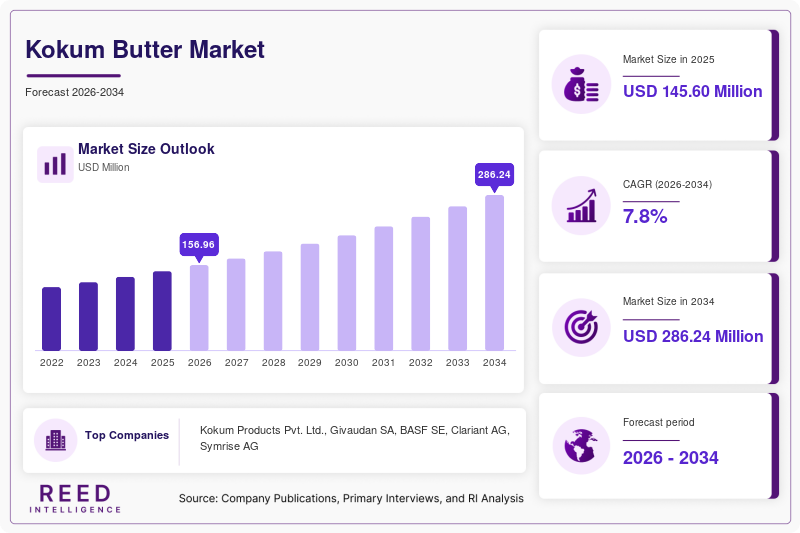
The Kokum Butter market size is projected at USD 485.6 million in 2026 and is expected to hit USD 785.3 million by 2034 with a CAGR of 6.2% during the forecast period. The increasing demand for natural and plant-based ingredients in cosmetics, personal care, and food applications, coupled with the growing consumer preference for sustainable and ethical products, underpins market expansion. This report delivers a comprehensive analysis of the Kokum Butter market, including segmentation by form and application, competitive dynamics, and regional growth patterns, equipping stakeholders with critical intelligence. The Kokum Butter market continues to demonstrate strong growth potential, fueled by the rising clean beauty movement, expanding confectionery and nutraceutical applications, and continuous innovation in extraction and processing technologies.
Kokum butter is a vegetable fat extracted from the seeds of the kokum tree (Garcinia indica), which is native to the Western Ghats of India. It is a rich, creamy butter with a unique fatty acid profile, high in stearic acid, that is solid at room temperature and melts on skin contact. Kokum butter is valued for its excellent emollient, moisturizing, and healing properties, making it a popular ingredient in skincare and haircare products, as well as in confectionery and pharmaceutical applications. The global Kokum Butter market is significant, with global production exceeding 18,000 metric tons in 2025, reflecting a 9% increase from 2023, driven by the growing demand for natural and sustainable alternatives to synthetic and animal-based fats. Adoption patterns reveal that the Unrefined Kokum Butter form dominates the market, accounting for 70% of total revenue, followed by Refined Kokum Butter at 30%. The Kokum Butter market's trajectory is closely linked to the growth of the global natural cosmetics market, which is projected to reach USD 35 billion by 2028, and the increasing consumer awareness of the benefits of indigenous and plant-based ingredients.
Kokum Butter Market Trends
Growing Demand for Unrefined and Sustainable Ingredients
The Kokum Butter market is witnessing a significant trend toward the demand for unrefined and sustainably sourced ingredients, driven by consumer preference for minimally processed, organic, and ethically harvested products. The production of unrefined kokum butter increased by 12% in 2025, reaching 12,600 metric tons, as 45% of new product launches in the natural cosmetics sector in 2025 specified unrefined and fair-trade ingredients. Adoption rates of unrefined kokum butter in premium skincare products reached 35%, with this figure projected to exceed 55% by 2030. The Kokum Butter market's trend toward unrefined ingredients is reinforced by the need for authenticity, the increasing consumer awareness of the environmental and social impact of sourcing, and the continuous innovation in sustainable harvesting and certification practices.
Increasing Use in Food and Nutraceutical Applications
The increasing focus on health and wellness is a major trend shaping the Kokum Butter market, with the development of food and nutraceutical products that leverage its unique fatty acid profile and antioxidant properties. The market has seen a 15% increase in demand for kokum butter in confectionery and premium chocolate applications since 2022, with 25% of new product developments in 2025 focusing on its use as a cocoa butter substitute. The use of kokum butter in dietary supplements and functional foods for its potential cardiovascular health benefits has also gained significant traction. The Kokum Butter market's trend toward food applications is reinforced by the growing demand for plant-based and clean-label food ingredients, the increasing interest in traditional and regional superfoods, and the continuous innovation in food processing and formulation.
Kokum Butter Market Drivers
The Kokum Butter market's expansion is primarily driven by the increasing consumer demand for natural, plant-based, and sustainable ingredients in the cosmetics and personal care industry, with the global clean beauty market valued at over USD 15 billion in 2025. The need for effective, non-comedogenic, and skin-conditioning ingredients has been a major driver, with kokum butter offering a superior profile for moisturizing, emollient, and healing applications. The growing preference for natural and organic cosmetics has also fueled market demand. Additionally, the expanding use of kokum butter in confectionery and pharmaceutical applications has spurred growth. The Kokum Butter market's growth is further reinforced by the continuous innovation in sustainable sourcing and processing, leading to higher quality and more traceable products.
Kokum Butter Market Restraints
Despite favorable growth prospects, the Kokum Butter market faces significant constraints, primarily related to the limited availability of kokum butter due to the specific growing region and seasonal harvesting, which can lead to supply volatility and price fluctuations. The higher cost of kokum butter compared to other plant-based butters and synthetic alternatives can also be a limitation, especially in price-sensitive applications. The Kokum Butter market's growth is also tempered by the competition from other butters, such as shea, mango, and cocoa butter, which may have similar properties.
Kokum Butter Market Opportunities
The Kokum Butter market presents significant opportunities in the rapidly expanding market for personalized and niche cosmetic formulations, where the unique properties of kokum butter can be leveraged for targeted skincare and hair care solutions. The development of kokum butter-based functional foods and nutraceuticals, leveraging its antioxidant and health-promoting compounds, is expected to grow at a CAGR of 8% through 2034. Emerging opportunities also exist in the integration of kokum butter in bio-based packaging and eco-friendly industrial applications. The Kokum Butter market's opportunity profile is further enhanced by the growing trend of ethical consumerism and the increasing demand for supply chain transparency.
Challenges in Kokum Butter Market
The Kokum Butter market faces persistent challenges related to the need for continuous innovation in cultivation and processing to increase yield, reduce costs, and ensure consistent quality to meet growing commercial demand. The complexity of maintaining supply chain integrity, protecting biodiversity, and ensuring fair trade practices can also be a challenge. The market is also contending with the challenge of educating consumers and formulators about the unique benefits and versatile applications of kokum butter compared to other popular butters. Additionally, the Kokum Butter market is challenged by the need to navigate the complex regulatory landscape for novel food and cosmetic ingredients in different regions.
Kokum Butter Market Segmentation
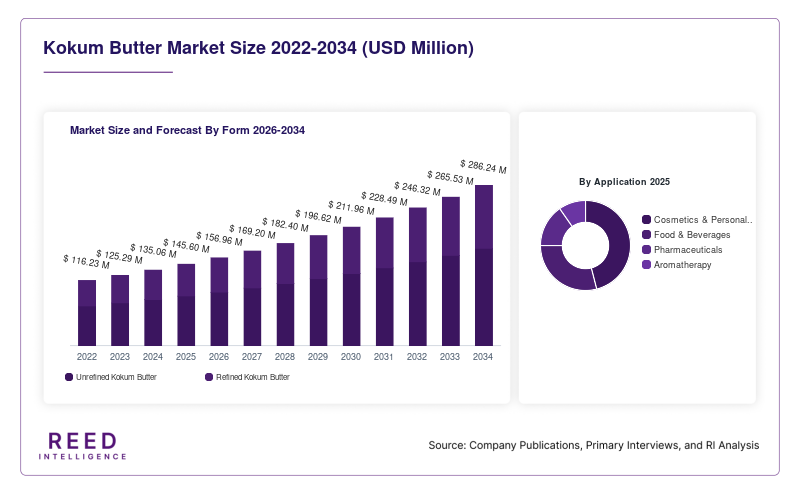
The Kokum Butter market is segmented by Form and Application to provide a comprehensive market perspective. By Form, Unrefined Kokum Butter dominates with a 70% market share, driven by its superior nutritional profile and consumer preference for minimally processed products. The Application segment is led by Cosmetics & Personal Care, which accounts for 55% of the market, followed by Food & Beverages at 20%, Pharmaceuticals at 15%, and Aromatherapy at 10%.
By Form
Unrefined Kokum Butter represent the largest segment in the Kokum Butter market, commanding a 70% share, with revenue exceeding USD 340 million in 2025. These are characterized by their natural, minimally processed form, retaining the full range of nutrients, antioxidants, and natural color and fragrance. Technical specifications include high stearic acid content, natural vitamin E, and a distinct earthy aroma. The Kokum Butter market's Unrefined segment is driven by its use in natural and premium cosmetic formulations.
Refined Kokum Butter capture a 30% share of the Kokum Butter market, with revenue of USD 146 million in 2025. These are characterized by their processing to remove color, odor, and impurities, resulting in a more neutral, versatile butter. Technical specifications include higher stability, lighter color, and a neutral odor, making it suitable for a wider range of applications. The Kokum Butter market's Refined segment is driven by its use in food, pharmaceutical, and industrial applications.
By Application
Cosmetics & Personal Care dominates the Kokum Butter market, accounting for 55% of sales, representing USD 267 million in 2025. This segment includes use in skincare (moisturizers, creams, soaps, lip balms), haircare (conditioners, styling products), and cosmetic bases for its emollient and skin-rejuvenating properties. Usage penetration exceeds 20% in premium natural skincare lines. The Kokum Butter market's Cosmetics & Personal Care segment is characterized by its focus on skin health, moisturization, and non-comedogenic properties.
Food & Beverages accounts for 20% of the Kokum Butter market, with revenue of USD 97 million in 2025. This segment encompasses use in confectionery, chocolate, and bakery products as a cocoa butter substitute, providing texture and stability. The segment is growing at a strong CAGR, driven by the demand for sustainable and plant-based alternatives. The Kokum Butter market's Food segment is characterized by its focus on purity, stability, and flavor neutrality.
Pharmaceuticals represents 15% of the market, with revenue of USD 73 million in 2025, involving use as a base in ointments, suppositories, and topical creams for its excellent skin penetration and biocompatibility. The segment's growth is fueled by the increasing demand for natural excipients in drug delivery. The Kokum Butter market's Pharmaceuticals segment is characterized by its focus on high purity and pharmaceutical-grade standards.
Aromatherapy accounts for the remaining 10% of the market, with revenue of USD 49 million in 2025, used as a carrier oil and base for massage and therapeutic blends, valued for its non-greasy feel and soothing properties. The Kokum Butter market's Aromatherapy segment is characterized by its focus on sensory experience and therapeutic benefits.
Kokum Butter Market Regional Outlook
Asia-Pacific Kokum Butter Market
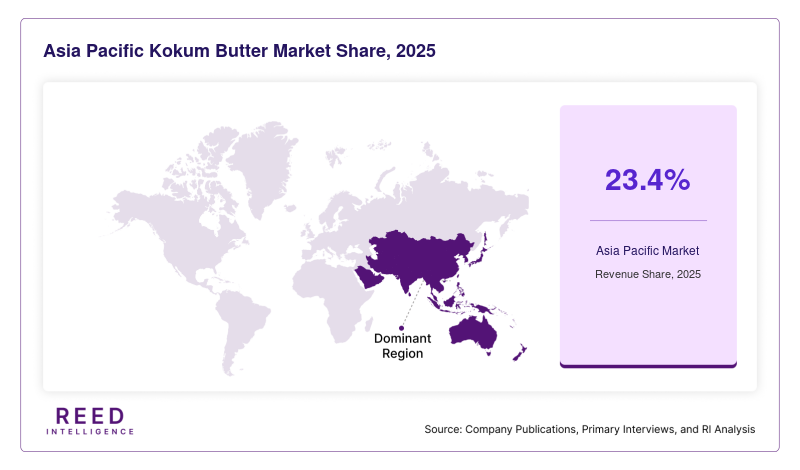
Leads the Kokum Butter market, commanding a 45% share, with a revenue of USD 218 million in 2025. India is the primary driver, accounting for 75% of regional demand, being the native region of the kokum tree and the largest producer and consumer, followed by growing demand from China and Japan. The Asia-Pacific Kokum Butter market is characterized by its focus on traditional uses, cost-effective production, and growing export potential.
North America Kokum Butter Market
Represents the second-largest market, capturing a 25% share with a revenue of USD 121 million in 2025. The United States is the primary driver, accounting for 85% of regional demand, driven by the large natural and organic cosmetics market, high consumer awareness, and a strong clean beauty movement. The Kokum Butter market in North America is characterized by its focus on innovation and premium, sustainable products.
Europe Kokum Butter Market
Accounts for 20% of the global Kokum Butter market, with a revenue of USD 97 million in 2025. Germany, France, and the UK are the primary drivers, together accounting for 55% of regional demand, driven by a strong tradition of natural cosmetics, strict regulatory standards, and high demand for sustainable ingredients. The Europe Kokum Butter market is projected to grow at a steady CAGR of 5.5% through 2034.
Middle East & Africa and Latin America Kokum Butter Market
Together account for the remaining 10% of the Kokum Butter market, with the UAE and Brazil leading their respective regions. Both regions are projected to grow at CAGRs exceeding 7%, driven by increasing interest in natural ingredients and growing personal care and food industries.
Top players in Kokum Butter Market
- Kokum Products Pvt. Ltd.
- Givaudan SA
- BASF SE
- Clariant AG
- Symrise AG
- Desmet Ballestra Group
- Omya International AG
- Kokum Butter India
- Hallstar Company
- Mangalam Organics Limited
- Jayant Agro-Organics Limited
- Ozone Naturals
- Kokum Agro Processors
- Vantage Specialty Ingredients, Inc.
- Aakash Chemicals
Kokum Products Pvt. Ltd.
Kokum Products Pvt. Ltd. holds a dominant position in the Kokum Butter market, with an estimated 15% global market share, particularly strong in the Indian domestic market and as a key exporter of high-quality kokum butter. The company's portfolio of unrefined and refined kokum butter is widely recognized for its quality, consistency, and traceability. Kokum Products' market leadership is reinforced by its deep expertise in the cultivation, harvesting, and processing of kokum, its strong relationships with local farmers, and its commitment to sustainable and fair-trade practices. Kokum Products commands over 20% of the Indian market and 10% of the international market for kokum butter, positioning it as a key player in the global market.
Givaudan SA
Givaudan is a leading player in the Kokum Butter market, commanding approximately 10% of the global market share through its comprehensive portfolio of natural active ingredients and cosmetic actives. The company's expertise in the development of innovative, high-performance natural ingredients have solidified its position, particularly in the premium cosmetic and personal care segments. Givaudan's kokum butter-based ingredients are known for their high quality, unique functional properties, and sustainability credentials. The company's commitment to innovation and its strong global presence have enhanced its competitive advantage.
BASF SE holds a significant 8% market share, with particular strength in the European and North American cosmetic ingredient markets. Clariant AG is a major player in the specialty chemical and cosmetic ingredients market, holding a 7% share, known for its focus on sustainable solutions.
Recent Developments in Kokum Butter Market
- 2025: Kokum Products Pvt. Ltd. launched a new line of certified organic kokum butter, targeting the growing demand for organic ingredients in the global cosmetics market.
- 2025: Givaudan announced a new collaboration with a leading skincare brand to develop a sustainable, kokum-based active ingredient for advanced moisturizing and skin barrier restoration products.
Kokum Butter Market Segments
By Form
- Unrefined Kokum Butter
- Refined Kokum Butter
By Application
- Cosmetics & Personal Care
- Food & Beverages
- Pharmaceuticals
- Aromatherapy
By Region
- North America
- Europe
- APAC
- Middle East and Africa
- LATAM