Kraft LigKraft Lignin Product Market Size, Share Demand Report By Type (Lignosulfonates, Kraft Lignin Powder, Hydrolyzed Lignin), By Application (Concrete Admixtures, Adhesives and Resins, Carbon Fiber, Dispersants, Energy Storage Materials), By End-Use Industry (Construction, Automotive, Chemicals, Energy, Agriculture) By Region & Segment Forecasts, 2026–2034nin Product Market
USD 3950
Market Overview
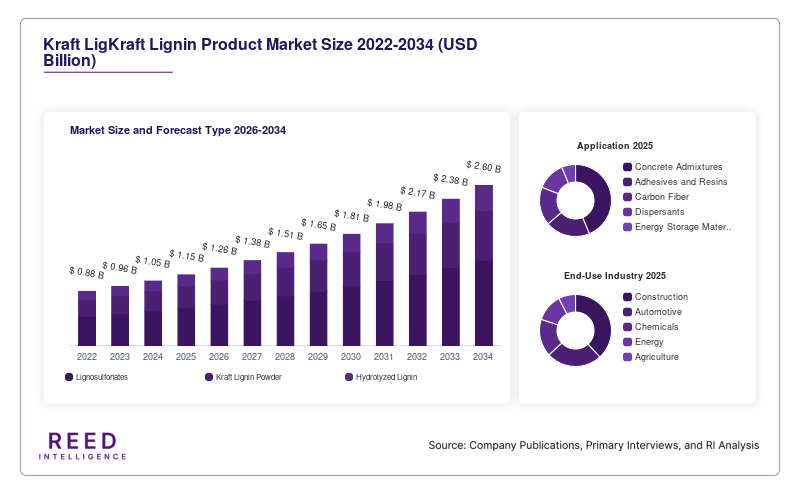
The Kraft Lignin Product Market was valued at approximately USD 1.15 billion in 2026 and is projected to reach USD 2.38 billion by 2034, expanding at a CAGR of 9.5% during the forecast period (2026–2034). The market has gained consistent traction as industries shift toward bio-based materials and sustainable alternatives to petrochemical-derived products. A key global factor supporting this growth has been the increasing adoption of circular economy practices, particularly in pulp and paper industries where lignin is being valorized instead of treated as waste.
Kraft lignin, a byproduct of the kraft pulping process, is increasingly used in applications such as adhesives, carbon fibers, dispersants, and energy storage materials. Its ability to replace fossil-based components in several industrial applications has positioned it as a strategic material across multiple sectors.
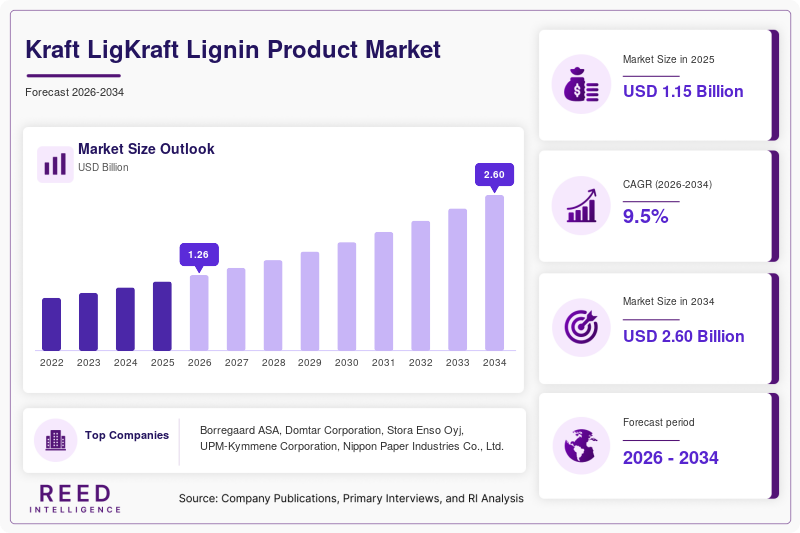
Key Highlights:
- Europe dominated the market with a 34.2% share in 2025, while Asia Pacific is expected to register the fastest growth at a CAGR of 10.8% (2026–2034).
- In terms of type, lignosulfonates accounted for the largest share at 46.5% in 2025, while kraft lignin powder is projected to grow fastest at a CAGR of 11.2%.
- By application, concrete admixtures led with 38.7% share in 2025, while carbon fiber applications are anticipated to expand at a CAGR of 12.4%.
- Germany remained the dominant country in Europe, with market values of USD 182 million in 2024 and USD 195 million in 2025.
Market Trends
Expansion of Bio-Based Carbon Fiber Applications
The increasing demand for lightweight and sustainable materials has accelerated the use of kraft lignin in carbon fiber production. Industries such as automotive and aerospace are exploring lignin-based carbon fibers as cost-effective alternatives to conventional polyacrylonitrile (PAN)-based fibers. This trend is reshaping the Kraft Lignin Product Market, particularly in high-performance materials segments.
Integration in Green Construction Materials
Kraft lignin is increasingly being used as a dispersant and binder in construction chemicals, particularly in eco-friendly concrete formulations. The push toward low-carbon construction practices has driven demand for lignin-based admixtures, enhancing durability and reducing water usage in concrete mixes.
Market Drivers
Rising Demand for Sustainable Industrial Materials
The transition toward environmentally sustainable materials has significantly boosted the adoption of kraft lignin across industries. As regulatory frameworks tighten around carbon emissions, manufacturers are seeking renewable alternatives. Kraft lignin offers biodegradability and lower environmental impact, making it an attractive substitute for synthetic polymers in adhesives, coatings, and composites.
Growth in Construction and Infrastructure Activities
The global expansion of infrastructure projects has increased demand for concrete additives and dispersants. Kraft lignin-based products improve the performance of construction materials by enhancing flow properties and strength. This has contributed to the steady growth of the Kraft Lignin Product Market, particularly in emerging economies with expanding urbanization.
Market Restraint
Limited Commercial Scalability and Processing Challenges
Despite its potential, the large-scale commercialization of kraft lignin products faces technical challenges related to purification, consistency, and processing costs. Variability in raw material quality and lack of standardized extraction processes can limit widespread adoption in high-performance applications.
Market Opportunities
Advancements in Biorefinery Technologies
Emerging biorefinery models are enabling efficient extraction and modification of lignin into high-value products. These advancements are opening new pathways for lignin utilization in specialty chemicals, resins, and advanced materials, creating long-term growth opportunities in the Kraft Lignin Product Market.
Increasing Use in Energy Storage and Battery Materials
Kraft lignin is gaining attention as a precursor material in energy storage applications, including lithium-ion batteries and supercapacitors. Its carbon-rich structure makes it suitable for producing sustainable electrode materials, offering opportunities in the rapidly evolving energy sector.
Segmental Analysis
By Type
The lignosulfonates segment held the dominant position with a 46.5% market share in 2025, owing to its extensive use in dispersants and additives. Its cost-effectiveness and wide availability contributed to its leadership in the Kraft Lignin Product Market.
The kraft lignin powder segment is expected to witness the fastest growth, registering a CAGR of 11.2% during the forecast period. This growth is driven by its increasing use in high-value applications such as carbon fiber production and specialty chemicals.
By Form
Liquid lignin dominated the market with a 52.3% share in 2025, primarily due to its ease of handling and application in industrial processes such as concrete admixtures and dispersants.
Solid lignin is projected to grow at a CAGR of 10.6% from 2026 to 2034, driven by its suitability for advanced material applications, including composites and energy storage systems.
By Application
Concrete admixtures accounted for the largest share of 38.7% in 2025, driven by increasing construction activities and the demand for improved material performance.
Carbon fiber applications are anticipated to grow at the fastest CAGR of 12.4% during the forecast period, supported by rising demand for lightweight and sustainable materials in transportation and industrial sectors.
By End-Use Industry
The construction industry dominated the market with a 41.2% share in 2025, as lignin-based products are widely used to enhance concrete properties and reduce costs.
The automotive sector is expected to grow at a CAGR of 11.5% from 2026 to 2034, driven by the adoption of lignin-based composites and carbon fibers to reduce vehicle weight and emissions.
Regional Analysis
North America
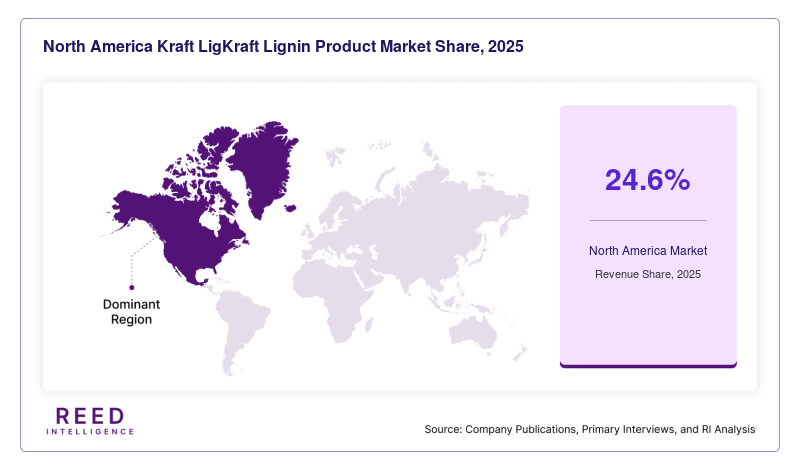
North America accounted for 24.6% of the market share in 2025 and is expected to grow at a CAGR of 8.9% during the forecast period. The United States dominated the region due to increasing research activities focused on bio-based materials. The country’s strong innovation ecosystem and investments in renewable technologies have supported the growth of lignin-based applications.
Europe
Europe held the largest share of 34.2% in 2025 and is projected to grow at a CAGR of 9.1% from 2026 to 2034. Germany led the regional market, driven by its advanced pulp and paper industry and strong focus on sustainable manufacturing practices. The presence of established lignin producers has contributed to consistent market expansion.
Asia Pacific
Asia Pacific captured 21.8% of the market share in 2025 and is anticipated to grow at the fastest CAGR of 10.8% during the forecast period. China emerged as the dominant country, supported by rapid industrialization and increasing demand for eco-friendly construction materials. The region’s expanding manufacturing base is expected to drive future growth.
Middle East & Africa
The Middle East & Africa region accounted for 9.3% of the market share in 2025 and is expected to grow at a CAGR of 8.2% from 2026 to 2034. The United Arab Emirates led the market, driven by infrastructure development and increasing adoption of sustainable construction practices.
Latin America
Latin America held 10.1% of the market share in 2025 and is projected to grow at a CAGR of 8.6% during the forecast period. Brazil dominated the region, supported by its strong pulp and paper industry and abundant biomass resources, which facilitate lignin production.
Competitive Landscape
The Kraft Lignin Product Market is moderately fragmented, with several key players focusing on product innovation and strategic collaborations. Leading companies are investing in research and development to expand lignin applications across high-growth sectors such as energy storage and advanced materials. One prominent market leader has strengthened its position by launching a new range of lignin-based carbon fiber precursors, enhancing its product portfolio and addressing evolving industry demands. Other players are emphasizing partnerships with construction and chemical companies to increase product adoption.
The competitive environment is characterized by continuous advancements in processing technologies and increasing emphasis on sustainability. Companies are also exploring regional expansion strategies to tap into emerging markets, particularly in Asia Pacific. Overall, the market is witnessing a steady shift toward value-added applications, supported by technological innovation and growing environmental awareness.
Key Players List
- Borregaard ASA
- Domtar Corporation
- Stora Enso Oyj
- UPM-Kymmene Corporation
- Nippon Paper Industries Co., Ltd.
- West Fraser Timber Co. Ltd.
- Sappi Limited
- Domsjö Fabriker AB
- Rayonier Advanced Materials Inc.
- Ingevity Corporation
- LignoTech Florida LLC
- Suzano S.A.
- Mercer International Inc.
- Burgo Group S.p.A.
- Canfor Corporation
Recent Developments
- In 2025, a leading European producer expanded its lignin extraction capacity to meet rising demand for bio-based materials.
- In 2024, a major pulp and paper company introduced a new lignin-based additive for construction applications.
- In 2025, a global chemical firm partnered with automotive manufacturers to develop lignin-based composite materials.
- In 2026, advancements in lignin purification technology enabled improved product consistency for industrial use.
- In 2024, several companies increased investments in lignin-based carbon fiber research to enhance performance characteristics.
Kraft LigKraft Lignin Product Market Segments
Type
- Lignosulfonates
- Kraft Lignin Powder
- Hydrolyzed Lignin
Application
- Concrete Admixtures
- Adhesives and Resins
- Carbon Fiber
- Dispersants
- Energy Storage Materials
End-Use Industry
- Construction
- Automotive
- Chemicals
- Energy
- Agriculture
By Region
- North America
- Europe
- APAC
- Middle East and Africa
- LATAM