Lab Furniture Market Size, Share & Trends Analysis Report By Product Type (Laboratory Casework, Laboratory Tables & Benches, Laboratory Storage Cabinets), By Material (Steel, Wood, Plastic & Polymer, Stainless Steel), By Laboratory Type (Wet Laboratories, Dry Laboratories, Clinical & Diagnostic Laboratories), By End User (Pharmaceutical & Biotechnology, Healthcare & Clinical, Academic & Research Institutions) and By Region (North America, Europe, APAC, Middle East and Africa, LATAM) Forecasts, 2
USD 3950
Lab Furniture Market Size
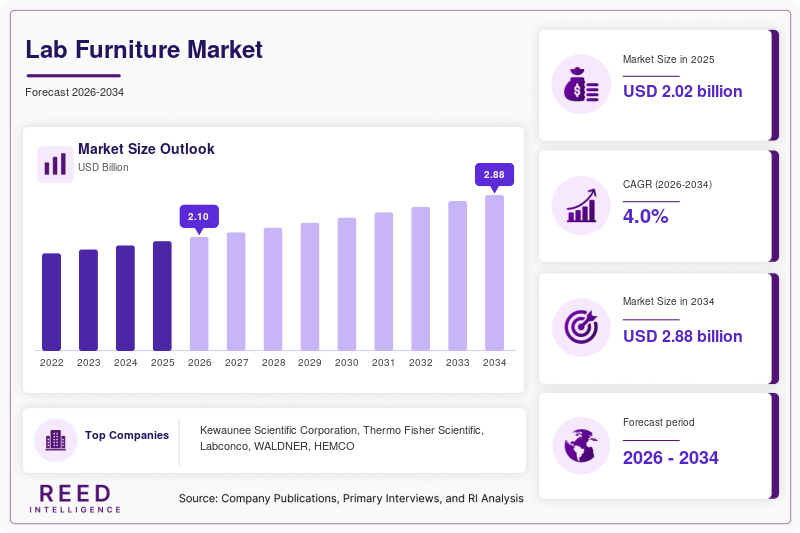
The global Lab Furniture Market size was valued at USD 2.02 billion in 2025 and is projected to grow from USD 2.10 billion in 2026 to USD 2.89 billion by 2034, registering a CAGR of 4.00% during the forecast period from 2026 to 2034.
The Lab Furniture Market is closely tied to laboratory construction, refurbishment and changes in research workflows. Unlike conventional commercial furniture, laboratory casework must accommodate chemicals, heavy instruments, utilities, cleaning and decontamination requirements. The U.S. National Institutes of Health (NIH) Design Requirements Manual states that laboratory casework includes fixed and mobile cabinets, shelving, countertops and accessories and describes casework as a major contributor to laboratory fit-out cost. It also requires flexibility and modularity to respond to changes in scientific processes.
The design direction is moving toward adaptable workspaces. The National Research Council's laboratory guidance notes the shift toward open, multi-module laboratories with relocatable furnishings, mobile carts, adjustable tables and equipment racks.
Demand is also influenced by life-sciences real-estate activity. JLL reported in June 2026 that U.S. lab availability had begun to contract after peaking in 2025, with demand returning in leading markets and tenants increasingly prioritizing newer, higher-quality facilities. CBRE similarly reported that U.S. lab/R&D construction activity had fallen sharply, but employment, venture capital and life-sciences demand were improving in 2026.
Kewaunee's industry presentation estimated the broader global laboratory furniture and enclosure market at USD 2.6 billion in 2022 and USD 3.6 billion by 2027, with lab furniture and fixtures representing about half of that broader market.
Lab Furniture Market Drivers
Laboratory Construction and Refurbishment Create Recurring Furniture Demand
Laboratory furniture demand is generated by both new laboratory construction and refurbishment of existing facilities. NIH renovation guidance specifically includes installation of casework and benchtops among moderate and extensive laboratory renovation activities.
The commercial mechanism is important because furniture is often specified as part of the laboratory fit-out rather than purchased as ordinary loose furniture. A new pharmaceutical laboratory, university research center, hospital laboratory or industrial testing facility may require casework, worktops, storage, benches, sinks, service carriers and specialized workstations.
The U.S. life-sciences property market is showing early signs of stabilization after several years of oversupply. JLL reported in June 2026 that availability had declined by about 2 million square feet from mid-2025, while tenants were increasingly moving toward higher-quality laboratory buildings.
This creates demand for new furniture in newly built facilities and replacement demand where older laboratories are renovated to meet current workflow, safety and equipment requirements.
Modularity and Adaptability Are Becoming Core Design Requirements
Laboratory workflows can change substantially as research programs, instruments and team structures change. The National Research Council recommends adaptable furnishings, mobile carts and adjustable tables, while NIH requires laboratory casework to be flexible and modular enough to respond to changing scientific processes.
Manufacturers are responding with modular benches, movable workstations, island systems and service carriers. Kewaunee's portfolio includes flexible systems, island modules, service carriers, enterprise modular workstations, heavy-duty tables and adjustable benches.
Thermo Fisher's Dimension4 Modular Lab Tables similarly provide scalable platforms for automated laboratory workstations. The tables can be connected into larger systems, adjusted in height and integrated with automation and power.
The commercial impact is a shift from fixed, one-purpose furniture toward products that can be relocated or reconfigured as laboratory equipment changes.
Safety and Hygiene Requirements Increase the Specification Level
Laboratory furniture must withstand chemical exposure, repeated cleaning and heavy equipment loads. OSHA's laboratory guidance recommends chemically resistant, smooth and easy-to-clean work surfaces, while wet laboratory flooring and other surfaces need resistance to chemicals and contamination.
NIH specifications go further for research facilities, requiring laboratory finishes to be smooth, easily sanitized and resistant to chemicals and disinfectants. It also specifies structural requirements for shelving, cabinets and countertops.
This creates demand for epoxy resin, stainless steel, chemical-resistant laminates, powder-coated steel and other specialized materials rather than standard office-furniture materials. Kewaunee, for example, offers steel casework, wood casework, epoxy-resin worktops and adaptable laboratory systems.
Lab Furniture Market Restraints
Laboratory Construction Cycles Are Uneven
Laboratory furniture demand depends heavily on capital-intensive construction and renovation projects. When pharmaceutical, biotechnology or university investment slows, furniture orders can be postponed.
The U.S. life-sciences property market demonstrates this cyclicality. CBRE reported in August 2026 that lab/R&D construction had fallen to 4.7 million square feet, down 88% from mid-2023, while vacancy remained elevated.
Although lower construction can eventually improve supply-demand conditions, the transition creates uneven order timing for furniture manufacturers and installers.
Customization Raises Manufacturing and Installation Complexity
Laboratory furniture is frequently customized according to room dimensions, equipment, utilities and scientific workflows. Kewaunee states that the majority of its products are customized to meet specific architectural design and performance requirements, with orders sometimes divided into manufacturing runs to match construction schedules.
Customization increases engineering, production and installation requirements. It can also extend project lead times when building designs or equipment specifications change.
For customers, customized systems improve laboratory functionality but can increase upfront costs compared with standardized commercial furniture.
Opportunities
Growth in Modular and Reconfigurable Laboratory Systems
Flexible laboratory design creates an opportunity for modular furniture suppliers. NIH and National Research Council guidance both emphasize adaptability, relocatable furnishings and modular laboratory configurations.
The commercial opportunity extends beyond new laboratories. Existing facilities can be upgraded by replacing fixed casework with mobile tables, modular benches, adjustable workstations and flexible service connections. This enables customers to modify workflows without completely rebuilding laboratory interiors.
Thermo Fisher's Dimension4 platform demonstrates the direction of this market, with modular tables designed to connect into larger automated systems and accommodate changing equipment configurations.
Pharmaceutical, Biotechnology and Advanced-Research Facilities
Life-sciences research remains an important source of specialized laboratory demand. CBRE reported in June 2026 that biotechnology R&D and pharmaceutical manufacturing employment were growing at their strongest pace in nearly three years, while venture-capital conditions were improving.
These facilities often require higher-specification furniture because laboratories must accommodate analytical instruments, biological materials, chemical handling, cleanability and controlled workflows.
The opportunity is particularly relevant to manufacturers capable of delivering complete laboratory environments rather than individual cabinets. Kewaunee's product portfolio combines casework, fume hoods, worktops, sinks, adaptable systems and safety cabinets.
Renovation of Aging Laboratory Infrastructure
Renovation provides an opportunity even when new laboratory construction is subdued. NIH's renovation framework explicitly includes casework and benchtop replacement as part of laboratory facility upgrades.
Older laboratories may require improved chemical resistance, better storage, ergonomic workstations, updated accessibility, improved equipment integration or safer anchoring. NIH's current design requirements specify structural loading, shelving heights and anchorage requirements for laboratory casework.
Segmental Analysis
By Product Type
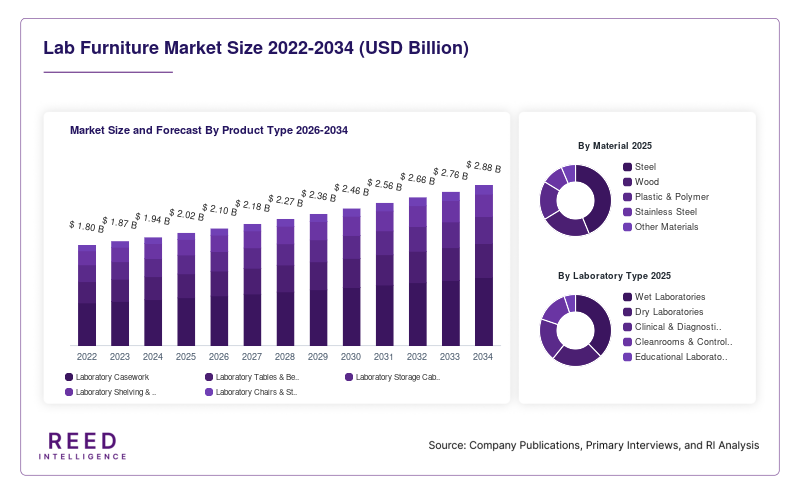
Laboratory Casework represents approximately 38% of the global market in 2025, making it the dominant product category. Casework includes base cabinets, wall cabinets, specialty storage and integrated work surfaces. NIH identifies casework as critical to laboratory function and a major laboratory fit-out cost component.
Laboratory Tables & Benches account for approximately 27%, followed by Laboratory Storage Cabinets at 16%, Laboratory Shelving & Racks at 11%, and Laboratory Chairs & Stools at 8%.
Laboratory Tables & Benches are the fastest-growing product segment, with approximately 4.8% CAGR, supported by modular, adjustable and automation-compatible laboratory configurations. Thermo Fisher's Dimension4 system illustrates the shift toward scalable workstations that can be reconfigured as laboratory equipment changes.
By Material
Steel represents approximately 42% of the market in 2025. Steel is widely used for laboratory casework because of its strength, durability, cleanability and compatibility with chemical-resistant coatings. Kewaunee describes its steel casework as heavy-gauge, full-frame construction designed for laboratory environments.
Wood accounts for approximately 25%, while Plastic & Polymer represents 13%, Stainless Steel 12%, and other materials 8%.
Stainless Steel is the fastest-growing material segment, with approximately 5.1% CAGR, supported by cleanrooms, controlled environments, healthcare laboratories and applications requiring high resistance to corrosion and repeated sanitation.
By Laboratory Type
Wet Laboratories represent approximately 34% of the market in 2025. These facilities require chemical-resistant surfaces, sinks, storage, ventilation integration and durable workstations. OSHA specifically recommends chemically resistant and easy-to-clean work surfaces for laboratory environments.
Clinical & Diagnostic Laboratories account for approximately 24%, Dry Laboratories 18%, Educational Laboratories 14%, and Cleanrooms & Controlled Environments 10%.
Cleanrooms & Controlled Environments are the fastest-growing laboratory type, with approximately 5.5% CAGR, reflecting requirements for highly cleanable, non-porous and controlled laboratory environments. NIH requires non-porous, easily sanitized finishes in laboratories and specifies higher-performance materials where contamination, humidity and frequent decontamination are concerns.
By End User
Pharmaceutical & Biotechnology represents approximately 31% of the market in 2025. The segment includes drug-development laboratories, analytical facilities, biotechnology research centers and production-support laboratories.
Academic & Research Institutions account for approximately 27%, followed by Healthcare & Clinical at 19%, Chemical & Petrochemical at 11%, Food & Beverage at 6%, and other industries at 6%.
Pharmaceutical & Biotechnology is also the fastest-growing end-user segment, with approximately 5.3% CAGR. Improving life-sciences employment and capital-market conditions are supporting renewed demand for laboratory space in leading markets.
Regional Analysis
North America Lab Furniture Market
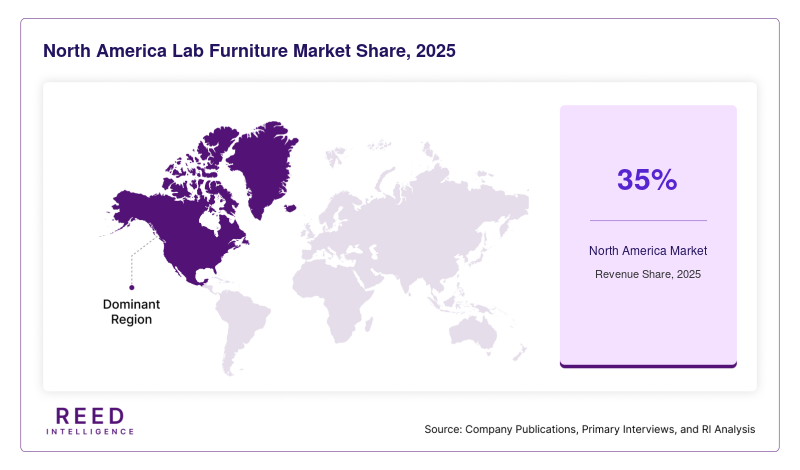
North America represents approximately 35% of the global Lab Furniture Market in 2025. The region has a large installed base of pharmaceutical, biotechnology, healthcare, university and industrial laboratories, supported by a mature laboratory-planning and construction ecosystem.
The U.S. market is currently transitioning from a period of laboratory-space oversupply toward more selective demand. JLL reported in June 2026 that lab availability had started to contract and tenants were increasingly prioritizing newer, higher-quality buildings.
CBRE reported that biotechnology R&D and pharmaceutical manufacturing employment growth strengthened in 2026, providing a demand signal for laboratory facilities even while overall vacancy remained high.
North American laboratory furniture specifications are also strongly influenced by safety and performance requirements. OSHA recommends chemical-resistant, smooth and easily cleaned laboratory work surfaces, while NIH requirements cover casework structural loading, accessibility and anchorage.
North America is projected to grow at approximately 3.5% CAGR through 2034. The region's established installed base creates replacement and renovation demand, while pharmaceutical and biotechnology investment provides new-project opportunities.
Europe Lab Furniture Market
Europe accounts for approximately 28% of the global market in 2025. The region has an established pharmaceutical and chemical manufacturing base, extensive university research infrastructure and a large network of clinical laboratories.
European demand is supported by both new research facilities and modernization of older laboratories. The emphasis on energy efficiency, worker safety, cleanability and adaptable laboratory layouts favors higher-specification casework and modular systems.
European suppliers also compete through customized laboratory environments rather than standardized furniture alone. This supports integrated project delivery involving casework, worktops, fume hoods, storage and installation.
Europe is projected to expand at approximately 3.7% CAGR. The key constraint is the relatively mature laboratory infrastructure in major Western European markets, which shifts demand toward refurbishment and replacement rather than rapid greenfield expansion.
APAC Lab Furniture Market
APAC represents approximately 24% of the global market in 2025 and is the fastest-growing region, with approximately 5.2% CAGR.
The region benefits from pharmaceutical manufacturing, biotechnology expansion, university research, healthcare infrastructure and industrial R&D. India and China are particularly important because they combine large research and manufacturing bases with expanding laboratory infrastructure.
Kewaunee operates a manufacturing facility in Bangalore serving India, Asian and African markets, alongside facilities in the U.S. and sales operations in Singapore and India.
The company's international strategy was also strengthened in April 2026 with the appointment of a new senior vice president for international sales focused on expanding its dealer network and strategic partnerships outside the U.S. and India.
APAC demand is also supported by the continued development of advanced laboratory and manufacturing facilities in biotechnology, pharmaceuticals, electronics and industrial testing. The region's principal constraints include differing standards, project-specific procurement requirements and price sensitivity in some markets.
Middle East and Africa Lab Furniture Market
Middle East and Africa represents approximately 6% of the global market in 2025 and is projected to grow at approximately 4.6% CAGR.
Demand is supported by hospital laboratory construction, university and research infrastructure, pharmaceutical manufacturing and industrial testing. Gulf countries are investing in healthcare and scientific infrastructure, while other markets are gradually developing specialized laboratory capacity.
The region's procurement structure often favors complete laboratory projects, making relationships among furniture manufacturers, distributors, architects, engineering firms and contractors important.
Kewaunee maintains sales activity in Saudi Arabia and identifies the Middle East among the regions covered by its international operations.
The main constraints are uneven laboratory infrastructure, project financing cycles and dependence on imported specialized furniture in several markets.
LATAM Lab Furniture Market
LATAM accounts for approximately 7% of the global market in 2025 and is expected to expand at approximately 4.5% CAGR.
Brazil and Mexico represent important laboratory-furniture markets because of their pharmaceutical, healthcare, food, chemical and academic research infrastructure. Demand is driven mainly by laboratory construction, refurbishment and equipment modernization.
The market favors suppliers capable of delivering customized casework and installation because laboratory projects often require furniture to be coordinated with utilities, ventilation, instruments and building layouts.
Price sensitivity and currency fluctuations remain constraints, particularly for imported laboratory furniture and specialized materials. Local manufacturing and regional distribution can therefore improve project competitiveness.
Competitive Landscape
The Lab Furniture Market contains specialized laboratory-furniture manufacturers, integrated laboratory-environment providers and companies that supply furniture alongside fume hoods, safety equipment and laboratory infrastructure.
Kewaunee Scientific is one of the major specialized suppliers. Its portfolio covers steel and wood casework, fume hoods, epoxy-resin worktops, sinks, adaptable systems, mobile workstations and educational furniture. The company operates manufacturing facilities in North Carolina and Bangalore and maintains sales operations in several international markets.
Thermo Fisher Scientific competes in specialized laboratory infrastructure through products such as its Dimension4 modular tables, which are designed for scalable automated workstations and can integrate power and laboratory automation systems.
Labconco combines laboratory ventilation and furniture products, including steel storage cabinets designed to support fume hoods and laboratory equipment. Its current cabinets use powder-coated steel and support loads of up to 800 pounds.
Key Market Players
- Kewaunee Scientific Corporation
- Thermo Fisher Scientific
- Labconco
- WALDNER
- HEMCO
- Mott Manufacturing
- Esco Lifesciences
- LOC Scientific
- Erlab
- Kottermann
- Shimadzu Corporation
- Asecos
- InterFocus
- New England Lab
- Diversified Woodcrafts
Recent Market Developments
- April 2026 – Kewaunee expanded its international commercial organization. The company appointed a new Senior Vice President of International Sales responsible for markets outside the U.S. and India, with a mandate covering dealer-network expansion and strategic partnerships.
- 2026 – Thermo Fisher continued offering Dimension4 modular laboratory tables. The system provides scalable platforms that can be connected into larger automated workstations, with height adjustment and integrated power.
Lab Furniture Market Segments
By Product Type
- Laboratory Casework
- Laboratory Tables & Benches
- Laboratory Storage Cabinets
- Laboratory Shelving & Racks
- Laboratory Chairs & Stools
By Material
- Steel
- Wood
- Plastic & Polymer
- Stainless Steel
- Other Materials
By Laboratory Type
- Wet Laboratories
- Dry Laboratories
- Clinical & Diagnostic Laboratories
- Cleanrooms & Controlled Environments
- Educational Laboratories
By End User
- Pharmaceutical & Biotechnology
- Healthcare & Clinical
- Academic & Research Institutions
- Chemical & Petrochemical
- Food & Beverage
- Other Industries
By Region
- North America
- Europe
- APAC
- Middle East and Africa
- LATAM