Laboratory Chemicals Market Size, Share & Trends Analysis Report By Type, By Grade, By Application, By End User and By Region, Forecasts 2026–2034
USD 3950
Laboratory Chemicals Market Size
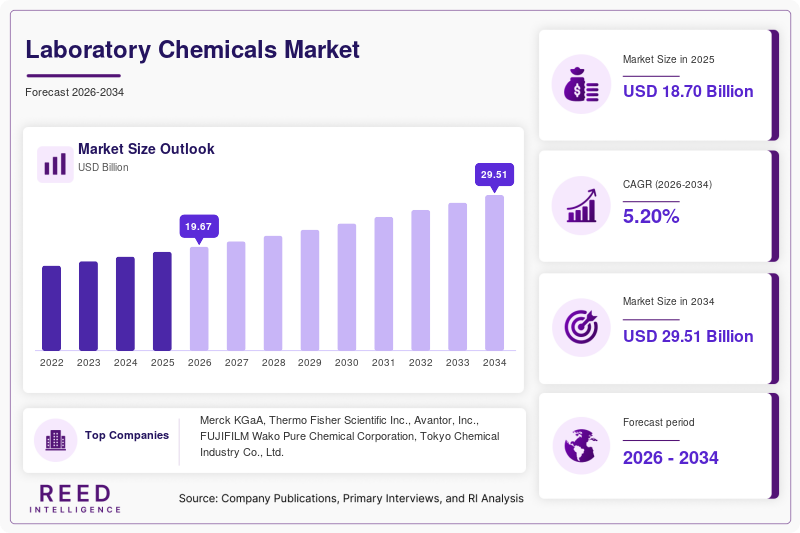
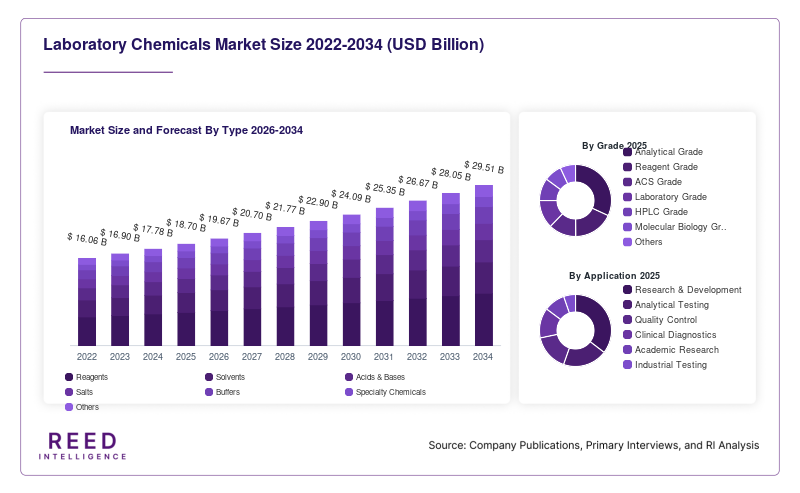
The global laboratory chemicals market was valued at USD 18.70 billion in 2025 and is projected to grow from USD 19.67 billion in 2026 to USD 28.90 billion by 2034, registering a CAGR of 5.20% during the forecast period from 2026 to 2034.
Laboratory chemicals are chemical substances used in research, testing, analytical procedures, diagnostics, quality control, education and industrial laboratory applications. They include solvents, acids, bases, salts, reagents, buffers, specialty chemicals and other chemical materials used for sample preparation, synthesis, analysis and experimentation.
The market is supported by increasing pharmaceutical and biotechnology research, expansion of clinical and diagnostic laboratories, growing academic research activity and increasing quality-control requirements across food, environmental, chemical and industrial sectors.
Laboratory Chemicals Market Drivers
Expansion of Pharmaceutical and Biotechnology Research
Increasing investment in drug discovery, pharmaceutical development and biotechnology research is creating demand for laboratory reagents and specialty chemicals.
Laboratory chemicals are used throughout research, synthesis, formulation development and analytical testing.
Growing Clinical Diagnostics
The expansion of clinical laboratories and diagnostic testing is increasing consumption of reagents, solvents, buffers and other laboratory chemicals.
The growing use of molecular and biochemical testing is also creating demand for specialized products.
Increasing Academic and Research Activity
Universities, research institutions and government laboratories require chemicals for scientific experimentation, analytical work and educational purposes.
Expansion of research infrastructure in emerging economies is contributing to market growth.
Rising Quality-Control Requirements
Pharmaceutical, food, beverage, chemical and manufacturing companies increasingly conduct laboratory testing to verify product quality and compliance.
This creates recurring demand for laboratory-grade chemicals.
Growth of Analytical Testing
Advanced analytical techniques such as chromatography, spectroscopy and mass spectrometry require high-purity solvents, reagents and standards.
Increasing adoption of these techniques is supporting demand for specialized laboratory chemicals.
Laboratory Chemicals Market Restraints
Stringent Chemical Regulations
Laboratory chemicals are subject to regulations concerning handling, storage, labeling, transportation and disposal.
Compliance requirements can increase manufacturing, distribution and operating costs.
High Cost of Specialty Chemicals
High-purity and specialized laboratory chemicals can be considerably more expensive than conventional industrial-grade chemicals.
Price sensitivity can limit adoption among smaller laboratories.
Supply-Chain Disruptions
Laboratory chemicals often depend on specialized raw materials and international supply chains.
Transportation disruptions, raw-material shortages and geopolitical factors can affect availability and pricing.
Chemical Waste Management
Laboratories must safely handle and dispose of chemical waste.
Increasing environmental requirements can increase the overall cost of laboratory operations.
Laboratory Chemicals Market Opportunities
Growth of Molecular Biology and Genomics
Expansion of genomics, proteomics, molecular biology and cell-based research is creating demand for specialized reagents and laboratory chemicals.
Increasing Demand for High-Purity Chemicals
Advanced analytical and research applications require chemicals with precise purity levels and low contamination.
This creates opportunities for suppliers of analytical-grade and specialty-grade products.
Expansion of Research Infrastructure in Emerging Markets
Government and private-sector investment in laboratories across Asia-Pacific, Latin America and other emerging markets is creating new demand.
Sustainable Laboratory Chemicals
Laboratories are increasingly seeking lower-toxicity, recyclable and environmentally preferable chemical products.
Suppliers developing greener solvents and safer alternatives can address evolving environmental requirements.
Digital Laboratory Procurement
Online ordering platforms and digital laboratory-supply systems are making it easier for researchers to identify and purchase chemicals.
Digital procurement can expand market access for specialized chemical suppliers.
Type Segment Analysis
By Type
Reagents accounted for approximately 31% of the laboratory chemicals market in 2025, making them the largest product-type segment. Reagents are widely used across chemical analysis, life-science research, diagnostics and pharmaceutical development.
Specialty chemicals accounted for approximately 12% and are projected to grow at approximately 6.6% CAGR, making them the fastest-growing major type segment. Increasing demand for highly specialized research and analytical applications is supporting growth.
Solvents represented approximately 27%, acids and bases 15%, salts 7%, buffers 6%, and other chemicals approximately 2%.
Grade Segment Analysis
By Grade
Analytical-grade chemicals accounted for approximately 29% of the market in 2025, making them the largest grade segment. Their controlled purity and consistency make them suitable for quantitative analysis and laboratory testing.
Molecular biology grade chemicals accounted for approximately 14% and are projected to grow at approximately 7.0% CAGR, making them the fastest-growing major grade segment. Expansion of genomics, molecular diagnostics and biotechnology research is supporting demand.
Reagent grade represented approximately 22%, ACS grade 17%, laboratory grade 11%, HPLC grade 5%, and other grades approximately 2%.
Application Segment Analysis
By Application
Research and development accounted for approximately 34% of the market in 2025, making it the largest application segment. Pharmaceutical, biotechnology, chemical and academic research organizations use laboratory chemicals extensively for experimentation and product development.
Clinical diagnostics accounted for approximately 17% and are projected to grow at approximately 6.4% CAGR, making it the fastest-growing major application segment. Increasing diagnostic testing and adoption of molecular and biochemical techniques are supporting demand.
Analytical testing represented approximately 21%, quality control 16%, academic research 8%, and industrial testing approximately 4%.
End-User Segment Analysis
By End User
Pharmaceutical and biotechnology companies accounted for approximately 32% of the market in 2025, making them the largest end-user segment. Drug discovery, formulation research, analytical testing and biotechnology development require substantial quantities of laboratory chemicals.
Hospitals and diagnostic laboratories accounted for approximately 18% and are projected to grow at approximately 6.5% CAGR, making them the fastest-growing major end-user segment. Increasing diagnostic volumes and expansion of laboratory-based testing are supporting growth.
Academic and research institutes represented approximately 24%, chemical and petrochemical companies 11%, food and beverage companies 7%, environmental testing laboratories 5%, and other end users approximately 3%.
Laboratory Chemicals Market Regional Analysis
North America Holds the Largest Share
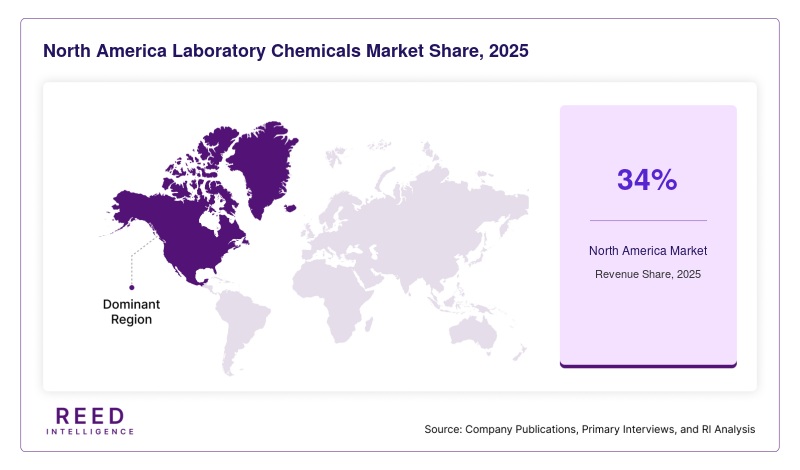
North America accounted for approximately 34% of the global laboratory chemicals market in 2025, making it the largest regional market. The region benefits from a strong pharmaceutical and biotechnology industry, extensive research infrastructure and widespread use of advanced analytical technologies.
Asia-Pacific accounted for approximately 29% and is projected to grow at approximately 6.7% CAGR, making it the fastest-growing major region. Increasing pharmaceutical manufacturing, biotechnology research, academic investment and laboratory infrastructure are supporting regional demand.
Europe Maintains Strong Research Demand
Europe accounted for approximately 26% of the market in 2025 and is projected to grow at approximately 4.8% CAGR.
The region benefits from established pharmaceutical, chemical and academic research sectors and strong demand for analytical and quality-control testing.
Latin America Shows Gradual Expansion
Latin America accounted for approximately 6% of the market in 2025 and is projected to grow at approximately 5.4% CAGR.
Expansion of pharmaceutical production, healthcare infrastructure and academic research is supporting demand for laboratory chemicals.
Middle East & Africa Represents an Emerging Market
Middle East & Africa accounted for approximately 5% of the market in 2025 and is projected to grow at approximately 5.7% CAGR.
Investment in healthcare, education, research infrastructure and industrial testing is creating opportunities for laboratory chemical suppliers.
Laboratory Chemicals Market Competitive Landscape
Competition in the laboratory chemicals market is based on chemical purity, product consistency, portfolio breadth, regulatory compliance, supply reliability, technical support, customization capabilities and distribution reach.
Manufacturers are expanding specialty-chemical portfolios while investing in high-purity production, sustainable products and digital ordering channels.
Key Market Players
- Merck KGaA
- Thermo Fisher Scientific Inc.
- Avantor, Inc.
- FUJIFILM Wako Pure Chemical Corporation
- Tokyo Chemical Industry Co., Ltd.
- Honeywell International Inc.
- BASF SE
- Spectrum Chemical Manufacturing Corp.
- Alfa Aesar
- Loba Chemie Pvt. Ltd.
Laboratory Chemicals Market Recent Developments
- Pharmaceutical, biotechnology and advanced analytical laboratories are increasingly requiring chemicals with tightly controlled purity specifications. This is supporting demand for analytical-grade, HPLC-grade and molecular-biology-grade products.
- Growth in genomics, molecular diagnostics, cell biology and biotechnology research is increasing demand for specialized reagents and laboratory chemicals.
Laboratory Chemicals Market Segments
By Type
- Reagents
- Solvents
- Acids & Bases
- Salts
- Buffers
- Specialty Chemicals
- Others
By Grade
- Analytical Grade
- Reagent Grade
- ACS Grade
- Laboratory Grade
- HPLC Grade
- Molecular Biology Grade
- Others
By Application
- Research & Development
- Analytical Testing
- Quality Control
- Clinical Diagnostics
- Academic Research
- Industrial Testing
By End User
- Pharmaceutical & Biotechnology Companies
- Academic & Research Institutes
- Hospitals & Diagnostic Laboratories
- Chemical & Petrochemical Companies
- Food & Beverage Companies
- Environmental Testing Laboratories
- Others
By Region
- North America
- Europe
- APAC
- Middle East and Africa
- LATAM