Lacrosse Market Size, Share & Trends Analysis Report By Equipment Type (Sticks & Heads, Shafts & Handles, Protective Equipment, Balls, Apparel & Footwear, Accessories & Training Equipment), By Playing Format (Field Lacrosse, Box Lacrosse, Sixes Lacrosse), By End User (Youth & Amateur, Collegiate, Professional, Recreational & Adult), By Distribution Channel (Sporting Goods & Specialty Stores, Online Retail, Team/Club & Institutional Sales) and Forecasts, 2026–2034
USD 3950
Lacrosse Market Size
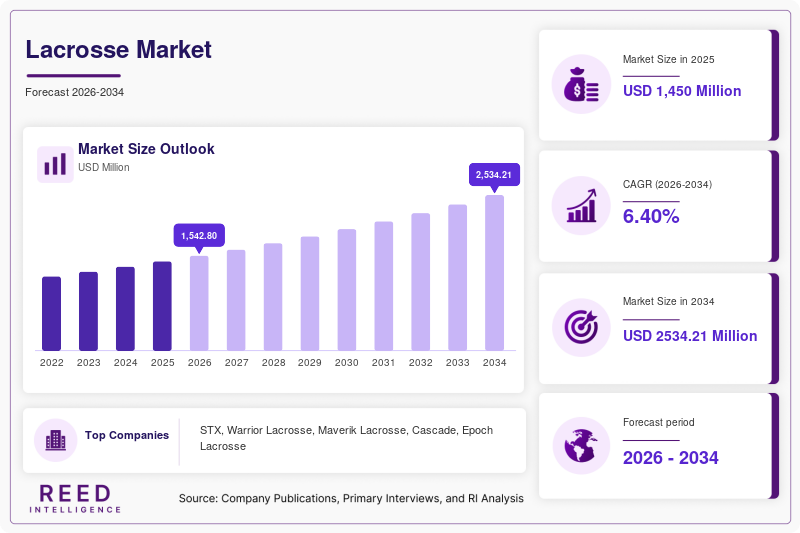
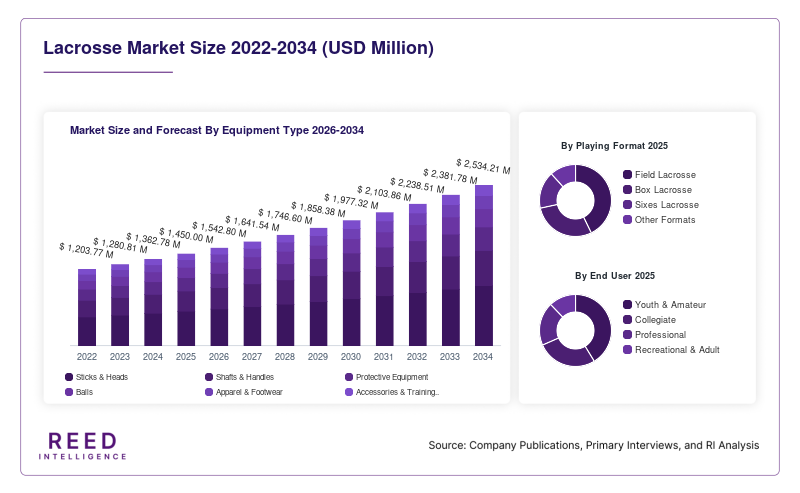
The global lacrosse market is valued at USD 1,450 Million in 2025 and USD 1,542.80 Million in 2026. The market is projected to reach USD 2,534.21 Million by 2034, registering a 6.40% CAGR during the forecast period.
The lacrosse market comprises equipment, apparel, protective gear, balls, accessories, training products, sporting-goods retail, organized competition and related commercial activity surrounding field, box and sixes lacrosse. The market serves youth and amateur participants as well as collegiate, professional and recreational athletes.
The sport is entering a significant expansion phase as participation pathways, professional leagues and international competition broaden simultaneously. USA Lacrosse states that lacrosse is one of the fastest-growing U.S. high-school sports, while its current development information identifies more than 900 NCAA varsity lacrosse programs across Divisions I, II and III, up from roughly 600 a decade ago. USA Lacrosse also identifies three professional leagues the National Lacrosse League, Premier Lacrosse League and Women's Lacrosse League and states that World Lacrosse now has more than 90 member nations.
Lacrosse Market Drivers
Expansion of youth, collegiate and grassroots pathways is increasing the addressable participant base
The expansion of organized lacrosse programs is one of the strongest structural demand drivers because each new participant requires sticks, protective equipment, balls, apparel and training gear.
USA Lacrosse currently reports more than 900 NCAA varsity lacrosse programs across Divisions I, II and III, compared with roughly 600 a decade earlier. The organization also states that nearly 15% of high-school lacrosse players continue to college competition.
At the youth level, USA Lacrosse reported in 2026 that more elementary-aged children are playing the sport than ever before. Its Momentum Lab, launched in May 2026, is designed to help member programs improve participation, operations and long-term sustainability.
The commercial effect is cumulative: increased participation generates recurring purchases as children move into new sizes, higher-performance equipment and different playing positions.
Olympic inclusion and international expansion are increasing visibility and supporting new lacrosse markets
Lacrosse will return to the Olympic Games at Los Angeles 2028, with men and women competing in the sixes format. World Lacrosse has already established qualification pathways leading into the Games.
International competition is already widening the participant base. The 2026 Women's World Championship featured 16 qualified teams, attracted more than 30,000 spectators in Tokyo and produced several firsts for emerging lacrosse nations.
World Lacrosse also confirmed in September 2026 that men's and women's sixes will be part of The World Games 2029 in Karlsruhe, Germany. The organization expects approximately 4,000 athletes from more than 100 countries across the full World Games program.
This creates additional opportunities for equipment suppliers because international programs require standardized sticks, balls, protective systems, uniforms and coaching resources.
Professional league commercialization is strengthening the connection between participation, apparel and consumer spending
Professional lacrosse is becoming a more diversified commercial platform. The NLL, PLL and WLL are increasing league-wide partnerships, fan engagement and grassroots initiatives, creating additional channels for equipment and apparel visibility.
The NLL's April 2026 agreement with Capelli Sport made the company the league's Official Uniform through 2029, including on-floor jerseys, shorts and training and lifestyle collections.
The NLL also partnered with STX as its Official Equipment Provider in February 2026, tying professional competition to equipment exposure and wholesale purchasing opportunities for member clubs.
The PLL's 2026 commercial platform includes premium consumer brands, the WLL's touring season, Street Lacrosse and PLL Play, integrating professional entertainment with youth participation and community activation.
Lacrosse Market Restraints
Equipment costs can create participation barriers for families and developing programs
Lacrosse requires a meaningful equipment investment, particularly for goalkeepers and older players who need specialized sticks, gloves, helmets, shoulder or chest protection and position-specific equipment.
The cost issue is not limited to new players. As athletes progress, equipment can become more specialized, creating additional expenditure for families and clubs.
USA Lacrosse's 2026 governance materials explicitly identify the economics of getting a first stick into a player's hands, noting an annual giving strategy based on a $28 cost for providing a first stick.
This makes rental programs, used equipment, charitable distribution and entry-level equipment packages commercially important in expanding participation.
Safety and equipment-standard requirements can increase product-development and compliance costs
Manufacturers must meet applicable equipment standards and, for certain products, obtain acceptance for organized competition.
USA Lacrosse requires certain protective equipment to meet ASTM or NOCSAE performance standards and maintains approved lists of legal women's sticks and other equipment. The 2026 boys' rules also introduced equipment-related changes and emphasized proper use of protective gear.
The compliance burden can increase tooling, testing and certification costs, particularly for helmets, headgear, goalie protection and other safety-critical products.
Lacrosse Market Opportunities
Sixes lacrosse can create a lower-barrier format for international and grassroots expansion
Sixes is especially relevant because it reduces team size and can fit more easily into multi-sport venues and shorter competition schedules than traditional field lacrosse.
The format is central to the 2028 Olympics and will also appear at The World Games 2029. World Lacrosse is already organizing Sixes world championships as part of the Olympic qualification pathway.
Equipment suppliers can address this opportunity with standardized sticks, lighter protective systems, compact goals, development equipment and training packages designed for new national programs.
Women's professional lacrosse is creating additional demand across equipment, apparel and media
The WLL's expansion into a full-field summer season during 2026 creates an additional professional pathway and increases the visibility of women's-specific equipment and apparel.
The commercial ecosystem is also expanding beyond the traditional equipment market. The NLL's Capelli Sport partnership and the WLL's relationship with Maybelline demonstrate how professional lacrosse is attracting consumer brands outside traditional sporting goods. The increased visibility can translate into demand for women's sticks, headgear, gloves, apparel, footwear and fan merchandise.
Digital commerce and direct-to-consumer brands can improve access to specialized equipment
Lacrosse has a wide range of position-specific products, making online retail particularly valuable for informed buyers seeking specific heads, shafts, mesh, gloves, protective gear and replacement components.
STX's current online product portfolio illustrates the depth of specialization, spanning heads, handles, complete sticks, gloves, protective products, helmets, mesh, bags and accessories. Its current lineup includes the Stallion 1K, Surgeon 1K and Magnet 2K heads and other position-specific equipment.
Online channels allow manufacturers to reach smaller regional markets and international players without maintaining a broad physical specialty-retail footprint.
Equipment Type Analysis
Sticks & Heads remain the dominant equipment category because every field player requires a primary playing stick
The Sticks & Heads segment accounts for 38% of the global market in 2026 and is projected to register a 6.10% CAGR.
Sticks are the core piece of lacrosse equipment and generate replacement and upgrade demand as athletes move from entry-level to performance-oriented equipment or change positions.
Product development is increasingly position-specific. STX's current portfolio includes offensive, midfield, defensive and faceoff heads, while its 1K and 2K collections emphasize weight, stiffness, durability and specialized geometry.
Protective Equipment is the fastest-growing major equipment category as safety specifications and participation broaden
The Protective Equipment segment accounts for 23% of the global market in 2026 and is projected to register a 7.20% CAGR, making it the fastest-growing major equipment category.
Protective demand includes helmets, gloves, shoulder and chest protection, elbow protection, goggles and headgear.
USA Lacrosse's equipment standards require defined performance certifications for several safety-critical products, while the 2026 rules continue to emphasize correct equipment use. The growth is also supported by participation expansion into youth and women's lacrosse, where equipment requirements differ by format and age.
Playing Format Analysis
Field Lacrosse remains the dominant playing format because it anchors the largest participation and collegiate ecosystem
The Field Lacrosse segment accounts for 57% of the global market in 2026 and is projected to register a 6.00% CAGR.
Field lacrosse drives substantial equipment demand across youth, high school, collegiate and professional competition. More than 900 NCAA varsity programs participate in men's and women's field lacrosse across the three NCAA divisions.
Distribution Channel Analysis
Sporting Goods & Specialty Stores remain the dominant distribution channel because players depend on fitting, technical guidance and immediate equipment access
The Sporting Goods & Specialty Stores segment accounts for 48% of the global market in 2026 and is projected to register a 5.90% CAGR.
Specialty retail is particularly relevant for sticks, helmets, gloves and protective systems because fit, stringing, position-specific selection and equipment compliance can influence purchasing decisions.
Online Retail is the fastest-growing distribution channel as specialized products become easier to discover and ship directly
The Online Retail segment accounts for 21% of the global market in 2026 and is projected to register a 8.90% CAGR, making it the fastest-growing distribution channel.
Lacrosse equipment is highly specification-driven, making online channels well suited to repeat purchases, replacement heads, shafts, mesh, apparel and accessories.
STX operates a large direct digital storefront spanning heads, handles, complete sticks, protective products, helmets, mesh, bags and accessories, demonstrating the breadth of products that can be sold directly to consumers.
Lacrosse Market Regional Analysis
North America Lacrosse Market
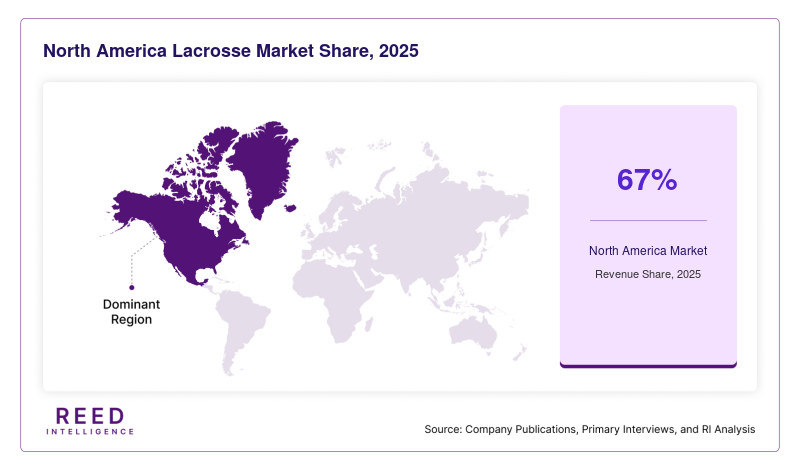
North America remains the dominant regional market because the United States and Canada contain the sport's deepest participation base, collegiate infrastructure, professional leagues, equipment suppliers and organized youth programs.
The North America region accounts for 67% of the global market in 2026 and is projected to register a 5.90% CAGR.
The U.S. collegiate ecosystem includes more than 900 varsity NCAA programs, while USA Lacrosse has more than 425,000 members and supports youth, high-school, collegiate and national-team pathways.
The NLL also welcomed more than 1 million fans for the fourth consecutive season, while its grassroots UnBOXed program is scheduled to expand into 60 communities by 2028.
Canada adds a substantial box-lacrosse ecosystem and maintains a formal participation and player-development relationship with the NLL through Lacrosse Canada.
APAC Lacrosse Market
APAC is the fastest-growing regional market as Japan, Australia, China, South Korea, India and other markets increase participation, competition hosting and grassroots investment.
The APAC region accounts for 9% of the global market in 2026 and is projected to register a 9.30% CAGR, making it the fastest-growing regional market.
Japan hosted the 2026 World Lacrosse Women's Championship, which drew more than 30,000 spectators across two Tokyo venues. The event also included a debut by the Philippines, while Japan itself reached the seventh-place position.
The region also has a growing international-development pipeline through World Lacrosse's continental qualification structure.
Europe Lacrosse Market
Europe is projected to register a 6.70% CAGR, supported by increasing participation, club development, university lacrosse and international championship activity.
The 2026 World Lacrosse Women's Championship Division II in Wroclaw featured 12 teams, with Italy winning the inaugural Division II title and teams from Europe, Asia-Pacific and Africa participating.
Europe is also positioned to benefit from sixes' Olympic visibility and the confirmation of the 2029 World Games competition in Germany.
Middle East and Africa Lacrosse Market
The Middle East and Africa market is projected to register a 8.10% CAGR, supported by youth development, school programs and gradual expansion of national-team structures.
International competitions are helping widen the market. The 2026 Women's World Championship included teams from across established and emerging lacrosse regions, while World Lacrosse's membership structure continues to support development across multiple continents.
Equipment suppliers can address this market through entry-level packages, federation partnerships, coaching initiatives and lower-cost sixes equipment.
LATAM Lacrosse Market
LATAM is projected to register a 7.80% CAGR, supported by increasing youth participation, international competition and growing visibility of professional and national-team pathways.
Argentina's ninth-place result at the 2026 Women's World Championship represented a 17-position improvement from its 2022 result, while Puerto Rico achieved its best-ever eighth-place finish. These outcomes demonstrate expanding competitive depth in the Americas.
Lacrosse Market Competitive Landscape
The lacrosse market is characterized by competition among global sporting-goods companies, specialized lacrosse brands, apparel suppliers, helmet manufacturers and direct-to-consumer equipment businesses.
STX remains a major equipment supplier across men's and women's lacrosse, with product lines covering heads, handles, complete sticks, gloves, protective gear, helmets, mesh and accessories. Its current portfolio includes the 1K collection, Magnet 2K, X-IT faceoff head and women's Lock Pocket products.
Warrior Lacrosse competes across sticks, shafts, heads, gloves and protective equipment, particularly in men's field and box lacrosse. The brand's product development emphasizes performance materials and position-specific designs.
Maverik Lacrosse serves men's field and box players through heads, shafts, complete sticks, gloves, helmets and protective systems and competes strongly in higher-performance equipment.
Key Market Players
- STX
- Warrior Lacrosse
- Maverik Lacrosse
- Cascade
- Epoch Lacrosse
- Nike
- StringKing
- Gait Lacrosse
- True Temper
- Brine
- Champro
- East Coast Dyes
- Capelli Sport
- Under Armour
- Regional Lacrosse Equipment Manufacturers
Recent Developments
September 2026 – the National Lacrosse League announced that it would move forward with 12 active clubs for the 2026–27 season after the Ottawa Black Bears and Philadelphia Wings discontinued operations. The league stated that the decision followed an assessment of ownership, venue, market infrastructure and operational sustainability. Despite the club changes, the NLL reported more than 1 million fans for the fourth consecutive season and said its UnBOXed grassroots program is planned to reach 60 communities by 2028.
August 2026 – the National Lacrosse League and YinzCam announced a league-wide digital-engine partnership. Beginning with the 2026 NLL Faceoff Weekend, the collaboration is scheduled to launch a new NLL mobile app, NLL Fan ID powered by YinzCam Single Sign-On and an NLL Customer Data Platform.
Lacrosse Market Segments
By Equipment Type
- Sticks & Heads
- Shafts & Handles
- Protective Equipment
- Balls
- Apparel & Footwear
- Accessories & Training Equipment
By Playing Format
- Field Lacrosse
- Box Lacrosse
- Sixes Lacrosse
- Other Formats
By End User
- Youth & Amateur
- Collegiate
- Professional
- Recreational & Adult
By Distribution Channel
- Sporting Goods & Specialty Stores
- Online Retail
- Team/Club & Institutional Sales
- Others
By Region
- North America
- Europe
- APAC
- Middle East and Africa
- LATAM