Lactate Monitoring Device Market Size, Share & Demand Report By Product Type (Handheld Lactate Analyzers, Benchtop Analyzers, Wearable Lactate Sensors), By Application (Critical Care Monitoring, Sports & Fitness Monitoring, Research & Laboratory Use), By End-User (Hospitals, Diagnostic Laboratories, Home Care Settings, Sports Institutes) & Segment Forecasts, 2026–2034
USD 3950
Market Overview
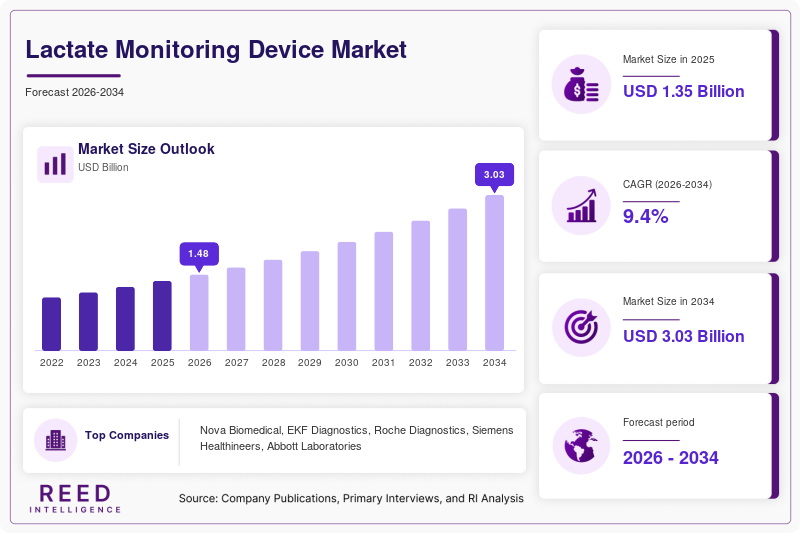
The Lactate Monitoring Device Market was valued at approximately USD 1.35 billion in 2026 and is projected to reach USD 2.78 billion by 2034, expanding at a compound annual growth rate (CAGR) of 9.4% during 2026–2034. Lactate monitoring devices are widely used in critical care, sports medicine, and chronic disease management to assess metabolic stress and tissue oxygenation. The increasing prevalence of conditions such as sepsis, cardiovascular disorders, and respiratory diseases has significantly driven demand for accurate and real-time lactate measurement solutions across healthcare settings.
One of the primary global factors supporting market growth is the rising emphasis on early diagnosis and patient monitoring in intensive care units (ICUs). Healthcare providers are increasingly adopting point-of-care (POC) diagnostic devices that enable rapid decision-making and improve patient outcomes. Lactate monitoring devices play a vital role in identifying hypoxia and metabolic imbalances, thereby aiding clinicians in timely intervention. Furthermore, technological advancements such as portable analyzers and wearable biosensors have improved device usability and expanded application scope beyond hospitals into home care and sports environments.
Key Highlights
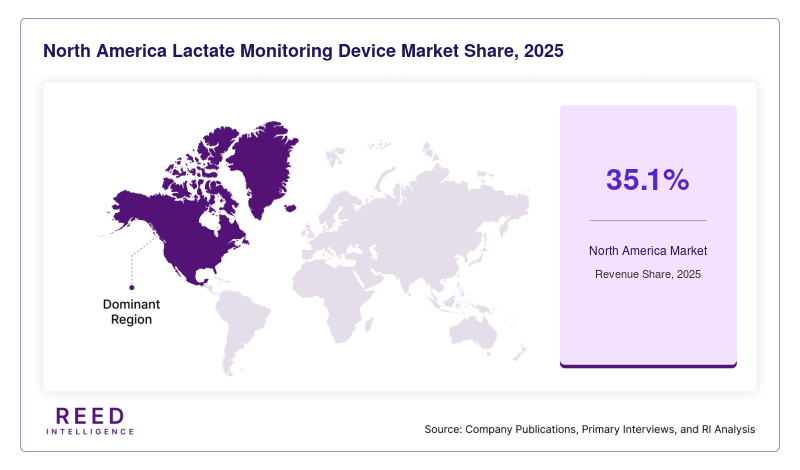
- North America dominated the market with a 35.1% share in 2025.
- Asia Pacific is expected to grow at the fastest CAGR of 10.8% during 2026–2034.
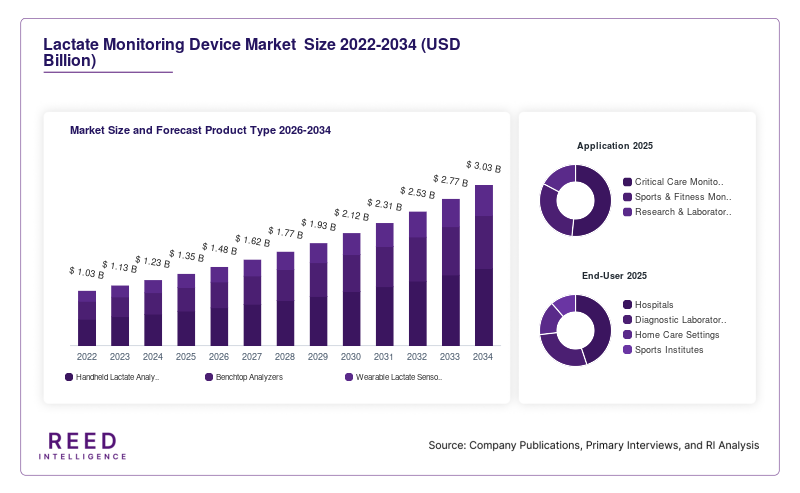
- By product type, handheld lactate analyzers accounted for the largest share of 39.2%, while wearable lactate sensors are projected to grow at a CAGR of 12.7%.
- By application, critical care monitoring led with a 42.6% share, whereas sports and fitness monitoring is expected to expand at a CAGR of 11.9%.
- The United States remained the dominant country, with market values of USD 480 million in 2024 and USD 525 million in 2025.
Market Trends
Integration of Wearable and Continuous Monitoring Technologies
A significant trend shaping the Lactate Monitoring Device Market is the integration of wearable technologies that allow continuous lactate tracking. Traditional lactate testing methods required blood samples and laboratory analysis, which limited their usability in dynamic environments. However, the emergence of non-invasive and minimally invasive wearable biosensors has transformed the monitoring process. These devices are increasingly being adopted in sports training, military applications, and rehabilitation programs. Athletes and trainers use real-time lactate data to optimize performance and prevent overtraining. Additionally, advancements in microfluidics and biosensor technologies have improved accuracy and reliability, making wearable devices a viable alternative to conventional analyzers. This trend is expected to drive innovation and expand the market into consumer health segments.
Expansion of Point-of-Care Testing in Healthcare Settings
Another notable trend is the growing adoption of point-of-care testing (POCT) solutions in hospitals and emergency care units. Lactate monitoring devices are increasingly integrated into portable diagnostic platforms that provide rapid results within minutes. This is particularly beneficial in critical care scenarios such as sepsis management, where timely lactate measurement can significantly impact patient survival rates. Healthcare systems are prioritizing efficiency and cost reduction, leading to increased investment in compact and user-friendly devices. Furthermore, the shift toward decentralized healthcare and outpatient care models has accelerated demand for portable lactate monitoring systems. This trend is likely to enhance accessibility and drive consistent market growth over the forecast period.
Market Drivers
Increasing Prevalence of Chronic and Critical Illnesses
The rising incidence of chronic and life-threatening diseases is a major driver for the Lactate Monitoring Device Market. Conditions such as sepsis, heart failure, and respiratory disorders often result in elevated lactate levels, making lactate measurement an essential diagnostic parameter. Hospitals and emergency departments rely on lactate monitoring to assess disease severity and guide treatment decisions. The growing global burden of chronic diseases has increased hospital admissions and ICU utilization, thereby boosting demand for lactate monitoring devices. Additionally, aging populations in developed and developing regions are more susceptible to such conditions, further contributing to market expansion. Continuous monitoring capabilities are increasingly preferred, enhancing the adoption of advanced devices.
Technological Advancements and Product Innovation
Rapid advancements in medical technology have significantly enhanced the functionality and efficiency of lactate monitoring devices. Innovations such as miniaturized sensors, wireless connectivity, and integration with digital health platforms have improved device performance and usability. Modern devices offer faster results, higher accuracy, and user-friendly interfaces, making them suitable for both clinical and non-clinical applications. Companies are investing in research and development to create next-generation devices that support remote monitoring and data analytics. These innovations not only improve patient outcomes but also enable healthcare providers to streamline workflows. As technology continues to evolve, it is expected to play a crucial role in driving market growth and expanding application areas.
Market Restraint
High Cost and Limited Accessibility in Developing Regions
One of the key restraints affecting the Lactate Monitoring Device Market is the high cost associated with advanced monitoring systems and limited accessibility in low- and middle-income countries. While technologically advanced devices offer enhanced accuracy and real-time monitoring capabilities, their high initial cost and maintenance requirements can be a barrier for smaller healthcare facilities. Many hospitals in developing regions operate under constrained budgets, limiting their ability to invest in advanced diagnostic equipment. Additionally, the cost of consumables such as test strips and calibration materials further adds to the overall expense. This restricts widespread adoption, particularly in rural and underserved areas.
The lack of trained healthcare professionals to operate and interpret results from these devices also poses a challenge. In some regions, inadequate infrastructure and limited awareness about the benefits of lactate monitoring hinder market penetration. For example, in parts of Africa and Southeast Asia, reliance on traditional diagnostic methods remains prevalent due to cost concerns. These factors collectively slow down market growth and highlight the need for affordable and scalable solutions to ensure broader adoption across diverse healthcare systems.
Market Opportunities
Growth in Sports and Fitness Applications
The expanding use of lactate monitoring devices in sports and fitness presents a significant growth opportunity. Athletes and fitness enthusiasts increasingly rely on lactate data to optimize training intensity and improve performance. Coaches use lactate thresholds to design personalized training programs, ensuring efficient energy utilization and minimizing fatigue. The rising popularity of endurance sports such as marathon running, cycling, and triathlons has further boosted demand for portable and wearable lactate monitoring devices. Additionally, the integration of these devices with mobile applications allows users to track performance metrics in real time. This growing consumer interest in health and fitness is expected to create new revenue streams for market players.
Expansion in Home Healthcare and Remote Monitoring
The shift toward home healthcare and remote patient monitoring is another promising opportunity for the market. With the increasing prevalence of chronic diseases, there is a growing need for continuous monitoring outside hospital settings. Lactate monitoring devices that are easy to use and provide accurate results are gaining traction among home care patients. Telemedicine platforms enable healthcare providers to remotely access patient data and make informed decisions. This reduces hospital visits and improves patient convenience. Furthermore, advancements in connectivity and cloud-based data management are enhancing the effectiveness of remote monitoring solutions. This trend is expected to drive significant market growth in the coming years.
Segmental Analysis
By Product Type
Handheld lactate analyzers dominated the Lactate Monitoring Device Market, accounting for approximately 39.2% share in 2024. These devices are widely used due to their portability, ease of use, and rapid results. They are particularly popular in clinical settings, sports environments, and emergency care scenarios. The ability to perform on-site testing without the need for complex laboratory infrastructure makes handheld analyzers highly efficient. Additionally, advancements in sensor technology have improved their accuracy and reliability, further driving adoption. Healthcare providers prefer these devices for quick decision-making, especially in critical care situations.
Wearable lactate sensors are the fastest-growing subsegment, projected to expand at a CAGR of 12.7% during the forecast period. The growth is driven by increasing demand for continuous monitoring and real-time data analysis. These devices are gaining popularity in sports and fitness applications, as they allow users to track lactate levels during physical activity. The integration of wearable sensors with smartphones and fitness apps enhances user experience and data accessibility. Furthermore, ongoing research in non-invasive monitoring technologies is expected to improve device performance and expand their application scope.
By Application
Critical care monitoring emerged as the dominant application segment, holding a share of 42.6% in 2024. Lactate monitoring is a crucial parameter in managing conditions such as sepsis and organ failure. Hospitals and intensive care units rely on lactate measurements to assess patient condition and guide treatment decisions. The increasing number of ICU admissions and growing focus on early diagnosis have significantly contributed to the dominance of this segment. Additionally, the integration of lactate monitoring devices with hospital information systems has improved workflow efficiency and patient management.
Sports and fitness monitoring is the fastest-growing application segment, expected to grow at a CAGR of 11.9%. The increasing awareness about health and fitness, coupled with the rising popularity of endurance sports, is driving demand in this segment. Athletes use lactate monitoring to optimize training and improve performance. The availability of portable and wearable devices has made lactate monitoring more accessible to fitness enthusiasts. Furthermore, the growing trend of personalized fitness programs is expected to boost adoption in this segment.
By End-User
Hospitals dominated the end-user segment, accounting for approximately 46.3% share in 2024. The high adoption of lactate monitoring devices in hospitals is attributed to the increasing number of critical care cases and the need for accurate diagnostic tools. Hospitals have the necessary infrastructure and trained personnel to effectively use these devices. Additionally, the availability of advanced technologies and integration with electronic health records enhances their utility in clinical settings.
Home care settings are the fastest-growing end-user segment, projected to grow at a CAGR of 11.3%. The shift toward home-based healthcare and remote monitoring is driving growth in this segment. Patients with chronic conditions prefer monitoring their health at home, reducing the need for frequent hospital visits. The development of user-friendly and portable devices has made lactate monitoring more accessible for home use. Furthermore, the increasing adoption of telemedicine and remote healthcare services is expected to further support growth in this segment.
Regional Analysis
North America
North America accounted for a dominant share of approximately 35.1% in 2025, driven by advanced healthcare infrastructure and high adoption of innovative medical technologies. The region is expected to grow at a CAGR of 8.9% during 2026–2034, supported by increasing demand for point-of-care diagnostic solutions and rising prevalence of chronic diseases. The presence of well-established healthcare facilities and favorable reimbursement policies further contribute to market growth.
The United States is the leading country in this region, supported by strong investment in healthcare innovation. A key growth factor is the widespread adoption of advanced monitoring devices in intensive care units. The focus on early disease detection and improved patient outcomes has accelerated the integration of lactate monitoring devices into clinical workflows.
Europe
Europe held a market share of around 27.4% in 2025 and is expected to grow at a CAGR of 8.5% during the forecast period. The region benefits from a well-developed healthcare system and increasing adoption of diagnostic technologies. Government initiatives aimed at improving healthcare quality and patient safety are driving demand for lactate monitoring devices.
Germany is the dominant country in Europe, driven by its strong medical device industry and research capabilities. A unique growth factor is the increasing focus on preventive healthcare and early diagnosis. This has led to higher adoption of point-of-care testing solutions across hospitals and clinics.
Asia Pacific
Asia Pacific is expected to register the fastest growth, with a CAGR of 10.8% during 2026–2034, and held a market share of approximately 21.6% in 2025. Rapid urbanization, increasing healthcare expenditure, and growing awareness about advanced diagnostic tools are key factors driving growth in this region.
China dominates the Asia Pacific market, supported by a large patient population and expanding healthcare infrastructure. A major growth factor is the increasing investment in healthcare modernization and digital health technologies. This has led to greater adoption of advanced monitoring devices in both urban and rural areas.
Middle East & Africa
The Middle East & Africa region accounted for a market share of about 8.3% in 2025 and is projected to grow at a CAGR of 7.6%. The region is gradually adopting advanced healthcare technologies, driven by increasing government investments and improving healthcare infrastructure.
Saudi Arabia is the leading country in this region. A unique growth factor is the government’s focus on healthcare transformation and modernization under national development plans. This has resulted in increased procurement of advanced diagnostic equipment, including lactate monitoring devices.
Latin America
Latin America held a market share of approximately 7.6% in 2025 and is expected to grow at a CAGR of 7.9% during the forecast period. The region is experiencing steady growth due to improving healthcare infrastructure and rising awareness about diagnostic technologies.
Brazil is the dominant country in Latin America, driven by its large healthcare sector. A key growth factor is the increasing adoption of point-of-care testing in hospitals and clinics. This trend is supported by efforts to improve healthcare accessibility and reduce diagnostic turnaround times.
Competitive Landscape
The Lactate Monitoring Device Market is moderately competitive, with several established players focusing on innovation and product development. Key companies are investing in research and development to introduce advanced devices with improved accuracy and usability. Strategic collaborations, mergers, and acquisitions are common strategies adopted by market participants to strengthen their market position.
Nova Biomedical is considered a leading player in the market, known for its advanced lactate analyzers and strong global presence. The company recently introduced an upgraded portable analyzer with enhanced connectivity features, enabling seamless integration with hospital information systems. Other major players are focusing on expanding their product portfolios and entering emerging markets to capitalize on growth opportunities. The competitive landscape is expected to intensify as new entrants introduce innovative solutions and existing players continue to enhance their offerings.
Key Players
- Nova Biomedical
- EKF Diagnostics
- Roche Diagnostics
- Siemens Healthineers
- Abbott Laboratories
- Arkray Inc.
- Radiometer Medical
- Medtronic plc
- Lactate Scout GmbH
- SensLab GmbH
- ApexBio
- YSI Life Sciences
- AccuBioTech
- Perimed AB
- i-SENS Inc.
Recent Developments
- In 2025, Nova Biomedical launched a next-generation portable lactate analyzer with wireless connectivity and improved accuracy.
- In 2024, EKF Diagnostics expanded its product portfolio by introducing a compact lactate monitoring device for sports applications.
- In 2025, Abbott Laboratories invested in research to develop non-invasive lactate monitoring technology for continuous use.
Lactate Monitoring Device Market Segments
Product Type
- Handheld Lactate Analyzers
- Benchtop Analyzers
- Wearable Lactate Sensors
Application
- Critical Care Monitoring
- Sports & Fitness Monitoring
- Research & Laboratory Use
End-User
- Hospitals
- Diagnostic Laboratories
- Home Care Settings
- Sports Institutes
By Region
- North America
- Europe
- APAC
- Middle East and Africa
- LATAM