Lactic Acid Blend Market Size, Share & Demand Report By Type (Food-Grade Lactic Acid Blends, Pharmaceutical-Grade Blends, Industrial-Grade Blends), By Application (Food & Beverages, Bioplastics, Pharmaceuticals, Personal Care), By End-Use Industry (Food Processing, Pharmaceutical Industry, Chemical Industry, Personal Care & Cosmetics), By Distribution Channel (Direct Sales, Online Distribution, Distributors), By Region & Segment Forecasts, 2025–2034
USD 3950
Market Overview
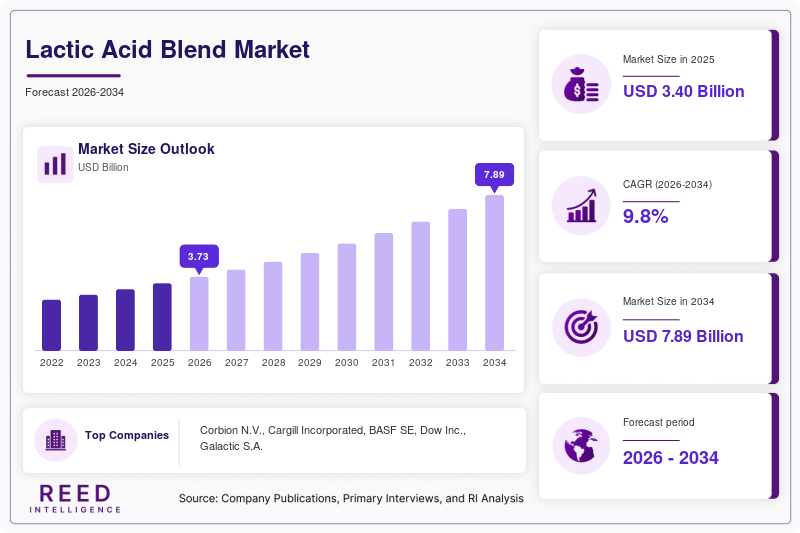
The Lactic Acid Blend Market size was valued at approximately USD 3.4 billion in 2025 and is projected to reach USD 7.9 billion by 2034, expanding at a CAGR of 9.8% from 2025 to 2034. The market is experiencing consistent growth due to increasing demand across food preservation, pharmaceuticals, personal care, and biodegradable plastics industries. Lactic acid blends, which combine lactic acid with other organic acids or functional ingredients, are widely used for enhancing product stability, shelf life, and functional performance.
A key global factor supporting the growth of the Lactic Acid Blend Market is the rising demand for sustainable and bio-based ingredients. Industries are increasingly shifting toward environmentally friendly solutions to reduce carbon footprints and comply with regulatory standards. Lactic acid blends, derived from renewable resources such as corn and sugarcane, are gaining traction as alternatives to synthetic chemicals.
Key Highlights:
- Asia Pacific dominated the Lactic Acid Blend Market with approximately 39% share in 2025, while North America is expected to grow fastest at a CAGR of 10.5%.
- By type, food-grade lactic acid blends led the market, while pharmaceutical-grade blends are projected to grow fastest at a CAGR of 10.9%.
- By application, food & beverages held the largest share, whereas bioplastics are anticipated to grow at a CAGR of 11.6%.
- China remained the dominant country, with a market value of USD 920 million in 2025 and an estimated USD 1.01 billion in 2026.
Market Trends
Increasing Adoption in Bioplastics Production
The Lactic Acid Blend Market is witnessing strong growth due to its increasing use in bioplastics production. Lactic acid blends are key raw materials in the manufacturing of polylactic acid (PLA), a biodegradable polymer widely used in packaging and consumer goods. The global shift toward reducing plastic waste is driving demand for sustainable alternatives, thereby supporting this trend.
Growth of Clean-Label and Natural Ingredients
Consumers are increasingly demanding clean-label products with natural ingredients. Lactic acid blends are widely used as natural preservatives and acidity regulators in food products. This trend is encouraging manufacturers to develop formulations that meet consumer expectations for transparency and health-conscious choices.
Market Drivers
Rising Demand for Sustainable Chemicals
The growing focus on sustainability is a major driver for the Lactic Acid Blend Market. Industries are replacing synthetic chemicals with bio-based alternatives to meet environmental regulations and consumer preferences. Lactic acid blends offer a renewable and biodegradable solution, supporting their adoption across various sectors.
Expansion of Food and Beverage Industry
The increasing demand for processed and packaged food products is driving the use of lactic acid blends as preservatives and flavor enhancers. Their ability to extend shelf life and maintain product quality makes them essential in the food and beverage industry.
Market Restraint
Fluctuations in Raw Material Prices
The Lactic Acid Blend Market faces challenges due to fluctuations in raw material prices. Lactic acid production depends on agricultural feedstocks such as corn and sugarcane, which are subject to price volatility due to weather conditions, supply-demand imbalances, and geopolitical factors.
These fluctuations can impact production costs and profit margins for manufacturers. Additionally, the reliance on agricultural inputs may create supply chain uncertainties, affecting market stability. Addressing these challenges requires improved supply chain management and diversification of raw material sources.
Market Opportunities
Expansion in Pharmaceutical Applications
The growing use of lactic acid blends in pharmaceutical formulations presents significant opportunities. They are used in drug delivery systems, pH regulation, and as excipients. Increasing demand for advanced healthcare solutions is expected to drive adoption in this segment.
Growth in Personal Care and Cosmetics
The personal care industry offers substantial growth potential for the Lactic Acid Blend Market. Lactic acid blends are widely used in skincare products for exfoliation and pH balancing. Rising consumer interest in natural and organic cosmetics is expected to support market expansion.
Segmental Analysis
By Type
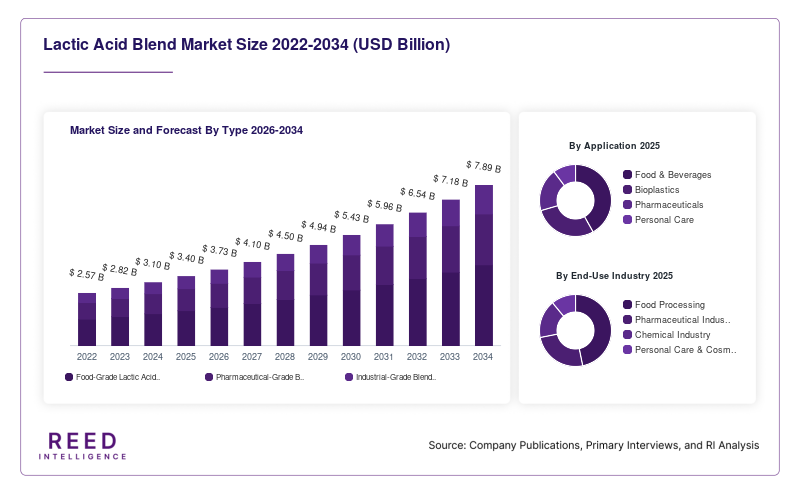
Food-grade lactic acid blends dominated the Lactic Acid Blend Market in 2025, accounting for approximately 54% of the total share. Their widespread use in food preservation, flavor enhancement, and acidity regulation has supported their dominance.
Pharmaceutical-grade blends are expected to be the fastest-growing subsegment, registering a CAGR of 10.9%. The growth factor lies in their increasing use in drug formulations and medical applications, driven by advancements in healthcare.
By Application
Food & beverages accounted for the largest share of approximately 48% in 2025, driven by the increasing demand for processed and packaged foods. Lactic acid blends are essential for maintaining product quality and safety.
Bioplastics are expected to grow at the fastest CAGR of 11.6%. The demand for biodegradable materials is increasing, supporting the use of lactic acid blends in the production of PLA.
By End-Use Industry
Food processing industry held the largest share of approximately 45% in 2025, driven by the widespread use of lactic acid blends in food production.
The pharmaceutical industry is projected to grow at a CAGR of 10.7%. Increasing demand for advanced drug formulations is expected to drive growth in this segment.
By Distribution Channel
Direct sales dominated the market with a share of around 50% in 2025, as manufacturers supply directly to industrial users.
Online distribution is anticipated to grow at a CAGR of 10.3%. The increasing adoption of digital platforms for purchasing industrial chemicals is supporting this growth.
Regional Analysis
North America
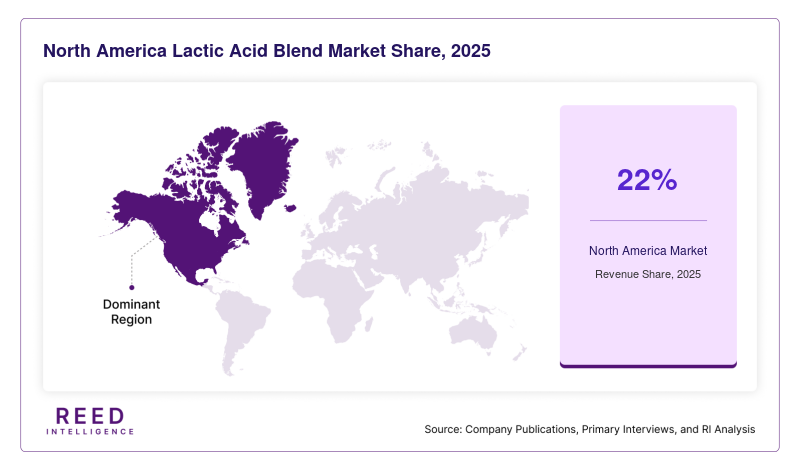
North America accounted for approximately 22% of the Lactic Acid Blend Market share in 2025 and is expected to grow at a CAGR of 10.5% during the forecast period. The region’s focus on sustainable products and advanced manufacturing technologies has supported market growth.
The United States dominated the regional market due to strong demand for bio-based chemicals and clean-label food products. The presence of established manufacturers and research institutions has facilitated innovation and product development.
Europe
Europe held nearly 26% share of the Lactic Acid Blend Market in 2025 and is projected to grow at a CAGR of 9.6%. Strict environmental regulations and the region’s commitment to sustainability have driven demand for bio-based materials.
Germany emerged as the dominant country, supported by its strong industrial base and focus on green technologies. The adoption of biodegradable plastics has contributed to market growth.
Asia Pacific
Asia Pacific represented around 39% of the market share in 2025 and is anticipated to grow at a CAGR of 9.9%. The region’s large population and expanding industrial sectors have supported market expansion.
China led the regional market, driven by its strong manufacturing capabilities and increasing demand for sustainable materials. Government initiatives promoting environmental sustainability have further supported growth.
Middle East & Africa
The Middle East & Africa accounted for approximately 7% share in 2025 and is expected to grow at a CAGR of 8.7%. The market is gradually developing due to increasing industrialization and awareness of sustainable products.
The United Arab Emirates dominated the region, supported by growing demand for eco-friendly products. The expansion of industrial sectors has contributed to market growth.
Latin America
Latin America held nearly 6% share of the Lactic Acid Blend Market in 2025 and is projected to grow at a CAGR of 9.2%. The region is experiencing growth due to increasing demand for sustainable materials.
Brazil emerged as the dominant country, driven by its agricultural resources and growing industrial base. The availability of raw materials has supported lactic acid production.
Competitive Landscape
The Lactic Acid Blend Market is characterized by the presence of global chemical manufacturers and specialized producers. Companies are focusing on expanding production capacity and developing innovative products to meet growing demand.
Corbion N.V. is a leading player in the market, known for its expertise in lactic acid production. The company has recently expanded its production facilities to support the growing demand for bio-based materials.
Other players are investing in research and development to enhance product performance and sustainability. Strategic partnerships and acquisitions are also common strategies to strengthen market presence.
Key Players List
- Corbion N.V.
- Cargill Incorporated
- BASF SE
- Dow Inc.
- Galactic S.A.
- Henan Jindan Lactic Acid Technology Co. Ltd.
- Musashino Chemical Laboratory Ltd.
- Jungbunzlauer Suisse AG
- Danimer Scientific
- NatureWorks LLC
- Futerro S.A.
- Godavari Biorefineries Ltd.
- Spectrum Chemical Manufacturing Corp.
- Vigon International LLC
- Merck KGaA
Recent Developments
- Corbion N.V. expanded its lactic acid production capacity.
- Cargill introduced new bio-based lactic acid formulations.
- BASF developed sustainable solutions using lactic acid blends.
- NatureWorks expanded its PLA production facilities.
- Jungbunzlauer launched new food-grade lactic acid products.
Lactic Acid Blend Market Segments
By Type
- Food-Grade Lactic Acid Blends
- Pharmaceutical-Grade Blends
- Industrial-Grade Blends
By Application
- Food & Beverages
- Bioplastics
- Pharmaceuticals
- Personal Care
By End-Use Industry
- Food Processing
- Pharmaceutical Industry
- Chemical Industry
- Personal Care & Cosmetics
By Distribution Channel
- Direct Sales
- Online Distribution
- Distributors
By Region
- North America
- Europe
- APAC
- Middle East and Africa
- LATAM