Lactic Acid Ester Market Size, Share & Demand Report By Product Type (Butyl Lactate, Propyl Lactate, Other Product Types), By Application (Solvents, Pharmaceutical Formulations, Food Additives), By End Use (Paints and Coatings, Pharmaceuticals, Food and Beverage Processing, Electronics) By Region & Segment Forecasts, 2026–2034
USD 3950
Market Overview
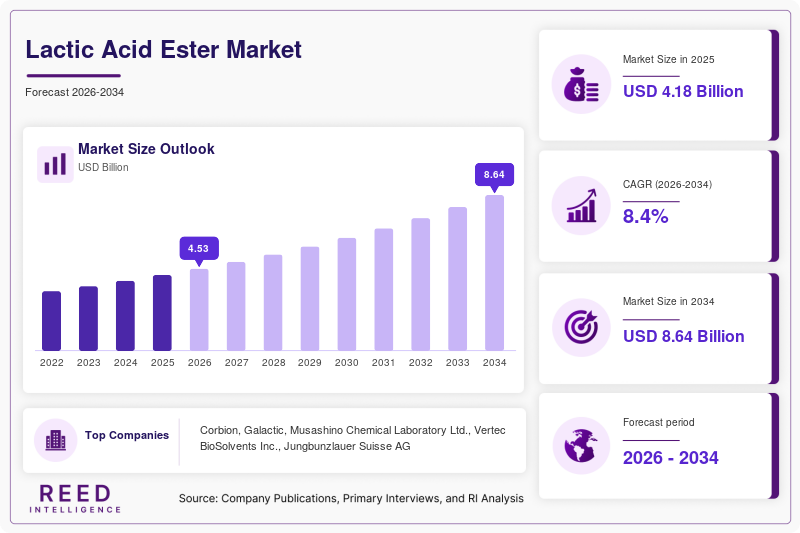
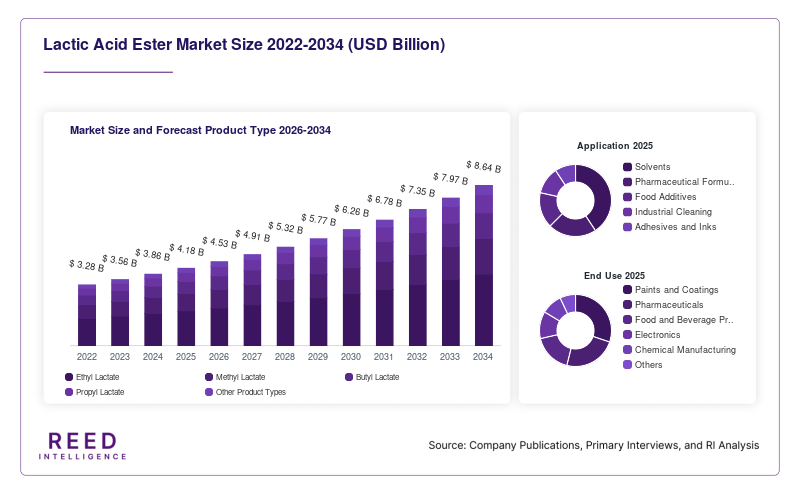
The global Lactic Acid Ester Market size was valued at USD 4.18 billion in 2026 and is projected to reach USD 7.96 billion by 2034, expanding at a CAGR of 8.4% during the forecast period from 2026 to 2034. Lactic acid esters are widely used as biodegradable solvents in paints, coatings, pharmaceuticals, food processing, electronics cleaning, and industrial formulations. Growing environmental regulations related to volatile organic compound emissions and the transition toward sustainable industrial chemicals are supporting long-term market expansion. Manufacturers across developed and emerging economies are increasing the adoption of bio-based solvents to reduce dependence on petroleum-derived chemicals and improve environmental compliance.
The market is also benefiting from rising investment in green chemistry technologies and sustainable manufacturing processes. Lactic acid esters offer low toxicity, strong solvency properties, and compatibility with several industrial applications, making them suitable for companies seeking alternatives to conventional solvents. Demand from the food and beverage industry is increasing because lactic acid esters are used as flavoring agents, preservatives, and processing additives. In addition, pharmaceutical companies are adopting these esters in drug formulation and cleaning processes due to their favorable safety profile.
Key Highlights
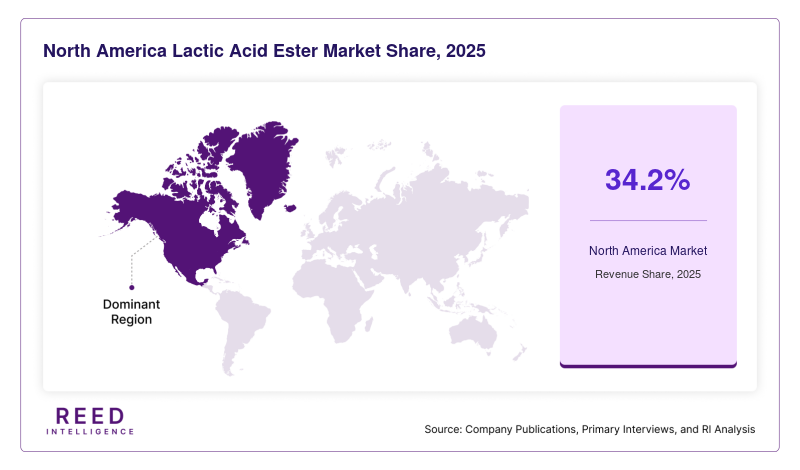
- North America dominated the market with a 34.2% share in 2025.
- Asia Pacific is expected to grow at the fastest CAGR of 10.9% during 2026–2034.
- By product type, ethyl lactate accounted for the largest share of 39.4%.
- while butyl lactate is projected to grow at a CAGR of 9.8%.
- By application, solvents led with a 42.7% share.
- whereas pharmaceutical formulations are expected to expand at a CAGR of 10.4%.
- By end use, paints and coatings accounted for the highest share of 31.6%.
- while food and beverage processing is projected to grow at a CAGR of 9.9%.
- The United States remained the dominant country, with market values of USD 820 million in 2024 and USD 890 million in 2025.
Market Trends
Rising Preference for Bio-Based Industrial Solvents
Industrial manufacturers are increasingly shifting toward bio-based solvents to align with sustainability targets and environmental regulations. Lactic acid esters are gaining traction because they offer biodegradable properties and lower toxicity compared to petroleum-derived solvents. Paints, coatings, adhesives, and cleaning product manufacturers are adopting these compounds to reduce harmful emissions and improve workplace safety standards. Several chemical companies are redesigning production processes to incorporate renewable feedstocks, which is supporting higher demand for lactic acid ester formulations. The growing awareness regarding carbon reduction goals among industrial buyers is also encouraging long-term procurement contracts for sustainable solvents. As industries continue to replace conventional chemical agents with eco-friendly alternatives, the market for lactic acid esters is expected to maintain stable expansion across developed and emerging economies.
Expanding Use in Pharmaceutical and Electronics Applications
The pharmaceutical and electronics industries are creating new growth avenues for lactic acid esters due to their strong solvency characteristics and compatibility with sensitive production environments. Pharmaceutical companies are using these esters in drug synthesis, purification processes, and cleaning applications because they provide efficient performance with lower environmental impact. In the electronics sector, manufacturers are adopting lactic acid ester-based cleaning agents for semiconductor and circuit board production. The rapid increase in electronic component manufacturing across Asia Pacific is contributing to higher product consumption. Technological improvements in high-purity ester production are also supporting adoption in precision industrial applications. As healthcare and electronics manufacturing continue to expand globally, demand for specialty-grade lactic acid esters is expected to increase steadily during the forecast period.
Market Drivers
Stringent Environmental Regulations Supporting Green Chemicals
Government regulations focused on reducing hazardous chemical emissions are a major factor driving the growth of the Lactic Acid Ester Market. Regulatory agencies across North America and Europe are implementing stricter standards regarding volatile organic compounds in industrial manufacturing processes. Companies operating in coatings, inks, adhesives, and cleaning applications are therefore replacing traditional solvents with biodegradable alternatives. Lactic acid esters are viewed as effective substitutes because they provide strong solvency performance while supporting sustainability objectives. The growing number of environmental compliance programs is encouraging chemical manufacturers to expand investments in green chemistry technologies. Industrial buyers are also prioritizing environmentally safer products to improve brand positioning and meet corporate sustainability targets. These regulatory and commercial shifts are expected to support stable demand for lactic acid ester products throughout the forecast period.
Growing Demand from Food Processing and Pharmaceutical Industries
The increasing use of lactic acid esters in food processing and pharmaceutical manufacturing is another important growth driver for the market. Food manufacturers use these esters in flavor enhancement, preservation, and processing applications because of their favorable safety profile and compatibility with food-grade standards. Pharmaceutical companies are also increasing their adoption of biodegradable solvents for drug formulation and equipment cleaning processes. The global expansion of healthcare infrastructure and processed food production is creating sustained demand for specialty chemical ingredients. In addition, rising consumer awareness regarding safer and cleaner ingredient sourcing is influencing manufacturers to adopt bio-based compounds. Emerging economies in Asia Pacific and Latin America are witnessing rapid industrialization in food and pharmaceutical sectors, further supporting the expansion of the lactic acid ester industry.
Market Restraint
High Production Costs and Raw Material Price Volatility
The growth of the Lactic Acid Ester Market is limited by relatively high production costs associated with bio-based manufacturing processes. Lactic acid esters are produced using renewable feedstocks such as corn, sugarcane, and other agricultural materials, which are subject to seasonal supply fluctuations and pricing volatility. Changes in agricultural commodity prices directly affect production expenses and profit margins for manufacturers. In comparison with traditional petroleum-based solvents, some lactic acid ester products remain more expensive, limiting adoption among price-sensitive industries. Smaller manufacturers often face difficulties in scaling production due to high capital investment requirements for fermentation and purification technologies. In addition, supply chain disruptions affecting agricultural raw materials can create instability in long-term procurement strategies. For example, fluctuations in corn prices in North America have periodically increased manufacturing costs for ethyl lactate producers, reducing pricing competitiveness in industrial solvent markets.
Market Opportunities
Increasing Demand for Sustainable Packaging Solutions
The expansion of sustainable packaging industries presents a strong opportunity for the Lactic Acid Ester Market. Packaging manufacturers are increasingly investing in biodegradable materials and environmentally safer processing chemicals to reduce plastic waste and meet consumer expectations. Lactic acid esters are being used in coatings, inks, and adhesive formulations for eco-friendly packaging applications because they provide effective solvency while supporting sustainability objectives. Food packaging companies are especially interested in bio-based ingredients that comply with environmental regulations and food safety standards. Growing demand for packaged food products in urban markets is further supporting investment in sustainable packaging technologies. As governments continue to introduce restrictions on conventional plastic materials and hazardous solvents, the integration of lactic acid ester formulations into packaging production processes is expected to increase significantly.
Expansion of Semiconductor and Electronics Manufacturing
Rapid growth in semiconductor fabrication and electronics manufacturing is creating favorable opportunities for lactic acid ester suppliers. Electronic component manufacturers require high-performance cleaning solvents that can remove residues without damaging sensitive materials. Lactic acid esters are gaining attention because they offer effective cleaning capabilities along with lower toxicity and reduced environmental impact. Asia Pacific countries such as China, South Korea, Taiwan, and India are investing heavily in semiconductor manufacturing infrastructure, creating additional demand for specialty solvents. The expansion of electric vehicles, smart devices, and industrial automation systems is also increasing semiconductor production worldwide. Chemical companies are therefore developing high-purity lactic acid ester grades specifically designed for electronics applications. This trend is expected to support long-term revenue opportunities for manufacturers operating in the specialty chemicals sector.
Segmental Analysis
By Product Type
Ethyl lactate accounted for the largest share of the Lactic Acid Ester Market in 2024, representing approximately 39.4% of total revenue. The segment maintained its leading position because of its extensive use as a biodegradable solvent across paints, coatings, inks, and industrial cleaning applications. Ethyl lactate offers favorable solvency performance, low toxicity, and compatibility with environmental regulations, making it a preferred alternative to petroleum-based solvents. Demand from electronics cleaning and pharmaceutical manufacturing industries also supported strong segment performance. In addition, the increasing adoption of sustainable industrial chemicals across North America and Europe contributed to higher product utilization. Manufacturers are investing in improved production technologies to enhance purity levels and reduce production costs, further strengthening the commercial position of ethyl lactate in the global market.
Butyl lactate is expected to witness the fastest growth during the forecast period, expanding at a CAGR of 9.8% from 2026 to 2034. The segment is gaining momentum because of its strong solvency characteristics and increasing use in specialty coatings, printing inks, and adhesives. Industrial manufacturers are adopting butyl lactate in applications requiring slower evaporation rates and enhanced formulation stability. Demand is particularly increasing in Asia Pacific due to the expansion of automotive coatings and industrial manufacturing activities. The rising emphasis on environmentally safer solvents is also encouraging chemical companies to introduce advanced butyl lactate formulations for high-performance industrial applications. Continuous research related to bio-based specialty chemicals and increasing investments in sustainable coatings technologies are expected to support long-term growth for this subsegment.
By Application
The solvents segment dominated the global Lactic Acid Ester Market in 2024 with a revenue share of 42.7%. Lactic acid esters are widely utilized as solvents in paints, coatings, industrial cleaners, and inks because they provide effective dissolving properties while reducing environmental impact. Increasing restrictions on hazardous chemicals have encouraged manufacturers to replace traditional solvents with biodegradable alternatives. The growing adoption of green chemistry principles in industrial production processes has also strengthened demand for lactic acid ester-based solvent systems. In addition, rising industrial activity in automotive, electronics, and construction sectors contributed to stable product consumption. Companies operating in industrial cleaning applications are increasingly using lactic acid esters to improve workplace safety and reduce volatile organic compound emissions, supporting the continued dominance of the solvents segment.
Pharmaceutical formulations are projected to expand at the fastest CAGR of 10.4% during the forecast period. The growth of this subsegment is supported by increasing demand for environmentally safer ingredients in drug manufacturing and processing applications. Pharmaceutical companies are adopting lactic acid esters for formulation development, extraction processes, and equipment cleaning because they provide effective performance with lower toxicity levels. Expanding healthcare infrastructure and rising pharmaceutical production in emerging economies are also contributing to segment growth. In addition, regulatory agencies are encouraging the use of sustainable chemicals in pharmaceutical manufacturing to improve environmental compliance. Research activities focused on developing high-purity ester formulations for sensitive pharmaceutical applications are expected to create additional opportunities for manufacturers throughout the forecast period.
By End Use
Paints and coatings represented the largest end-use segment in the Lactic Acid Ester Market in 2024, accounting for approximately 31.6% of total market revenue. The segment benefited from increasing demand for environmentally safer solvents in decorative, industrial, and automotive coating applications. Lactic acid esters are widely used in coating formulations because they offer strong solvency properties and support low-emission manufacturing processes. Regulatory pressure regarding volatile organic compound emissions has encouraged coating manufacturers to adopt bio-based chemical alternatives. The construction and automotive industries also contributed significantly to segment demand due to rising infrastructure projects and vehicle production activities. Several coating manufacturers are investing in sustainable product portfolios to improve compliance with environmental standards, further supporting the commercial adoption of lactic acid ester formulations.
Food and beverage processing is expected to record the fastest CAGR of 9.9% during 2026–2034. The segment is witnessing rapid growth because lactic acid esters are increasingly used in flavoring, preservation, and food-grade processing applications. Consumer demand for cleaner-label food products and safer ingredients is encouraging manufacturers to adopt biodegradable and food-compatible chemical compounds. Expanding processed food industries in Asia Pacific and Latin America are also supporting higher product utilization. In addition, stricter food safety regulations are promoting the use of sustainable processing agents that comply with international quality standards. Food manufacturers are increasingly investing in environmentally responsible production systems, creating long-term opportunities for lactic acid ester suppliers in the global food and beverage industry.
Regional Analysis
North America
North America accounted for 34.2% of the global Lactic Acid Ester Market share in 2025 and is expected to maintain a stable growth trajectory during the forecast period. The region is projected to expand at a CAGR of 7.9% from 2026 to 2034 due to strong demand from paints and coatings, industrial cleaning, and pharmaceutical applications. Environmental regulations established by federal and state agencies are encouraging industries to adopt biodegradable solvents in manufacturing processes. Increasing investment in sustainable chemicals and advanced green manufacturing technologies is also supporting regional market development.
The United States remained the dominant country within North America due to its large industrial base and established bio-based chemicals industry. Strong demand from pharmaceutical manufacturing and industrial coatings continues to support product adoption across the country. A major growth factor in the United States is the increasing transition toward low-emission industrial solvents in automotive and aerospace manufacturing. Several chemical producers are expanding production capacity to meet the rising need for environmentally compliant formulations, which is strengthening the regional supply chain.
Europe
Europe represented a significant share of the Lactic Acid Ester Market in 2025 and is anticipated to grow at a CAGR of 7.6% during the forecast period. Strict environmental regulations introduced by the European Union regarding volatile organic compound emissions are encouraging the replacement of conventional solvents with bio-based alternatives. Countries across the region are investing in circular economy initiatives and sustainable chemical manufacturing. The demand for eco-friendly coatings, adhesives, and packaging materials is also contributing to consistent product consumption throughout major industrial economies.
Germany remained the leading country in the European market due to its advanced manufacturing sector and strong focus on sustainable industrial practices. The country has witnessed increasing adoption of biodegradable solvents across automotive, electronics, and pharmaceutical industries. A unique growth factor supporting the German market is the rapid integration of green chemistry technologies into industrial production systems. Research collaborations between universities and chemical companies are accelerating product innovation and improving the commercial adoption of specialty-grade lactic acid esters.
Asia Pacific
Asia Pacific is expected to register the fastest CAGR of 10.9% in the global Lactic Acid Ester Market during 2026–2034. Rapid industrialization, expanding manufacturing activity, and rising environmental awareness are driving regional market growth. Countries such as China, India, Japan, and South Korea are increasing investments in sustainable chemical production and electronics manufacturing. The region is also witnessing rising consumption of paints, coatings, pharmaceuticals, and processed food products, all of which utilize lactic acid ester formulations in various applications.
China dominated the Asia Pacific market due to its large-scale chemical manufacturing industry and strong export-oriented production capacity. The country is experiencing growing demand for biodegradable solvents in electronics cleaning and industrial coatings applications. A key growth factor in China is the rapid expansion of semiconductor manufacturing facilities supported by government investment programs. Domestic producers are increasing production efficiency and improving ester quality to meet rising demand from international electronics and pharmaceutical companies.
Middle East & Africa
The Middle East & Africa region is gradually emerging as a developing market for lactic acid esters and is forecast to expand at a CAGR of 6.8% through 2034. Industrial diversification initiatives and growing awareness regarding sustainable chemicals are supporting market growth across the region. Demand for biodegradable solvents is increasing in construction, paints and coatings, and industrial cleaning applications. Governments in Gulf countries are also encouraging investment in environmentally safer industrial production methods as part of broader sustainability and economic diversification strategies.
Saudi Arabia remained the dominant country in the regional market due to ongoing industrial infrastructure development and rising investments in specialty chemicals manufacturing. The country is increasingly adopting bio-based solvents in construction coatings and industrial maintenance applications. A unique growth factor in Saudi Arabia is the expansion of large-scale industrial cities and manufacturing hubs that require advanced cleaning and coating solutions. These industrial development projects are expected to support steady demand for lactic acid ester products over the forecast period.
Latin America
Latin America accounted for a moderate share of the global Lactic Acid Ester Market in 2025 and is projected to grow at a CAGR of 7.1% during the forecast period. Expanding food processing industries and increasing demand for sustainable industrial chemicals are supporting regional market expansion. Countries across the region are gradually implementing environmental regulations that encourage the adoption of biodegradable solvents. Rising urbanization and industrial development are also increasing the consumption of coatings, adhesives, and packaging products that utilize lactic acid ester formulations.
Brazil remained the leading country in the Latin American market due to its strong agricultural sector and expanding industrial manufacturing base. The country benefits from abundant availability of renewable feedstocks such as sugarcane, which supports bio-based chemical production. A major growth factor in Brazil is the increasing investment in sustainable packaging and food processing industries. Domestic manufacturers are expanding the use of environmentally safer solvents to improve export competitiveness and comply with international sustainability standards.
Competitive Landscape
The global Lactic Acid Ester Market is moderately consolidated, with leading companies focusing on product innovation, capacity expansion, and strategic collaborations to strengthen their market positions. Major participants are investing in sustainable production technologies and high-purity ester formulations to meet growing demand from pharmaceutical, electronics, and industrial applications. Companies are also expanding their regional distribution networks to improve supply chain efficiency and access emerging markets.
Corbion remained one of the leading players in the market due to its strong portfolio of bio-based chemicals and extensive global manufacturing presence. The company recently expanded its sustainable solvent production capabilities to support rising demand from coatings and industrial cleaning industries. Galactic, Musashino Chemical Laboratory, Vertec BioSolvents, and Jungbunzlauer also maintained significant market shares through investments in product development and environmentally compliant manufacturing processes. Several market participants are collaborating with packaging and pharmaceutical companies to develop application-specific lactic acid ester solutions. Competitive strategies within the industry increasingly focus on improving product purity, reducing production costs, and expanding application areas across industrial and specialty chemical markets.
Key Players
- Corbion
- Galactic
- Musashino Chemical Laboratory Ltd.
- Vertec BioSolvents Inc.
- Jungbunzlauer Suisse AG
- Henan Jindan Lactic Acid Technology Co., Ltd.
- Godavari Biorefineries Ltd.
- Merck KGaA
- Tokyo Chemical Industry Co., Ltd.
- Vigon International LLC
- Shenzhen Esun Industrial Co., Ltd.
- BASF SE
- Dow Inc.
- DuPont de Nemours, Inc.
- Spectrum Chemical Manufacturing Corp.
Recent Developments
- In February 2025, Corbion announced the expansion of its bio-based solvent production facility to increase global supply capacity for ethyl lactate and specialty ester products.
- In August 2024, Galactic introduced a new pharmaceutical-grade lactic acid ester formulation designed for high-purity drug manufacturing applications.
- In November 2025, Vertec BioSolvents partnered with an electronics manufacturer to develop sustainable cleaning solutions for semiconductor production facilities.
- In March 2026, Jungbunzlauer expanded its distribution network across Asia Pacific to strengthen its presence in industrial coatings and food processing applications.
Lactic Acid Ester Market Segments
Product Type
- Ethyl Lactate
- Methyl Lactate
- Butyl Lactate
- Propyl Lactate
- Other Product Types
Application
- Solvents
- Pharmaceutical Formulations
- Food Additives
- Industrial Cleaning
- Adhesives and Inks
End Use
- Paints and Coatings
- Pharmaceuticals
- Food and Beverage Processing
- Electronics
- Chemical Manufacturing
- Others
By Region
- North America
- Europe
- APAC
- Middle East and Africa
- LATAM