Lan Tester Market Size, Share Demand Report By Type (Handheld LAN Testers, Network Analyzers, Certification Testers), By Application (Network Installation & Maintenance, Data Center Testing, Network Troubleshooting), By End-Use Industry (IT & Telecommunications, Healthcare, Manufacturing, Commercial Buildings), By Distribution Channel (Online Retail, Offline/Authorized Distributors) & Segment Forecasts, 2025–2034
USD 3950
Market Overview
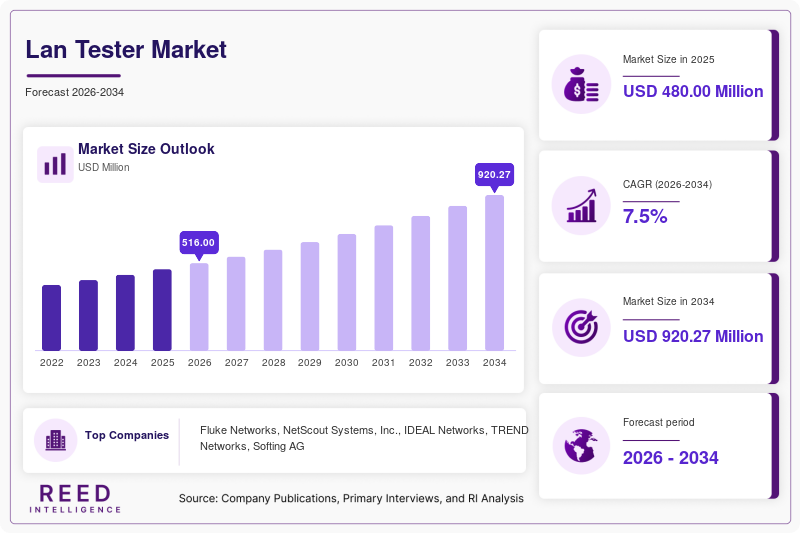
The Lan Tester Market size was valued at approximately USD 480 million in 2025 and is projected to reach USD 920 million by 2034, expanding at a CAGR of 7.5% during the forecast period (2025–2034). The market growth is being driven by the increasing global demand for reliable network infrastructure testing tools amid rapid digital transformation across enterprises, telecom networks, and data centers. As organizations continue to deploy high-speed Ethernet networks, the need for precise cable verification, troubleshooting, and performance validation has intensified, supporting sustained market expansion.
A key global factor contributing to the growth of the Lan Tester Market is the rising adoption of cloud computing and IoT ecosystems. These technologies require robust networking frameworks, thereby increasing dependency on advanced LAN testing equipment to ensure connectivity efficiency and minimize downtime.
Key Highlights
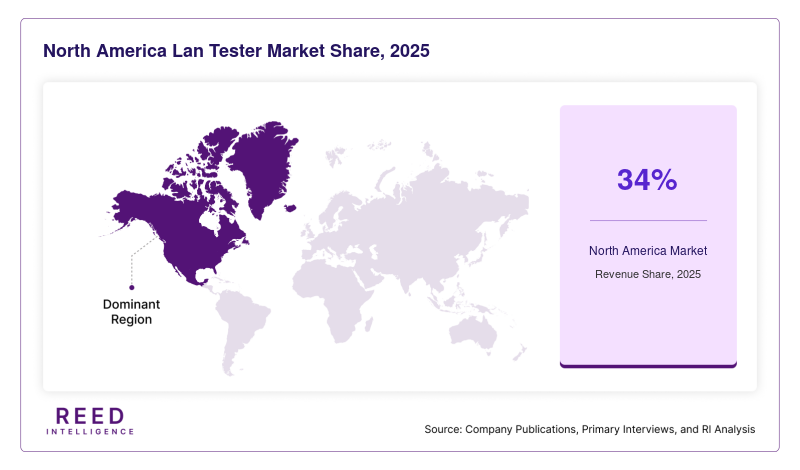
- North America dominated the market with a 34% share in 2025, while Asia Pacific is expected to register the fastest CAGR of 9.2%.
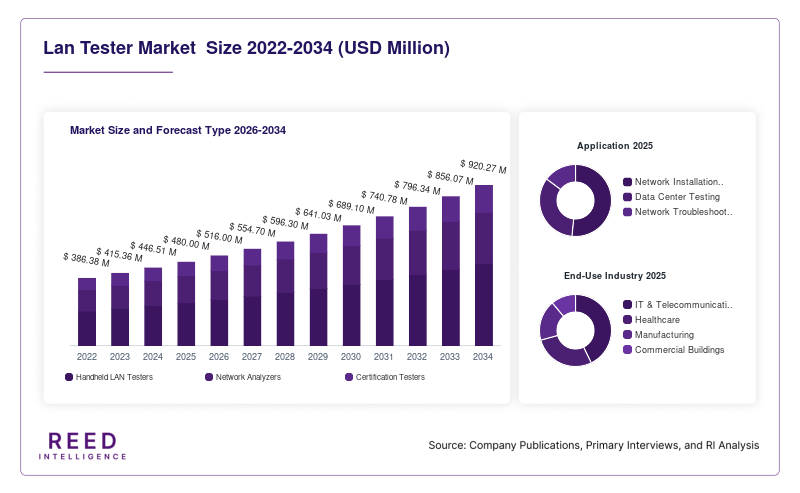
- By type, handheld LAN testers led with a 58% share, while advanced network analyzers are projected to grow fastest at a CAGR of 8.6%.
- By application, network installation & maintenance accounted for the largest share, whereas data center testing is expected to grow at a CAGR of 9.0%.
- The U.S. Lan Tester Market was valued at USD 145 million in 2025 and is estimated to reach USD 155 million in 2026.
Market Trends
Integration of Smart Diagnostics and AI-Based Testing Tools
The Lan Tester Market is witnessing a shift toward intelligent testing solutions integrated with artificial intelligence and smart diagnostics. Modern LAN testers are no longer limited to basic cable continuity checks; they now provide real-time insights, predictive fault detection, and automated reporting. These advanced capabilities reduce manual intervention and enhance operational efficiency for network engineers. The incorporation of AI-driven analytics is particularly beneficial in large-scale enterprise networks, where quick identification of faults can significantly reduce downtime and maintenance costs.
Growing Demand for High-Speed Network Testing Capabilities
Another notable trend shaping the Lan Tester Market is the rising need for testing solutions compatible with high-speed networks such as Cat6a, Cat7, and fiber optics. As organizations upgrade their infrastructure to support 5G, cloud services, and edge computing, traditional testing devices are being replaced with high-performance testers capable of handling gigabit and multi-gigabit speeds. This trend is encouraging manufacturers to innovate and develop testers that support advanced protocols, PoE (Power over Ethernet) validation, and fiber network diagnostics, thereby expanding the functional scope of LAN testing tools.
Market Drivers
Expansion of Data Centers and IT Infrastructure
The rapid expansion of data centers worldwide is a major driver of the Lan Tester Market. Enterprises are investing heavily in digital infrastructure to support cloud services, big data analytics, and remote operations. This growth has increased the complexity of networking systems, requiring precise testing tools to ensure seamless performance. LAN testers play a critical role in validating network configurations, detecting faults, and maintaining uptime, thereby becoming essential tools in modern IT environments.
Rising Demand for Network Reliability and Performance
Businesses across industries are prioritizing network reliability due to the increasing reliance on digital operations. Even minor network disruptions can lead to significant financial losses and operational inefficiencies. As a result, organizations are adopting LAN testing solutions to maintain network integrity and performance. The growing emphasis on preventive maintenance and proactive network monitoring is further accelerating demand for advanced LAN testers with enhanced diagnostic capabilities.
Market Restraint
High Cost of Advanced Testing Equipment
One of the key challenges in the Lan Tester Market is the high cost associated with advanced testing devices. Sophisticated LAN testers equipped with features such as fiber testing, AI diagnostics, and high-speed compatibility can be expensive, limiting their adoption among small and medium enterprises. These organizations often rely on basic or manual testing tools due to budget constraints, which may hinder overall market growth.
Additionally, the need for skilled professionals to operate advanced LAN testers adds to the total cost of ownership. Training requirements and technical expertise can create barriers, particularly in developing regions where access to skilled labor is limited. This cost-related constraint may slow the penetration of high-end testing solutions despite increasing demand for network reliability.
Market Opportunities
Growth in Smart Buildings and IoT Deployments
The increasing adoption of smart buildings and IoT-based systems presents significant opportunities for the Lan Tester Market. These environments rely heavily on interconnected devices and robust network infrastructure. LAN testers are essential for ensuring proper installation and functionality of these networks. As smart infrastructure projects expand globally, the demand for efficient network testing solutions is expected to rise, creating new growth avenues for market players.
Emerging Markets and Infrastructure Development
Developing regions are experiencing rapid growth in telecommunications and IT infrastructure. Governments and private sectors are investing in digital transformation initiatives, including broadband expansion and smart city projects. This trend is creating opportunities for LAN tester manufacturers to expand their presence in emerging markets. Affordable and user-friendly testing solutions tailored to these regions can help companies tap into new customer bases and drive market growth.
Segmental Analysis
By Type
Handheld LAN testers dominated the Lan Tester Market in 2025, accounting for nearly 58% of the total share. These devices were widely preferred due to their portability, ease of use, and cost-effectiveness. They are commonly used by field technicians for basic cable testing and troubleshooting tasks, making them essential tools in network installation and maintenance.
Advanced network analyzers are expected to grow at the fastest CAGR of 8.6% during the forecast period. These devices will gain traction due to their ability to perform complex diagnostics, analyze network performance, and support high-speed testing. The increasing complexity of network infrastructures will drive demand for these sophisticated testing solutions.
By Application
Network installation and maintenance represented the largest application segment in 2025, holding around 46% of the market share. The widespread deployment of networking systems across industries has increased the need for reliable testing during installation and routine maintenance activities.
Data center testing is anticipated to grow at the fastest CAGR of 9.0%. The rapid expansion of data centers will require advanced testing tools to ensure optimal performance and minimize downtime. The increasing reliance on cloud computing will further accelerate growth in this segment.
By End-Use Industry
The IT and telecommunications sector dominated the Lan Tester Market in 2025 with a share of approximately 52%. The sector’s continuous demand for high-performance networks has driven the adoption of LAN testing solutions.
The healthcare sector is projected to grow at the fastest CAGR of 8.4%. The increasing use of connected medical devices and digital health systems will require reliable network infrastructure, thereby boosting demand for LAN testers.
By Distribution Channel
Offline distribution channels accounted for the largest share of the market in 2025, contributing around 62%. Customers preferred purchasing LAN testers through authorized dealers and distributors due to the availability of technical support and product demonstrations.
Online distribution channels are expected to grow at the fastest CAGR of 8.8%. The increasing popularity of e-commerce platforms and the convenience of online purchasing will drive growth in this segment.
Regional Analysis
North America
North America accounted for approximately 34% of the Lan Tester Market share in 2025 and will grow at a CAGR of 6.8% during the forecast period. The region’s mature IT infrastructure and early adoption of advanced technologies have contributed to its leading position.
The United States dominated the regional market due to the strong presence of data centers and technology companies. The increasing need for high-speed networking and continuous infrastructure upgrades has driven demand for advanced LAN testing solutions in the country.
Europe
Europe held around 27% of the Lan Tester Market share in 2025 and is expected to grow at a CAGR of 6.5% through 2034. The region’s focus on digitalization and industrial automation has supported market expansion.
Germany emerged as the dominant country, driven by its strong industrial base and adoption of Industry 4.0 technologies. The need for reliable networking in manufacturing and automation systems has increased the use of LAN testers across the country.
Asia Pacific
Asia Pacific captured nearly 24% of the market share in 2025 and will register the fastest CAGR of 9.2% during the forecast period. Rapid urbanization and digital transformation initiatives are key factors driving growth in the region.
China led the regional market due to its extensive investments in telecommunications infrastructure and smart city projects. The expansion of broadband networks and data centers has significantly boosted demand for LAN testing equipment.
Middle East & Africa
The Middle East & Africa region accounted for about 8% of the Lan Tester Market in 2025 and is projected to grow at a CAGR of 7.8%. Increasing investments in digital infrastructure are supporting market growth.
The United Arab Emirates dominated the region, driven by its focus on smart city development and advanced telecommunications networks. The growing need for network reliability has fueled demand for LAN testing tools.
Latin America
Latin America held approximately 7% of the market share in 2025 and is expected to grow at a CAGR of 7.1% through 2034. The region is gradually adopting advanced networking technologies.
Brazil emerged as the leading country, supported by expanding IT infrastructure and increasing adoption of cloud services. The need for efficient network management has contributed to the growing use of LAN testers.
Competitive Landscape
The Lan Tester Market is characterized by the presence of several established players focusing on product innovation and technological advancements. The market leader, Fluke Networks, has maintained a strong position due to its comprehensive range of testing solutions and continuous investment in research and development. The company recently introduced enhanced network testing tools with advanced diagnostic capabilities, strengthening its market presence.
Other key players are focusing on expanding their product portfolios and entering emerging markets to gain a competitive edge. Strategic collaborations, product launches, and technological upgrades are common strategies adopted by companies to enhance their market position.
Key Players
- Fluke Networks
- NetScout Systems, Inc.
- IDEAL Networks
- TREND Networks
- Softing AG
- Viavi Solutions Inc.
- AEM Precision Cable Test
- Klein Tools, Inc.
- Byte Brothers
- Psiber Data Systems
- Triplett Test Equipment
- Extech Instruments
- Greenlee Tools, Inc.
- Platinum Tools
- Tempo Communications
Recent Developments
- Fluke Networks launched upgraded LAN testers with enhanced automation features for faster diagnostics.
- Viavi Solutions introduced new fiber-optic testing capabilities in its LAN testing devices.
- IDEAL Networks expanded its product line with compact and portable testers targeting field technicians.
- Softing AG developed advanced testing solutions compatible with industrial Ethernet networks.
- TREND Networks focused on expanding its presence in emerging markets through distribution partnerships.
Lan Tester Market Segments
Type
- Handheld LAN Testers
- Network Analyzers
- Certification Testers
Application
- Network Installation & Maintenance
- Data Center Testing
- Network Troubleshooting
End-Use Industry
- IT & Telecommunications
- Healthcare
- Manufacturing
- Commercial Buildings
Distribution Channel
- Online Retail
- Offline/Authorized Distributors
By Region
- North America
- Europe
- APAC
- Middle East and Africa
- LATAM