Land based Remote Weapon Station Market Size, Share & Demand Report By Component (Weapon Systems, Fire Control Systems, Sensors, Others), By Platform (Armored Vehicles, Unmanned Ground Vehicles, Naval Adapted Land Systems, Others), By End-Use (Military, Homeland Security, Law Enforcement), By Region & Segment Forecasts, 2026–2034
USD 3950
Market Overview
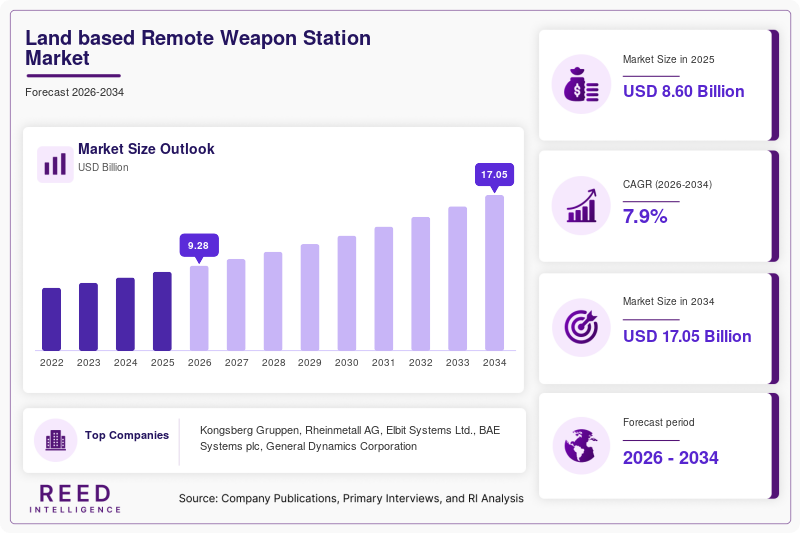
The Land based Remote Weapon Station Market size was valued at approximately USD 8.6 billion in 2026 and is projected to reach USD 15.9 billion by 2034, expanding at a CAGR of 7.9% during the forecast period (2026–2034). The market is witnessing consistent growth due to increasing defense modernization programs and the rising need for enhanced battlefield safety. Land-based remote weapon stations (RWS) allow operators to control weapon systems from protected positions, reducing exposure to hostile environments while improving targeting precision and operational efficiency.
A major global factor supporting market growth is the increasing focus on soldier survivability in modern warfare. Defense agencies are actively investing in advanced combat technologies that minimize direct human involvement in high-risk combat zones. Remote weapon stations integrated with advanced sensors, fire control systems, and stabilization technologies provide a significant tactical advantage, especially in asymmetric warfare scenarios and urban combat operations.
Key Highlights
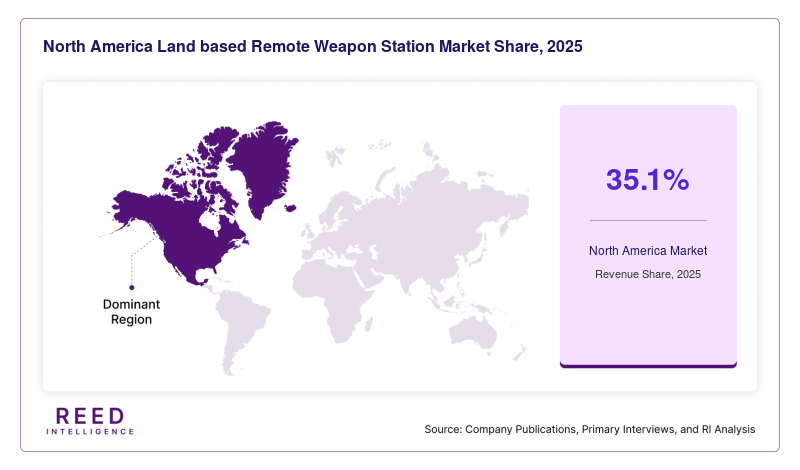
- North America dominated the market with a 35.1% share in 2025.
- Asia Pacific is expected to grow at the fastest CAGR of 9.8% during 2026–2034.
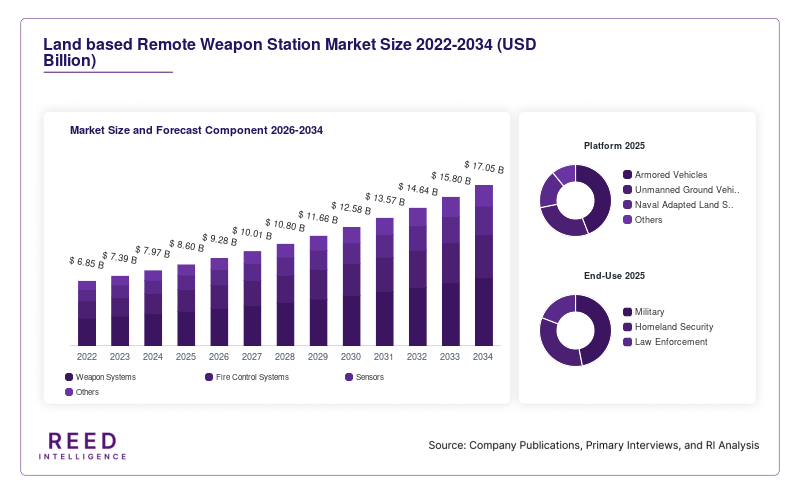
- By component, weapon systems accounted for the largest share of 42.3%.
- while fire control systems are projected to grow at a CAGR of 10.6%.
- By platform, armored vehicles led with a 47.5% share.
- whereas unmanned ground vehicles are expected to expand at a CAGR of 11.4%.
- The United States remained the dominant country, with market values of USD 1.9 billion in 2024 and USD 2.1 billion in 2025.
Market Trends
Integration of AI and Advanced Targeting Technologies
The integration of artificial intelligence and advanced targeting technologies is becoming a defining trend in the Land based Remote Weapon Station Market. Modern systems are increasingly equipped with machine learning algorithms capable of identifying threats, tracking moving targets, and assisting operators in decision-making processes. These intelligent systems reduce human error and improve operational accuracy, especially in complex battlefield environments. Enhanced electro-optical sensors, thermal imaging, and radar-based tracking are also being incorporated to ensure high precision during day and night operations.
This trend is further supported by the growing emphasis on network-centric warfare, where weapon systems are interconnected through secure communication networks. Remote weapon stations can now share real-time data with command centers and other battlefield assets, enabling coordinated responses. As defense agencies continue to prioritize automation and digital transformation, the adoption of AI-enabled RWS is expected to expand significantly, particularly in technologically advanced military forces.
Growing Deployment on Unmanned Platforms
Another notable trend is the increasing deployment of remote weapon stations on unmanned ground vehicles (UGVs). As militaries worldwide explore autonomous and semi-autonomous systems for reconnaissance, surveillance, and combat missions, the integration of RWS on these platforms is gaining traction. This combination allows for remote engagement in high-risk zones without endangering personnel, making it highly suitable for border patrol, counter-insurgency, and urban warfare scenarios.
The trend is driven by advancements in robotics, sensor fusion, and communication technologies, which enable seamless control and coordination of unmanned platforms. Additionally, defense contractors are focusing on developing lightweight and modular RWS solutions that can be easily integrated into various unmanned systems. This flexibility enhances operational versatility and supports rapid deployment in diverse mission environments, contributing to the overall growth of the market.
Market Drivers
Rising Defense Expenditure and Modernization Programs
The steady increase in global defense expenditure is a key driver of the Land based Remote Weapon Station Market. Governments are investing heavily in modernizing their military capabilities to address evolving security threats, including cross-border conflicts, terrorism, and hybrid warfare. As part of these modernization initiatives, armed forces are upgrading their existing fleets of armored vehicles with advanced remote weapon stations to enhance combat effectiveness and survivability.
Developing nations are also increasing their defense budgets to strengthen their military infrastructure and adopt advanced technologies. This trend is particularly evident in regions such as Asia Pacific and the Middle East, where geopolitical tensions are driving demand for advanced defense systems. The growing emphasis on technological superiority and operational efficiency is expected to sustain the demand for remote weapon stations over the forecast period.
Increasing Focus on Soldier Safety and Operational Efficiency
The need to improve soldier safety and operational efficiency is another significant driver of market growth. Traditional weapon systems often require manual operation, exposing personnel to direct threats during combat. Remote weapon stations eliminate this risk by enabling operators to control weapons from protected positions within armored vehicles or command centers.
In addition to enhancing safety, RWS systems improve operational efficiency by offering precise targeting, faster response times, and reduced fatigue for operators. These systems are equipped with stabilization mechanisms that allow accurate firing even while the vehicle is in motion. As military forces continue to prioritize personnel safety and mission effectiveness, the adoption of remote weapon stations is expected to increase across various applications.
Market Restraint
High Cost and Integration Complexity
One of the primary restraints affecting the Land based Remote Weapon Station Market is the high cost associated with development, procurement, and integration. Advanced RWS systems incorporate sophisticated components such as sensors, fire control systems, and stabilization units, which significantly increase overall costs. For many developing countries with limited defense budgets, these expenses can act as a barrier to adoption.
Additionally, integrating remote weapon stations into existing military platforms can be technically challenging. Compatibility issues, system calibration requirements, and the need for specialized training can delay deployment and increase operational costs. Smaller defense forces may struggle to maintain and upgrade these systems due to limited technical expertise and infrastructure. This restraint is expected to slow market penetration in cost-sensitive regions, although ongoing technological advancements and economies of scale may gradually reduce these challenges.
Market Opportunities
Expansion in Emerging Economies
Emerging economies present significant growth opportunities for the Land based Remote Weapon Station Market. Countries in regions such as Asia Pacific, Latin America, and Africa are increasingly investing in defense modernization to strengthen their military capabilities. These nations are focusing on upgrading their land-based combat systems, including armored vehicles and patrol units, with advanced remote weapon stations.
The rising need for border security, counter-terrorism operations, and peacekeeping missions is driving demand for cost-effective and scalable RWS solutions. Manufacturers are responding by offering modular and customizable systems tailored to the specific requirements of these markets. As defense budgets continue to grow in emerging economies, the adoption of remote weapon stations is expected to accelerate, creating substantial opportunities for market players.
Technological Advancements and Modular System Development
Technological innovation is opening new avenues for growth in the market. The development of modular remote weapon stations that can be easily integrated into various platforms is gaining traction. These systems offer flexibility, allowing users to customize configurations based on mission requirements and budget constraints.
Advancements in lightweight materials, energy-efficient components, and compact designs are also enabling the deployment of RWS on smaller vehicles and unmanned systems. Furthermore, the integration of advanced communication technologies and cybersecurity features is enhancing system reliability and resilience. As manufacturers continue to invest in research and development, these technological advancements are expected to drive market expansion and create new growth opportunities.
Segmental Analysis
By Component
The weapon systems segment dominated the Land based Remote Weapon Station Market in 2024, accounting for approximately 42.3% of the total market share. This dominance is attributed to the essential role of weapon modules in overall system functionality. These systems include machine guns, cannons, and missile launchers that are integrated into remote weapon stations. The increasing demand for advanced weaponry with higher precision and lethality is driving the growth of this segment. Additionally, continuous upgrades in weapon technologies and the integration of advanced targeting systems are further enhancing their performance and reliability.
The fire control systems segment is expected to be the fastest-growing, with a projected CAGR of 10.6% during the forecast period. This growth is driven by the increasing need for accurate targeting and improved operational efficiency. Fire control systems play a critical role in ensuring precision by integrating sensors, ballistic computers, and stabilization mechanisms. The rising adoption of AI-based targeting solutions and advanced sensor technologies is further accelerating the growth of this segment.
By Platform
Armored vehicles emerged as the dominant platform segment in 2024, holding a market share of approximately 47.5%. The widespread use of armored vehicles in military operations and their compatibility with remote weapon stations are key factors contributing to this dominance. These vehicles provide a stable and protected platform for mounting RWS systems, enabling efficient operation in various combat scenarios. The increasing deployment of armored vehicles in conflict zones and peacekeeping missions is further supporting the growth of this segment.
Unmanned ground vehicles are expected to be the fastest-growing platform segment, with a CAGR of 11.4% during the forecast period. The growing adoption of unmanned systems in military operations is driving this growth. UGVs equipped with remote weapon stations offer enhanced operational capabilities, allowing for remote engagement in high-risk environments. The integration of advanced communication and control technologies is further supporting the expansion of this segment.
By End-Use
The military segment dominated the market in 2024, accounting for approximately 68.9% of the total share. The extensive use of remote weapon stations in military operations, including combat, reconnaissance, and surveillance, is driving this dominance. Military forces are increasingly adopting RWS systems to enhance operational efficiency and reduce risks to personnel. The continuous modernization of defense equipment and the integration of advanced technologies are further supporting the growth of this segment.
The homeland security segment is expected to be the fastest-growing, with a projected CAGR of 9.2% during the forecast period. The increasing need for advanced security solutions in border control, law enforcement, and counter-terrorism operations is driving this growth. Remote weapon stations are being used to enhance surveillance and response capabilities in high-risk areas. The rising focus on public safety and security is expected to sustain the growth of this segment.
Regional Analysis
North America
North America accounted for the largest share of the Land based Remote Weapon Station Market in 2025, contributing approximately 35.1% of the global revenue. The region is expected to maintain steady growth, with a projected CAGR of 7.4% during the forecast period. Strong defense budgets, continuous modernization programs, and the presence of leading defense contractors are key factors supporting market growth. The region also benefits from advanced technological infrastructure and high adoption rates of next-generation combat systems.
The United States dominates the regional market due to its extensive investment in defense technologies and ongoing efforts to enhance military capabilities. A key growth factor is the increasing deployment of remote weapon stations in armored vehicles used for overseas operations. Additionally, the integration of advanced AI-based targeting systems in military platforms is further strengthening the country’s position in the market.
Europe
Europe held a significant share of the global market in 2025, accounting for around 24.3%, and is expected to grow at a CAGR of 7.1% over the forecast period. The region’s growth is driven by increasing defense collaboration among member states and the modernization of military equipment. Rising geopolitical tensions and the need to strengthen border security are also contributing to market expansion.
Germany leads the European market, supported by its strong defense manufacturing base and technological expertise. A unique growth factor in the region is the increasing focus on joint defense initiatives and cross-border collaborations, which are promoting the adoption of standardized and interoperable remote weapon systems across multiple countries.
Asia Pacific
Asia Pacific is projected to be the fastest-growing region in the Land based Remote Weapon Station Market, with a CAGR of 9.8% during the forecast period. The region accounted for approximately 21.7% of the global market share in 2025. Rapid economic growth, increasing defense budgets, and rising security concerns are key drivers of market expansion.
China dominates the regional market, driven by its extensive military modernization programs and investments in advanced defense technologies. A unique growth factor is the country’s focus on developing indigenous defense systems, including advanced remote weapon stations, to reduce reliance on imports and strengthen domestic capabilities.
Middle East & Africa
The Middle East & Africa region accounted for around 11.2% of the global market in 2025 and is expected to grow at a CAGR of 8.3% during the forecast period. The region’s growth is primarily driven by ongoing conflicts, rising defense spending, and the need for advanced security solutions.
Saudi Arabia is the dominant country in the region, with significant investments in military modernization and defense infrastructure. A unique growth factor is the increasing demand for remote weapon stations in border security and counter-terrorism operations, where these systems provide enhanced surveillance and combat capabilities.
Latin America
Latin America held a smaller share of the global market in 2025, accounting for approximately 7.7%, but is expected to grow at a CAGR of 6.9% over the forecast period. The region’s growth is supported by increasing efforts to modernize defense systems and improve internal security.
Brazil leads the market in Latin America, driven by its focus on strengthening military capabilities and enhancing border security. A unique growth factor is the rising adoption of remote weapon stations in law enforcement and paramilitary applications, where these systems are used to improve operational efficiency and reduce risks.
Competitive Landscape
The Land based Remote Weapon Station Market is characterized by the presence of several established defense contractors and technology providers. Companies are focusing on innovation, strategic partnerships, and product development to strengthen their market positions. The competitive landscape is shaped by continuous advancements in weapon systems, sensor technologies, and integration capabilities.
A leading player in the market is Kongsberg Gruppen, known for its advanced remote weapon station solutions and strong global presence. The company has recently introduced upgraded RWS systems with enhanced targeting capabilities and improved modular design. Other key players are also investing in research and development to introduce innovative products and expand their market reach. The increasing demand for advanced defense technologies is expected to intensify competition among market participants.
Key Players
- Kongsberg Gruppen
- Rheinmetall AG
- Elbit Systems Ltd.
- BAE Systems plc
- General Dynamics Corporation
- Leonardo S.p.A.
- FN Herstal
- Saab AB
- ASELSAN A.S.
- Thales Group
- Denel Dynamics
- Rafael Advanced Defense Systems Ltd.
- Otokar
- ST Engineering
- Hanwha Defense
Recent Developments
- Kongsberg Gruppen introduced a next-generation remote weapon station with AI-enabled targeting features to enhance operational accuracy.
- Rheinmetall AG secured a contract to supply advanced RWS systems for armored vehicle modernization programs in Europe.
- Elbit Systems Ltd. launched a lightweight remote weapon station designed for integration with unmanned ground vehicles, expanding its product portfolio.
Land based Remote Weapon Station Market Segments
Component
- Weapon Systems
- Fire Control Systems
- Sensors
- Others
Platform
- Armored Vehicles
- Unmanned Ground Vehicles
- Naval Adapted Land Systems
- Others
End-Use
- Military
- Homeland Security
- Law Enforcement
By Region
- North America
- Europe
- APAC
- Middle East and Africa
- LATAM